Fury: The White Hurricane of 1913

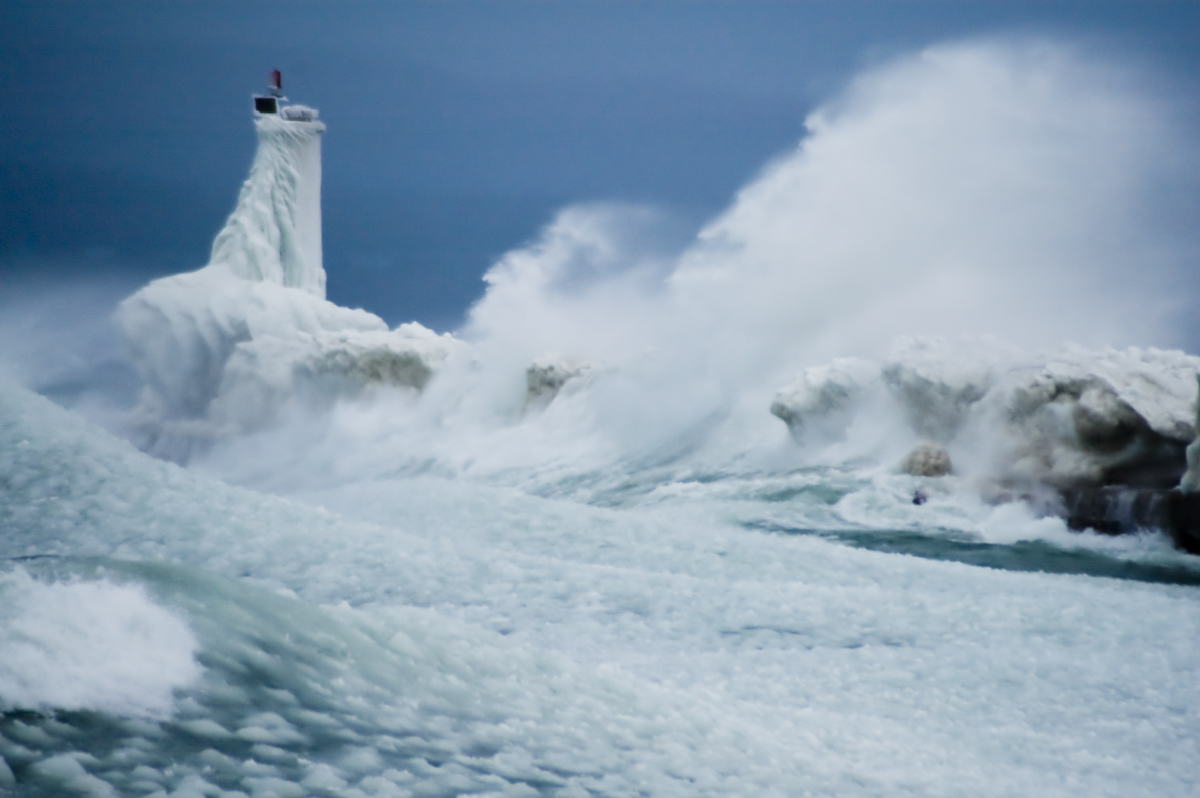
Furious Lake Michigan

Furious Lake Michigan Petoskey, photo by Odalaigh.

“No lake master can recall in all his experience a storm of such unprecedented violence with such rapid changes in the direction of the wind and its gusts of such fearful speed! Storms ordinarily of that velocity do not last over four or five hours, but this storm raged for sixteen hours continuously at an average velocity of sixty miles per hour, with frequent spurts of seventy and over.

Obviously, with a wind of such long duration, the seas that were made were such that the lakes are not ordinarily acquainted with. The testimony of masters is that the waves were at least 35 feet high and followed each other in quick succession, three waves ordinarily coming one right after the other.

~Report from the Lake Carriers Association in the wake of the Great Lakes “White Hurricane”

97 years ago the Great Lakes region reeled under the deadliest storm in its history. Known as the “Big Blow” and the “Freshwater Fury”, was a blizzard with hurricane-force winds that devastated the Great Lakes Basin in the Midwestern United States and the Canadian province of Ontario from November 7 through November 10, 1913. Read on for more!

Check this out bigger and in Charles’ Petoskey Storm Photos slideshow. He also has video of this storm.

Freshwater Fury: The Great Storm of 1913

Dear wife and Children. We were left up here in Lake Michigan by McKinnon, captain James H. Martin tug, at anchor. He went away and never said goodbye or anything to us. Lost one man yesterday. We have been out in storm forty hours. Goodbye dear ones, I might see you in Heaven. Pray for me. / Chris K. / P.S. I felt so bad I had another man write for me. Goodbye forever.

~A message found in a bottle 11 days after Plymouth disappeared, dictated by Chris Keenan, federal marshal in charge of the barge.

Wikipedia says that the Great Lakes Storm of 1913, also known as the “Freshwater Fury“or the “White Hurricane”, was a blizzard with hurricane-force winds that ravaged the Great Lakes November 7-10, 1913. With the sinking of 19 ships, the stranding of another 19 and a death toll of at least 250, it remains the deadliest and most destructive natural disaster in Great Lakes history.

Major shipwrecks occurred on all but Lake Ontario, with most happening on southern and western Lake Huron. Lake masters recounted that waves reached at least 35 feet (11 m) in height. Being shorter in length than waves ordinarily formed by gales, they occurred in rapid succession, with three waves frequently striking in succession. Masters also stated that the wind often blew in directions opposite to the waves below. This was the result of the storm’s cyclonic motion*, a phenomenon rarely seen on the Great Lakes.

In the late afternoon of November 10, an unknown vessel was spotted floating upside-down in about 60 feet (18 m) of water on the eastern coast of Michigan, within sight of Huronia Beach and the mouth of the St. Clair River. Determining the identity of this “mystery ship” became of regional interest, resulting in daily front-page newspaper articles. The ship eventually sank, and it was not until early Saturday morning, November 15, that it was finally identified as the Charles S. Price. The front page of that day’s Port Huron Times-Herald extra edition read, “BOAT IS PRICE” DIVER IS BAKER “SECRET KNOWN”. Milton Smith, the assistant engineer who decided at the last moment not to join his crew on premonition of disaster, aided in identifying any bodies that were found.

More shipwrecks on Michigan in Pictures!

Support Michigan in Pictures with Patreon

The Quincy Dredges

164/365 - Dredge

164/365 – Dredge, photo by dcclark (catching up again!).

Brenden Balliod’s Great Lakes Shipwreck Research (a fantastic resource for divers & historians) has this to say about the Quincy Dredges #1 & #2:

For almost 100 years, the copper mines of the Keweenaw extracted copper from mined rock with the use of stamp mills. The mined rock was smashed by large stamp heads and the brittle non metallic rock broke off leaving the metallic copper. The broken poor rock was ground into “stamp sand” and simply dumped into the lake. Subsequently, large fields of stamp sand now line the Keweenaw Waterway and Lake Superior. Portions of Torch Lake by Lake Linden and Hubbell were almost completely filled in. After WWII it was found that the stamp sand still contained a great deal of copper which could be extracted at a profit by regrinding it. Because of this, in 1947 the Calumet and Hecla Mining Company built a suction dredge capable of vacuuming stamp sand off the lake bottom to a depth of 110 ft. The dredge was operated by the Quincy Mining Co. and was a common sight on Torch Lake throughout the summer months, where it could be seen “mining” the discarded tailings from Torch Lake.

The dredge was usually laid up during the winter months by anchoring it out in the lake, and it carried onboard pumps to combat the slow leakage of water through its hull. Apparently, at 9:00 AM on Sunday January 15, 1956, the pumps stopped working, and before they could be restarted, the dredge plunged to the bottom, leaving only her roof exposed. Raising the dredge was thought to be uneconomical and only limited salvage was conducted. Gradually, the dredge settled into the lake bottom leaving only the peak of her roof above water.

Today, the Quincy Dredge #1 is barely visible above the surface and can be seen from Hwy. M26 by Hubbell. Her sister dredge, the Quincy Dredge #2 lies near her, up on the beach at Mason. The Dredge #1 is a truly creepy dive and offers low visibility, especially near the lake bottom. Her steel superstructure is all that remains, and it rises over 40 ft. off the lake bottom. A good deal of machinery has been left at the site, but low visibility and general creepiness hampers most exploration. Divers who want to explore the Dredge should do so in early Spring or late Fall with a good dive light. Ice diving the Dredge in the Winter may also be a good option for divers with ice diving experience.

Click through to see old photos & maps. There’s a lot more shipwrecks and other diving opportunities in the Keweenaw Underwater Preserve. About the photo, David adds:

This photo has a fun story behind it. The dredge is beached at the shore of Torch Lake, not too far from the highway. I parked near it and walked in, where I met two kayakers who had just come to shore after looking around the water side of the dredge. We chatted, and not five minutes after I’d met them, they offered to let me take a kayak out and see it for myself! — Which I did, of course. I love the UP!

Check it out bigger and in his slideshow.

When The Gales Of November Came Early

When The Gales Of November Came Early

When The Gales Of November Came Early, photo by siskokid.

The legend lives on from the Chippewa on down
of the big lake they called “Gitche Gumee.”
The lake, it is said, never gives up her dead
when the skies of November turn gloomy.
With a load of iron ore twenty-six thousand tons more
than the Edmund Fitzgerald weighed empty,
that good ship and true was a bone to be chewed
when the “Gales of November” came early.

If you’re from Michigan … or Wisconsin … or Minnesota or Ontario or any place that touches the Great Lakes you probably grew up hearing Gordon Lightfoot’s commemorative ballad played (and overplayed) every November. While looking for lyrics to the song, I came across this page about the Wreck of the Edmund Fitzgerald on Gordon Lightfoot’s web site.

“According to a legend of the Chippewa tribe, the lake they once called Gitche Gumee ‘never gives up her dead.'”
~Great Lakes: The Cruelest Month, James R. Gaines with Jon Lowell in Detroit, Newsweek Magazine

Thus began the Newsweek article in the issue of November 24, 1975. That lead and the news magazine’s dry story inspired Gordon Lightfoot to write one of the greatest “story songs” ever…

Lightfoot wrote Wreck Of The Edmund Fitzgerald as a tribute to the ship, the sea, and the men who lost their lives that night. When asked recently what he thought his most significant contribution to music was, he said it was this song, which he often refers to as “The Wreck”. In spite of its unlikely subject matter, the song climbed to #2 on the Billboard pop charts and Wreck of the Edmund Fitzgerald remains one the most stirring topical ballads ever written and a highlight of every Lightfoot concert.

More Edmund Fitzgerald and more shipwrecks on Michigan in Pictures.

Check this out bigger and see Jim’s whole Lake Superior set (slideshow).

There’s not way I’m not going to link over to include* Joseph Fulton’s amazing tribute video to the 29 men who died November 10, 1975 aboard the Edmund Fitzgerald. If you haven’t watched this, do it. It’s one of the best videos on the internet and shows the power of the Fitz and of Superior.

featured-wordpress

*And break my own rule of “just photos” – sorry about that if it bothers you.

Freshwater Fury: The Great Lakes Storm of 1913

Charles S Price upside down, 1913

Charles S Price upside down, 1913,  Wikipedia

Dear wife and Children. We were left up here in Lake Michigan by McKinnon, captain James H. Martin tug, at anchor. He went away and never said goodbye or anything to us. Lost one man yesterday. We have been out in storm forty hours. Goodbye dear ones, I might see you in Heaven. Pray for me. / Chris K. / P.S. I felt so bad I had another man write for me. Goodbye forever.

~A message found in a bottle 11 days after Plymouth disappeared, dictated by Chris Keenan, federal marshal in charge of the barge

Wikipedia says that the Great Lakes Storm of 1913, also known as the “Freshwater Fury” or the “White Hurricane”, was a blizzard with hurricane-force winds that ravaged the Great Lakes November 7-10, 1913. With the sinking of 19 ships, the stranding of another 19 and a death toll of at least 250, it remains the deadliest and most destructive natural disaster in Great Lakes history.

detroit-news-great-lakes-stormMajor shipwrecks occurred on all but Lake Ontario, with most happening on southern and western Lake Huron. Lake masters recounted that waves reached at least 35 feet (11 m) in height. Being shorter in length than waves ordinarily formed by gales, they occurred in rapid succession, with three waves frequently striking in succession. Masters also stated that the wind often blew in directions opposite to the waves below. This was the result of the storm’s cyclonic motion, a phenomenon rarely seen on the Great Lakes.

In the late afternoon of November 10, an unknown vessel was spotted floating upside-down in about 60 feet (18 m) of water on the eastern coast of Michigan, within sight of Huronia Beach and the mouth of the St. Clair River. Determining the identity of this “mystery ship” became of regional interest, resulting in daily front-page newspaper articles. The ship eventually sank, and it was not until early Saturday morning, November 15, that it was finally identified as the Charles S. Price. The front page of that day’s Port Huron Times-Herald extra edition read, “BOAT IS PRICE — DIVER IS BAKER — SECRET KNOWN”. Milton Smith, the assistant engineer who decided at the last moment not to join his crew on premonition of disaster, aided in identifying any bodies that were found.

You can get a map to the wreck of the Charles S Price, and here’s a list of shipwrecks of the 1913 storm and an account of the weather. You can see more photos from Wikipedia and also in Lakeland Boating’s great slideshow of some of the on and offshore damage from the Freshwater Fury.

More at absolutemichigan.com/Shipwreck and even Michigan shipwrecks on Michigan in Pictures.

Exploring the Florida in the Thunder Bay National Marine Sanctuary

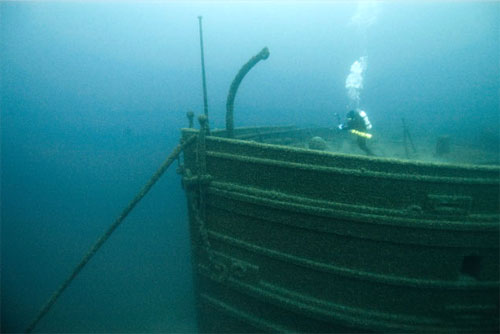
Diver exploring the wreck of the Florida

Exploring the Florida, Thunder Bay National Marine Sanctuary

The Thunder Bay National Marine Sanctuary encompasses almost 450 square miles of Lake Huron’s bottomlands off Alpena. It is the thirteenth national marine sanctuary and was established in 2000 to protect a nationally significant collection of nearly 200 shipwrecks, spanning over a century of Great Lakes shipping history. Thunder Bay is the first Great Lakes sanctuary and also the first to focus solely on a large collection of underwater cultural resources. The headquarters of the Sanctuary is the Great Lakes Maritime Heritage Center in Alpena.

The photo above is one of many awesome underwater photos of the Florida and other shipwrecks that can be viewed in their Fieldwork 2007 Gallery. Seriously, this is cool – go look at it and be sure to click the “slideshow” view at the top left to see the larger sized images.

Dave Swayze’s amazing Great Lakes Shipwrecks File includes information on 4,760 great lakes shipwrecks. It says that on May 21, 1897 in dense fog off False Presque Isle, the 271′ package freighter Florida, one of largest boats on the Great Lakes, collided with one of the few that was larger, the steamer George W. Roby. The Roby rescued her crew, but with a large hole in her starboard side, the Florida sank in just 12 minutes in 250′ of water.

There’s more information on the Thunder Bay National Marine Sanctuary and Underwater Preserve over at Absolute Michigan.

Diving the Wreck of the Vienna off Whitefish Point

Vienna - 19

Vienna – 19, photo by mschout.

Global Underwater Explorers page on diving the Vienna says that although extended range divers often use the Vienna as a “blow-off dive because it’s shallow and near shore, it’s also one of the finest wrecks to dive in Michigan’s Upper Peninsula. They write that this 191′ wooden steamer:

…came to her demise the same way that many do in Lake Superior, by collision. On 16 September 1892, she was down bound from Marquette, Michigan, with a load of iron ore. In tow was the schooner Mattie C. Bell. At Whitefish Point, the Vienna met up with the Nipigon. The Nipigon also had schooners in tow. Without warning, the Nipigon suddenly veered and struck the Vienna. Despite the efforts of both crews to save the Vienna, the vessel sank approximately one mile from shore. It was never fully understood why the Nipigon veered off course.

You can get more information about this wreck and others near Whitefish Point including a great photo of the Vienna at the ore docks in Marquette at Nordic Diver’s page on the wreck of the steamer Vienna.

Michael Schout has more photos of diving the Vienna (slideshow) and from diving more Great Lakes wrecks including the William Young, Panther, Minneapolis, Northwest, Sandusky and the Eber Ward in his very cool Diving set.

Much more shipwreck info (along with another great photo from Michael) can be found at the Absolute Michigan word of the week: Shipwreck!

Along the Graveyard Coast

Keel at Au Sable

Keel at Au Sable, photo by swaneesimpalass.

The Pictured Rocks National Lakeshore says that the shipwrecks of Lake Superior’s “Graveyard Coast” represent many eras of shipping. They are relatively well preserved because they have been spared from the human pressures of population and industry.

Some of them have lost their names, while others like the Mary Jarecki or the Annie M Peterson retain some of their stories:

The Annie M. Peterson was a 2-masted wooden schooner-barge built in 1874. She sank in a storm on November 19, 1914 off the mouth of Two-Hearted River on Michigan’s Upper Peninsula, when she was lost from her towline, and broke up offshore in heavy seas.

Winter storms in 2003 revealed her ice-encased remains, embedded in the Lake Superior shoreline, about 6 miles east of Grand Marais. Last I heard, she had disappeared again.

Click over to Bruce Moore’s site for the a map to the wreck and stay tuned to Absolute Michigan keyword shipwreck (there’s already a ton of stuff there!) and Michigan in Pictures all November for tales of the wrecks and information about museums, preserves and web sites to learn more about the unfortunate side of Michigan’s rich maritime history.

Whitefish Point Lighthouse & The Great Lakes Shipwreck Museum

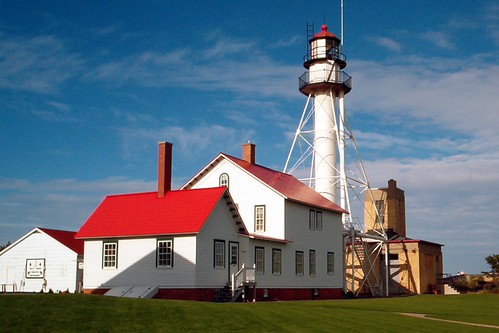
Whitefish Point Lighthouse

Whitefish Point Lighthouse, photo by heidigoseek.

Heidi writes This light, the oldest active on Lake Superior, began operating in 1849, though the present tower was constructed later. Early a stopping place for Indians, voyageurs, and Jesuit missionaries, the point marks a course change for ore boats and other ships navigating this treacherous coastline to and from St. Mary’s Canal. Since 1971 this light, fog signal, and radio beacon have been automated and controlled from Sault Ste. Marie.

The Whitefish Point Lighthouse & The Great Lakes Shipwreck Museum form the premier destination for lovers of Great Lakes maritime lore. You can get much more information and many more photos at Destination: Michigan Whitefish Point Lighthouse & Museum on Absolute Michigan.