The Great Storm of 1913 and the Charles S. Price

charles-s-price-great-storm-1913

I’ve featured the worst storm in Great Lakes history before, but ThumbWind has a cool feature on The Great Storm of 1913 that includes some interesting information and photos. It says in part:

…the most savage storm in the history of the Great Lakes swept the inland waters November 7-12, 1913 resulting in much greater loss of life. Combined of the forces of two storm fronts colliding with hurricane force bringing monstrous waves and driving snow and ice that doomed anyone caught out on the big lake. The greatest losses in lives and ships occurred on Lake Huron where 24 vessels were lost or severely damaged. 10 ships went to the bottom of the lake.

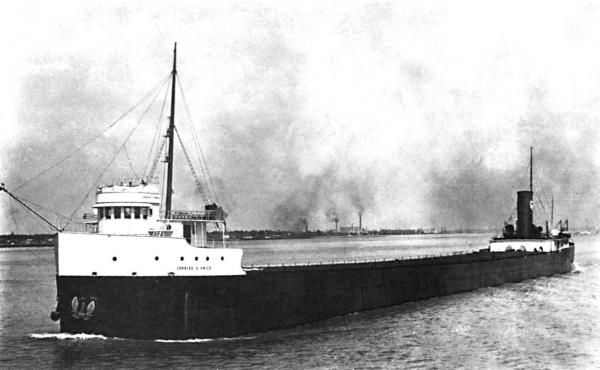
…On Lake Huron big freighters were tossed about by winds blowing from seventy-five to eighty miles an hour. One of these steamers was the Charles S. Price which received more space on the front pages of newspapers than any other ship. On Saturday morning, the Price, laden with soft coal, left Ashtabula, Ohio. When the freighter passed the town of St. Clair before dawn on Sunday morning, November 9, Second Mate Howard Mackley gave a short blast of the whistle as a signal to his young bride that he was passing and in reply she turned on an upstairs light in their home. By dawn the Price was making its way up Lake Huron. About noon Sunday the Price was seen north of Harbor Beach by Capt. A. C. May of the Steamer H. B. Hawgood.

On Monday afternoon a big steel freighter was seen floating upside down in the lake about eight miles north and east of the mouth of Lake Huron. Many people were anxious to learn the name of the steamer, although it was generally believed to be the Regina. On Wednesday morning an attempt was made to find out the identity of the vessel, however, owing to the high sea the diver did not make his descent. Lake Huron kept its awful secret for almost a week. It was not until Saturday morning, November 15, that William H. Baker, a diver from Detroit, solved the mystery. When he went down he read the name of the steamer twice and the letters spelled out Charles S. Price. The forward part of the bottom of the ship was buoyed up by air that was held in her when she turned turtle, but two streams of bubbles were coming out of the bow which meant that she would settle gradually. On Monday morning, November 17, the Price disappeared from view.

Read on for much more and follow Thumbwind on Facebook too!

More Michigan shipwrecks on Michigan in Pictures.
Happy Halloween … and the Indian Drum

pumpkin-on-the-shore-happy-halloween

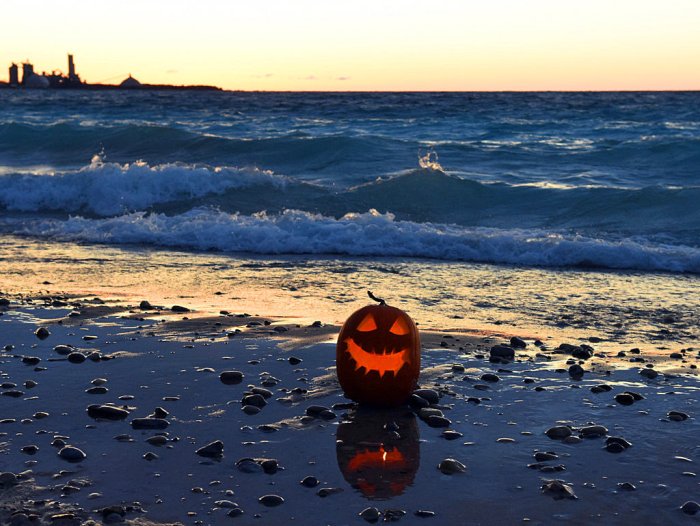
Happy Halloween, photo by Julie

Happy Halloween everyone! I shared this story a few years ago, but since we’re back up on northern Lake Michigan at a time when the witch of November is rousing, why not share it again? In 1915, William MacHarg & Edwin Balmer wrote a book called The Indian Drum. The whole book is available online along with 53,000+ more books at Project Gutenberg. Chapter I begins:

Near the northern end of Lake Michigan, where the bluff-bowed ore-carriers and the big, low-lying, wheat-laden steel freighters from Lake Superior push out from the Straits of Mackinac and dispute the right of way, in the island divided channel, with the white-and-gold, electric lighted, wireless equipped passenger steamers bound for Detroit and Buffalo, there is a copse of pine and hemlock back from the shingly beach. From this copse—dark, blue, primeval, silent at most times as when the Great Manitou ruled his inland waters—there comes at time of storm a sound like the booming of an old Indian drum. This drum beat, so the tradition says, whenever the lake took a life; and, as a sign perhaps that it is still the Manitou who rules the waters in spite of all the commerce of the cities, the drum still beats its roll for every ship lost on the lake, one beat for every life.

So—men say—they heard and counted the beatings of the drum to thirty-five upon the hour when, as afterward they learned, the great steel steamer Wenota sank with twenty-four of its crew and eleven passengers; so—men say—they heard the requiem of the five who went down with the schooner Grant; and of the seventeen lost with the Susan Hart; and so of a score of ships more. Once only, it is told, has the drum counted wrong.

At the height of the great storm of December, 1895, the drum beat the roll of a sinking ship. One, two, three—the hearers counted the drum beats, time and again, in their intermitted booming, to twenty-four. They waited, therefore, for report of a ship lost with twenty-four lives; no such news came. The new steel freighter Miwaka, on her maiden trip during the storm with twenty-five—not twenty-four—aboard never made her port; no news was ever heard from her; no wreckage ever was found. On this account, throughout the families whose fathers, brothers, and sons were the officers and crew of the Miwaka, there stirred for a time a desperate belief that one of the men on the Miwaka was saved; that somewhere, somehow, he was alive and might return. The day of the destruction of the Miwaka was fixed as December fifth by the time at which she passed the government lookout at the Straits; the hour was fixed as five o’clock in the morning only by the sounding of the drum.

The region, filled with Indian legend and with memories of wrecks, encourages such beliefs as this. To northward and to westward a half dozen warning lights—Ile-aux-Galets (“Skilligalee” the lake men call it), Waugaushance, Beaver, and Fox Islands—gleam spectrally where the bone-white shingle outcrops above the water, or blur ghostlike in the haze; on the dark knolls topping the glistening sand bluffs to northward, Chippewas and Ottawas, a century and a half ago, quarreled over the prisoners after the massacre at Fort Mackinac; to southward, where other hills frown down upon Little Traverse Bay, the black-robed priests in their chapel chant the same masses their predecessors chanted to the Indians of that time. So, whatever may be the origin of that drum, its meaning is not questioned by the forlorn descendants of those Indians, who now make beadwork and sweet-grass baskets for their summer trade, or by the more credulous of the white fishermen and farmers; men whose word on any other subject would receive unquestioning credence will tell you they have heard the drum.

Read on at Project Gutenberg.

View Julie’s photo bigger and see more in her Holidays slideshow.

See 700 more Halloween photos in the Absolute Michigan photo group  and more haunted, Halloween fun on Michigan in Pictures.

November 18, 1958: The Wreck of the Carl D Bradley

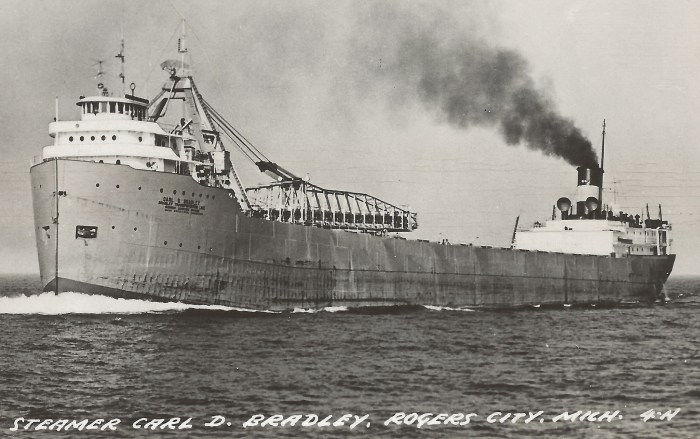
Steamer Carl D Bradley Rodgers City Mich

Steamer Carl D Bradley Rogers City Mich, photo by UpNorth Memories/Don Harrison

Every year, I revisit the story of the Edmund Fitzgerald on November 10th. I do this because I remember the ferocity of the winds on the day of the wreck vividly from my childhood, because as a Michigander Lightfoot’s song is probably coded in my DNA by now, and also because it’s very popular with readers. Nonetheless, the feature Should musicians decide the shipwrecks we know? from IPR News Radio by Peter Payette & Morgan Springer definitely struck a chord. There are thousands of ships that have gone down the world’s eighth sea, and so many families that have felt the loss when a sailor doesn’t return from one of the most dangerous jobs there is. We’d do well to remember some of the others as well!

On this day in 1958, my vote for the most devastating Great Lakes shipwreck of the modern era took place. 33 of 35 crew members perished in the wreck, and 23 of them were from the town of Rogers City that boasted a population of less than 4000 people. The Presque Isle County Historical Museum’s website for the Steamer Carl D. Bradley tells the tale of the wreck of the Bradley:

The steamer was 638 feet long overall, with a 65-foot beam, a depth of 33 feet and a cargo capacity of 14,000 tons of crushed stone. The unloading boom was 160 feet long. The engineering and propulsion plant on the Carl D. Bradley was similar to that on the T.W. Robinson which was built two years before the Carl D. Bradley.

…The Carl D. Bradley, traveling light departed Buffington, Indiana around 9:30 pm, Monday, November 17, and headed up Lake Michigan bound for the Port of Calcite. Roland Bryan, a sailor since age fourteen, was the master. This trip was the last for the season and the steamer was going home. The Bradley never made it. In less than 24 hours the Carl D. Bradley was on the bottom of Lake Michigan and 33 of the 35-man crew were dead or missing.

When the vessel left Buffington, the winds were blowing up to 35 miles per hour from the south. The storm that was about to engulf the Bradley was developing over the plains when a cold front from the north met a warm front over the plains. The temperature in Chicago had dropped about 20 degrees that day. The forecast warned of gale winds. The crew prepared for severe weather by securing the unloading boom and the hatches. The steamer followed the route up the Wisconsin shore to Cana Island then changed course and cut across Lake Michigan toward Lansing Shoal. As the wind velocity increased, the crew filled the ballast tanks to maximum practical condition. By 4:00 pm of the next day, the 18th, the winds had reached 65 miles per hour. Even though the lake was rough and the winds high, the boat rode the heavy seas with no hint of the laboring.

Captain Bryan had asked the cooks to serve an early dinner. He knew the turn from Lake Michigan toward Lake Huron would put heavy weather broadside of the vessel. He wanted to give the mess crew the opportunity to clean up and secure before turning. The mess room was full of crewmembers anticipating going home.

About 5:30 pm First Mate Elmer Flemming radioed Calcite that the Bradley would arrive at 2:00 am. Then a “loud thud” was heard. In the pilothouse Captain Bryan and Flemming looked aft and saw the stern sag. Flemming immediately sent a distress signal over the radio. “Mayday! Mayday! This is the Carl D. Bradley. Our position is approximately twelve miles southwest of Gull Island. We are in serious trouble! We’re breaking up!” Captain Bryan sounded the general alarm, signaled the engine room to stop the ship, and blew the whistle to abandon ship. The power system failed and the lights in the bow section went out. The Bradley heaved upward near amidships and broke in two. The forward section rolled over and sank. The stern end plunged to the bottom. Within a few minutes the Carl D. Bradley was gone.

Read on for much more including theories of how the ship sank and the story of how deckhand Frank Mays & Elmer Flemming survived the wreck. At the website you’ll also find some cool old photos of the ship, newspaper clippings and photos of the crewmen lost at sea. The Wikipedia entry for the Carl D Bradley is particularly good as well with a lot more details!

This trailer for November Requiem, a DVD about the Carl D Bradley, the impact on Rogers City and the dive to the Bradley:

View Don’s photo big as the Bradley, check out more of his freighter postcards & pics, and friend him up on Facebook for lots more great old photos of Michigan.

PS: I added a new category that I somehow didn’t have already: Michigan shipwrecks – enjoy!

PPS: Apparently great minds this alike – check this out from today’s Interlochen Public Radio!

The Wreck of the Edmund Fitzgerald

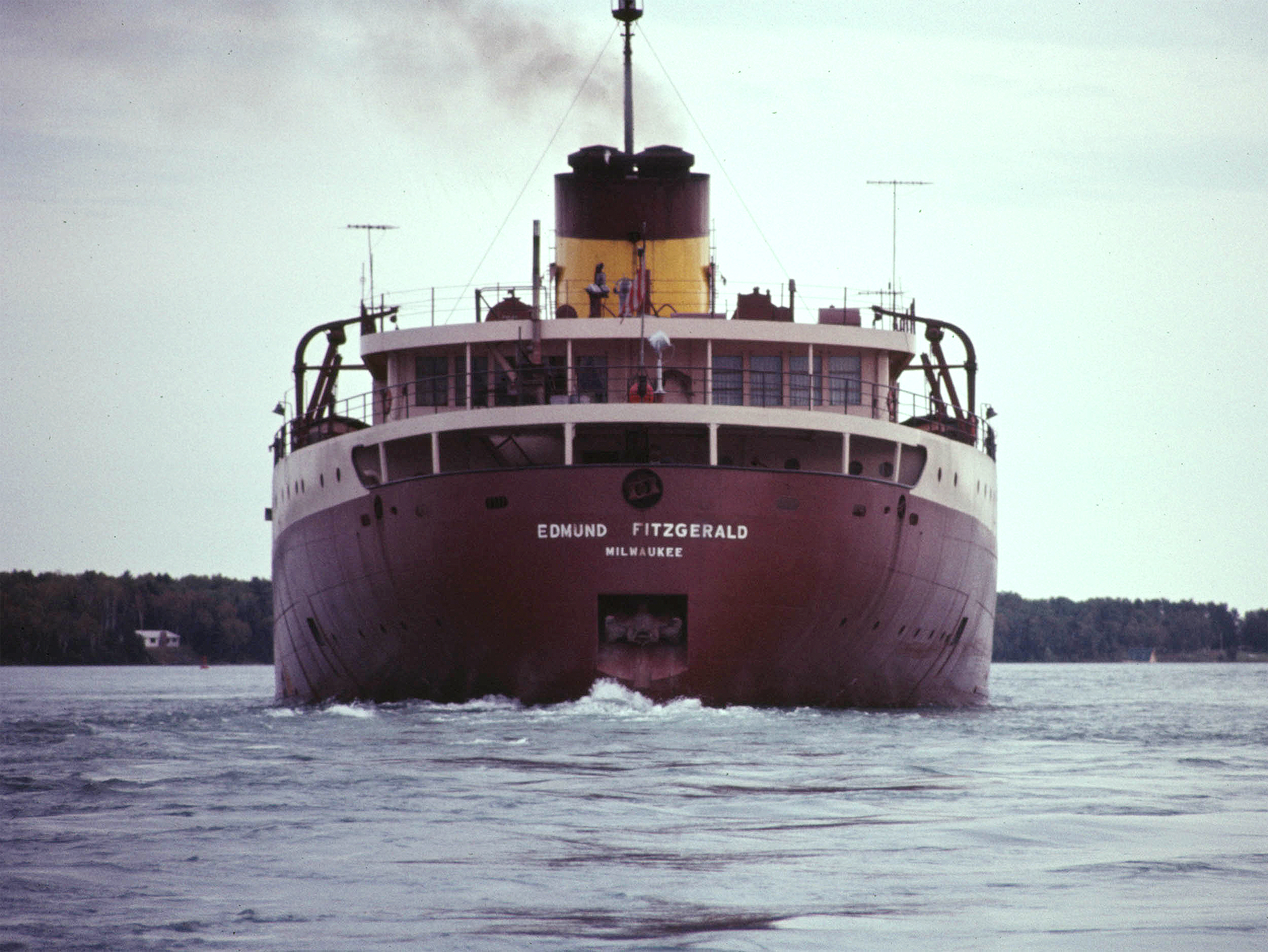
SS Edmund Fitzgerald Underway

SS Edmund Fitzgerald Underway, photo via Wikimedia Commons

I went and bought all of the old newspapers, got everything in chronological order, and went ahead and did it because I already had a melody in my mind. It was from an old Irish dirge that I heard when I was about three and a half years old. I think it was one of the first pieces of music that registered to me as being a piece of music. That’s where the melody comes from, from an old Irish folk song.
~Gordon Lightfoot on The Wreck of the Edmund Fitzgerald

40 years ago today, Michigan’s most remembered shipwreck took place. A big part of this is certainly Gordon Lightfoot’s signature ballad The Wreck of the Edmund Fitzgerald. The song – familiar to almost every Michigander – seems to memorialize more than simply the 29 men who perished in that horrible storm. There is certainly no better video of this song than this one crafted by Joseph Fulton featuring footage of the Fitz that you’ve probably never seen. It starts out with Walter Cronkite’s Harry Reasoner’s news report from November 11, 1975 and just gets better from there – definitely worth your time!

mLive has an article about how & why Gordon Lightfoot wrote ‘The Wreck of the Edmund Fitzgerald’ that you should check out. It includes a nice little video where he shares how he’s edited the live lyrics to reflect what’s been learned about the sinking of the ship. They got Lightfoot’s account of  the writing of the song from the songwriter’s Ask Me Anything on Reddit, an interesting look inside of the mind of a thoughtful and talented songwriter.

I made some minor corrections to today’s photo to get the colors a little closer to those of the Fitz. View it big as the Fitz and see more at Edmund Fitzgerald images at Wikmedia.

There more ships and more shipwrecks on Michigan in Pictures.

Continue reading The Wreck of the Edmund Fitzgerald

The Great Storm of 1913 and the Last Voyage of the Henry B. Smith

Henry B Smith Great Storm of 1919

Henry B Smith LOC det 4a16048, photo by Detroit Publishing Co. (via Library of Congress)

In November I like to share stories of some of the ships that have been lost in the most dangerous month of shipping on the Great Lakes. November is a month when owners and captains have historically sought to bet the margins in their favor. Sometimes their gamble doesn’t pay off…

The Great Lakes Storm of 1913 is one that caught many ships in the wrong place at the wrong time. More or less via Wikipedia’s page:

The Great Lakes Storm of 1913 is historically referred to as the “Big Blow,” the “Freshwater Fury,” or the “White Hurricane.” It was a blizzard with hurricane-force winds that ravaged Michigan, Ontario and much of the Midwest from November 7-10, 1913. The storm was most powerful on November 9, battering and overturning ships on four of the five Great Lakes, particularly Lake Huron. Deceptive lulls in the storm and the slow pace of weather reports contributed to the storm’s destructiveness.

The deadliest and most destructive natural disaster ever to hit the lakes, the storm killed more than 250 people, destroyed 19 ships, and stranded 19 others. The financial loss in vessels alone was nearly US $5 million (or about $120 million in today’s dollars).

There’s so much more about this storm on the Wikipedia page and definitely check out this Michigan in Pictures post on the unique weather pattern on the Great Storm.

One of the ships lost to the lakes was the Henry B. Smith, a 525′ steel-hulled, propeller-driven lake freighter. Well…

The Smith arrived at Marquette on November 6 to take on iron ore. Over the next two days a southwest gale swept over Lake Superior, dropping the temperature to 24 degrees Fahrenheit. The cold weather caused the ore to freeze inside the hopper cars, requiring men to knock them loose by hand. This resulted in a loading delay for the Smith. Captain James Owen had been plagued by misfortunes all year that had resulted in the Smith being delayed or late for its destinations. Rumors abounded, then and now, that the owners of the boat made it clear to Owen that he better make this last trip on time, or else.

Around 5 p.m. on November 9, the Smith loaded its last car of ore. Since the gale seemed to be in a brief lull, the big freighter immediately backed away from the dock and began to leave. As soon as the Smith left Marquette Harbor, the fierce wind returned and the storm’s lull ended. Witnesses on shore noted that the deckhands were frantically trying to close the Smith‍ ’​s hatches. The freighter had a total of 32 hatches; each hatch required individual attention with locking bars, clamps, and tackle. It was a couple hours’ work for even the most skilled crew. And so it was that Captain James Owen was piloting the Henry B. Smith into one of the worst storms in memory with unsecured hatches.

After about twenty minutes, the full force of the gale hit the Smith as huge waves crashed over her deck, drenching the hapless deckhands who were still struggling to close the hatches. Instead of turning to starboard on the usual course for the Soo Locks, the Smith hauled to port, rolling greatly as she did so. Witnesses on shore concluded that Owen had realized his error and was heading for shelter behind Keweenaw Point to the north. With the encroaching darkness and thick snow squalls, the Smith was then lost from view.

Two days after the storm blew itself out, the beaches along Chocolay Bay, Shot Point, and Laughing Fish Point were littered with debris from the Smith. The wreckage was found high up on the beach, indicating it came ashore at the height of the storm. The body of the second cook, H.R. Haskin, was found floating about fifty miles west of Whitefish Point some days later. Only one other body of the Smith‍ ’​s crew was ever recovered; the skeleton of third engineer John Gallagher was found on Parisian Island in the spring of 1914.

A note in a bottle, allegedly from the Smith, was found in June 1914. In it, the author claimed the ship had broken in two 12 miles east of Marquette. After a long debate, the boat’s owners decided the note was a phony; it was dated 12 November, when the Smith sank either on the 9th or the early morning hours of the 10th.

Read on for more about the Smith. In May of 2013, the wreck of the Henry B. Smith was rediscovered in about 535 feet of water roughly 30 miles north of Marquette. The article is less kind to Captain “Dancing Jimmy” Owen – so named for his habit of frequenting local dance halls – than the Wikipedia version.

View the photo background big at Wikimedia.

More of the Freshwater Fury and more Michigan shipwrecks on Michigan in Pictures.
 

The Indian Drum

petoskey-breakwall-wave

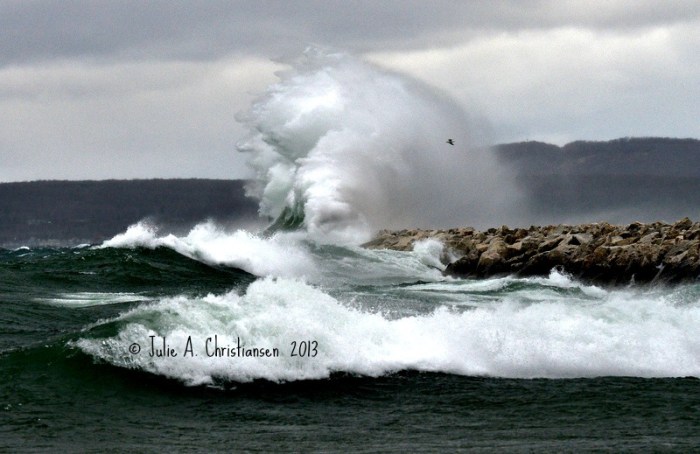
Petoskey Breakwall, photo by Julie A. Christiansen

Earlier this week I posted about The Crooked Tree. While August isn’t yet shipwreck season in Michigan, the post reminded me of the 1915 novel by William MacHarg & Edwin Balmer set in the same region called The Indian Drum. The whole book is available online at Project Gutenberg (hooray for free books!). It begins:

Near the northern end of Lake Michigan, where the bluff-bowed ore-carriers and the big, low-lying, wheat-laden steel freighters from Lake Superior push out from the Straits of Mackinac and dispute the right of way, in the island divided channel, with the white-and-gold, electric lighted, wireless equipped passenger steamers bound for Detroit and Buffalo, there is a copse of pine and hemlock back from the shingly beach. From this copse—dark, blue, primeval, silent at most times as when the Great Manitou ruled his inland waters—there comes at time of storm a sound like the booming of an old Indian drum. This drum beat, so the tradition says, whenever the lake took a life; and, as a sign perhaps that it is still the Manitou who rules the waters in spite of all the commerce of the cities, the drum still beats its roll for every ship lost on the lake, one beat for every life.

So—men say—they heard and counted the beatings of the drum to thirty-five upon the hour when, as afterward they learned, the great steel steamer Wenota sank with twenty-four of its crew and eleven passengers; so—men say—they heard the requiem of the five who went down with the schooner Grant; and of the seventeen lost with the Susan Hart; and so of a score of ships more. Once only, it is told, has the drum counted wrong.

At the height of the great storm of December, 1895, the drum beat the roll of a sinking ship. One, two, three—the hearers counted the drum beats, time and again, in their intermitted booming, to twenty-four. They waited, therefore, for report of a ship lost with twenty-four lives; no such news came. The new steel freighter Miwaka, on her maiden trip during the storm with twenty-five—not twenty-four—aboard never made her port; no news was ever heard from her; no wreckage ever was found. On this account, throughout the families whose fathers, brothers, and sons were the officers and crew of the Miwaka, there stirred for a time a desperate belief that one of the men on the Miwaka was saved; that somewhere, somehow, he was alive and might return. The day of the destruction of the Miwaka was fixed as December fifth by the time at which she passed the government lookout at the Straits; the hour was fixed as five o’clock in the morning only by the sounding of the drum.

The region, filled with Indian legend and with memories of wrecks, encourages such beliefs as this. To northward and to westward a half dozen warning lights—Ile-aux-Galets (“Skilligalee” the lake men call it), Waugaushance, Beaver, and Fox Islands—gleam spectrally where the bone-white shingle outcrops above the water, or blur ghostlike in the haze; on the dark knolls topping the glistening sand bluffs to northward, Chippewas and Ottawas, a century and a half ago, quarreled over the prisoners after the massacre at Fort Mackinac; to southward, where other hills frown down upon Little Traverse Bay, the black-robed priests in their chapel chant the same masses their predecessors chanted to the Indians of that time. So, whatever may be the origin of that drum, its meaning is not questioned by the forlorn descendants of those Indians, who now make beadwork and sweet-grass baskets for their summer trade, or by the more credulous of the white fishermen and farmers; men whose word on any other subject would receive unquestioning credence will tell you they have heard the drum.

Read on at Project Gutenberg.

Julie took this shot back in November of 2013. You can view it bigger, see more in her This & That slideshow and also check out this video from the day.

More Michigan shipwreck lore on Michigan in Pictures.

Shipwreck Saturday: The Wreck of the Minnehaha

Taking on Water

Taking on Water, photo by Aaron Springer

“She was built in 1880 [by Linn & Craig in Gibralter, Michigan] and has been unfortunate from the start. Two years ago [in 1891] she was wrecked near Detour [at the north end of Lake Huron], and remained on the rocks all winter, being abandoned to the underwriters, who finally rescued the wreck and sold it.”
~ Buffalo Evening News Monday, October 16, 1893

Historic Arcadia Michigan tells the tale of The Wreck of the Minnehaha:

In October of 1893, the steam barge Henry J. Johnson was towing the Minnehaha from Chicago bound for Point Edward at the south end of Lake Huron with 58,000 bushels of corn. At 7:30 PM on October 13, the two ships found themselves off Point Betsie facing 90 mile per hour gale force winds. They tried to find shelter behind the Manitou Islands, but at dawn the next day, they were still south of Sleeping Bear Point fighting high winds and waves to stay out of shallow water.

Captain Benniteau of the Johnson decided to turn the ships south and head to Frankfort, the nearest refuge. However, somewhere near Frankfort high waves crashed over the Minnehaha’s deck, smashed two hatch covers, and began filling the hold with water. William Parker, captain of the Minnehaha, realizing his ship was in serious trouble, sent up distress signals, released the tow lines, and headed for the beach. There was nothing the crew of the Johnson could do but avoid the same shallow water.

The Minnehaha ran aground about a quarter of a mile offshore between Burnham and Arcadia. To avoid the waves sweeping the decks, all but one member of the crew, who drowned trying to swim to shore, climbed into the ship’s rigging. As the ship was breaking up, the captain called to the crew to grab whatever would float and go over the side anyway. But only the captain made it to shore safely. One crew member made it to a pier, but was too tired to hold onto a pole used to try to pull him to safety.

Read on for much more including photos of the Minnehaha.

Check out Aaron’s photo bigger where he also has a pic of the wreck in calm water and see many more of his great photos of Lake Michigan.

More Michigan shipwrecks on Michigan in Pictures!

Coast Guard shares Manitou Passage shipwrecks from above

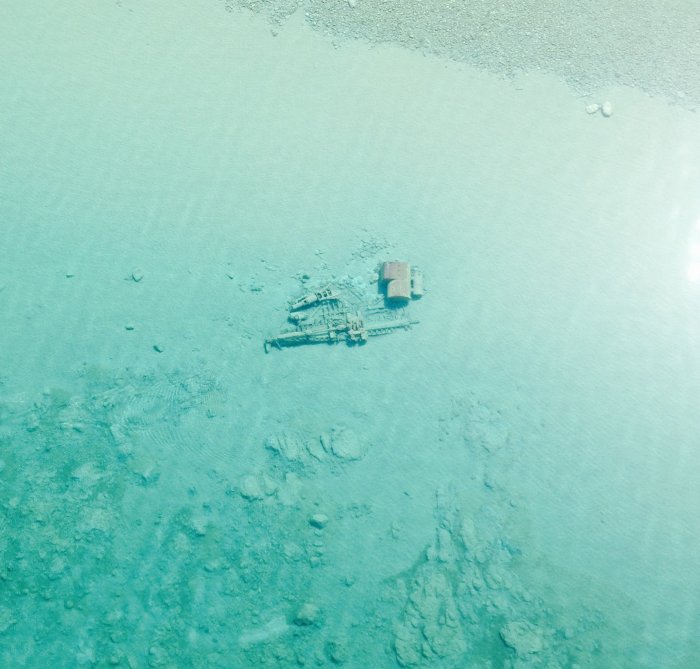
Wreckage of the Rising Sun

Wreckage of the Rising Sun, photo by U.S. Coast Guard Air Station Traverse City

Yesterday the U.S. Coast Guard Air Station Traverse City shared a collection of photos from the Manitou Passage Underwater Preserve, writing”

We can call it “Shipwreck Sunday” – With Lake Michigan ice gone for the season the crystal clear, deep blue waters of northern Michigan are back (albeit still VERY VERY cold at an average of 38 degrees).

During a routine patrol this past Friday, an aircrew captured these photos of a handful of the many shipwrecks along the Lake Michigan shoreline. These photos were taken near Sleeping Bear Point northeast along the shoreline to Leland, Michigan up to Northport.

Information on the shipwrecks is scarce, please post if you recognize any of the photographed sites.

View the Coast Guard’s photo bigger and click through for photos of other wrecks including the James McBride. Definitely follow them on Facebook for more cool shots of Michigan’s coastline from above!

Regarding the Rising Sun, the Leelanau Enterprise shares Leelanau historian George Weeks account of the wreck that includes a photo of the grounded Sun:

In October 1917, the Rising Sun went to High Island to get potatoes, rutabagas and lumber to take to Benton Harbor. On 29 October, in one of the early-season snowstorms that sweep the Lakes, the Rising Sun went aground at Pyramid Point. Lifeboats were launched and all thirty-two people aboard eventually saved.

As was often the case with Great Lakes wrecks, shoreline residents, not the U.S. Coast Guard, were the first to provide assistance. In this case, Fred Baker, summoned in the night by survivors pounding at the door of his home atop the Port Oneida bluff, was the first to respond. He hastened to his barn, quickly unloaded 60 bushels of potatoes that were on his wagon, hitched his team, and went down to the beach. The survivors, including a woman found unconscious on the beach, were brought to Baker’s house. (By the 1990s, Baker’s daughter, Lucille, who was four years old at the time of the wreck, was still residing at Port Oneida, the wife of Jack Barratt, great grandson of Port Oneida settler Carsten Burfiend.)

The Coast Guard beach rescue rig arrived from Glen Haven, pulled by two teams of horses borrowed from D.H. Day. A man who was asleep when the others abandoned ship was rescued by the guardsmen.

Remains of the Rising Sun are visible from the shore on a clear day, and are popular for recreational divers. As with other wrecks, the remains are protected objects within the Manitou Passage Bottomland Preserve.

Read more about the Rising Sun, it’s caro and final voyage and the House of David that owned it from Chris Mills and see more shipwrecks on Michigan in Pictures.

#TBT: Wreck of the Carl D. Bradley

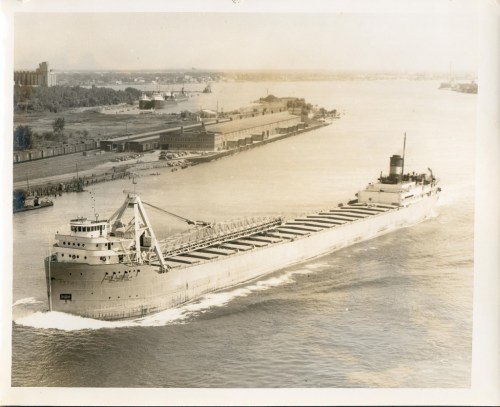
Carl D. Bradley

Carl D. Bradley, photo by John Rochon

If you know of any shipwreck on the Great Lakes, chances are it’s the S.S. Edmund Fitzgerald. While that was no doubt a terrible tragedy, my vote for the most grievous loss is the S.S. Carl D Bradley which sank 56 years ago next Tuesday on November 18, 1957. I found a really excellent article on the ship and shipwreck at Lake Effect Living titled Lost To The Lake: The Wreck of the Carl D. Bradley:

Known as ‘Queen of the Lakes’, the Carl D. Bradley was the largest ship on the Great Lakes from 1927 to 1949. At 639 feet, it was the longest freighter on the Lakes until the launch of the SS Wilfred Sykes twenty-two years later. The largest self-unloading ship for its time, the Bradley was the Bradley Transportation Company’s flagship. Named after the president of Michigan Limestone, Carl David Bradley, this state of the art freighter had its maiden voyage in the summer of 1927. Since Michigan Limestone’s company base was in Rogers City, Michigan, the freighter drew most of its crew from this small community.

…On Monday, November 17, 1958, the steamer left Buffington, Indiana bound for Port of Calcite harbor in Rogers City, Michigan.

The Bradley’s captain was 52-year old Roland Bryan, a veteran seaman. Manned by a crew of thirty-five and carrying a light cargo, the Bradley headed out onto Lake Michigan at 9:30pm. But signs of severe weather were already in evidence when they left Buffington, where winds gusted at more than 35 miles an hour. It was the first ominous indications of an extreme cold front forming over the plains. Temperatures in Chicago plummeted twenty degrees in one day, and thirty tornadoes were sighted from Texas to Illinois.

Aware that gale winds were forecast, the crew readied the steamer for bad weather. They traveled along the Wisconsin shore until reaching Cana Island, where they shifted course for Lansing Shoal which lay across Lake Michigan. The winds on the lake reached 65 miles an hour by 4pm the following day. Still, the Bradley seemed to be weathering the gale force winds and heavy seas with little problem. This changed at 5:30pm when the Port of Calcite received a radio message from First Mate Elmer Fleming informing them that the Bradley, approx. twelve miles southwest of Gull Island, would arrive home at 2am. As soon as this message was sent however, a loud thud or bang was heard on the ship.

When the day was done, 33 of the 35 member crew were dead, 23 of the from Rogers City, Michigan. For a town of less than 4000, it was a heavy blow. Read on for much more and also see Seeking Michigan: The Wreck of the Carl D. Bradley on Absolute Michigan and the tribute site at carldbradley.org.

John Rochon shared this photo of the Bradley was taken from the Blue Water Bridge by Schjelderup Marine Studio and shows the ship heading towards the mouth of Lake Huron. View it big as the Bradley and see more in his massive Great Lakes Ships & Shipping slideshow.

More shipwrecks on Michigan in Pictures.

Hunting the Griffon

Detail: The LaSalle Stained Glass Window, Installed at Dossin Great Lakes Museum, Belle Isle Park--Detroit MI

Detail: The LaSalle Stained Glass Window, Installed at Dossin Great Lakes Museum, Belle Isle Park–Detroit MI, photo by pinehurst19475

John Flesher of the Associate Press has a feature on NBC News about the possible discovery of the Holy Grail of Great Lakes shipwrecks, Le Griffon, the ship of French explorer Rene-Robert Sieur de La Salle. The article says (in part):

A wooden beam embedded at the bottom of northern Lake Michigan appears to have been there for centuries, underwater archaeologists announced Tuesday, a crucial finding as crews dig toward what they hope is the carcass of a French ship that disappeared while exploring the Great Lakes in the 17th century.

Expedition leaders still weren’t ready to declare they had found a shipwreck or the long-lost Griffin. The ship, commanded by the French explorer La Salle, was never seen again after setting sail in September 1679 from an island near the entrance of Green Bay, in what is now northern Wisconsin, with a crew of a six and a cargo of furs.

…Scientists and divers began excavating last week at the base of the wooden beam, hoping to determine whether it is part of the Griffin. Steve Libert, a diver and shipwreck enthusiast who has searched three decades for the Griffin, discovered the timber in 2001 and recently obtained state and federal permits to probe beneath the muddy surface.

Read on for more. Libert is president of Great Lakes Exploration Group started the Lasalle-Griffon Project with the state of Michigan and the Republic of France in July of 2010. He’s definitely obsessed with finding the ship, and their Expedition page explains:

If the wreck Libert has found is Le Griffon, it will be a find of tremendous historical significance. Le Griffon was built by Rene-Robert Sieur de La Salle, one of the first French explorers of the Great Lakes Region. He would later claim the Mississippi River watershed for France, a vast expanse of land that extended from the Allegheny Mountains to the Rocky Mountains and North of the Great Lakes, a portion of which became what is presently known as the Louisiana Purchase.

Exploration and study of the ship will tell us much about the history of our country and how our ancestors lived. “The ship is a time capsule that will fill the missing gaps of La Salle’s early exploration of North America,” says Libert. In particular, the wreck is a record of ship construction of that period, about which relatively little is known. La Salle constructed Le Griffon on the banks of the Niagara River, about three miles above the falls. There is strong documentation to support the view that Le Griffon was built on what is now the U.S. side of the Falls. If the wreckage is Le Griffon, however, it may be possible to use samples to establish definitively which side it was built on.

The fact that Le Griffon was built in the wilderness, as opposed to a shipyard, will reveal the circumstances La Salle and his men faced and the tools and technology they possessed. The ship was built with timber cut on site. The exact dimensions of the vessel are not known. It is however known to have been a 40 tun* vessel with three masts, a foremast, main and mizzen, and several square sails.

*Tun is an old French word for a large cask used in shipping wine, equivalent to 33.7 cubic feet or 252 gallons. Read on for a whole lot more.

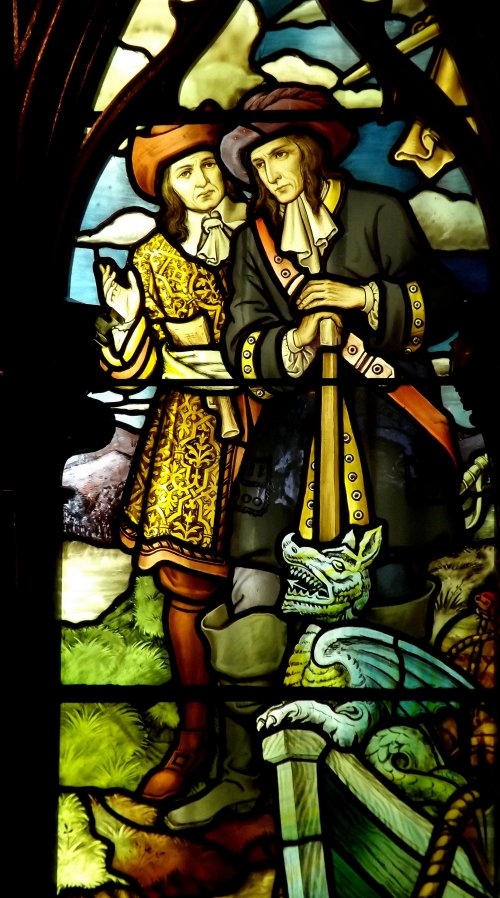
Regarding the stained glass above, pinehurst19475 writes:

This is a full view of part of a panel that depicts two cavaliers in discussion. They are part of a scene that depicts Robert Cavalier Sieur de la Salle’s voyage through the Detroit River in 1678-9. The small boat in the foreground is the “Griffon,” the vessel that made the voyage.

The five-part stained glass window was originally installed in the Gothic Room of the “City of Detroit III.” At the time it was built (1912), it was the world’s largest side-wheeler. The Edward F. Lee Glass Company of Detroit designed the stained glass window.

View his photo background big and see more in his Stained Glass slideshow.