houston we have liftoff

houston we have liftoff

houston we have liftoff, photo by suesue2.

OnSunday night I had the very great honor and pleasure of spending the evening with some folks from the Flickr based photo group Exposure.Detroit.

After dinner at Slows BBQ (three words: “baby back ribs”) we went downtown and enjoyed shooting Campus Martius Park and Hart Plaza on a beautiful October evening.

Sue’s photo of the Dodge Fountain is just one of many that you can check out in this nifty slideshow.

Victory Eagle, Marshall Fredericks

"Victory Eagle" at Former Veterans Memorial Building--Detroit MI

“Victory Eagle” at Former Veterans Memorial Building–Detroit MI, photo by pinehurst19475.

Anthony Lockhart writes:

This monumental sculptural relief (twenty-eight feet tall) by Marshall Fredericks is on the north wall of what was the Veterans Memorial Building. It symbolizes both sacrifice and victory. The building is now the UAW-Ford National Programs Center. It was designed by the firm of Harley, Ellington and Day and dedicated in 1951.

He has many more statues & sculptures from Detroit (view slideshow)

Editor’s note: I’m always surprised when I find that I’ve never featured a photo from a photographer whose work I follow closely. This is one of those times – if you’re looking for architectural photographs of Detroit and the surrounding area with informed commentary … look no further.

Friendship Circle at Bay City’s Wenonah Park

011

011, photo by mark5032001.

Patty Inglis’s Bay City, Michigan page on hubpages identifies this sculpture as Friendship Circle at Wenonah Park.

You can see another view of this sculpture in Wenonah Park by stenbough and see more lots more views of Bay City from Mark (slideshow).

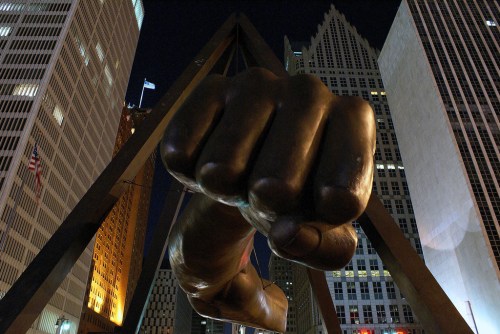
Fist of a Champion – Detroit’s Monument to Joe Louis

Joe Louis 2

Joe Louis 2, photo by buckshot.jones.

Scott writes I simply love this piece of art work. It says so much about the heart and soul, the toughness, about the town and the people who live here and have built this area. Joe Louis Barrow, aka “The Brown Bomber” is one of the all-time great boxers. The 24 x 24 x 11.5 feet Monument to Joe Louis was commissioned by Time Inc. for the City of Detroit to honor Joe Louis. It was created by sculptor Robert Graham and installed at Jefferson Avenue at Woodward, Detroit on October 16, 1986.

Robert Graham’s page on the Joe Louis Memorial says:

The monument is a 24-foot long arm and fist held in balanced suspension from a pyramidal support of bronze poles. Weighing approximately 8,000 lb., it rises 24 feet above a major downtown intersection.

The initial arm was modeled in clay at 14 inches in length. With the aid of a computer, a full-scale steel armature, 24 feet in length, was made and wrapped with wire and covered with clay. The final clay model was divided into eight sections and cast in bronze, then assembled. The pyramid structure was fabricated out of steel, and faced with bronze plates. A tribute to Joe Louis is inscribed on the arm.

Detroit Yes writes in Downtown Montage that he may be the only person in Detroit (other than Scott) who likes the Fist:

So great was Joe Louis that is difficult to measure the historical contribution of this immense figure who, without a close second, is by far the greatest sports figure to ever arise from Detroit and assume center stage on the world theater. It was he who helped shatter the Nazi myth of racial superiority with his dramatic defeat of German champion Max Schmeling during the rise of Nazism. In doing so and then serving his country nobly in the segregated army of World War II, he laid bare the disgraceful hypocrisy that denied Afro American athletes access to the major leagues of American sport, not to mention all Afro Americans who were and are denied the basic birthrights of American citizenship.

He did this with his fists and determination. So it is fitting that he is honored with a place at the center of his hometown with an artwork as powerful and controversial as he was.

You can get a birds eye view of the Joe Louis Memorial on the Absolute Michigan map of Michigan. Also see Monuments of Detroit from the Detroit News, a slideshow of photos of the Fist and a video look at the Joe Louis Fist Statue. For more about Joe Louis, Wikipedia’s Joe Louis entry and the Official site of the Joe Louis Estate.

stacked

stacked

stacked, photo by The Real Ferg.

Ferg took this @ Deepwater Point Natural Area. The Grand Traverse Regional Land Conservancy says Deepwater Point is a 15 acres property is owned by Acme Township on East Bay, north of Traverse City. The plaque reads:

In memory of Clyde H. Reed
Who along with his neighbors fought to protect Acme Township’s Deepwater Point Area – a place precious and dear to him. May we follow his example by being good stewards of this beautiful land for the benefit of future generations.

When I saw this photo, I realized that I had never shared on Michigan in Pictures something that I saw this summer. We called it the Amazing Frankfort Rock Gallery. I spend a ton of time on Michigan’s beaches, but this summer I seemed to see these rock structures everywhere. I wasn’t the only one either.

Anyone in the audience have any idea what’s behind this rock-stacking mania in Michigan?

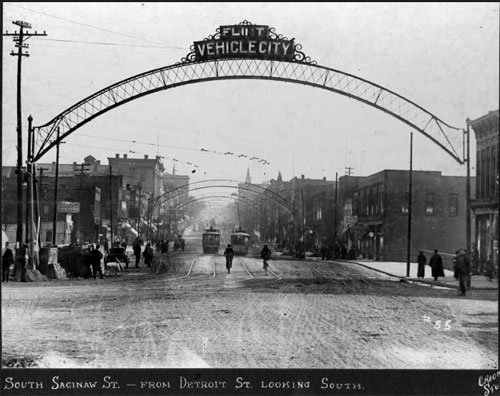
Flint Vehicle City Arch – The Making of Modern Michigan

Flint Vehicle City Arch

Flint Vehicle City Arch, photo by Arthur Crooks (Kettering University Library, Scharchburg Archive)

This photo of Saginaw Street (from Detroit Street looking south) shows the Vehicle City Arch that was erected in 1905 as part of the City’s 50th anniversary. It was taken in 1909 and is one of many photos from Michigan’s past in The Making of Modern Michigan, a collaborative project headed by the Michigan State University Libraries, in partnership with the Library of Michigan, the Michigan Library Consortium, and the 50+ libraries currently participating in the project. It includes local history materials from communities around the state – photographs, family papers, oral histories and genealogical materials on a wide range of subjects.

Many of the images (such as the one above) are part of collections. The Crooks collection includes lots more photos of Flint at the turn of the century like Buick: Made in Flint, The circus comes to town and a shot of the arches lit up at night. The Crooks collection reaches into the 1920s, and you have to check out Bootleg Raid in Flint.

As is often the case, I got curious about those arches. Fortunately, I didn’t have to go any further than Arches Restoration to Celebrate our Heritage (ARCH). Their history page explains:

The Flint arches were erected in 1899 to replace gas lanterns used to illuminate the business district at night. Built by Genesee Iron Works, five arches were placed at intersections along Saginaw Street. Each arch was built with 50 light bulbs to illuminate the City’s main street at night. Half were turned off at midnight. The arches supported decorations for every parade of importance held in the city and colorful lights replaced golden incandescence at holiday times. None of the original arches had the famous Flint Vehicle City crown at its apex.

When Flint celebrated its 50th anniversary in 1905 two additional arches were erected with the famous Flint Vehicle City graphic at the crown. These arches were placed at the south end of the city at the intersection of Fifth and Saginaw Streets and at the north end of the business district at the confluence of Saginaw and Detroit Streets (now M.L. King Boulevard).

Though many believe the arches celebrated Flint’s heritage as a center for automobile manufacturing, the original arches were a salute to Flint as the world’s largest volume manufacturer of horse drawn carriages.

They were successful in their campaign to restore the arches on Saginaw and you can see a photo by day and by night!

Photos of Arts & Culture in Michigan

Art Museum

Art Museum, photo by I am Jacques Strappe.

Over at the Ann Arbor Area Crappy Camera Club, Matt Callow posted an announcement from ArtServe Michigan. They are seeking:

…quality photographs that capture and document arts and culture in Michigan: the buildings where arts and culture takes place, artists at work in their studios or participating in festivals, community arts projects, arts and cultural activities indoors and out, arts educators in their classrooms, individuals of all ages engaged in arts and cultural activities, art festivals, audience moments, performance pieces, etc.

They hope to gather photographs from every county of the state to be included in a photo montage during the ceremony of the 2007 Governor’s Awards for Arts and Culture and for use in the event program. Photographs are due by September 14, 2007. Please click through for details on format and where to send the photos!

Marjorie says that this photo (which I think you should check out big) of the University of Michigan Museum of Art was taken during the Ann Arbor (likely in 2004) and that the kids of Ann Arbor are missing a slide as the sculpture has been dismantled. It was taken with a Holga, one of the many fine toy cameras, trash cams, cheap plastic point-and-shoots, pinholes, dollar store disposables, and junk store cameras wielded by the Crappy Camerians. Heck, they even discussed the merits of a Pop Tart Camera!

ArtServe MichiganArtServe Michigan is a statewide organization that builds support for the arts, artists, arts education, and cultural activities. They champion the arts across the state through advocacy and education programming and services to individual artists and cultural organizations and seek to support artists and arts organizations by increasing cultural audiences, linking businesses and the arts, and standing up for arts in education and state arts funding.

Michigan Capitol, Michigan Governor, Michigan Week

Blair and the Capitol

Blair and the Capitol, photo by Apocaplops.

On the statue of Austin Blair “War Governor of Michigan” at the Michigan Capitol in Lansing it says “He gave the best years of his life to Michigan and his fame is inseparably linked with the glorious achievements of her citizen soldiers.” (check it out in the super-biggie-sized view and Michigan Governor Austin Blair on Wikipedia)

It’s hard to ask that anyone give the best years of their life to anything as large as a state, but it might be good to take a few moments sometime during Michigan Week (May 19 – 25, 2007) to consider the massive challenges that people of our state have fought through in the past. From hundreds of thousands of lives given to preserve the Union to hundreds of thousands of hours labored to carve farms from forest, Michiganians have a history of standing tall and staring down and battling through adversity.

While saving our state from today’s troubles is beyond any one of us, there’s little doubt that each one of us has some measure of the solution with our grasp.

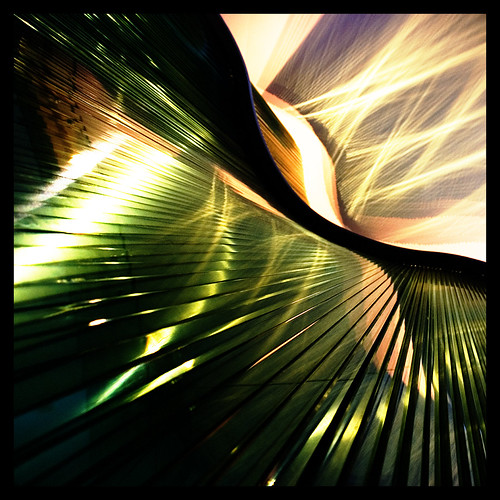
Danny Lane’s sculpture ‘Borealis’ at the Renaissance Center

Reflective Distortion

Reflective Distortion, photo by rckrawczykjr.

Ralph writes: Detail of a glass wall within the entrance space of the Renaissance Center with a happy little cross process filter applied for good measure.

The wall is part of the Danny Lane sculpture Borealis. As the Kinetic Curtain in Glass Magazine explains, Borealis is one of the largest glass sculptures in the world:

Borealis comprises two enormous walls of undulating glass that measure 47 and 50 feet long, and weigh nearly 50,000 pounds each. A single wall contains about 1,100 43-pound panels of annealed float glass (auto safety glass of course) 4 inches wide, 11⁄2 inches thick and 221⁄2 feet long. The panels stand on end side-by-side and lean at different angles up to 71⁄2 degrees from center to create a wave effect. If laid end-to-end, the panels would extend 9.4 miles.

The article is pretty interesting and details the engineering challenges in building this amazing work of art. You can also see more from Danny Lane at his web site.

A visit to Cranbrook House and Gardens

Untitled, photo by Rhonda_Marie.

Last weekend, the Exposure.Detroit group on Flickr held a photography meetup at Cranbrook. Here is a link to many more great photos taken at Cranbrook.

Cranbrook House and Gardens in Bloomfield Hills is the heart of the over 300-acre National Historic Landmark Cranbrook campus. The English Arts and Crafts-style Cranbrook House was designed by Detroit architect Albert Kahn in 1908 for Detroit News publisher George Gough Booth and Ellen Scripps Booth. The home is the oldest surviving manor in the metro Detroit area. According to the Cranbrook House and Gardens site:

The Booths commissioned the finest artisans, craftsmen and studios of the period to furnish the house with handcrafted furniture, tapestries, tiles, stained and leaded glass, and other works of fine and decorative art.

The 40 acres of gardens that surround Cranbrook House were originally designed by George Booth to entice visitors to savor the serenity of the spring and summer months. From the symmetry of the Sunken Garden to the scent of the herbaceous garden to the casual beauty of the bog garden, there is something to capture everyone’s interest. Sculpture, fountains and architectural fragments enhance the setting with spacious lawns, specimen trees, and a lake stretching out beyond the fieldstone walls.

Also see Cranbrook’s History in the Cranbrook Archives and How one man’s bad luck paved way for creation of Cranbrook from the Detroit News Rearview Mirror. Also see this map of the Cranbrook area with geotagged photos.