Worlds (3rd) Largest Cherry Pie

Worlds (3rd) Largest Cherry Pie

Worlds (3rd) Largest Cherry Pie, photo by Allen Gathman.

February is National Cherry Month and there’s nothing more cherry than the cherry pie. The folks at Roadside America (who keep track of stuff like this) have this to say about the titanic battle for the World’s Largest Cherry Pie:

Charlevoix was the first into the mix. In 1976 a man named Dave Phillips, in a burst of bicentennial fervor, convinced local businesses in Charlevoix to bake the World’s Largest Cherry Pie as part of the town’s annual cherry festival. A giant pan was built, along with an equally titanic oven. Local farmers supplied the ingredients. The result: a cherry pie weighing 17,420 pounds. It was a world record.

Further south, the town of Traverse City had its own cherry festival. It had perhaps heard one too many boasts from Charlevoix, and in 1987 it decided to do something about it…

The Chef Pierre Bakeries went to work, and on July 25 it baked a cherry pie that put Charlevoix to shame: 28,350 pounds; 17 feet, 6 inches in diameter. As an added snub, the town had Guinness Book of World’s Records certify its pie as the largest ever. Charlevoix’s days in the spotlight were ended after only 11 years.

But time has a way of humbling the proud. The Chef Pierre Bakeries were bought out by Sara Lee. The cherry farms around Traverse City were turned into golf courses. Yuppies from downstate began invading the town, as they were invading Charlevoix. And in 1992, after only five years, Traverse City’s cherry pie crown was knocked clear into Canada when the tiny town of Oliver, British Columbia, baked a cherry pie for the ages — 39,683 pounds.

For some reason Oliver failed to save its pan, so you can still see the largest cherry pie pan in Traverse City here and get a sense of the scale right here.

Check Allen’s photo out bigger.

The story of the Irish Hills Towers

Irish Hills Towers

Irish Hills Towers, photo by dt10111.

The Wikipedia entry for the Irish Hills Towers says that these wooden observation towers were constructed along US-12 in the Irish Hills region in northern Lenawee County as the result of a curious competition along the lines of the skyscraper frenzy in New York:

In the early 1920s, the Michigan Observation Company sought places of high elevation to erect fifty foot high enclosed platforms to boost tourism. In southern Michigan, a tower was placed atop Bundy Hill in Hillsdale County, Michigan and officials sought a knoll in the heart of the Irish Hills in Lenawee County. A farmer who owned half of the knoll, Edward Kelly, turned down the company’s offer to purchase his portion of the land. The adjoining land owner, Thomas Brighton, consented the sale of his plat, and construction of the Irish Hills Observatory commenced.

The opening of the Irish Hills Observatory was announced by The Brooklyn Exponent in September 1924. In a gala celebration on October 4 and October 5, hundreds of people ascended the hill and tower to gaze upon the rolling landscape and crystal blue lakes in all directions. Kelly seemed spited by the exploitation of the MOCs venture, and protested by erecting his own tower. By the end of November, 1924, his own observation platform was in place, just feet away from the MOCs structure, and several feet higher.

The Michigan Observation Company responded by adding a second observation enclosure to the top of its own facilities, now designated as the “Original Irish Hills Tower”. Kelly proceeded to add a raised platform to his “Gray” tower (named as such because of its gray-painted exterior), an act which brought the two edifices to an even height. The MOC informed Kelly that if he attempted to compete with more height given to his tower, they would tear down their own and construct a metal observatory so large that Kelly’s efforts would be nullified. He conceded, and turned his efforts instead to drawing more revenue to his creation.

In the 1950s Frank Lamping purchased both and added a gift shop. The towers closed in 2000.

Here’s a cool postcard from the 1930s of the view from Irish Hills Towers, a sweet photo from Matt Callow and a few photos showing different views of the towers. You can see the location on Waymarks.

See this bigger right here and in Daniel’s Buildings set (slideshow).

More Michigan roadside attractions from Michigan in Pictures!

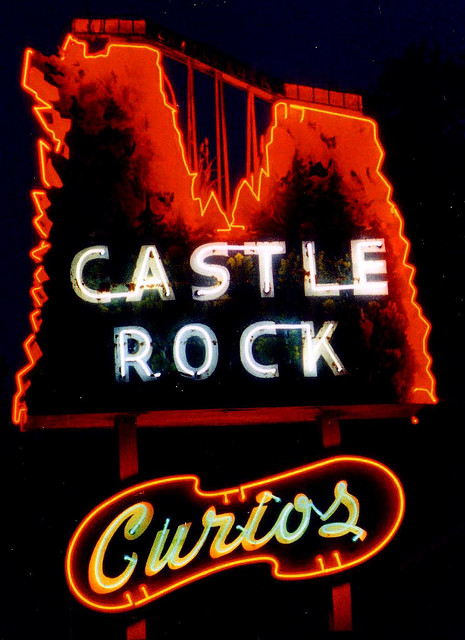
Castle Rock: Another (Michigan) Roadside Attraction

Castel Rock Curios

Castle Rock Curios, photos by Alan C of Marion,IN

This photo is just one of very many in Alan ‘s Roadside Finds set (slideshow) and you’ll also want to wander through his Michigan pics!

Michigan’s Roadside Tourist Attractions will be showcased in a special exhibit opening at the Michigan Historical Museum in Lansing on January 10, 2009.

Michigan’s Roadside Attractions, set to run through Sept. 14, 2009, features more than 50 roadside attractions that grew up as Michigan expanded its highway system from the 1930s through the 1970s. Many of these attractions still provide fun and excitement for millions of tourists each year.

“Deer parks and dinosaur gardens are just a couple travel experiences that take center stage again in this exhibit. Places like Castle Rock in St. Ignace, the Soo Locks Boat Tours and the multiple locations where Paul Bunyan has been spotted are also featured through photos, artifacts and souvenirs,” said Phillip C. Kwiatkowski, director of the Michigan Historical Museum System. ” Michigan’s Roadside Attractions is about treasured mementoes, from miniature Paul Bunyan statues and plastic purses to dinosaurs, seashells and even ceramic doll dish sets.”

Learn more about the exhibit from the Michigan Historical Museum.

I know you’re all wondering about Castle Rock – here’s what Roadside America has to say:

Castle Rock is an abrupt, geologic protuberance just north of the Mackinac Bridge on Michigan’s Upper Peninsula. The nearly 200-ft. column of rock was long ago augmented with a man-made ramp and walkway to provide tourists a climb for an unparalleled view of Lake Huron and distant Mackinac Island.

At the base of the Castle Rock lookout is an amusing Paul Bunyan statue accompanied by his mythical sidekick, Babe the Blue Ox. This Bunyan is rare. Instead of standing, ready to deforest Michigan, Paul sits, staring googly-eyed towards the lake. With a newspaper in his hands, we’d complete the visual that Paul is halfway through one of his mighty bowel movements.

OK, probably should have cut that one sentence earlier. Read more about Castle Rock from Hunt’s UP Guide (I learned that it only costs 50¢ to climb – definitely stopping next time!)

flame on

flame on

flame on, photo by jenny murray.

This is part of Jenny’s ttv (through the viewfinder) set (slideshow).

Hope your weekend is as exciting as this mailbox … I’m pretty sure that if you get a tattoo or paint your face like this, it will be!

quincy karma on US 12

quincy karma

quincy karma, photo by buckshot.jones.

This colorful capture is part of Scott’s A trip down historic US 12 set (slideshow). He writes:

I turned off the Interstate and took US 12 on my way back to Dearborn. Lots of small towns and rural scenes.

You can follow US 12 all the way to the Pacific ocean. In Detroit and Chicago, US 12 is known as Michigan Avenue. From the Water Tower to old Tiger Stadium, this route has lots of history.

en.wikipedia.org/wiki/US_12 (and also see the US 12 in Michigan entry!)

Here’s Quincy, Michigan and US-12 on the Absolute Michigan Map of Michigan.

Nothing more I can say except “Thanks Scott for posting these in big, beautiful, background-sized glory!”

…and have a great weekend everyone!

…I’m Just The Messenger – Coleman, Michigan

...I'm Just The Messenger - Coleman, Michigan

…I’m Just The Messenger – Coleman, Michigan, photo by jfactor1.

Just wondering what goes through someone’s mind just before they shoot a sign.

Any thoughts?

Another (Michigan) Roadside Attraction

Paul Bunyan

Paul Bunyan, photo by I am Jacques Strappe.

The Michigan Historical Museum is planning an exhibit called Michigan’s Roadside Attractions, set to run from January to June of 2009. They are looking for stories, pictures and artifacts of the unique places – open or long shuttered – that folks visit on the way from someplace to someplace else. Michigan Historical Museum System Director Phillip C. Kwiatkowski says:

We want to hear what made you stop at these roadside attractions – places like the Mystery Spot in St. Ignace, Deer Forest in Coloma, Windmill Island in Holland and the multiple locations where Paul Bunyan has been spotted – and to see the photos you took and the souvenirs that you kept. Our biggest need is your treasured mementoes, from miniature Paul Bunyan statues and plastic purses to dinosaurs, seashells and even ceramic doll dish sets.

If you can help, please contact Eve Weipert, curator of collections, at (517) 373-1509 or weiperte@michigan.gov. Most artifacts used in the exhibit will be considered on loan and will be returned after the exhibit ends. The museum has an established review process that is utilized prior to acceptance of loans or permanent donations. Artifacts are needed by April 1, 2008 to allow time to complete the exhibit storyline around the available artifacts.

This photo by Marjorie is part of her Roadside Curiosities set (slideshow) and it’s available “Bunyan-sized” for your desktop wallpaper.

If you’re interested in Michigan’s roadside attractions, here’s some “roadside” photos from the Absolute Michigan pool, Michigan Tourist Traps from WaterWinterWonderland.com, the “roadside” tag on Michigan in Pictures, this Absolute Michigan “Weird Wednesday” featuring Domke’s Dinosaur Gardens and of course, Michigan’s legendary Big Boy Graveyard.

If you have links or memories to share, post them in the comments!

Tree – Salem Township, Michigan

PICT1982

PICT1982, photo by bryan_axe.

Michigan has a Salem Township in Washtenaw county and another in Allegan County. Based on Bryan’s other photos I’m guessing Washtenaw.

Happy weekend, people!

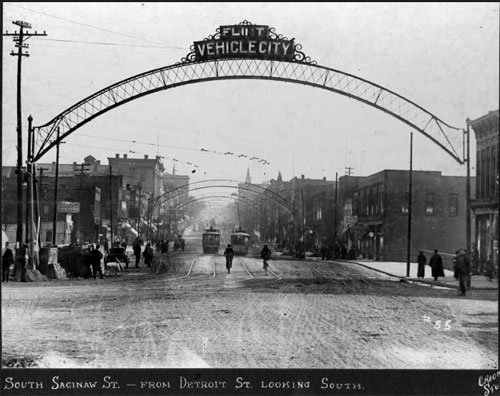
Flint Vehicle City Arch – The Making of Modern Michigan

Flint Vehicle City Arch

Flint Vehicle City Arch, photo by Arthur Crooks (Kettering University Library, Scharchburg Archive)

This photo of Saginaw Street (from Detroit Street looking south) shows the Vehicle City Arch that was erected in 1905 as part of the City’s 50th anniversary. It was taken in 1909 and is one of many photos from Michigan’s past in The Making of Modern Michigan, a collaborative project headed by the Michigan State University Libraries, in partnership with the Library of Michigan, the Michigan Library Consortium, and the 50+ libraries currently participating in the project. It includes local history materials from communities around the state – photographs, family papers, oral histories and genealogical materials on a wide range of subjects.

Many of the images (such as the one above) are part of collections. The Crooks collection includes lots more photos of Flint at the turn of the century like Buick: Made in Flint, The circus comes to town and a shot of the arches lit up at night. The Crooks collection reaches into the 1920s, and you have to check out Bootleg Raid in Flint.

As is often the case, I got curious about those arches. Fortunately, I didn’t have to go any further than Arches Restoration to Celebrate our Heritage (ARCH). Their history page explains:

The Flint arches were erected in 1899 to replace gas lanterns used to illuminate the business district at night. Built by Genesee Iron Works, five arches were placed at intersections along Saginaw Street. Each arch was built with 50 light bulbs to illuminate the City’s main street at night. Half were turned off at midnight. The arches supported decorations for every parade of importance held in the city and colorful lights replaced golden incandescence at holiday times. None of the original arches had the famous Flint Vehicle City crown at its apex.

When Flint celebrated its 50th anniversary in 1905 two additional arches were erected with the famous Flint Vehicle City graphic at the crown. These arches were placed at the south end of the city at the intersection of Fifth and Saginaw Streets and at the north end of the business district at the confluence of Saginaw and Detroit Streets (now M.L. King Boulevard).

Though many believe the arches celebrated Flint’s heritage as a center for automobile manufacturing, the original arches were a salute to Flint as the world’s largest volume manufacturer of horse drawn carriages.

They were successful in their campaign to restore the arches on Saginaw and you can see a photo by day and by night!

Lost on vacation

Lost by Terrapin Dawg

Lost, photo by Terrapin Dawg

One of the great things about being on vacation is getting lost. Not the kind of lost where everyone’s hot and cranky, but rather the kind of lost where you see things you never expected and aren’t even sure you could find your way back.

This photo from Cheboygan County, Michigan is part of a great set of photos of Northern Michigan, which Matt says is his favorite place in the world. (slideshow).