A Challenge for Michigan

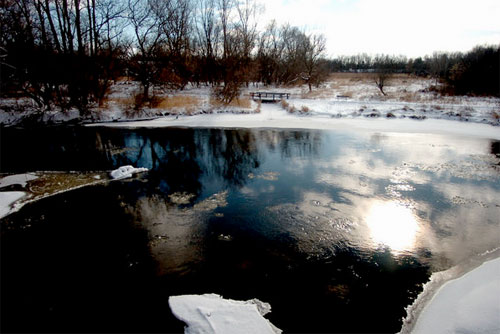
Dead River Fog

Dead River Fog, photo by bgreenlee.

Brad took this photo at Dead River Basin, north of his hometown of Ishpeming, Michigan.

I saw this photo several days ago and was struck by its richness. For me – maybe for anyone who has ever stood next to a glass calm and still Michigan lake on a late summer morning – this picture holds an armload of images. The way the shore floats in and out of focus in the slowly moving mist … the haunting call of a loon … the splash of fat trout. All of this and so much more.

Further to the north – too far to walk in a day but not all that far – are the Yellow Dog Plains, one of the fronts in a battle that if lost, would change this image of Michigan forever.

The Yellow Dog is not the only front though. Consider White River, where Michigan’s water is poured out to the rest of the world, never to return. Or all the inland lakes where exotic zebra mussels have poured in, sterilizing them of other life. And countless other places and ways that our rivers, lakes, streams, ponds, wells and wetlands face the pressure that comes where a resource is not valued.

This is probably the point where right around 50% of brains will want to shut off and wander off, thinking “Here comes another environmentalist rant.” While I am a huge fan of the environment (which I like to think of as my life support system) this isn’t about politics.

This is about money.

Tourism is Michigan’s second largest industry. Unlike extractive industries like acid mining or water bottling that send most of the revenue away from Michigan, tourism sends income rushing through our local economies, generating business profits (and tax revenues) along with many jobs in hotels, motels, B&Bs and cabins, restaurants, shops, outfitters, galleries, musicians and countless other industries. Economists talk about “the multiplier effect”, describing how one dollar pays for a room for the night, then morning coffee, afternoon canoe rental, evening dinner and fifty more things before it moves along.

That dollar has a future from the moment it is laid on the counter. The other dollar doesn’t.

This is not only about money though.

I have chosen to make my lifelong home in Michigan for the same very simple reason that I made this web site: I am hopelessly in love with the beauty of Michigan. From the towering face of the Pictured Rocks to the corn stalk stubbles in the next field, I am head over heels for Sweet Mama Michigan and I cannot bear to see her carved up and sold off.

Even in our hour of need, I hope we can all agree that it is precisely this beauty, this richness of water and wild that is among Michigan’s greatest treasures.

It’s in that hope (and also for pay) that I worked with others to make a challenge to all of you: Make a short video that tells why we should protect Michigan’s water.

We call it the Save the Wild UP Video Challenge and I invite you to learn more about it.

PS: Apologies to Brad for tacking all on this on to what could have been a simple post of a great photo.

PPS: Those of you who are Flickrites might want to check out the Save the Wild UP Challenge group.

PPPS: Apologies also for any over-preachyness. I promise to try and keep it to a minimum.

World Water Day in the world’s water headquarters

Michigan and the Great Lakes from Space

Provided by the SeaWiFS Project, NASA/Goddard Space Flight Center, and ORBIMAGE (via Wikimedia)

I am not even going to tell you how long I agonized over the perfect photo with which to mark World Water Day. Water is one of the things that defines Michigan above all others. Industries may come and go, but (assuming we can take care of it) Michigan’s water is forever.

Here’s hoping…

stacking the river raisin

stacking the river raisin

stacking the river raisin, photo by postpurchase.

The photographer says this is an experiment stacking multiple frames of short exposure taken in daylight in order to emulate a longer exposure without the use of filters. (from Manchester, MI)

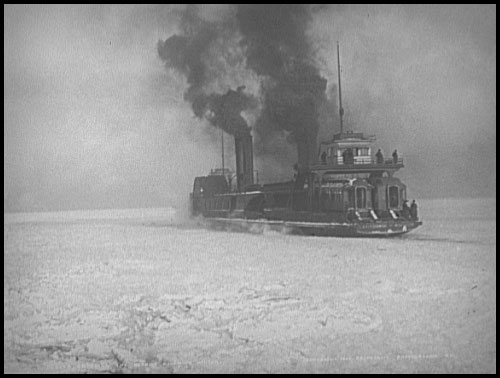
Lansdowne of Windsor, a Detroit River ferry boat

Steamer Lansdowne of Windsor

Crossing the Detroit River in winter c. 1904, LC-D4-22154

Under the headline of “Things I found when looking for something else” comes this photo from the massive Detroit Publishing Co. collection in the Library of Congress.

The ferry is identified as the steamer Lansdowne of Windsor, a vessel mentioned briefly in The Detroit River ferryboats in the Detroit News’ Rearview Mirror:

The old paddle-wheeled steamer, the Lansdowne, which by its retirement in 1956 was one of the oldest vessels still operating on the lakes, once carried passenger train cars across the Detroit River. It was resurrected briefly during the 1980s as a floating restaurant off downtown Detroit.

If you click the “More Photos” button at the top left of the article, you can see another (clearer) shot of the Lansdowne. The March 1970 edition of the Toronto Marine Historical Society’s Scanner  had this to say:

For well over one hundred years there have been carferries operating across the Detroit River between Windsor and Detroit, and a large portion of this period, 87 years in fact, could well be called “The Lansdowne Era.” For exactly this long, a major item on the Detroit River scene has been the paddle-driven railway ferry, LANSDOWNE.

This veteran, 294 feet in length, was completed in 1884 by the Detroit Dry Dock Co. at Wyandotte, where her iron hull was known as Hull 66. Her horizontal, low-pressure engines were built in 1872 by E.E. Gilbert & Sons at Montreal for the wooden carferry MICHIGAN (I) and they were placed in LANSDOWNE at the time of her completion. Originally equipped with four stacks and two pilothouses, the ferry now carries but two stacks and one bridge and looks somewhat gaudy in the Canadian National Railway’s new livery. Nevertheless, she is the last sidewheeler operating on the Great Lakes and holds a great charm known to anyone who has observed her or made a crossing in her.

Recent photos of the “somewhat gaudy” Lansdowne can be found at the amazing Boatnerd.com.

Saginaw Train Bridge

Saginaw Train Bridge

Saginaw Train Bridge, photo by n8xd.

Keith DeLong writes: This is a train bridge near St. Mary’s Hospital in Saginaw, Michigan.

I recommend you check this one out bigger.

The Salmon Trout River on the Yellow Dog Plains

The Salmon Trout River on the Yellow Dog Plains

The Salmon Trout River on the Yellow Dog Plains, photo by savethewildup.

Somewhere there are lines, and I’m pretty sure that today I will cross a few. Over the life of this blog, I have stayed away from things that have sides, because sides too often divide us and this blog is really all about loving Michigan.

In my day job, I build web sites. A short while ago, I and some really talented people put together a new site for some people that have spent the last few years at a hard and lonely task: speaking up and standing up for Michigan’s rivers and lakes against the terrible risks posed by metallic sulfide mining and acid mine drainage.

They have been focused on the Salmon Trout River on the Yellow Dog Plains, but that is just the first of many that will follow. To be very clear: There has never been a metallic sulfide mine that has failed to pollute its watershed. You can read more from Save the Wild UP … and scroll down for a special treat featuring tons more photos and music from Greg Brown’s upcoming CD, Yellow Dog.

More photos of the beauty of the Yellow Dog Plains and Salmon Trout River can be seen at Save the Wild UP’s web site.

If you are a photographer who loves Michigan’s water and wild, please consider making them available to be used in fighting metallic sulfide mining and other threats to Michigan’s legacy of unspoiled water and add them to the Save the Wild UP photo pool.

Greg Brown, Yellow Dog slide show (or new window)

Au Sable River in Winter

Au Sable #040

Au Sable #040, photo by joelmaust.

One of several photos of one of Michigan’s premier trout rivers in winter.

Learn a little more on the Au Sable River from Wikipedia.

NOTE: Minor technical difficulties have delayed Bobby Alcott’s photographer profile – check back tomorrow!

skyed

skyed

skyed, photo by UrbanTiki.

After a too-long hiatus, we will finally be profiling another Michigan photographer: Bobby Alcott aka “UrbanTiki”, a Detroit photographer. We’ll be asking Bobby some questions next week (Monday through Wednesday) and we’d also like to ask you to give us some questions. Just post a comment below or e-mail your question to us.

You can see more work by Bobby at his Flickr page and also at Bobby Alcott Photography. Check out our past profiles of Matt Callow and Marjorie O’Brien on the Michigan Photographers profile page.

UPDATE: Too-long sadly became just a little bit longer as Bobby and others have had the unfortunate loss of a friend. We’ll be doing Bobby’s profile next Monday – Wednesday (Feb 26-28) and our condolences go out to all the friends and family of  Jeffrey Colby.

Back in time on the Fallasburg Bridge

Vintage bridge

Vintage bridge, photo by pnygirl1.

BJ writes Playing around with some techniques – liked how this effect captured the old wooden bridge…like it was captured back in time. She has more views of this and other bridges (and a ton more photos).

The Michigan Historical Markers page on the Fallasburg Bridge (includes map) has the text of the marker:

John W. and Silas S. Fallas settled here in 1837, founded a village which soon boasted a chair factory, sawmill, and gristmill. About 1840 the first of several wooden bridges was placed across the Flat River, but all succumbed in a short time to high water and massive spring ice jams. Bridge builder Jared N. Bresee of Ada was given a contract in 1871 to build the present structure. Constructed at a cost of $1500, the bridge has lattice work trusses made of white pine timbers. As in all covered bridges, the roof and siding serve to protect the bridge timbers from rot. Repairs in 1905 and 1945 have kept the bridge safe for traffic for one hundred years.

You can learn a bunch more about the bridge from Michael Frazier’s Covered Bridges of Michigan, get a surprising amount of information and links from Wikipedia’s entry on the Fallasburg Bridge and get details on Fallasburg Park from Kent County Parks.

The Chippewa River in winter

Chippewa River by Lisa Yanick

Chippewa River, photo by Lisa Yanick

If you click the photo above, blogger Eric Baerran of Among the Trees will take you down to the Chippewa River in Mt. Pleasant with a cool fusion of photographer Lisa Yanick’s great photos of the river with spoken words, sounds from the river and Bob Busch’s music.

Be sure to click the link for “the cleaner version” and also check out Eric’s two part feature on canoeing the river a couple years ago (part 1 and part 2).