Super Moon over Detroit

Supermoon from Belle Isle
Supermoon from Belle Isle, photo by Alanna St. Laurent Photography

On Saturday night the Super Moon took to the skies. While it didn’t appear to be the biggest moon I’ve ever seen, it was definitely very impressive. You can still check it out pretty big tonight if it’s out.

Check this out bigger and see a couple more in Alanna’s Detroit Slideshow.

There are a bunch more shots of the Super Moon over some familiar Michigan scenery in the Absolute Michigan pool on Flickr – add your own if you have them and settle back for the Super Moon slideshow!

More about the Super Moon on Michigan in Pictures and check out the Super Moon slideshow from the Absolute Michigan pool!

The Trestle Bridge at Hamilton

The Trestle Bridge at Hamilton

The Trestle Bridge at Hamilton, photo by bill.d.

Hope you enjoyed your morning commute…

Check this out big as a bridge and in Bill’s Allegan County slideshow.

Miles more bridges on Michigan in Pictures.

U.S. Coast Guard Icebreakers and the Great Lakes

International Partners

International Partners, photo by KathysPix.

Icebreakers and the U.S. Coast Guard is a great article from the Coast Guard Historian’s Office says that the origin of icebreaking in the United States came in the 1830s as side-wheel steamers with reinforced bows were found to be excellent for clearing harbor ice. This page tells the story of CG icebreaking around the country, and the Great Lakes were certainly a part of that. The Escanaba class light icebreakers in the early 20th century didn’t get the job done, but World War II made icebreaking an essential technology and led to the development of the Wind class vessels. In addition to to these four ships, a fifth was built in 1944, the icebreaker Mackinaw:

The final heavy icebreaker built during the war was the Mackinaw, a ship specifically for Great Lakes use. She was, according to Admiral Thiele, a “squashed down” Wind class vessel, with greater beam and length, but shallower draft than those vessels. Her powerplant and general design were those of the Wind class, but her hull was of mild steel, for fresh water operations. (The ocean going cutters were of high tensile steel.) This vessel was designed to extend the operating season in Great Lakes ports, a strategically important task considering the essential raw materials originating on the Lakes: iron ore, coal, limestone, etc.

In 2006, the Mackinaw was decommissioned and replaced by the new USCG Mackinaw, which we see in the picture above.

You can see more of what was involved in freeing a stuck freighter in Kathy’s Coast Guard Cutters slideshow.

Follow the flowing water to Spring?

Flowing Water

Flowing Water, photo by corinne.schwarz.

Things have really heated up in Michigan this week, and as Ashley says: Peace out snowpocalypse. It’s been real..

Michigan’s own Weather Underground looks like April: 48° in Battle Creek, 49° in Grand Rapids, 38° in Marquette, 46° in Traverse City, 47° in Detroit!

Check this out bigger and in Corinne’s Lenawee County slideshow.

Greater Buffalo or “When I grow up I want to be an aircraft carrier”

Greater Buffalo

Greater Buffalo, photo by joeldinda.

Joel’s Borucki’s Lakers set features photos some great old photos along with history of the vessels. He uploaded one the other day of the steamer Greater Buffalo heading toward Lake Erie on the Detroit River that was taken in August 4, 1939. On another photo of the Greater Buffalo he writes that this photo is easily the most interesting ship in the Borucki picture collection and says:

Greater Buffalo, shown here passing under the Ambassador Bridge, was launched at Lorain on October 27, 1923, for the Detroit and Cleveland Navigation Company, and made her first trip on May 13, 1925. She could carry 300 crew members and 1,200 passengers between Buffalo and Detroit on an overnight basis. Her sister ship Greater Detroit alternated on the run with her. These two Frank Kirby-designed ships were the last, largest, and (perhaps) fastest sidewheel passenger ships built on the lakes; when they were launched their construction costs were reported as $3.5 million apiece.

Greater Buffalo was requisitioned by the Navy in 1942, converted to an aircraft carrier and renamed USS Sable; she and USS Wolverine (the former Seeandbee–another Kirby design, and the other “fastest” claimant) worked as training ships out of Great Lakes Naval Station near Chicago. She was retired after the war and broken up in 1948.

There’s a couple more photos of the Greater Buffalo/U.S.S. Sable in the UD Mercy Marine Historical Collection.

Check it out big as a battleship and in Joel’s Borucki’s Lakers slideshow.

Gabbro Falls

Gabbro Falls

Gabbro Falls, photo by siskokid.

The Go Waterfalling page on Gabbro Falls (located in the western UP near Blackjack Mountain) begins:

Gabbro Falls is on the Black River and is as impressive, if not more impressive, than its more celebrated neighbors downstream along the Black River Scenic Byway. This is a largely wild waterfall with no fences or barriers of any kind. It consists of three separate drops. When the water is high there is a fourth drop that is the height of the other three combined. The main drop falls into a narrow crevice between two large rock formations.

Gabbro Falls is relatively easy to find but there is some confusing information out there. The waterfall is also known as Baker’s Falls, and it is often mistakenly called Garbo Falls (gabbro is a type of rock). There is also a Neepikon Falls upstream, but it is just an unremarkable rapid. (read on for detailed directions)

Jim says that he grew up in this area, but only found out this waterfall existed last week! Check it out background big and in his Da UP slideshow.

Many more Michigan waterfalls on Michigan in Pictures!

Tri-Centennial State Park Lighthouse, Detroit Michigan: Velvia Version

Tri-Centennial State Park Lighthouse, Detroit Michigan: Velvia Version

Tri-Centennial State Park Lighthouse, Detroit Michigan: Velvia Version, photo by friday1970.

Tri-Centennial State Park is now known as the William G. Milliken State Park and Harbor. It was the first urban park in Michigan, and covers 31 acres on the banks of the Detroit River.

This 63-foot lighthouse is a scaled down replica of the Tawas Point Lighthouse, the only true Victorian-era style station on the Great Lakes.

Be sure to check this out background boomtacular and in his slideshow.

Many more Michigan lighthouses on Michigan in Pictures!

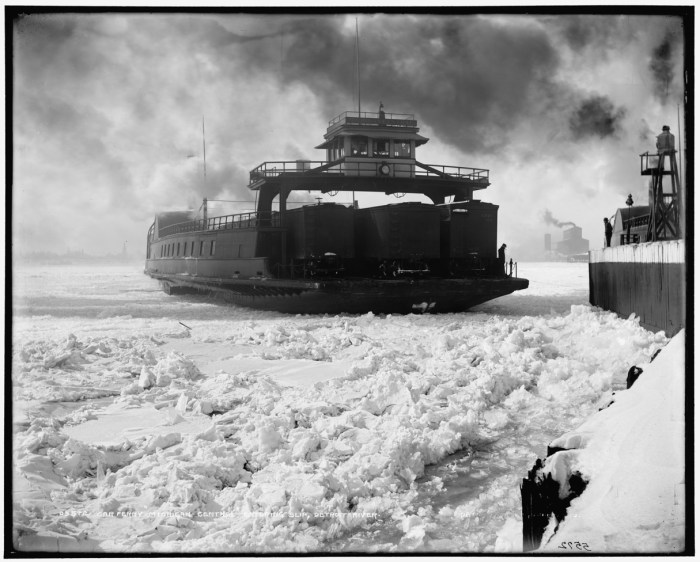
Rail Car Ferry Michigan Central on the Detroit River

Car ferry, Michigan Central, entering slip, Detroit River, photo by Detroit Publishing Co.

It’s kind of cruel to post a photo like this while it’s still November. I think we all know what’s coming though…

I spent some time learning about this photo I found in the Library of Congress aka maybe the coolest place on the internet. (You probably paid 3 cents for it last year, so check it out sometime). I finally found the same photo on the fantastic photo blog Shorpy. One of the commentors writes:

This is the Detroit side. The river flows extremely fast, and the ferry docks were set up so the boats always entered dock facing upstream. Michigan Central was built in 1884 by Detroit Dry Dock in Wyandotte, while Transport was built there in 1880. Both were cut down to barges by the 1930’s. A nearly identical boat, Lansdowne of 1884, survived in steam until 1970 for CN/Grand Trunk, until she blew a cylinder head (I remember the shock among the Detroit trainwatching community at the time).

You can see the Lansdowne of Windsor on Michigan in Pictures and check the comments at Shorpy for more including a shot of this location from the Ambassador Bridge in 1957.

See the photo background bigtacular at Shorpy.

Michigan’s Tallest: The Renaissance Center in Detroit

renaissance center detroit

renaissance center detroit, photo by Detroitmi97.

The list of the tallest buildings in Michigan says that the title of tallest building in Michigan belongs to the Renaissance Center at 77 stories and 722 feet tall. It also has the distinction of being the tallest all-hotel skyscraper in the Western Hemisphere.

The RenCen is owned by General Motors and Wikipedia says that the Ren Cen was conceived as a catalyst for Detroit’s economy by Henery Ford II and investors, and that it generated in excess of $1 billion in economic growth for downtown Detroit in its first year of operation.

John Portman was the principal architect for the original design. The first phase constructed a five tower rosette rising from a common base. Four 39-story office towers surround the 73-story hotel rising from a square-shaped podium which includes a shopping center, restaurants, brokerage firms, banks, a four-screen movie theatre, private clubs.The first phase officially opened in March 1977. Portman’s design renewed attention to city architecture, constructing the world’s tallest hotel at the time. Two additional 21-story office towers (known as Tower 500 and Tower 600) opened in 1981. This type of complex has been termed a city within a city.

…The architects’ initial design for the Renaissance Center focused on creating secure interior spaces, while its design later expanded and improved to connect with the exterior spaces and waterfront through a reconfigured interior, open glass entryways, and a Wintergarden.

While it might be a little over-photographed, it’s an amazing space for photographers to explore, inside and out.

Mark says he can see the whole world from here – can you? Check it out background boomtacular and see some other shots from high up in the RenCen in his detroit top slideshow.

More Renaissance Center and don’t miss the RenCen slideshow from the Absolute Michigan pool!

More of Michigan’s tallest on Michigan in Pictures.

Rock River Falls in the Rock River Canyon Wilderness Area

Rock River Falls

Rock River Falls, photo by gkretovic.

Regular readers of Michigan in Pictures know that  Go Waterfalling is the source for Michigan waterfall information. Their Rock River Falls entry says:

This wild waterfall is hidden in the Rock River Wilderness Area north of Chatham. Reaching it will require you to drive down some old logging roads and hike a mile or two along some ill defined trails, but if you are looking for a good waterfall adventure it is worth it.

Rock River Falls is in the Rock River Wilderness Area in the Hiawatha National Forest, which is just north of Chatham. This area is not well marked, but finding the falls is not too hard.

There’s detailed directions at the link above there and Greg also has this photo on his map. See it bigger along with a few other views in his slideshow

Many more Michigan waterfalls on Michigan in Pictures!