Quiet Night at Frankfort Lighthouse

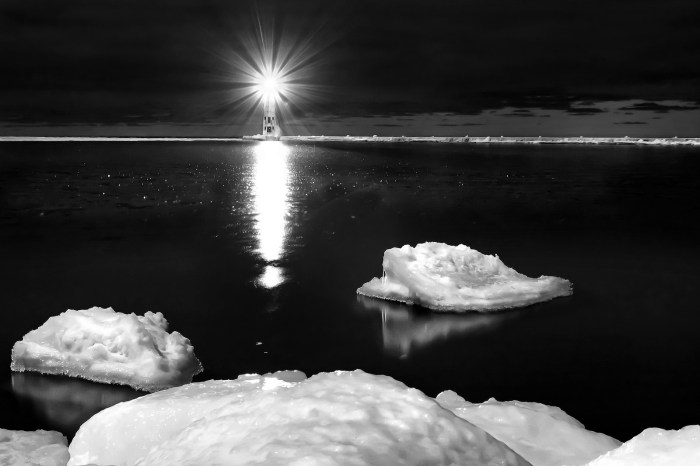
Frankfort Lighthouse at Night

Quiet Night at Frankfort Lighthouse, photo by Snap Happy Gal Photography

I was going to talk this morning about how I will continue to talk about what I want to talk about on Michigan in Pictures, but then I saw this awesome photo by Heather. I’m sure you get the idea.

On her Snap Happy Gal blog where you can view & purchase some great lighthouse photos, Heather writes:

I think of myself as a serendipitous shooter: I go out to scenes in all kinds of light – the good, the bad, even the ugly – and I take photos. Sometimes I walk away with artwork worth sharing, and sometimes I just walk away with happy memories. I don’t often stalk a scene for the best light, I don’t think of myself as having a favorite thing to photograph, and I don’t find that I’m predictable (even I don’t know when or where I’ll be heading out to shoot until I get the itch). But, lately, if you wanted to catch me out and about, you’d look at northern Michigan’s west coast lighthouses.

I’ve visited every one of them from Manistee up to Northport (though I didn’t take the camera out), and I’ve been there from sunrise to sunset, and well into the night.

Last Wednesday, I checked the weather and saw something I hadn’t seen in what felt like eons: the possibility for clear night skies. I packed my gear, my cold weather clothes, and food and water, and headed for the coast. I missed the best light in an incredible sunset, but caught the afterglow and the first light of the moon on the lakeshore just south of Empire. While the skies were still cloudy, I headed south into Frankfort to see how the ice was shaping up along the beach. By this time, the winds had died down almost entirely. The water inside the breakwall was very still, the forming ice chattered, and tiny waves sloshed against the icebergs beached on the sand.

Read on for the rest, view & comment on her picture on Facebook, and definitely follow Snap Happy Gal for great pics of lighthouses and much more.

More about the Frankfort North Breakwater Light on Michigan in Pictures.

Why is Ice Blue or Green?

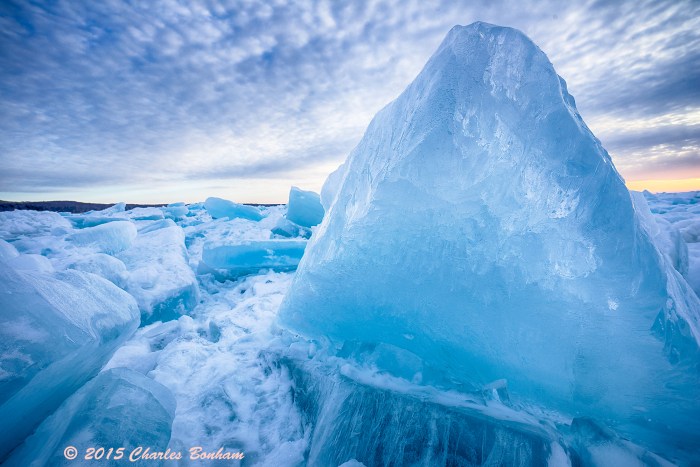
The Blue Ice

The Blue Ice, photo by Charles Bonham

The Causes of Color answers the question: What causes the blue color that sometimes appears in snow and ice?

As with water, this color is caused by the absorption of both red and yellow light (leaving light at the blue end of the visible light spectrum). The absorption spectrum of ice is similar to that of water, except that hydrogen bonding causes all peaks to shift to lower energy – making the color greener. This effect is augmented by scattering within snow, which causes the light to travel an indirect path, providing more opportunity for absorption. From the surface, snow and ice present a uniformly white face. This is because almost all of the visible light striking the snow or ice surface is reflected back, without any preference for a single color within the visible spectrum.

The situation is different for light that is not reflected, but penetrates or is transmitted into the snow. As this light travels into the snow or ice, the ice grains scatter a large amount of light. If the light is to travel over any distance it must survive many such scattering events. In other words, it must keep scattering and not be absorbed. We usually see the light coming back from the near surface layers (less than 1 cm) after it has been scattered or bounced off other snow grains only a few times, and it still appears white.

In simplest of terms, think of the ice or snow layer as a filter. If it is only a centimeter thick, all the light makes it through; if it is a meter thick, mostly blue light makes it through. This is similar to the way coffee often appears light when poured, but much darker when it is in a cup.

Click through for lots more about light & color!

Charles took this photo last March off Gills Pier on the Leelanau Peninsula when there was a whole lot more ice than there is this winter. View it background bigilicious and see more in his Leelanau Peninsula slideshow.

More winter wallpaper and more amazing ice on Michigan in Pictures.

Morning Light at the Manistee Pierhead Light

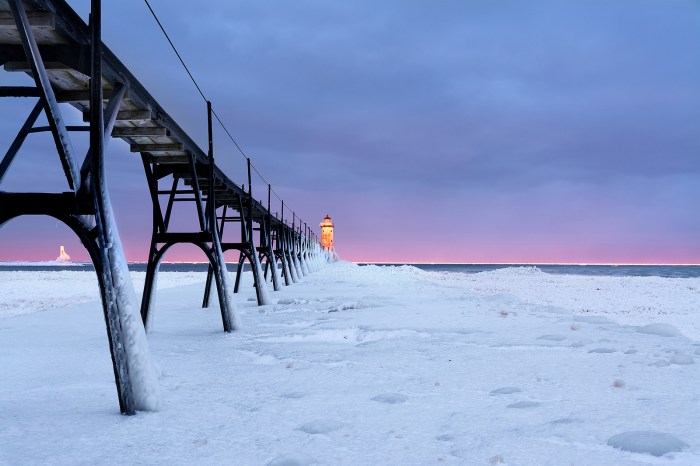
Manistee Lighthouse

Manistee Morning Light, photo by Heather Higham

Terry Pepper’s Seeing the Light has an extensive entry on the history of the Manistee Pierhead Light with copious information and historical photos. Terry goes deep on Manistee’s history as a lumber port:

Although the first sawmill had been established on the banks of the Manistee in 1841, settlement in the area was not widespread until the Chippewa relinquished their reservation by treaty in 1849, and the federal government offered lands along the Manistee for public sale. It did not take lumber interests long to realize the incredible potential of the Manistee which snaked a hundred miles into the forests, and lumbermen soon began lobbying for federal funding to improve the harbor and to erect a lighthouse at the river mouth. With no appropriation forthcoming, the businessmen of Manistee took the matter into their own hands, erecting a pair of short stub piers at the river mouth in an attempt to stem the deposition of sand and silt.

In 1861, Congress instructed the Army Corps of Engineers to dispatch an Engineer Officer to Manistee to conduct a survey of the river entrance. Water depth in the opening between the piers was found to be from seven to eight feet, and a 250-foot long sand bar with a water depth of less than five feet above it was identified 600 feet off the end of the piers.

…To serve this burgeoning maritime commerce, the piers were extended an additional 150 feet in 1875, and the channel between them dredged to a minimum depth of ten feet. With the main light now standing a considerable distance to the rear of the pierheads, the decision was made to replace the shore light on the north bank with a pierhead beacon on the outer end of the longer south pier. Click to view enlarged image The new south pierhead light consisted of a timber-framed pyramidal beacon typical of the type being erected on pierheads throughout the Great Lakes. With its lower half open, the upper half immediately below the gallery was enclosed to provide a small service room for lamp maintenance. Equipped with windows, the service room also served as a sheltered area in which the keeper could stand watch during inclement weather. Standing 27 feet in height, the beacon was capped with a square gallery with iron handrails and an octagonal cast iron lantern installed at its center.

Read on for a whole lot more.

About the photo, Heather writes:

I still can’t believe I managed to drag myself out of bed this morning. There were 8 minutes of pink light – and a stunning sunrise to the east that I completely ignored – followed by about 90 minutes of interesting (if not sunrise) light.

View it bigger, see more in her Lighthouses slideshow and definitely add Snap Happy Gal Photography to your Facebook follows!

More Michigan Lighthouses and more sweet sunrises on Michigan in Pictures.

Help Keep Michigan in Pictures Rockin’

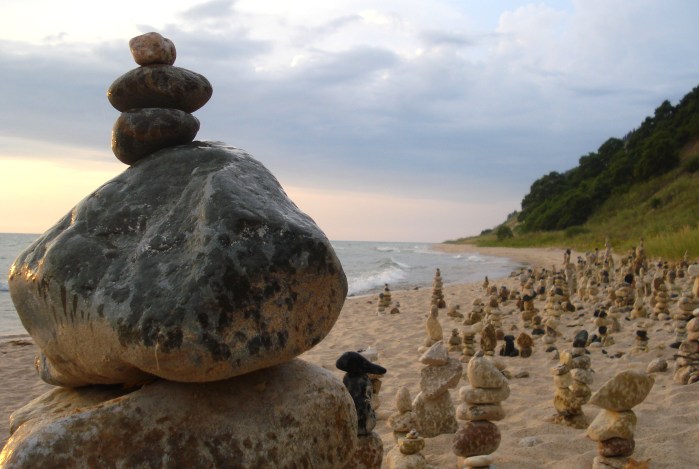
Frankfort Rock Gallery 2008

Rain Comes (Frankfort Rock Gallery), photo by Andrew McFarlane

As you may know, 2016 is my 11th year of making Michigan in Pictures. I really love doing it and am certainly going to keep it up as long as I am able. It does take a bunch of my time that might otherwise be spent working or getting out to see some of Michigan’s beauty, so I’ve been looking for a way to subsidize it that doesn’t involve ads, paywalls, or other annoyances.

Yesterday, I was reading a blog and saw they had a button to support them using a web service called Patreon. I checked it out, and it basically allows readers to become patrons of blogs they enjoy. Seemed like a great idea to me so I have set it up. If you’d like to donate a buck or more a month, I would very much appreciate it! Click here for my Patreon donations.

OK, on to today’s photo. Back in August of 2007, I was out walking with my friend Ken Lake on Frankfort beach. About a mile north of town we rounded a point and came upon a wondrous site – hundreds of balanced rock sculptures comprised of thousands of rocks. It remains one of the coolest works of art I’ve ever seen, and also a total mystery. I’ve still never heard who built these or why.

You can view this photo background bigtacular and see more in my Rock Gallery slideshow.

PS: Here’s a video I shot of these scene. The audio on this is kind of loud and crappy – sorry. ;)

Michigan Wild & Scenic Rivers: Over the (Pine) River

HDRtist Pro Rendering - http://www.ohanaware.com/hdrtistpro/

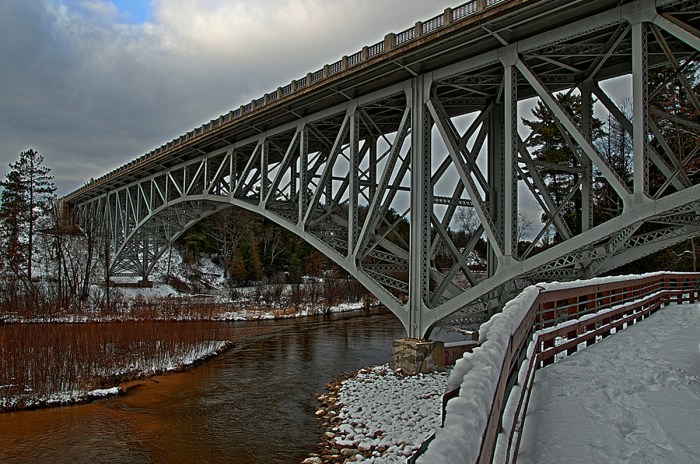
Pine River Bridge Wellston, Michigan, photo by John Mickevich

It is hereby declared to be the policy of the United States that certain selected rivers of the Nation which, with their immediate environments, possess outstandingly remarkable scenic, recreational, geologic, fish and wildlife, historic, cultural or other similar values, shall be preserved in free-flowing condition, and that they and their immediate environments shall be protected for the benefit and enjoyment of present and future generations.
~Wild & Scenic Rivers Act, October 2, 1968

Michigan has 16 nationally designated Wild & Scenic Rivers, and one of these is the Pine River. The Pine River Management Plan says (in part):

Visitors to the Pine River Corridor continue to enjoy a variety of recreation experiences in natural appearing settings. Visitors may encounter both non-motorized and motorized recreation on land within the Pine River corridor (such as hiking, mountain biking, hunting, and auto touring) while only non-motorized recreation is encountered in the river channel. High quality commercial services are available for recreation activities, particularly for boating and fishing.

Watercraft use, particularly canoeing, is an important recreation activity on the Pine River. The river character provides watercraft users with a moderate challenge in practicing boating and water safety skills and a high degree of interaction with the natural environment.

…Fishing on the Pine River is another popular recreation activity. The Pine River is considered a “blue ribbon” trout fishery and many anglers take advantage of the early morning and evening hours and weekdays to fish with some degree of solitude.

Click to view it on a map!

View John’s photo background big and see more in his Manistee County slideshow.

More Michigan Wild & Scenic Rivers on Michigan in Pictures – safe travels everyone!

PS: Marilyn Wilkie shared that this is the Mortimer E Cooley Bridge on M-55. It’s a Metal Cantilever 12 Panel Rivet-Connected Pratt Deck Truss bridge built in 1935.

The Colors of Omena

The Colors of Omena

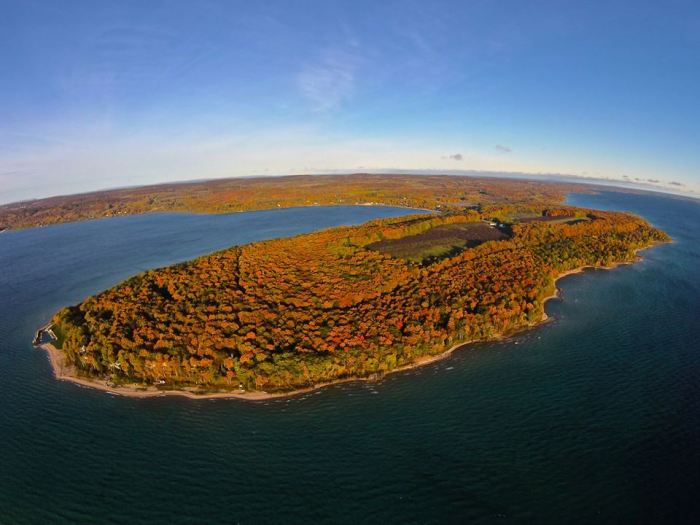
The Colors of Omena, photo by Elijah Allen

Here’s a shot by a friend taken just north of me showing the incredible fall color that’s still out there along the Lake Michigan coast. It was taken from off Omena Point at the northern part of the Leelanau Peninsula, so how about a little Omena history courtesy the Omena Historical Society?

The Omena settlement had its beginnings when Aghosa Indians started arriving in 1850. In 1852, the Reverend Peter Dougherty and a band of Ottawas and Chippewas led by Chief Ahgosa moved from the present-day Old Mission Peninsula to a beautiful little bay on the Leelanau Peninsula’s eastern side. Chief Shabwasung and his Ottawa band were already encamped on the point to the north of the bay, on land Chief Ahgosa and his families from Old Mission had purchased. Ahgosa settled a little to the north, and his village became Ahgosatown. Both bands became part of the New Mission, soon to be called Omena.

Young George A. Craker came with Dougherty and taught farming to students in the mission school, and he and his descendants became active workers in Dougherty’s Grove Hill New Mission Church. Now called the Omena Presbyterian Church, it was dedicated in 1858 and has stood as the oldest Protestant Church in Leelanau County and one of the oldest historical landmarks in Northern Michigan. The Ahgosa family was also very active and some are now buried in the mission cemetery.

Click through to read more and for some historical photos of Omena.

View Elijah’s photo bigger on Facebook and scroll though when you get there for more!

More aerial photos, more history and more Leelanau on Michigan in Pictures.

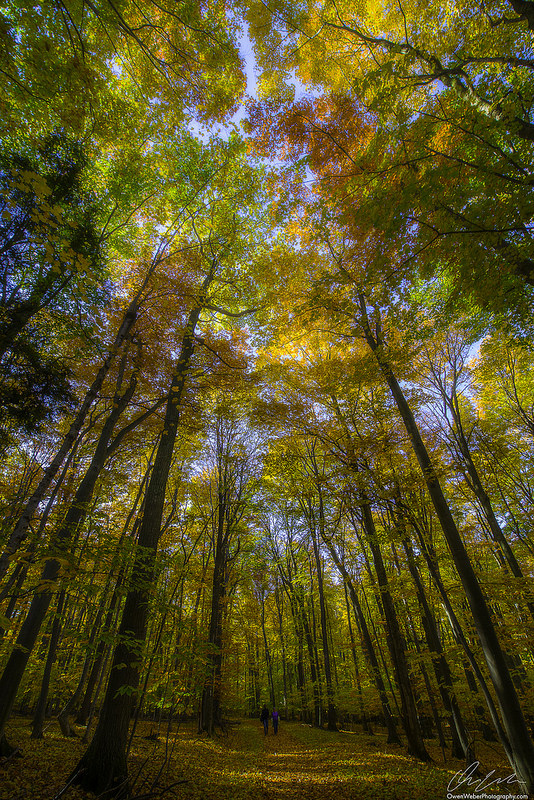
Under An Autumn Sunbeam: Fall Color Explained

Fall Color 2015 in Michigan

Under An Autumn Sunbeam, photo by Owen Weber

As we wait for the fall color season in Michigan to kick off, here’s a look back to last October and my annual rework of one of the most popular posts on Michigan in Pictures, the Science of Fall Color. If you already know the words you can sing along – have a great weekend folks!

The Science of Color in Autumn Leaves from the United States National Arboretum says (in part):

Many think that cool weather or frost cause the leaves to change color. While temperature may dictate the color and its intensity, it is only one of many environmental factors that play a part in painting deciduous woodlands in glorious fall colors.

…The process that starts the cascade of events that result in fall color is actually a growth process. In late summer or early autumn, the days begin to get shorter, and nights are longer. Like most plants, deciduous trees and shrubs are rather sensitive to length of the dark period each day. When nights reach a threshold value and are long enough, the cells near the juncture of the leaf and the stem divide rapidly, but they do not expand. This abscission layer is a corky layer of cells that slowly begins to block transport of materials such as carbohydrates from the leaf to the branch. It also blocks the flow of minerals from the roots into the leaves. Because the starting time of the whole process is dependent on night length, fall colors appear at about the same time each year in a given location, whether temperatures are cooler or warmer than normal.

During the growing season, chlorophyll is replaced constantly in the leaves. Chlorophyll breaks down with exposure to light in the same way that colored paper fades in sunlight. The leaves must manufacture new chlorophyll to replace chlorophyll that is lost in this way. In autumn, when the connection between the leaf and the rest of the plant begins to be blocked off, the production of chlorophyll slows and then stops. In a relatively short time period, the chlorophyll disappears completely.

This is when autumn colors are revealed. Chlorophyll normally masks the yellow pigments known as xanthophylls and the orange pigments called carotenoids — both then become visible when the green chlorophyll is gone. These colors are present in the leaf throughout the growing season. Red and purple pigments come from anthocyanins. In the fall anthocyanins are manufactured from the sugars that are trapped in the leaf. In most plants anthocyanins are typically not present during the growing season.

As autumn progresses, the cells in the abscission layer become more dry and corky. The connections between cells become weakened, and the leaves break off with time. Many trees and shrubs lose their leaves when they are still very colorful. Some plants retain a great deal of their foliage through much of the winter, but the leaves do not retain their color for long. Like chlorophyll, the other pigments eventually break down in light or when they are frozen. The only pigments that remain are tannins, which are brown.

Temperature, sunlight, and soil moisture greatly influence the quality of the fall foliage display. Abundant sunlight and low temperatures after the time the abscission layer forms cause the chlorophyll to be destroyed more rapidly. Cool temperatures, particularly at night, combined with abundant sunlight, promote the formation of more anthocyanins. Freezing conditions destroy the machinery responsible for manufacturing anthocyanins, so early frost means an early end to colorful foliage. Drought stress during the growing season can sometimes trigger the early formation of the abscission layer, and leaves may drop before they have a chance to develop fall coloration. A growing season with ample moisture that is followed by a rather dry, cool, sunny autumn that is marked by warm days and cool but frostless nights provides the best weather conditions for development of the brightest fall colors. Lack of wind and rain in the autumn prolongs the display; wind or heavy rain may cause the leaves to be lost before they develop their full color potential.

OK, sorry to share a novel with you. Might have to change the name of the blog to “Michigan in a Whole Bunch of Words with a Picture.”

Owen took this last October in Glen Arbor. View it bigger and see more in his Michigan slideshow.

PS: I have to think that it doesn’t look the same there this year due to the crazy storm they are still recovering from.

Tons more fall photos on Michigan in Pictures.

Legend of the Crooked Tree

The Crooked Tree Petoskey

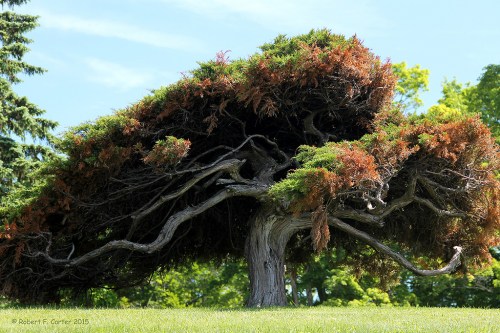
The Crooked Tree, photo by Robert Carter

Robert writes: Huge and ancient . . . this locally famous ‘Crooked Tree’ sits beside one of the roads near my home. “Crooked Tree”: “Crooked Tree Arts Center”, “Crooked Tree Breadworks”, “Crooked Tree Golf Club”, “Crooked Tree Septic Service”, “Crooked Tree This and Crooked Tree That”. This may not be the actual tree from which they take their names . . . but it is the most crooked tree I’ve come across in my travels, and it jumps out at everyone as they drive past.

Robert is correct that this isn’t the original. The Crooked Tree; Indian legends and a short history of the Little Traverse Bay region is available online and tells the story of the original Crooked Tree:

A tall, crooked pine tree overhanging a high bluff, served to designate what was probably the most important Indian village in the north, prior to the advent of the white man. “Wau-go-naw-ki-sa” the Crooked Tree could be seen for many miles by the occupants of approaching canoes. After rounding the northwestern extremity of what is now Emmet county, in the state of Michigan, on their way south, it was a familiar sight, and one that never failed to bring exultations of joy from the brave and daring Ottawas.

Just where the Crooked Tree stood we have been unable to ascertain; but tradition says it was in the vicinity of Middle Village of the present day. According to the legend it was bent by Na-na-bo-jo. Formerly it was straight, but as the great hunter and chieftain was climbing the hill one day at this point, with his canoe over his head, the end of the boat caught on the tree and gave him a bad fall. In anger he struck the tree a blow with his fist and bent it over. Where he hit the trunk a large swelling came out, and henceforward every knot or growth protruding from a tree was called “Na-na-bo-jo’s Fist.”

Read on for some cool stories from the area including some about the tree-punching Na-na-bo-jo!

View Robert’s photo bigger and see more in his My Petoskey slideshow.

Faith

Faith in Grand Traverse Bay

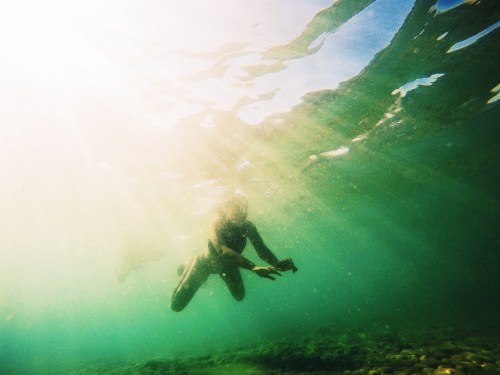
Faith, photo by Cameron

View Cameron’s photo from underneath Grand Traverse Bay background bigtacular and see more in his Elk Rapids MI slideshow.

More great summer wallpaper on Michigan in Pictures!

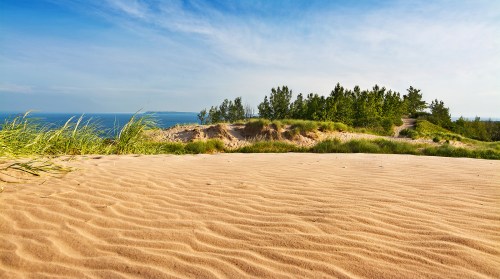
Promising Start

Promising Start

Promising Start, photo by Heather Higham

Heather writes:

Hard to believe that a raging storm tore through just hours after this idyllic morning in the dunes. But this is from the same day (Sunday) as the monster winds that uprooted and snapped countless large trees…

View her photo bigger, see more in her Sleeping Bear Dunes slideshow and follow her at Snap Happy Gal Photography on Facebook.

PS: I’ve been posting lots of updates from the storm on my Leelanau.com Facebook.