G1, X Flare … could it be an Aurora Borealis Bingo?

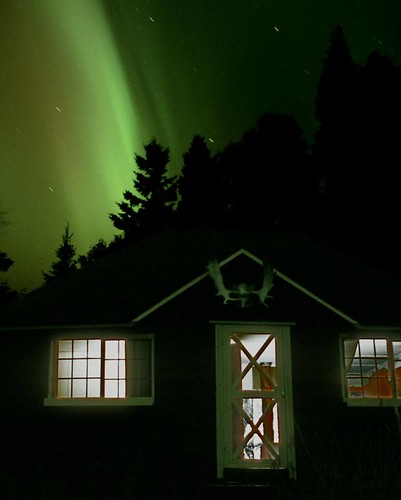
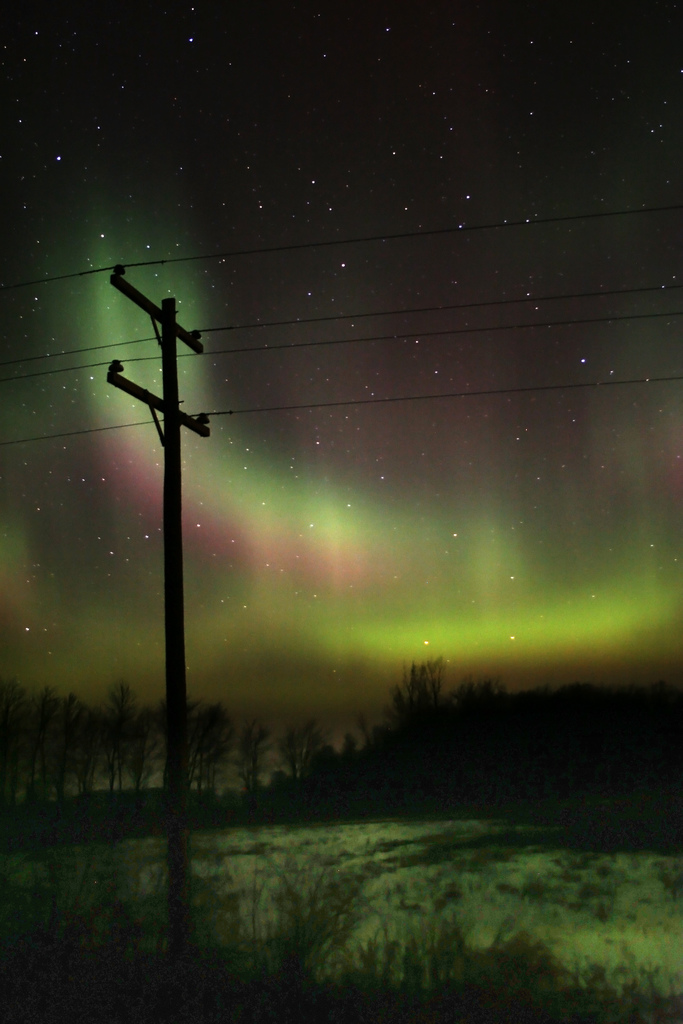
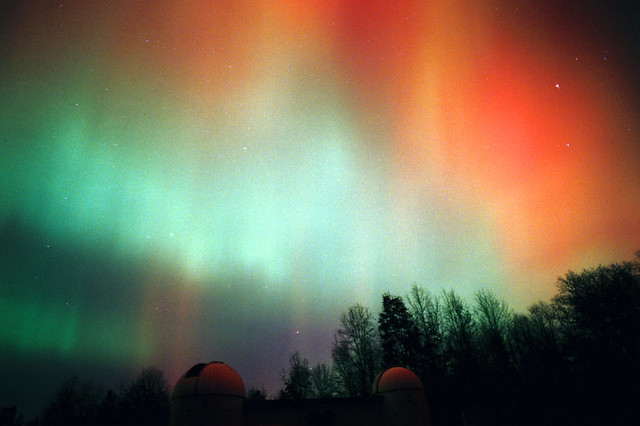
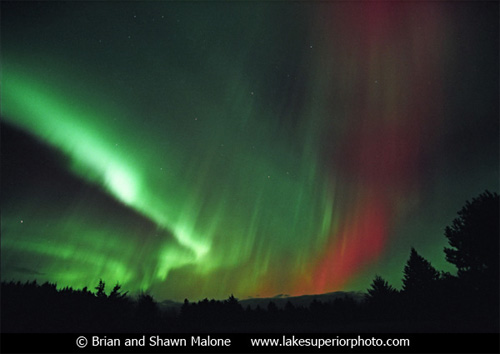
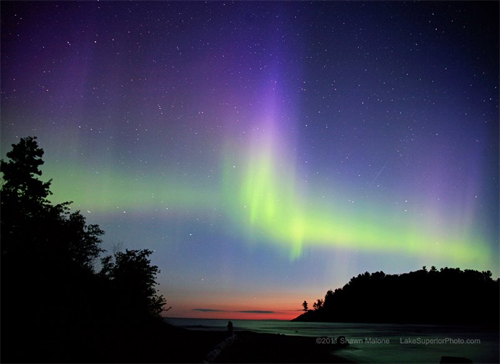
Northern Lights at Little Presque Isle, photo by Lake Superior Photo

This is a little technical, but you can boil it down to say “We might well see some northern lights in the next few days!”

Space Weather says that a category G1 (Minor) geomagnetic storm is expected on August 5th due to the effects of a CME (Coronal Mass Ejection) observed early on 02 August 2nd. In plain English, that means we might see the Northern Lights on the 5th! Don’t get too terribly excited though – according to NOAA Space Weather who puts out the email alerts that I subscribe to, G1 is the lowest level of a scale that goes up to 5. Don’t get depressed either though, as they say that during G1 activity, the Aurora Borealis is commonly visible at high latitudes (northern Michigan and Maine)!

I posted the above on Facebook, and my friend Shawn Malone (who took the photo above) told me that it is also possible for an x flare this week producing an EARTHWARD directed flare that would hit earth probably some time next week which would produce a northern lights display to remember! There was a brief x flare on July 29 – read about it here and see a video from NASA here. The displays in February 2011 were produced by a powerful x flare…

You can see & purchase lots more of Shawn’s photos of northern lights through LakeSuperiorPhoto.com and also check out her cool Northern Lights – square format album!

Michigan in Pictures has LOTS more pictures and information about the Aurora Borealis (Northern Lights).
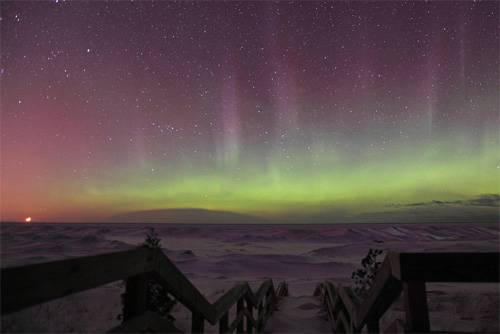
March 11, 2011 Northern Lights over Lake Superior

Editor’s note: I had planned a post about Michigan St. Patrick’s Day parades, some of which take place today or tomorrow. Check out  information for St. Paddy’s celebrations in DetroitBay CityClareFlint,KalamazooGrand LedgeSaugatuckTraverse City and Muskegon. Sorry about that, but when the Aurora Borealis calls, I’m picking up the phone!

March 11 Northern Lights over Lake Superior, photo by Shawn Malone

Last week Michigan in Pictures featured an article saying that the prospects for Northern Lights viewing in Michigan were looking great for the next couple of years. Thanks to Pure Michigan’s Facebook, that post became the most popular ever.

Yesterday on Facebook (does it look like I’m spending too much time there??) I saw that photographer Shawn Malone of Lake Superior Photo had captured a fantastic series of northern lights shots over the frozen landscape of Lake Superior near Marquette in the early morning of March 11th. She writes:

Nice to see the northern lights back, I caught the tail end of the strongest part of the display. These were taken along the Lake Superior shore near Marquette MI.

Lights were bright, brightest I’ve seen them in years. Snow did a good job reflecting the light hitting it.

See the whole gallery on Facebook. Shawn and Brian haven’t posted the photos to their site yet, but when they do, they’ll likely be in the Northern Lights section which includes some truly jaw-dropping photos!

If you’re interesting in keeping up with geo-magnetic forecasts, I would recommend NOAA’s Space Weather site, which includes the ability to subscribe for updates (link to “Email Products” at the bottom of the page). Definitely tune into the Northern Lights on Michigan in Pictures, and if you see the aurora, post a comment on the Michigan Northern Lights Log!


Northern Lights: Best Viewing in a Decade for Michigan

aurora borealis #6

aurora borealis #6, photo by ats8110.

In Best northern lights viewing in Michigan on mLive, Kim Schneider writes that:

The Aurora Borealis is entering a new cycle of higher activity, offering the best viewing in 10 years in Michigan, said astronomer Dick Cookman, a retired professor of astronomy, geology and environmental science at Northwestern Michigan College in Traverse City. Cookman posts monthly night sky updates at enerdynet.com, the website of his Suttons Bay science and nature store, Enerdyne.

The strongest solar flare in four years erupted a couple of weeks ago, Cookman said. If not for the cloud cover that obscured the drama, it would have led to light displays visible as far south as Upper Iowa, South-Central Wisconsin and mid-Michigan. The best part, he noted, is that the 7- to 11-year cycle is just beginning, offering great northern lights viewing possibilities likely to peak in 2012 or 2013.

Read on for viewing tips and some great links. You can see more of the aurora borealis on Michigan in Pictures including what makes the colors of the northern lights, predicting the northern lights and unlocking the mystery of the northern lights. If you do see the aurora borealis, be sure to post it to the Northern Lights Log on Absolute Michigan.

Aaron took these near Clare in November of 2004 and asks if you see the Big Dipper. Check out the Northern Lights gallery on his website or his aurora borealis slideshow.

Viewing the Northern Lights in Michigan

20100804-DSC_6621

20100804-DSC_6621, photo by xmatic.

Michigan in Pictures has seen over 10,000 people looking for aurora borealis aka the northern lights in the last two days. The cause of this is a major solar ejection that hit our magnetic environment on Tuesday/Wednesday. The good news is that here’s another plasma cloud on the way. The second wave may have hit last night, but it might hit tonight as well (and even if it doesn’t we may still be able to see some activity).

Most people I know downstate haven’t been able to catch them but xmatic up on the Keweenaw Peninsula got a great series of photos over of the aurora over Lake Superior. Check this out bigger and in xmatic’s northern lights slideshow.

Here’s a photo that Shawn Malone took of the aurora over Marquette Harbor in the Detroit News. Shawn has another photo on Michigan in Pictures and many more on her northern lights page.

Michigan in Pictures has lots more information including What makes the colors of the Northern Lights and information about the “rivers from the sun” that cause the northern lights.

Skywatchers should also mark August 12 for the peak of the Perseid Meteor Shower!

Michigan Northern Lights – October 16, 2009

Northern lights over Amygdaloid Island Ranger Station

Northern lights over Amygdaloid Island Ranger Station, photo by yooper1949.

Last night our Michigan Northern Lights Log on Absolute Michigan lit up like … well … the northern lights I guess with reports from Howell, Perry, Bancroft, Pleasant Lake, Eaton Rapids

They were all over. North, South, East and West. I wasn’t sure at first what they were, because of seeing them in all directions. Never seen anything quite like it.

…and Hartland, where Eddie wrote:

Finally….some verification of what myself and the rest of the family was looking at. I’m in Hartland and saw them everywhere but the northwest direction last night. Then this morning on the way to work, to the north and north east only. Saw single shafts of vertical light streaks mostly with a few areas that were “brush stroked” also, completely vertical. My kids also saw them for the first time.

Our northern lights log is set up to be a resource for notification when the aurora borealis is out. If you’ve never seen the lights, you might want to subscribe to the feed to get notification. I’m really wishing I’d checked my email last night and I’m hoping that I at least get to see some of the photos in the Absolute Michigan pool!

Carl took this photo on Northern lights over Amygdaloid Island Ranger Station on Amygdaloid Island (<– read that link) in Isle Royale National Park on November 6, 2007. You can see it bigger in his Under the Stars slideshow or check out this whole set or his Isle Royale National Park photos.

I didn’t see this one at Carl’s Mackinac Scenics web site (where you can purchase some of his work) but he does have some great shots of Isle Royale under the stars!

There’s lots more Northern Lights / Aurora Borealis photos & information on Michigan in Pictures!

What makes the colors of the Northern Lights?

Colors of the Northern Lights

Electric, photo by Muvv

Matt took this picture (and a few others) on December 15, 2006. Just for fun, I thought I’d link to a slideshow of “aurora” photos taken on December 15th of 2006 on Flickr (there are a lot of them – I even have one in there!)

10 Stunning Images and Legends of the Northern Lights (Aurora Borealis) notes that in Latvian folklore the aurora borealis, especially if red and observed in winter, are fighting souls of dead warriors. The images are indeed stunning.

If you’re not buying that dead Latvian warrior thing, the most excellent Aurora FAQ from the Geophysical Institute at the University of Alaska has an answer to what makes the different colors of the northern lights (aurora borealis). They explain that the composition and density of the upper atmosphere at the altitude of the aurora are behind it all.

Basically, the aurora excites atoms & molecules (as well as photographers) and as that atom or molecule returns to the ground state, it sends out a photon with a specific energy.

This energy depends on the type of atom and on the level of excitement, and we perceive the energy of a photon as color. The upper atmosphere consists of air just like the air we breathe. At very high altitudes there is atomic oxygen in addition to normal air, which is made up of molecular nitrogen and molecular oxygen. The energetic electrons in aurora are strong enough to occasionally split the molecules of the air into nitrogen and oxygen atoms. The photons that come out of aurora have therefore the signature colors of nitrogen and oxygen molecules and atoms. Oxygen atoms, for example, strongly emit photons in two typical colors: green and red. The red is a brownish red that is at the limit of what the human eye can see, and although the red auroral emission is often very bright, we can barely see it.

Photographic film has a different sensitivity to colors than the eye, therefore you often see more red aurora on photos than with the unaided eye. Since there is more atomic oxygen at high altitudes, the red aurora tends to be on top of the regular green aurora. The colors that we see are a mixture of all the auroral emissions. Just like the white sunlight is a mixture of the colors of the rainbow, the aurora is a mixture of colors. The overall impression is a greenish-whitish glow. Very intense aurora gets a purple edge at the bottom. The purple is a mixture of blue and red emissions from nitrogen molecules.

The green emission from oxygen atoms has a peculiar thing about it: usually an excited atom or molecule returns to the ground state right away, and the emission of a photon is a matter of microseconds or less. The oxygen atom, however, takes its time. Only after about a 3/4 second does the excited atom return to the ground state to emit the green photon. For the red photon it takes almost 2 minutes!

Check the Aurora FAQ for much more information about this wonderful phenomenon and get more posts about the Northern Lights from Michigan in Pictures!

Northern Lights Forecast: Predicting the Aurora Borealis in Michigan

Skyfire by Kevin’s Images

A lot of people end up at Michigan in Pictures every day when searching for the northern lights, and one of the biggest questions I get asked through comments and email is “When and where can I see the Northern Lights in Michigan?”

The Geophysical Institute in Alaska is one of the hotspots for information about viewing the aurora borealis aka the northern lights. In their excellent Aurora FAQ, they answer the question Can you predict when and where there will be aurora?, saying you can, but with less confidence than weather prediction. The aurora is powered by the solar wind, and strong solar winds tend to bring intense auroras.

The Institute’s Auroral Forecast Page presents data on the solar wind forecasts the intensity level of the aurora. You can then check the “Can I see the aurora?” link at the top and also their page on interpreting the aurora, where they offer this advice:

The auroral activity forecast predicts the expected location of the most active auroral forms that can be expected for the given period. Aurora viewing is also affected by a variety of other factors, such as cloud cover, moonlight, and urban light pollution, so what you see will be strongly affected by your particular location and meteorological luck.

The best time to observe aurora is near local midnight, when the most active forms often occur. More precisely, the time to shoot for is an hour or two prior to local geomagnetic midnight, and the forecast maps found here are calculated for that time. If you are a serious aurora watcher, plan to spend the night from about 9 P.M. to 3 A.M. watching for auroral action. Auroral activity tends to come in waves during an evening, which are called auroral substorms. Even during an active period, there will be lulls in which the auroral activity is subdued; however, the patient observer will often see a new burst of activity within an hour or two.

I found that selecting the North Polar view seemed to provide the best view for Michigan, and it appears to me that we need to have an activity level of 3 to see any of the lights in Lower Michigan and 2 for the Upper Peninsula. Based on today’s forecast, it appears that on December 23 we’ll have a chance to see the aurora – if anyone does, please post it here and on the Michigan Northern Lights Log over on Absolute Michigan.

You can see this photo larger and also more shots that Kevin took that night at the James C. Veen Observatory in Grand Rapids in his Astronomy set (slideshow).

For much more Michigan northern lights goodness check out the northern lights category on Michigan in Pictures and the Michigan Tech-based leading page on the northern lights, The Aurora Page. And I might as well slip in this amazing time lapse of the aurora borealis from British Columbia.

Isle Royale Sunset and the Great Lakes Sea Kayak Symposium

Round Is. sunset

Round Is. sunset, photo by yooper1949.

Carl took this photo at Herring Bay in Isle Royale National Park. It’s part of his super-cool Isle Royale National Park (slideshow) which, in addition to having many more kayak photos, has some incredible views of this amazing Michigan park including a sweet shot of the northern lights over Amygdaloid Island Ranger Station (plus he has them uploaded at “wallpaper size”).

This weekend, July 17-20, 2008, head up to Grand Marais for the 24th annual Great Lakes Sea Kayak Symposium. It’s the oldest kayaking symposium on the Great Lakes and offers paddlers of all ages and abilities for a weekend packed with fun and learning opportunities including on-the-water classes, classroom lectures, kayak demos and vendors, social events, a race and of course plenty of opportunities to paddle including guided tours of the Pictured Rocks National Lakeshore. Keynote speakers this year are adventure filmmaker and expedition sea-kayaker Justine Curgenven and Sam Crowley, who circumnavigated Ireland in 2007 in a sea kayak.

Rivers from the sun, unlocking the mystery of the Northern Lights with THEMIS

November 7-8, 2004 Aurora Borealis by Brian & Shawn Malone

November 7-8, 2004 Aurora Borealis, photo by Brian & Shawn Malone

This photo is one of many taken by Upper Peninsula photographers Brian & Shawn Malone of LakeSuperiorPhoto.com from the fantastic Northern Lights displays of November 2004 and other years. They have a ton more from all kinds of U.P. places and events that you can view and purchase if you’re so inclined.

The source of the aurora borealis (Northern Lights) has long been a beautiful mystery. Last week, however, CNN featured an article on the possible discovery of the energy source for the Northern Lights.

New data from NASA’s Themis mission, a quintet of satellites launched this winter, found the energy comes from a stream of charged particles from the sun flowing like a current through twisted bundles of magnetic fields connecting Earth’s upper atmosphere to the sun.

The energy is then abruptly released in the form of a shimmering display of lights…

You can get more in the article above or head over to NASA’s THEMIS mission for all the crunchy details including some multimedia (which in turn includes the THEMIS Mission Trailer – guaranteed to get your inner geek jumping!). Also see the THEMIS video & image gallery at the University of California – Berkley. Themis was the Greek goddess of justice (aka “the blindfold lady”) and the daughter of sky god Uranus and earth goddess Gaia.

Manabezho Falls in the Porcupine Mountains State Park

Manabezho Falls, long exposure

Manabezho Falls, long exposure, photo by DA2Brian.

GoWaterfalling’s page on Manebezho Falls says:

The Manabezho Falls are part of the Presque Isle River’s spectacular final dash to Lake Superior. The entire 1 mile stretch is very beautiful, with lots of bare rock and rapids. It is easily accessible from the Presque Isle entrance off of CR-519 on the western end of the park…

Manido Falls are just short distance upstream. Nawadaha Falls is a bit farther upstream. Downstream of Manabezho the river plunges into a narrow gorge. The “falls” there have no name, but they are quite interesting.

The falls are located in the Porcupine Mountains State Park and you can see more photos of Manabehzho Falls on Flickr (slideshow) and also check out the Porcupine Mountains group!

I’m pretty sure that “Manabehzo” is Manabozho, the Ojibwa/Algonquin trickster and messenger of the Great Spirit. For more about this colorful figure, check out Manabozho, the Mischief-maker by Rick Walton.