
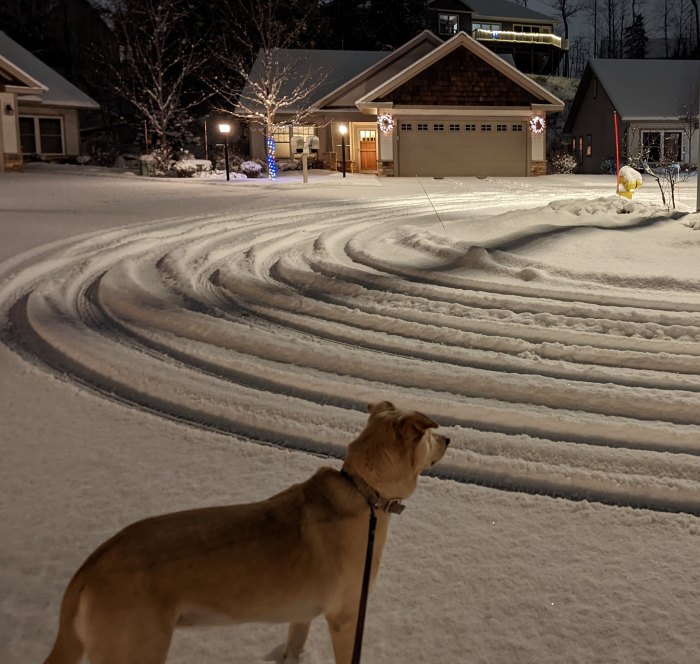
Before the Plows Come By by Ann Fisher
Ann captured a nice winter mood in this photo from a late December evening in Marquette. See more in her 2021 UP gallery on Flickr & thanks to all the hardworking plow drivers around the state!

Before the Plows Come By by Ann Fisher
Ann captured a nice winter mood in this photo from a late December evening in Marquette. See more in her 2021 UP gallery on Flickr & thanks to all the hardworking plow drivers around the state!
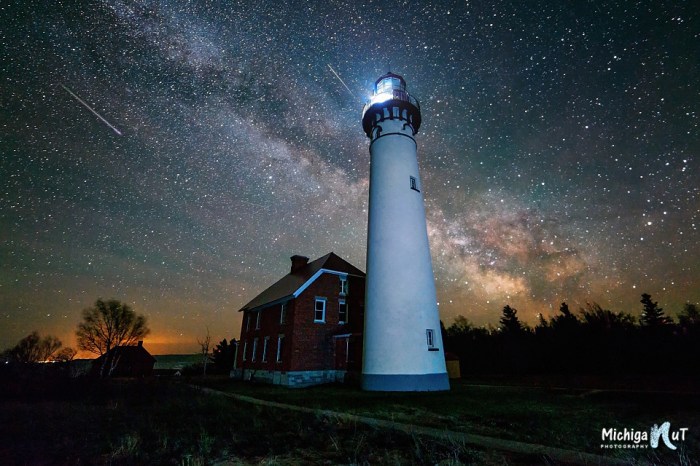
Milky Way over Au Sable Point Lighthouse by Michigan Nut Photography
EarthSky says that the annual Geminid Meteor Shower that will peak next week is one of the year’s best:
The Geminids are a reliable shower for those who watch around 2 a.m. local time from a dark-sky location. We also often hear from those who see Geminid meteors in the late evening hours. This year, a waxing gibbous moon will be above the horizon during peak time for viewing. But it’ll set shortly afterwards, leaving the sky dark for watching meteors. Thus the best time to watch for Geminid meteors in 2021 is likely before dawn – say, from around 3 a.m. to dawn – on the morning of December 14.
It’s a somewhat narrow window for meteor-watching. But still worth a look!
On a dark night, near the peak of the shower, you can often catch 50 or more meteors per hour. On an optimum night for the Geminids, it’s possible to see 150 meteors per hour. A new moon on December 4 means that the peak of the shower coincides with a moon just a few days past first-quarter phase.
Click through for all the details but remember the key to success is finding dark skies!!
John took this back in May 2014 at the Au Sable Lighthouse in the Pictured Rocks National Lakeshore. See more in his Starry Nights gallery on Flickr & view and purchase prints & calendars on his website.
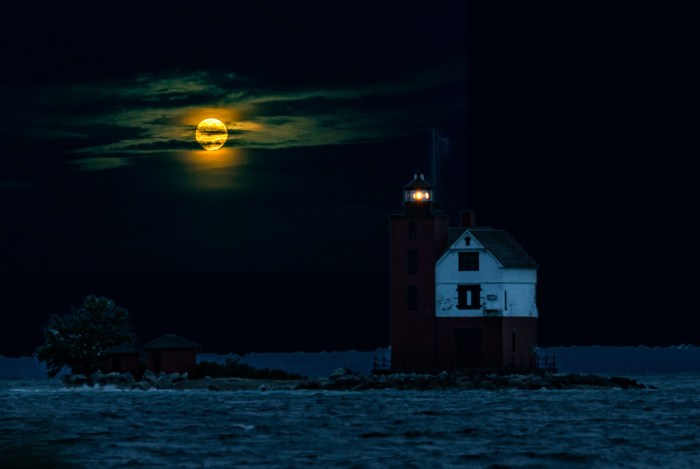
Round Island Light, with a little moon added for effect by Tom Clark
Tom’s shot of Round Island Light off Mackinac Island just might be the most Michigan Halloween photo ever. See more in his Night scenes & after dark images gallery on Flickr & head over to Tom’s website to explore his photos.
If you want a spooky lighthouse, check out The Haunting of the White River Light on Michigan in Pictures & happy Halloween everyone!!
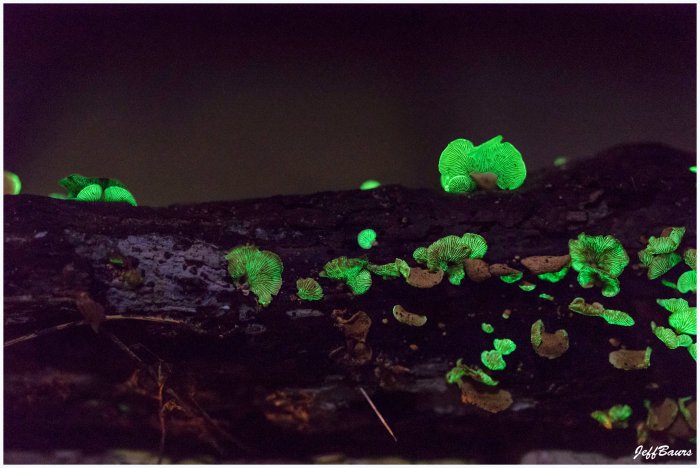
Bioluminescent Oyster Mushrooms by Jeff Baurs
It’s not every day that I learn something new about Michigan, but the fact that Michigan has mushrooms that produce their own illumination is a new one to me!! PlantSnap explains that Bitter Oyster Mushrooms (Panellus stipticus) are one of over 80 species of bioluminescent mushrooms:
The mushrooms use a class of molecules called luciferins, which paired with an enzyme and oxygen, release light. Panellus stipticus (also known as the bitter oyster) is one of the brightest-glowing examples of bioluminescent fungi. It is found throughout Asia, Australia, Europe, and North America. These flat mushrooms grow on tree branches creating a mesmerizing effect as soon as the sun goes down. Foragers are able to find this variety growing around birch, oak, and beech trees.
The luciferins found in bioluminescent mushrooms are the same compound found in fireflies and underwater creatures.
They recommend that the best way to find them is by identifying them in the daytime, and you can head over to It’s Nature for a look at the bitter oyster mushroom.
Jeff took this photo a couple nights ago in southwest Michigan (Barry County). You can follow him on Twitter, Facebook & Instagram for more great pics!
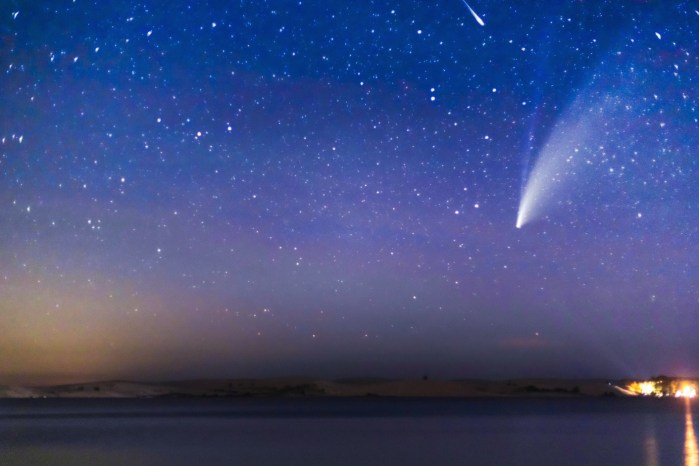
Neowise and meteor by Gary Syrba
In addition to being the season of cider, changing leaves, and Halloween, October also brings a pair of meteor showers. Our friends at EarthSky give you all you need to know to see the Draconid & Orionid meteor showers:
The Draconids, October 8th
In 2021, watch the Draconid meteors at nightfall and early evening on October 8. You might catch some on the nights before and after, as well. Fortunately, the thin waxing crescent moon sets before nightfall. It won’t hinder this year’s Draconid shower … This shower is usually a sleeper, producing only a handful of languid meteors per hour in most years. But watch out if the Dragon awakes! In rare instances, fiery Draco has been known to spew forth many hundreds of meteors in a single hour.
The Orionids, October 21st
Unfortunately a full moon accompanies 2021’s Orionid shower. Try watching for these meteors in the wee hours before dawn on October 21. You won’t escape the moon, though. On a dark, moonless night, the Orionids exhibit a maximum of about 10 to 20 meteors per hour. More meteors tend to fly after midnight, and the Orionids are typically at their best in the wee hours before dawn. The Orionids sometimes produce bright fireballs, which might be able to overcome a moonlit glare. If you trace these meteors backward, they seem to radiate from the Club of the famous constellation Orion the Hunter.
Gary took this shot last summer. Head over to his Flickr for the latest!
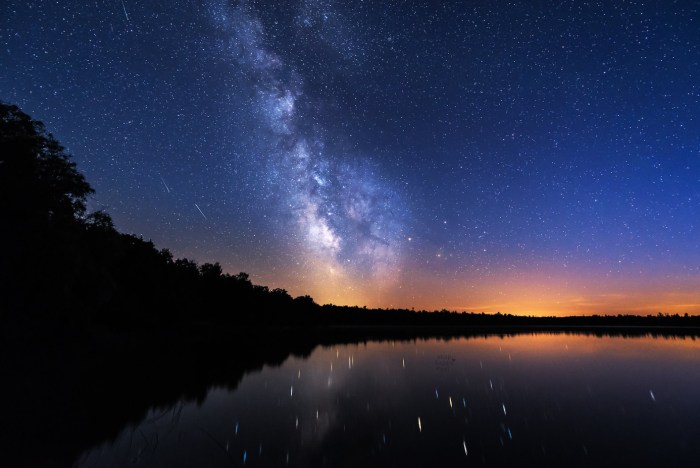
Falling Skies by Heather Higham
Our friends at EarthSky share that August is THE month for meteor watching, with two major showers:
The Delta Aquariid meteor shower is long and rambling. You might catch a Delta Aquariid anytime from about July 12 to August 23 each year. The nominal peak falls on or near July 29. But don’t pay too much attention to that date; the shower typically provides a decent number of meteors for some days after and before it. In 2021, a bright waning gibbous moon will wash out a good number of Delta Aquariids in late July. As we move into early August, a much fainter waning crescent moon will be less intrusive. As always happens, when the Perseid meteor shower is rising to its peak (mornings of August 11, 12 and 13), the Delta Aquariids will still be flying, too.
In the Northern Hemisphere, we rank the August Perseids as our all-time favorite meteor shower … No matter where you live worldwide, the 2021 Perseid meteor shower will probably produce the greatest number of meteors on the mornings of August 11, 12 and 13. On the peak mornings in 2021 – in the early morning hours, when the most meteors will be flying – there’ll be no moon to ruin on the show.
Click those links for viewing tips & happy sky watching!
Heather took this photo back in 2016 on Loon Lake in the Sleeping Bear Dunes National Lakeshore. See more in her Night Skies gallery. For sure follow her on Instagram @SnapHappyMichigan & view and purchase her work on her website.
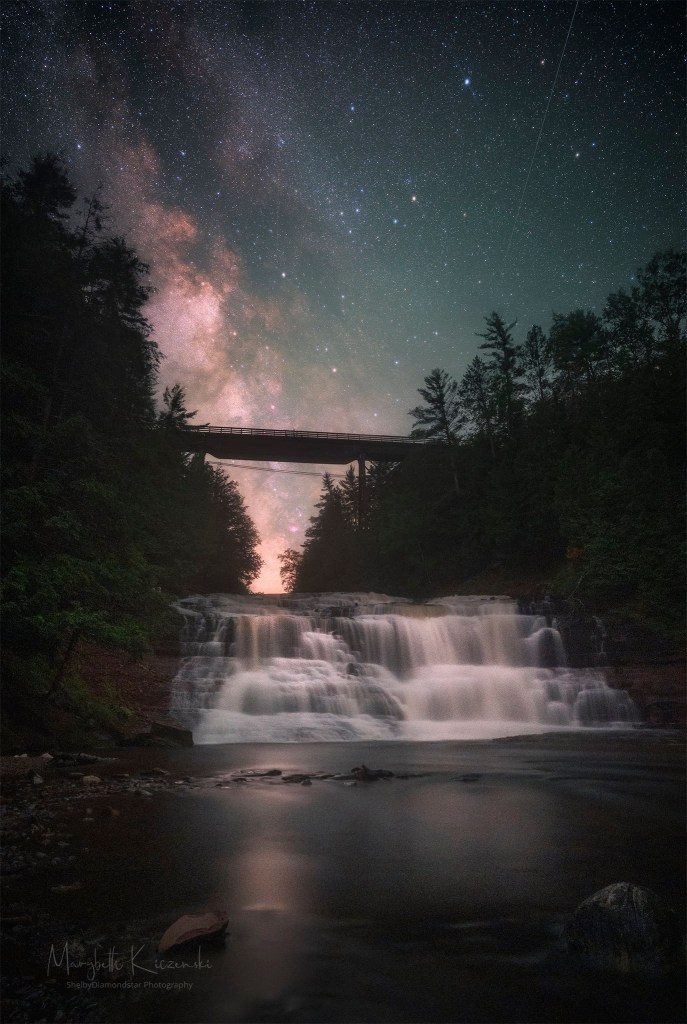
Agate Falls under the Milky Way by Shelbydiamondstar Photography
GoWaterfalling says that Agate Falls is an impressive waterfall that’s relatively easy to get to:
Agate Falls is a Michigan State Scenic Site 6.5 miles east of Bruce Crossing on MI-28. There is a roadside park (Joseph F. Oravec roadside park) just past the bridge over the Ontonagon River. This is one of the largest and most impressive waterfalls in Michigan. Unfortunately the provided trails and overlooks are somewhat limited. With some effort you can scramble down to the river to get some very good views of the falls, which seems to be popular with local fishermen, or scramble up the river banks to get to the old railroad bridge over the falls. The bridge is now part of a snowmobile trail.
Marybeth got this stunning shot last week. See lots more on her Facebook page & at shelbydiamondstar.com!
More Michigan waterfalls on Michigan in Pictures!
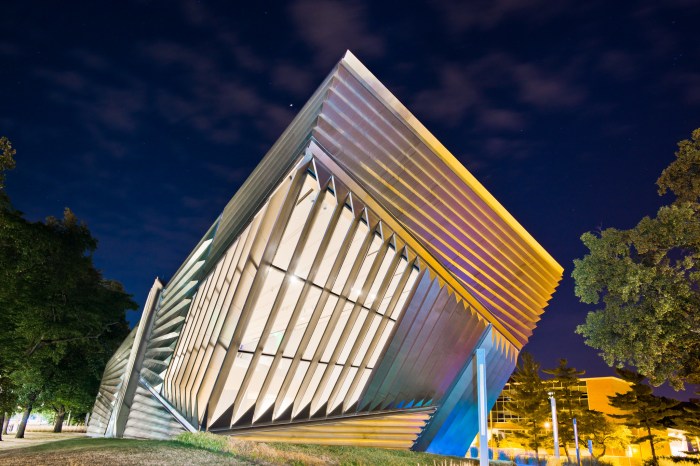
Another Night at the Museum by fotoman91
Michigan State University’s Broad College of Business dean Sanjay Gupta shares a tribute to billionaire alumnus Eli Broad who died last week at the age of 87, saying in part:
As a loyal Spartan, Mr. Broad has left an extraordinary and unparalleled legacy on the banks of the Red Cedar. In total, Eli and Edythe have given nearly $100 million to support MSU in a multitude of ways. From building the Eli and Edythe Broad Art Museum to supporting the College of Education, their impact has been significant across campus.
Nowhere has their giving been more evident than here in the Broad College of Business. Passionate about the MBA program, in 1991, Mr. Broad made what was at the time the largest gift ever made to a public business school. His $20 million commitment to the Eli Broad College of Business and the Eli Broad Graduate School of Management — both renamed in his honor — was designed to help the university’s new full-time MBA program emerge as one of the nation’s top graduate management programs. Today, that program is a top 25 U.S. public program that has launched the careers of countless Spartans.
The Broad Museum is a contemporary art museum and is open free of charge Friday – Sunday from noon to 6 PM.
fotoman91 took this pic last summer. See more in his awesome Night Time gallery on Flickr.
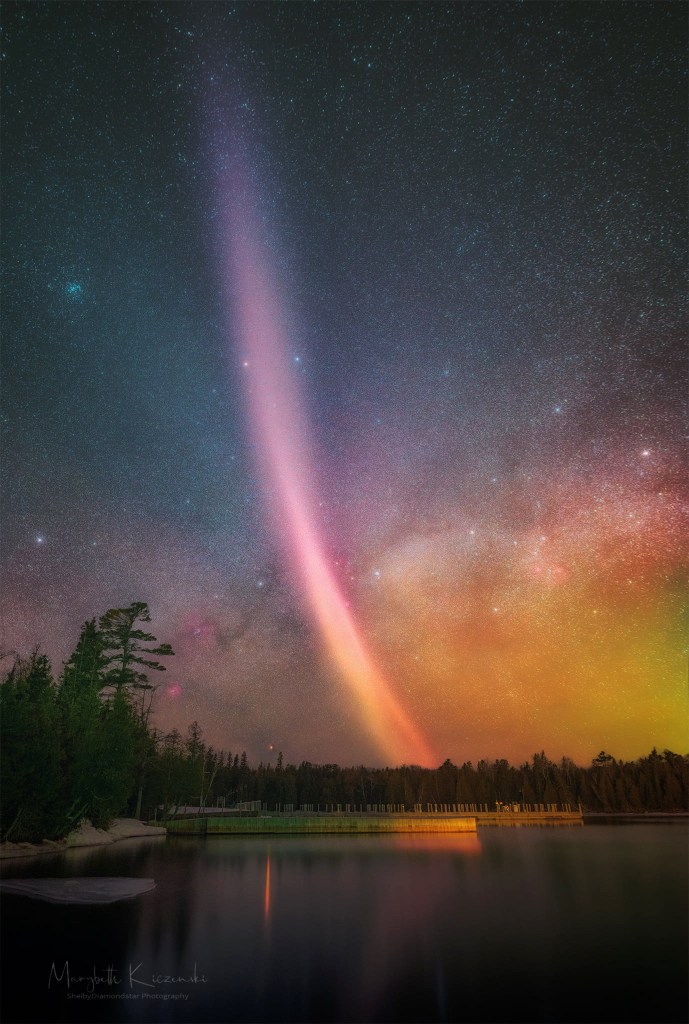
Five Minutes with STEVE by Shelbydiamondstar Photography
This spring has been big for fans of the aurora borealis. Shelby took created this photo of five, 1-min tracked shots blended with an untracked foreground shot the night of March 13/14th in Copper Harbor. It shows a phenomenon I’d never heard of, a Strong Thermal Emission Velocity Enhancement aka STEVE about which Space.com says (in part):
A typical aurora — sometimes called the northern lights or the southern lights, depending on the hemisphere in which it’s located — occurs when charged particles from the sun interact with Earth’s oxygen and nitrogen molecules. This interaction excites the molecules and causes them to glow.
But STEVE, formally known as Strong Thermal Emission Velocity Enhancement, is different. In the Northern Hemisphere, the phenomenon is visible from areas farther south than a typical aurora, and it looks like a ribbon of pink or mauve light. Sometimes, STEVE even has a “picket fence” appearance, with green columns of light passing through the ribbon. Auroras, by contrast, usually are shimmering green ribbons.
…The new study examined satellite data gathered above STEVE events in April 2008 and May 2016. The measurements included information about Earth’s magnetic and electrical fields in the magnetosphere, the region of Earth’s atmosphere where the planet’s magnetic field is stronger than any influence coming from the sun. Then, scientists compared the satellites’ findings with amateur photos of STEVE taken from the ground at the same time.
When STEVE was on display, the study authors realized, energetic electrons were pouring into Earth’s ionosphere, the layer of the planet’s atmosphere where atoms lose electrons due to solar and cosmic radiation. The friction that flood creates heats particles, which creates the pinkish glow, almost like an incandescent light bulb.
Satellite information further revealed how the “picket fence” aspect of STEVE develops. The data revealed waves moving from Earth’s magnetosphere to the ionosphere. In this region, the waves can both energize electrons and move them out of the magnetosphere, creating the picket-fence appearance, which happens simultaneously in the Northern and Southern hemispheres.
Lots more at Space.com.
You can comment on Shelby’s photo right here. For sure follow her on Facebook and view & purchase her work at shelbydiamondstar.com.
Lots more northern lights on Michigan in Pictures!
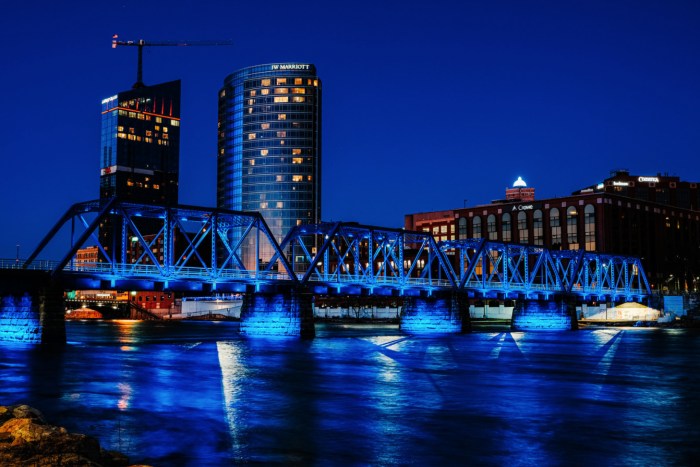
Dan shares:
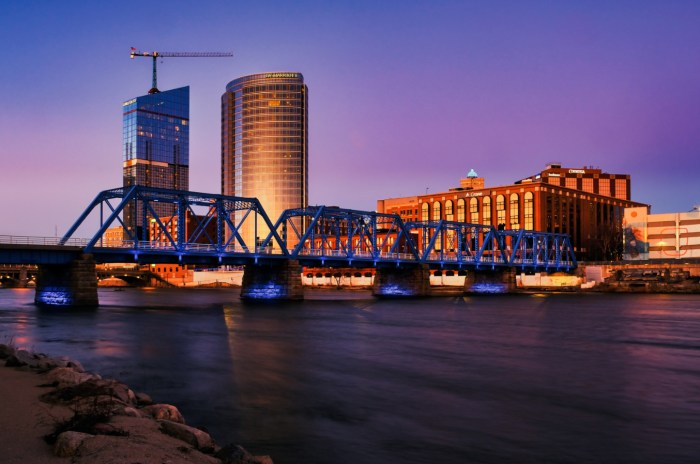
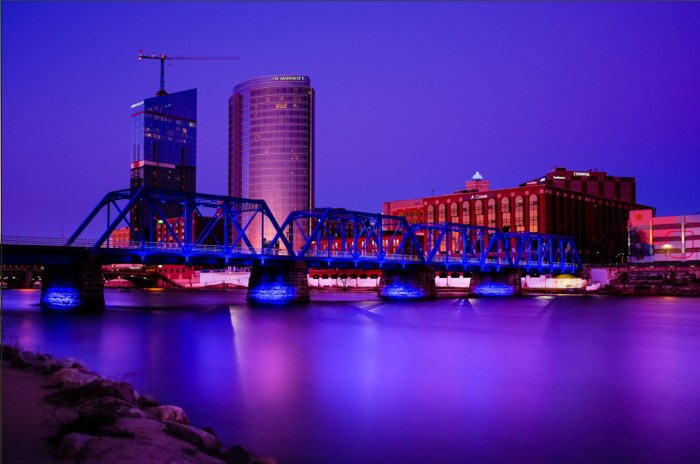
I’ve never spent much time in Grand Rapids, but I have seen photos of this striking bridge across the Grand River. I wanted to capture the river as the sun went down. I love watching how quickly light can change. These three photos, all very different, were taken within 15-20 minutes of each other on Saturday, 6 March 2021. The photo above is the third in the series, taken at night with most of the light in the image now comes from the lights on the bridge, hotel windows and street lights.
Image 1: Just at sunset, you can see the warm tones from the last light on the buildings
Image 2: Blue hour – the sky almost balances the surface of the river perfectly
 Michigan in Pictures