

THU-Textures-23-Edit, photo by jakphoto.
Be sure to check it out large and on black
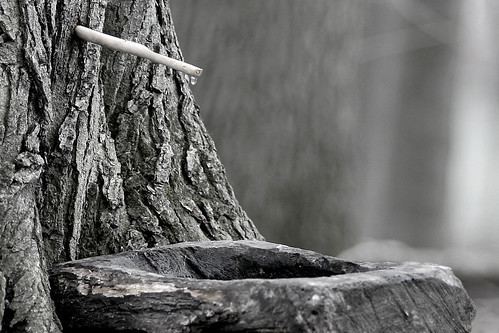
One Drip at a Time, photo by Graphic Knight.
Eric took this photo of an American Indian demonstration on how maple trees were tapped for collecting the sap to make maple syrup at the Kensington Metropark Farm Learning Center. He also has a couple photos of them boiling the say to make maple syrup.
It’s said that there was a time when the sap of the maple tree was as thick and sweet as honey. More practical tales are told of how Nanahboozhoo taught the making of maple sugar:
Then Nanahboozhoo gave the Indians a bucket made of Birch bark, and a stone tapping-gouge with which to make holes in the tree-trunks; and he shaped for them some Cedar spiles or little spouts, to put in the holes, and through which the sap might run from the trees into buckets. He told them, too, that they must build great fireplaces in the woods near the Maple groves, and when the buckets were full of sap, they must pour it into their kettles, and boil it down. And the amount of Sugar they might boil each Spring would depend on the number of Cedar spiles and Birch bark buckets they made during the Winter.
You can learn about a traditional Native American sugarbush from NativeTech and take a look inside the book Ininatig’s Gift of Sugar: Traditional Native Sugarmaking.
Also be sure to check out The Cycle of Sweetness: From Sap to Maple Syrup on Michigan in Pictures for more photos of this fascinating process.
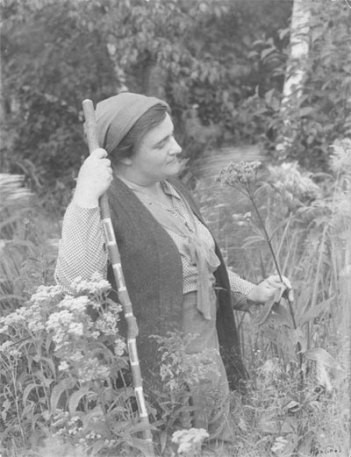
Genevieve Gillette, photo courtesy Archives of Michigan
In honor of Women’s History Month, the Archives of Michigan is highlighting conservationist Genevieve Gillette, one of the prime movers in the creation of Michigan’s State Park system. Gillette was born in 1898 and in 1920 she became the first woman to earn a degree in Landscape Architecture from the Michigan Agricultural College. Over the course of her lifetime, the number of Michigan state parks increased from one to ninety-six.
She was instrumental in creating P.J. Hoffmaster State Park near Muskegon, and the park includes the E. Genevieve Gillette Nature Center (Michigan’s Sand Dune Interpretive Center). Gillette was one of the inaugural inductees of the Michigan Walk of Fame in 2006 and is also in the Michigan Women’s Hall of Fame. Also see Emma Genevieve Gillette in Wikipedia.

OtisDude writes:
I was shooting some duck pictures today when all the sudden something startled all the ducks. Calm to chaos in less than a second. I managed to snap off 4-5 pics before I got a little panicked and got out of the way.
We’ve all heard of the many Inuit names for snow. In case anyone was wondering, ducks are pretty much the same. There’s quite a collection of names for a group of ducks including a paddling of ducks or a raft of ducks (when floating along), a plump or team of ducks (in flight overhead), a brace of ducks (post hunting I believe) or a dopping of ducks (when diving). More ducks on Michigan in Pictures.
None of these seemed quite right but fortunately there’s also a flush of ducks, which I’m going to assume covers exactly this scenario.

trumpeter swan, photo by tobibritsch.
On the Michigan DNR’s page on the trumpeter swan, says that at 25-35 pounds when fully grown, the trumpeter swan is the world’s largest waterfowl with a wingspan of nearly 8′ and that:
Historically, trumpeter swans were most likely abundant throughout the Great Lakes region, even in the southern Michigan marshlands. On his travels along the Detroit River in 1701, Cadillac compared the abundance of swans to lilies among the rushes. However, with the settlement of America, the populations of trumpeters plummeted. Beginning in the late 1800s, European settlers cleared the land, draining and filling important marsh habitat, and market hunters took swans for their fine down and quills. By 1933, only 66 trumpeter swans remained in the continental United States, mainly in remote parts of the Rocky Mountains and Alaska. Nearly 100 years passed before trumpeter swans were seen again in the Michigan wilds.
In the 1980s Michigan began a swan reintroduction program as part of the North American Restoration Plan. While the program has been a success and dramatically increased the number of nesting pairs, there are some who question whether these birds did in fact historically nest in Michigan. Nuthatch at the excellent Michigan blog bootstrap analysis presents the case in with great links in swans, take 2. It’s something that merits consideration as swans are pretty rough on aquatic habitats!
For more on these birds, check out The Trumpeter Swan Society. Also, the UM Animal Diversity Web Cygnus buccinator (trumpeter swan) listing has some photos but unfortunately no sounds. Wikipedia’s Trumpeter Swan entry also includes creative commons photos of trumpeter swans for use and download.
The photographer has a cool set of waterbird photos (slideshow) and this photo is in the Birds of Michigan group on Flickr. It’s for sharing photos of birds found anywhere in the State of Michigan and they say that if you cannot identify the bird, post it to the group and likely someone there can!

Wonderland, photo by SpringChick.
SpringChick (Deb) says that she works at Camp Miniwanca, located on Lake Michigan and also on Stony Lake near Shelby, MI. She has a great set of photos from Miniwanca (slideshow) and you can learn more about the camp at the American Youth Foundation’s Miniwanca pages.

Sometimes when I’m not sure what Michigan in Pictures will be about, I look at my Michigan events calendar for inspiration. There were no events, but the calendar also shows hunting information. I saw that on Monday, Bobcat Trapping Season opened in northern Michigan. That jarred me enough to go looking for stuff about bobcats in Michigan.
In this closer view of the cat, BJ says that she photographed this bobcat the Blandford Nature Center in Grand Rapids, that he was taken in from Tennessee as an injured animal and that his name is BOB.
The very excellent University of Michigan Museum of Zoology’s Animal Diversity Web has information & photos about bobcat (Lynx rufus). You can find a lot more in the Wikipedia entry for Bobcat, which says that these cats are phenomenal climbers that are crepuscular (most active at twilight and dawn) and found all over North America. As to their size:
The adult male Bobcat is 28 to 47 inches long, averaging 36 inches; this includes a stubby 4 to 7 inch (10–18 cm) tail, which has a “bobbed” appearance and gives the species its name. An adult stands about 14 or 15 inches (36–38 cm) at the shoulders. Adult males usually range from 16 to 30 pounds (7–14 kg); females average about 20 pounds (9 kg). The Bobcat is muscular, and its hind legs are longer than its front legs, giving it a bobbing gait. At birth it weighs 0.6 to 0.75 pounds (280–340 g) and is about 10 inches (25 cm) in length. By its first year it will reach about 10 pounds (4.5 kg)
Don Harrison has several photos of a bobcat by the side of the road and also old postcards of a bobcat crossing the Military Rd near Stateline, MI and a bobcat at Lake Baldwin. Here’s a video of a bobcat crossing a bridge that gives you an idea of how these animals move.
Finally, any of you who were hoping for bobcat trapping are out of luck as the season is (permanently?) closed south of the bridge according to the DNR’s bobcat trapping page. Here’s the link to report bobcat, cougar and lynx to the Michigan DNR.

A Herd of Turkeys, photo by curlyson.
The thought of two guys in the woods chasing turkeys around for a photo is pretty funny.
You can learn more about Michigan turkeys (both wild & plattered) at Absolute Michigan.
Happy Thanksgiving folks.

maplepath, photo by Aunt Owwee
Our next fall color tour from Travel Michigan, Lansing – Grand Ledge – Hastings – Battle Creek – Eaton Rapids, starts where the above photo was taken: at the Fenner Nature Center in Lansing (once known as the Fenner Arboretum). The park is named after biologist Carl G. Fenner and has 130 acres with 4 miles of trails winding through maple groves, pine forests, swamp forests, old fields and 3 different ponds. This weekend (Oct 20 & 21) they’re having an Apple Butter Festival. Aunt Owwee (Shirl) has a cool four seasons view from here and lot more great shots of autumn in Michigan.
If you’ve got the nature center bug, you can stop at the Woldumar Nature Center, located along the Grand River not far southwest of Lansing. From there, head out M-43 to Grand Ledge. Fitzgerald Park aka “The Ledges” are absolutely gorgeous in the fall, as evidenced by this photo from Rein Nomm of Fall at the Ledges that appeared last year on Michigan in Pictures. Not convinced? Search fall at Grand Ledge on Flickr. Last weekend, the city of Grand Ledge held their annual Color Cruise, but there’s still plenty of color to be found.
 Then it’s on to Hastings and Historic Charlton Park, a re-creation of a 19th century town. The structures are open only Memorial Day to Labor Day but you can certainly enjoy strolling along the river. For a little more exercise, jump on the non-motorized vehicle only Paul Henry – Thornapple Trail (see photos of the trail on Flickr). When complete, the trail will be a 42-mile route from Grand Rapids to Vermontville. The photo to the right of the Thornapple River was taken by hansendm.
The it’s on to Gull Lake and the W.K. Kellogg Bird Sanctuary. The sanctuary is one of the North America’s pioneer wildlife conservation centers and offers a chance to see birds in the wild, bird displays and birds of prey enclosures featuring rare and common raptors including a bald eagle, red-tailed hawks and eastern screech owl.
Travel Michigan suggests a possible detour to the Fort Custer Recreation Area, located between Battle Creek and Kalamazoo. It features three lakes, the Kalamazoo River and an excellent trail system that includes 16 miles of mountain bike trails. The 3000+ acre area was farmland that was acquired by the federal government to establish Camp Custer, an induction and military training center for the US Army during WWII.
If it’s raining or all this outdoor stuff doesn’t sound fun, consider stopping at the Gilmore Car Museum in Hickory Corners which features almost 200 vehicles spanning over 100 years of automotive heritage from a 1899 Locomobile to the muscle cars of the 60s and 70s.
 Continuing south, we come to the city of Battle Creek where recommended stops include the Sojourner Truth Monument (check out this set of photos of the Monument), Binder Park Zoo, the Leila Arboretum and Children’s Garden and the Battle Creek Linear Park. The park is a walkable, bikeable and billed as “the world’s largest classroom,” featuring signs that tell about plant, animal, cultural and historical points-of-interest along the park.
If you’re hungry as you head out on Old 27, consider Cornwell’s Turkey House aka Turkeyville USA. A bit further south is the town of Marshall. In addition to being a shopping mecca, Marshall’s downtown is designated as a National Historic Landmark District and features a wealth of historic attractions including the American Museum of Magic.
The photo to the right is of the Kalamazoo river from the Nature Center bridge by cathie and it’s just one of the places you can stop as you ease on down the road back to Lansing through the towns of Albion, Springport & Eaton Rapids. They recommend a stop at The English Inn of Eaton Rapids for dinner. Having eaten there before, I can only say “got room for another?”
Just so it’s clear, these fall color tour entries are produced by Absolute Michigan & Michigan in Pictures using the great information compiled in Travel Michigan’s Fall Color Tours as a starting point. We’re trying to add to what they’ve put together – not rip them off! As always, if you have links to information or photos that we missed, comments or reports, post them in the comments below!
Don’t miss our Michigan Fall Wallpaper series and see more of Travel Michigan’s Fall Color Tours.

 Michigan in Pictures