

woods_049, photo by Hart Ryan Noecker.
Circa 2000. It’s part of Hart Ryan Noecker’s un luogo solitario set (slideshow).
woods_049, photo by Hart Ryan Noecker.
Circa 2000. It’s part of Hart Ryan Noecker’s un luogo solitario set (slideshow).

black morels, photo by PLskell
Peter says that he found this delicious pair black morels in Delta County in the UP last May.
Over on Absolute Michigan we have a nice feature on morel hunting in Michigan that offers some tips for tracking down these elusive and tasty mushrooms.
Our best advice for how to find morels is to attend one of Michigan’s morel celebrations. The 50th annual Mesick Mushroom Festival happens this weekend (May 8-10, 2009) and the Boyne City National Morel Mushroom Festival takes place May 14-17, 2009.
More morel madness from Michigan in Pictures!
For more photos, check out the Michigan Morel slideshow on Flickr.

Trout Lilies on a Sunday Morning, photo by farlane>
FYI, the photo that was featured here was removed, so here’s one of mine…
A good friend was telling me about trout lilies the other day as we walked through the woods. She said that they only bloom every 17 years, something I have been unable to find anything about online. If anyone has more info on this, please post a comment. I’ve been told it’s 7 years, and there seems to be support for that.
This great Wild About Gardening feature on the trout lily (Erythronium americanum) says that the name is is derived from the resemblance of its mottled leaves to the coloring on brook trout. This 4-10″ tall wildflower is one of the earliest to bloom in Michigan and is also known as Adder’s Tongue and Dogtooth Violet:
This is a plant that relies more on the spreading abilities of its underground root system (corms) than on seed production from its flowers. In fact, it takes a few years for a plant to be mature enough to produce a flower and seeds. Trout lilies have recruited the help of ants, who eat a nutritious appendage attached to each seed and leave the rest to germinate. If you wish to propagate your trout lilies from seed, you will want to follow nature’s lead, at least as far as temperature is concerned. Keep your seeds moist and give them a few months of warm followed by a few months of cold, similar to the seeds falling on the ground at the beginning of summer and receiving the summer warmth and winter cold before sprouting the following spring. Wildflowers sometimes stagger their germination over several years, so you might want to sow a few extra seeds to avoid disappointment.
These plants will naturally spread by forming vast colonies. Some wild colonies are reputed to be as old as the trees around them — two or three hundred years! Despite its ability to spread, the trout lily is not considered an aggressive spreader but rather a delight to have in one’s garden.
You can see this larger right here or in Robert’s slideshow. Even more in Flickr’s Michigan Trout Lily slideshow.

As yesterday’s Traverse City Record-Eagle reported:
The bald eagle is now off both state and federal endangered species lists for Michigan. But the federal Bald Eagle Protection Act of 1940 makes it a crime to hunt, kill or otherwise harm them.
Fewer than 100 nests existed in the state in 1969, DNR officials said. In 2006, there were nearly 500 occupied nests, and the number is growing.
The Michigan DNR page on the Bald Eagle in Michigan has lots of information about their seasonal behavior (they are beginning to hatch their eggs right now) and documents the history of the bald eagle in Michigan:
Before European settlement, bald eagles probably nested in all regions of Michigan where food was available. In the early 1900s they were described as being “generally distributed,” but “nowhere abundant.” A decline through the early and mid-1900s was probably related to slow but consistent loss of suitable habitat and available food, and predator control by humans. These eagles are so disturbed by the presence of humans near their nest that they may be induced to abandon the nest, or even chicks that have already hatched. By 1959, the species was considered, “largely restricted to the northern half of the state.”
Through the 1950s, the slow decline accelerated dramatically, until suddenly, bald eagles were on the brink of extinction in the lower 48 states. The population crash was due to several factors that had reduced reproductive success of nesting pairs, but was mostly the result of increased use of pesticides with chemicals such as PCB and DDT. These chemicals affected the eagles in many ways, including causing them to delay their breeding until it was too late in the season, or even to not breed at all. Eggs that were laid often had thin shells, causing them to break in the nest. At its worst in 1967, only 38 percent of the Michigan population of bald eagles were able to raise at least a single chick. Productivity must be at least 70 percent for a bald eagle population to remain stable.
Recognition of the plight of bald eagles in the US and its cause finally occurred in the 1960s. By the 1970s DDT had been banned in the US. Intensive monitoring of eagles in Michigan began in 1961. Although bald eagles had been protected at federal and state levels since 1940 and 1954, respectively, they received much greater protection after the ratification of the Endangered Species Act in 1973, and the Michigan endangered species act in 1974.
Reproductive success began to improve and in 1975, the 70 percent productivity mark was reached, although it dropped off again soon after. The population remained at around 86 nesting pairs through the 1970s. In 1981, the population at last began to increase. The 1999 survey found 343 nests that produced 321 young. The productivity was calculated as 96% (young per nests with known outcomes). But some problems still exist. Eagles nesting along the Great Lakes coasts have higher contaminant levels in their blood than inland nesting pairs.
The American Bald Eagle information site has all kinds of sighting information from Michigan and will help you find places to see bald eagles.
If you’d like to check them out from your computer, you can see the above photo background big or in Bob’s Eagles set (slideshow, check out the Bald Eagle slideshow in the Absolute Michigan pool and/or Michigan Bald Eagles on Flickr.

A Blue Like No Other, photo by sl33stak.
Wikipedia’s American Robin entry (that’s Turdus migratorius for all the 3rd graders out there) says:
The American Robin begins to breed shortly after returning to its summer range. It is one of the first North American bird species to lay eggs, and normally has two to three broods per breeding season, which lasts from April to July.
The nest is most commonly located 1.5–4.5 meters (5–15 ft) above the ground in a dense bush or in a fork between two tree branches, and is built by the female alone. The outer foundation consists of long coarse grass, twigs, paper, and feathers. This is lined with smeared mud and cushioned with fine grass or other soft materials. A new nest is built for each brood, and in northern areas the first clutch is usually placed in an evergreen tree or shrub while later broods are placed in deciduous trees. The American Robin does not shy away from nesting close to human habitation.
A clutch consists of three to five light blue eggs, and is incubated by the female alone. The eggs hatch after 14 days, and chicks leave the nest a further two weeks later. All chicks in the brood leave the nest within two days of each other.
The cool blog ColorBuzz has a cool post about Robin’s Egg Blue that has a number of cool tidbits about this unique shade of blue such as the reason that a robin’s egg is blue is to hide it from color blind mammals and that Tiffany has trademarked the hue.
In case you’re itching for a fight with Tiffany and wondering how to make it, in hex code it’s #00CCCC or 0, 204, 204 in RGB. You might just want to buy the crayon.
You can view this larger in Jamie’s Nature slideshow (or check out the set).
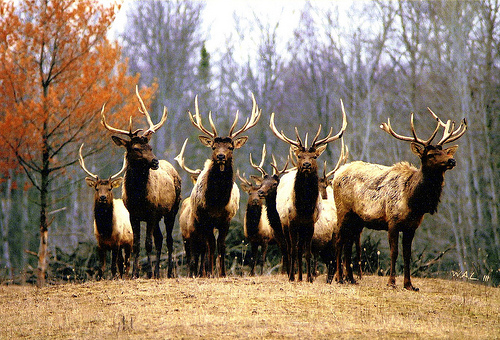
Got Rut?, photo by lonewolv / William A. LaCrosse III.
When I saw this picture (shot in Hillman, MI in 2004) I figured “elk farm.” However, as I looked into the subject I discovered that Michigan has a significant wild elk population. Michigan Elk: Past and Present from the Michigan DNR says:
Michigan’s native elk disappeared around 1875. Today’s elk herd dates back to 1918, when seven western animals were released near Wolverine. From that reintroduction, the number of animals grew steadily to about 1,500 elk in the early 1960s. They reached the point where limited hunting was possible in 1964 and 1965.
… Reduced poaching losses, habitat improvement and successful management of hydrocarbon development resulted in an increase in elk numbers to 850 by 1984.
As the herd grew, problems also increased with forest and agricultural damage. To bring the herd in better balance with its natural food supplies and with the needs of landowners, elk hunting resumed in 1984. Biologists estimated the January 2006 population to be between 800-900 animals. This goal is a winter herd of 800 to 900 elk.
The village of Atlanta claims the title of Elk Capital of Michigan and holds an Elk Festival every September (September 25-27, 2009). You can read more about the second largest species of deer (following only the moose) in Wikipedia’s Elk entry which has this to say about rut:
Adult elk usually stay in single-sex groups for most of the year. During the mating period known as the rut, mature bulls compete for the attentions of the cows and will try to defend females in their harem. Rival bulls challenge opponents by bellowing and by paralleling each other, walking back and forth. This allows potential combatants to assess the others antlers, body size and fighting prowess. If neither bull backs down, they engage in antler wrestling, and bulls sometimes sustain serious injuries.
Find even more elk info and photos under Cervus elaphus, elk (also: red deer; wapiti) from the University of Michigan Museum of Zoology’s Animal Diversity Web.
See this larger in William’s slideshow.

Ring-necked Pheasant, photo by palofmine2.
The All About Birds page on the Ring-necked Pheasant and Wikipedia’s Common Pheasant entry both note that the pheasant is native to Asia and is one of the most hunted birds in the world. If you’re interested, the Michigan DNR has information about Pheasant season and gamebird preserves.
You can see this photo larger in Renee’s excellent Birds slideshow.

2007 0300 Wolf on LakeMIUS2, photo by Dennis Raney.
Alexis writes Paw took this one of a wolf on Lake Michigan off US2 on the way back downstate. There was another wolf on the ice, but it didn’t make it into this frame It’s part of her very cool Michimania set (slideshow).
Wikpedia says the timber wolf, gray wolf or simply wolf is the largest member of the Canidae family. From the Michigan DNR page on the Gray Wolf (canis lupus) and a recent DNR release regarding the delisting of the gray wolf, we get a picture of the state of wolves in Michigan:
It is believed that wolves were once present in all 83 counties in the state of Michigan. A combination of European werewolf mythology, fairy tales, views that wolves were incompatible with civilization, and active predator control programs throughout the 20th century virtually eliminated the gray wolf from Michigan: by 1840, they could no longer be found in the southern portion of the Lower Peninsula; by around 1910 they had completely disappeared from the Lower Peninsula; and by 1960, when the state-paid bounty on wolves was repealed, they had nearly vanished from the Upper Peninsula.
In 2008, a minimum of 520 gray wolves lived in Michigan’s Upper Peninsula, part of an estimated population of 4,000 gray wolves living in Michigan, Minnesota and Wisconsin.
(DNR Director Rebecca Humphries) emphasized that while the gray wolf has been removed from the federal endangered species list, it remains on the state’s protection as a species. There currently is no hunting or trapping of gray wolves allowed in Michigan, and starting on April 22, the gray wolf will be listed as a nongame species in Michigan. In order for hunting to occur, the Michigan Legislature would need to pass a law to add the gray wolf to the list of game species in the state, she said.
You can get more about Canis lupus (gray wolf) from the University of Michigan Museum of Zoology’s Animal Diversity Web and check out pictures & sounds of the gray wolf from Wikimedia including this pic of a wolf print and these sounds from a wolf pack.
You might also want to check out this Absolute Michigan “Weird Wednesday” on the Giant Wolf of Flint by the author of Weird Michigan, Linda Godfrey.

Bothered, photo by Aaron Fortin.
Aaron writes that he spent an entire summer tracking 18 of these snakes around the park and watching their habits and where they went throughout the season. Lots of fun trekking through swamps, up hills, through shrubbery, etc. You can see more of his rattlesnake photos (slideshow) including a great shot of the rattler’s fangs. You might also enjoy this Michigan rattlesnake slideshow on Flickr!
The Michigan DNR says that the Eastern Massasauga Rattlesnake (Sistrurus catenatus catenatus) is Michigan’s only venomous snake. They say that Massasaugas are found throughout the Lower Peninsula, but not in the Upper Peninsula and that they are becoming rare in many parts of their former range, due to wetland habitat loss and persecution by humans. After reading Wisconsin’s very excellent page on the Massasauga Rattlesnake I’m also thinking that wild pigs are accounting for some of that drop. Remember that they are classed as an Endangered Species so don’t kill them! Here’s a few tidbits:
You can learn more about this snake at Wikipedia, Sistrurus catenatus and at Sistrurus catenatus (massasauga rattlesnake) from the University of Michigan Department of Zoology Animal Diversity Web.

Grand Sable Dunes In Winter, photo by mandj98.
James says they rode his brother’s snowmobiles back along H58 to this overlook of Grand Sable Dunes in the Pictured Rocks National Lakeshore last weekend.
 He has more photos from Pictured Rocks in winter & all seasons in his tremendous Pictured Rocks National Lakeshore set (slideshow) with tons of photos including the pic to the right of the same scene in August.
I was a little surprised to find that I hadn’t written anything about Grand Sable Dunes on Michigan in Pictures. In my opinion, it’s one of the most amazing vistas in Michigan, a broad sweeping dune that arcs along the shore of Lake Superior. It’s a great hike, either from the drive-up overlook (where you can view or visit the Au Sable Light Station) or by walking along the base on the Superior shore just a mile west from Grand Marais. Michigan Tech has a nice writeup on the history, geology and natural character of the Grand Sable Dunes. They’re a perched dune like the Sleeping Bear Dunes in lower Michigan that were formed when:
Glacial ice that melted within the Superior Basin produced many large rivers after the last major readvance, The Marquette readvance, in North America. These rivers deposited millions of tons of debris into many different configurations south of the Superior Basin. The Grand Sable Banks may have originated as a glaciofluvial kame terrace along one of these glacial rivers during deglaciation.
Pictured Rocks then became very dry about 9500 years before present due to the Lake Superior basin draining to the north. The outlets to the east were now the low spots. A north facing ice contact bluff and a platform to the south of it remained in place for 4500 years after deglaciation right around the area where Grand Marais is located today.
Isostatic rebound then occurred about 4000 to 6000 years before present. North Bay began to rise which caused water levels to rise rapidly. In fact, Lake Superior rose to about 40 feet higher than it is today! The rise in lake levels formed Lake Nipissing. Lake levels of Lake Nipissing also began to rise which caused the Grand Sable Banks to become unstable. From this point the formation of a perched dune can explain how the dunes formed from the Grand Sable Banks.
When Lake Nipissing water level rose it caused the Grand Sable Banks to become unstable. In turn, the high water eroded the bluffs which left them exposed to wind. A dominant northwesterly wind blew through the Grand Sable Banks which carried the wind from the bluff to the top of the flat upland. This sand was “perched” on top of the upland, hence the name, “perched dune system.”
You can check out Grand Sable Dunes on Absolute Michigan’s Map of Michigan and check out the Grand Sable Dunes slideshow on Flickr. I have written a fair amount on Pictured Rocks that you might enjoy.
 Michigan in Pictures
