Michigan Mushroom Nation!

The First Morels this Year  05/02/2010

The First Morels this Year 05/02/2010, photo by rickrjw

The TIME Magazine feature Mushroom Nation linked over to our feature on yellow chanterelle mushrooms. In it, James Beard Award–winning food writer Josh Ozersky takes a look at how wild mushrooms are becoming as American as apple pie. He writes that:

…for all their exoticism, they’re still pretty cheap. Even a mom-and-pop restaurant can make a mood-altering dish with some woodsy mushrooms, roasted up with salt and served along side a gelatinous hunk of braised short rib. A few fresh chanterelles in a little omelet with some small spring asparagus, and you’ve got an appetizer of unsurpassable elegance. Unlike their fetishized cousins the truffles, people still use mushrooms as staple items and not luxuries — a practice that might not persist if they become more popular. They add a level of flavor and texture to everything they touch, and there’s a variety for nearly every use, from the delicacy of enoki to the almost obscene potency of portobellos.

Compared with the crappy little button mushrooms you see at the supermarket, de-natured and nude, and grown somewhere far from the forest floor, they represent an instant ticket to a better vision of life. If a restaurant, you can charge for that; if cooking at home, you can brag on it. Either way, it costs little. And of course there are no calories to speak of in mushrooms, so even the most ascetic of eaters can consume them with abandon. They’re apparently loaded with various unpronounceable anti-oxidants too, so that’s another benefit.

Read on at TIME and find more about mushrooms on Michigan in Pictures. It won’t be long now before morels make their appearance in Michigan woods!

Rick bagged his first blonde morels in 2010 on May 2nd and says (with true morel hunter evasiveness) that he found them “in the woods”. See this photo background bigilicious and check out more in his Boyne City, Michigan slideshow.

Kent Lake in Kensington Metropark … and a photowalk

Panorama Kent Lake

Panorama Kent Lake, photo by ansonredford

In the Absolute Michigan pool on Flickr, Charles posted an announcement of a spring photo walk taking place this Saturday (April 16) at Kensington Metro Park in Milford:

The walk is hosted by Southeast Michigan Digital Photography group and will take place on the Kensington nature trails with a raffle and optional lunch afterwards. Spring is a beautiful time of year for local photographers to enjoy photography together. The event is free though a permit is required to enter the park, permit prices can be found in the event details at Southeast Michigan Digital Photography or at our Facebook group site.

I have hazy but fond memories of my grandmother taking me here to feed the carp Ritz crackers when I was little. The Huron-Clinton Metroparks page on Kensington Metropark says:

Kensington’s 4,481 sprawling acres of wooded, hilly terrain surrounds beautiful Kent Lake, and is home to an abundance of wildlife and waterfowl. Kensington Metropark offers a multitude of recreational activities throughout the year, from biking and boating to cross-country skiing and tobogganing. In addition to striking sunrises and sunsets, 1,200-acre Kent Lake offers plenty of fun activities: swim at Martindale or Maple beaches, get soaked at the Splash ‘n’ Blast, or just spend the day fishing, boating or picnicking along the water. Take a tour of the lake aboard the Island Queen II in the summer and fall. Or, enjoy a winter day ice-fishing or skating on frozen lake waters.

This first-class recreational area also features an 18-hole regulation golf course, 27-hole disc course, nature center, farm center, beautiful picnic areas and scenic hiking and biking trails for hours of enjoyment. With two and a half million visitors every year Kensington Metropark is a favorite place to enjoy Michigan’s natural treasures.

Donald took this photo a couple of weeks ago. Check it out background big and see a lot more photos in his Kensington Metro Park slideshow!

There’s even more photos that show the diversity of wildlife and scenery in this slideshow from the Absolute Michigan group!

Auto trail coming to Shiawassee National Wildlife Refuge

Shiawassee National Wildlife Refuge

Shiawassee National Wildlife Refuge, photo by Wigwam Jones.

The Great Lakes Echo has a feature by Emma Ogutu about a 7.5-mile auto trail through Saginaw County’s Shiawassee National Wildlife Refuge that opens in May (assuming the eagles cooperate).

“Everything will depend on a pair of eagles which built a nest just 50 feet off the road. It all depends if they start nesting early or late– it’s critical that we do not disturb them,” DeVries said (Ed DeVries, assistant manager of the refuge).

The gravel trail, which was completed in November, will be the second of its kind in the state, after one in the Upper Peninsula’s Seney National Wildlife Refuge.

Along the trail are two new observation decks with spotting scopes to assist visitors in viewing more birds, DeVries said. The refuge has also constructed a parking area to accommodate the anticipated larger amount of traffic and a new fishing and canoe access site along the Spaulding Drain.

“Previously we had only one day in September where tourists were allowed to drive in the refuge,” DeVries said. “With the new trail, it’s going to be possible for more people to view a wider variety of birds and other wildlife throughout spring and summer seasons.”

The Shiawassee refuge was established in 1953 to protect and increase the breeding of migratory birds and other wildlife. The refuge includes marsh areas, swamps, bogs, grasslands and forests and has one of largest and most productive wetland ecosystems in the state, according to the service.

Learn more about the Shiawassee National Wildlife Refuge.

Check Wigwam Jones’ photo out background big and in his Shiawassee National Wildlife Refuge slideshow.

New Year’s Resolution Case Study #77: The Tufted Titmouse

Im not Fat, Im Fluffy!

Im not Fat, Im Fluffy!, photo by Spring Noel.

All About Birds says that the Tufted Titmouse is common in eastern deciduous forests and a frequent visitor to feeders. They eat mostly insects in the summer but aren’t above seeds, nuts, and berries and (in the case of this fellow) cheesecake and jelly donuts. Fun facts:


  • Experiments with Tufted Titmice indicate they always choose the largest seeds they can when foraging. (see above)
  • Tufted Titmice hoard food in fall and winter, a behavior they share with many of their relatives, including the chickadees and tits. Titmice take advantage of a bird feeder’s bounty by storing many of the seeds they get. Usually, the storage sites are within 130 feet of the feeder. The birds take only one seed per trip and usually shell the seeds before hiding them.
  • Tufted Titmice nest in tree holes (and nest boxes), but they can’t excavate their own nest cavities. Instead, they use natural holes and cavities left by woodpeckers.
  • Tufted Titmice often line the inner cup of their nest with hair, sometimes plucked directly from living animals. The list of hair types identified from old nests includes raccoons, opossums, mice, woodchucks, squirrels, rabbits, livestock, pets, and even humans.
  • The oldest known wild Tufted Titmouse lived to be 13 years 3 months old.
  •  

Check out Birding in Michigan’s Ode to the Tufted Titmouse and see more birds on Michigan in Pictures.

See this bigger in Spring’s Birds slideshow.

Short Eared Owl

P1090935

P1090935, photo by Sherri & Dan.

The Short-eared Owl – Asio flammeus entry at Owl Pages says:

A Danish bishop and amateur naturalist, Erich Ludvigsen Pontoppidan, published the first description of this Owl in 1763. In Latin, the word “flammeus” means fiery, flaming, or the colour of fire. Local names for the Short-eared Owl include the Evening Owl, Marsh Owl Bog or Swamp Owl, Grass Owl, Meadow Owl, Mouse-hawk, and Flat-faced Owl.

The Short-eared Owl is a medium-sized Owl. The plumage is buffy brown with dark streaks on the chest, belly, and back. Males tend to be lighter in colour than females. This colouring provides good camouflage, but if this fails, a Short-eared Owl will feign death to avoid detection. The wings and tail are strongly barred. The yellow eyes are circled with black and set in whitish or buffy-white facial disks, which are suffused with a ring of brown. The bill is black. The head appears round without ear tufts, but at very close range small ear tufts are visible. In flight, the dark “wrist” on the underwing is the key field mark.

Check it out background big and in see more great shots of this bird in Sherri & Dan’s Animals slideshow.

The Bird Girl

The Bird Girl Angie

The Bird Girl Angie, photo by sharona 315 사론아.

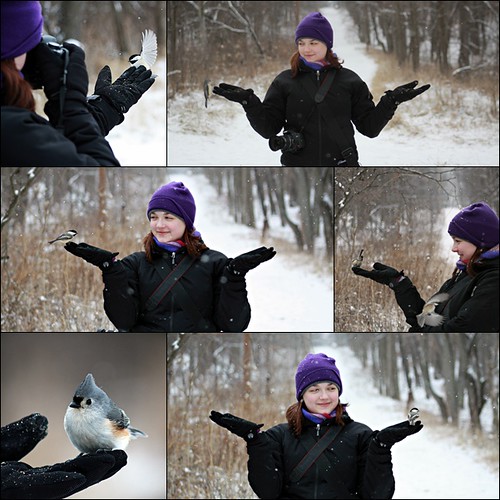
Michigan in Pictures has a lot of Michigan birds but nothing quite like Angie!!

Check this out bigger in Sharon’s Winter slideshow.

Rough-legged Hawk (Light Morph)

rough-legged hawk light morph

rough-legged hawk light morph, photo by Sherri & Dan.

Bird Web’s entry on Rough-legged Hawks (Buteo lagopus) says these birds:

…are variable in plumage, with light and dark color phases and variations in between. Dark phases account for only ten percent of western Rough-legged Hawks. Adults are generally mottled light-and-dark underneath, with dark patches at the wrists. Seen from below, the tails of both phases appear light with a dark terminal band. Seen from above, both phases appear mostly dark, but the light phase shows a light tail with a dark terminal band, and the tail of the dark phase appears dark all over. The adult male can have several dark bands at the tip of its tail as compared to the female, which only has one band. The light phase has a distinctive light-colored head, in contrast to its dark upperside. The Rough-legged Hawk’s bill and feet are relatively small.

Read more about these hawks at Rough-legged Hawk (Dark Morph) on Michigan in Pictures.

Check this out background big and in Sherri & Dan’s Animals slideshow.

Many more Michigan birds on Michigan in Pictures!

Ambience – Tannery Falls (Pictured Rocks National Lakeshore – Upper Michigan)

Ambience - Tannery Falls (Pictured Rocks National Lakeshore - Upper Michigan)
Ambience – Tannery Falls (Pictured Rocks National Lakeshore – Upper Michigan), photo by Aaron C. Jors

This was supposed to run on Saturday but I guess I didn’t hit the right buttons. One thing that I did so right was pick a time to visit the Pictured Rocks. Almost everywhere we went, we were the only people. Late November is definitely a time to visit if  you want to experience the Lakeshore more or less by yourself!

Aaron has done an amazing job capturing the magic of the Pictured Rocks National Lakeshore.

See it bigger in his Michigan slideshow.


Crane Fest: Sandhill Cranes at Baker Sanctuary

Crane Fest

Crane Fest, photo by .jowo..

Joel says that last weekend the Michigan Audubon Society and Battle Creek Kiwanis hosted Crane Fest at Baker Sanctuary, near Bellevue. The event celebrates the annual fall migration of the Sandhill Crane. While we’ve missed that, he writes:

Thousands of Sandhill Cranes gather at Big Marsh Lake every evening in October. Well worth your evening.

What my camera cannot capture is the glorious racket these large birds make. Absolutely incredible.

Shot from the Kiwanis Youth Area, which will be open from 4 to 7 every Saturday and Sunday in October. If you can’t make the festival, you can still see the spectacle. Go. You’ll enjoy!

Check this out background boomtacular and in his Baker Sanctuary slideshow.

Michigan Mushroom Season is here … join a public hunt to know what’s edible!

_MG_9261

_MG_9261, photo by jt354.

I’m a year older and a little wiser and pretty sure these are edible honey mushrooms, although I’m not sure about the darker brown bumps. Still a fantastically vital idea to know what you’re picking and eating!!

While morels draw the lion’s share of mushroom coverage, there are a ton of edible mushrooms out in the woods right now. The other day I had some fantastic Oyster mushrooms. Can you eat the mushrooms pictured here? Who knows? One thing is for certain, if you aren’t sure, don’t eat it!!

One way to learn what you can and can’t eat is to join a public mushroom hunt through the Michigan Mushroom Hunters Club. These hunts are held throughout the year and all around the state and offer a chance to tour the woods with a knowledgeable guide.

Check this photo out bigger in James’ Pictured Rocks slideshow!