Coywolves: Coyote & Wolf hybrids in Michigan

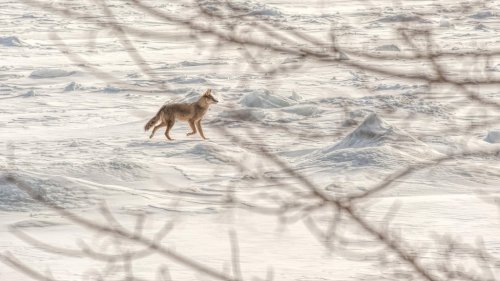
Coyote on Ice by Jakphoto

Hunting on Ice, photo by OnceJakPhoto

The Freep has an article about a new animal that is being seen in Michigan titled Michigan’s mysterious, misunderstood coywolves:

…a unique, still relatively unknown and misunderstood hybrid of coyotes known as eastern coyotes or coywolves. They’re mostly coyote, but contain a small percentage of wolf from an unlikely mating of the two species about a century ago. It may sound like an urban legend, but coywolves exist throughout the northeastern U.S. and eastern Canada, and have been confirmed in northeast Lower Michigan through blood-testing and DNA analysis.

Coywolves tend to be a little larger and heavier than their western coyote counterparts, but still well below the size of even the smallest North American wolves. They look like coyotes, though observers often note wolflike characteristics in their faces and fur.

…Coyote expert Stan Gehrt, a professor of wildlife ecology at Ohio State University, rejects the term “coywolf.” He doesn’t even like referring to them as hybrids. It leaves the impression that they are a near 50-50 mix of wolf and coyote, and that just isn’t the case, he said.

“They are eastern coyotes,” Gehrt said. “They aren’t really different from other coyotes, other than they have a little bit of genetic difference. I’ve trapped and tracked hundreds of Midwestern coyotes and a pretty good sample of eastern coyotes in Nova Scotia, and I wouldn’t be able to tell the difference between the two.”

But those, including biologists, who encountered coywolves up close in the Lower Peninsula say they had some wolflike features.

Read on for more including a photo of an actual Michigan coywolf. If you think you’ve seen a coywolf, you can report it online through the DNR or by calling the DNR’s Gaylord office at 989-732-3541, ext. 5901.

If you’re interested in learning more, Meet the Coywolf from PBS’s Nature is a cool profile of this animal that you can watch online for free.

Jim caught this photo of a coyote on the ice of Grand Traverse Bay last week. View it bigger on Flickr and jump into his slideshow for more icy goodness.

More Michigan wildlife on Michigan in Pictures.
Fireproof? Michigan’s bald eagles full of flame retardants

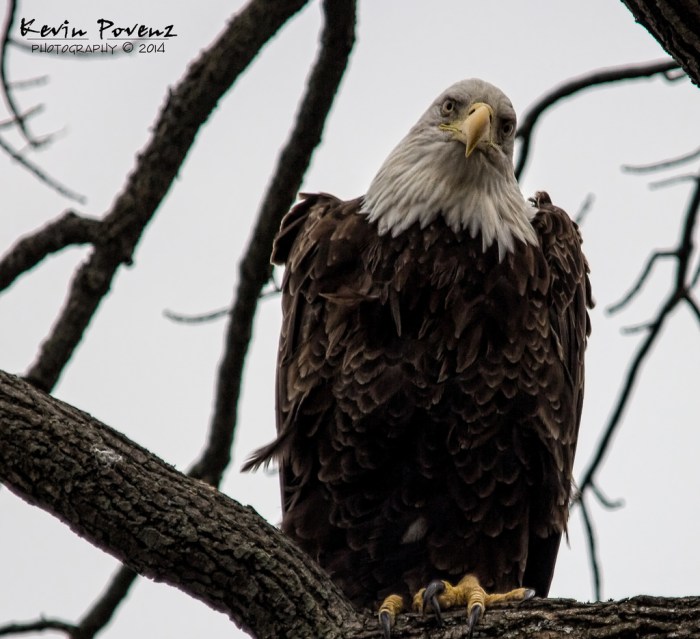
Bald Eagle by Kevin Povenz

Bald Eagle, photo by Kevin Povenz

Sorry. I like to start the weekend on a better note usually, I hope you have a good one.

Environmental Health News recently ran a story bluntly titled Michigan’s bald eagles full of flame retardants. It says (in part):

Michigan’s bald eagles are among the most contaminated birds on the planet when it comes to phased-out flame retardant chemicals in their livers, according to new research.

The study, published last month in the Journal of Great Lakes Research, found that the top predators in the Great Lakes are highly exposed to banned flame retardants, still widespread in the environment.

Michigan’s population of bald eagles is stable, but the compounds have been linked in other birds to impaired reproduction, weird behavior and development, and hormone disruption.

“While the sensitivity of eagles to PBDEs has yet to be determined, there is a possibility that the exposures reported here may be associated with sub-clinical effects,” Nil Basu, an associate professor at McGill University who led study while at the University of Michigan, said in an email.

More than four decades ago, companies started putting polybrominated diphenyl ethers, PBDEs, into furniture cushions, electronics and clothing in an effort to slow the spread of flames if they catch fire.

…The chemicals “are everywhere,” Basu said. “They build up in the food chains so that top predators – such as bald eagles – accumulate high levels.”

Flame retardants have been found in birds all over the world – from the United States to China.

Read on for lots more about a sad story for these amazing animals. Oh, and don’t forget. Humans are a “top predator” too!

About this photo from last November, Kevin wrote:

Went down by the Grand River to see if any eagles were around. Now the conditions were not the greatest, quite windy, grey overcast skies and light mist in the air. But I haven’t been out all day so I said to myself that I just got to do this. Well I got to see the Eagles and this one just looked at me with the expression like “why are you here on such a crappy day”

Kevin is far and away the master bald eagle photographer in the Absolute Michigan pool on Flickr – heck, I just featured one of his eagle photos a couple of weeks ago. View his photo bigger and see many more of his really great Michigan bald eagle photos on Flickr.

Lots more about bald eagles on Michigan in Pictures.

Happy Groundhog Day, Michigan!

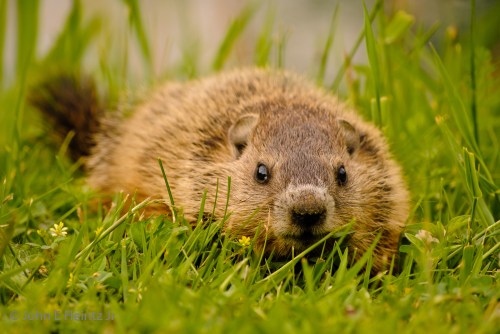
Michigan Groundhog
Young Groundhog, photo by John E Heintz Jr

Happy Groundhog Day everyone! We’re hoping that folks in the southern part of the state are digging out all right!

Michigan has native groundhogs, also known as woodchucks, whistle-pigs, or land-beavers. You can learn all about them from the University of Michigan Animal Diversity Web under Marmota monax (woodchuck) which says (in part):

Woodchucks have numerous common names, including ground hog, and whistle pig. The word “woodchuck” is a misinterpretation of their Native American name “wuchak”, which roughly translates as “the digger”. Groundhog Day occurs when Punxsutawney Phil, a captive woodchuck held in rural Pennsylvania, is awakened from hibernation in order to determine if he will see his shadow. According to the legend, if he sees his shadow there will be 6 additional weeks of winter. If he does not see his shadow, legend predicts an early spring.

The legend of Groundhog Day is likely due to the fact that woodchucks often re-enter hibernation after emerging from their dens prematurely.

We all know about Punxsutawney Phil, but have you heard of Michigan’s Official Groundhog? Her name is Woody, and she lives at the Howell Conference & Nature Center and unfortunately is battling a severe respiratory infection so her alternate Murray will stand in if she’s unable to perform her official duties at 8:15 today.

Woody correctly forecast six more weeks of winter weather on February 2, 2014, much to the chagrin of close to two hundred shivering attendees of that Sunday morning’s Groundhog Day festivities.

Last year’s prognostication, her sixteenth, was made crystal clear by her outright refusal to even leave her home. With temperatures at the Nature Center hovering in the low 20′s and several inches of snow on the ground, the clairvoyant chuck’s behavior was interpreted as just another sign of her wisdom.

Read on for more.

View John’s photo bigger and see lots more backyard wildlife in his ANIMAL PHOTOGRAPHY slideshow.

Costa’s Hummingbird #0001

Costa's Hummingbird - Michigan

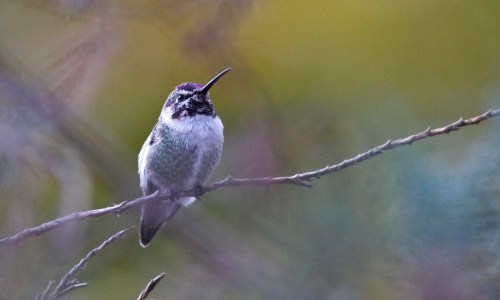
Costa’s Hummingbird, photo by Zak Pohlen

The other day I was browsing through the Sleeping Bear Birding Trail (SBBT) website and I came across a report that in November of 2014, the first Michigan sighting of a Costa’s Hummingbird was recorded. They write:

Michigan’s first Costa’s Hummingbird was found at the feeder of Jan and Ron Joslyn in Onekama just at the start of the SBBT off from M-22. The bird had been coming to the feeders for a couple weeks when the Joslyn’s called the Lake Bluff Audubon center concerned about the cold weather and the bird’s future.

I stopped at the Joslyn’s on Saturday November 1st and literally got weak in the knees when the bird appeared at the feeder and showed its purple gorget. I knew this was a first state record and with help from Caleb Putnam, Adam Byrne and Allen Chartier we were able to ID the bird.

Read on for more about the bird and also see this news report.

Where the story gets even cooler is that I went to Flickr and was able to find this photo of the bird, which Zak allowed me to feature. View it bigger and see more in his Birds of Michigan slideshow.

You can see more shots of the hummingbird on Flickr including several from Allen Chartier.


Home Improvement: Bald Eagle Edition

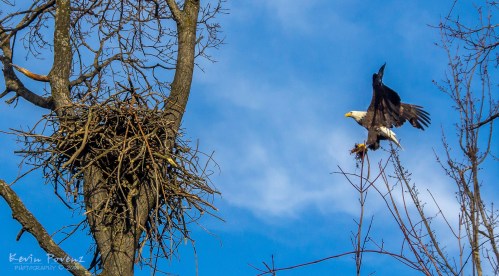
Nest Builder by Kevin Povenz

Nest Building, photo by Kevin Povenz

Kevin took this shot of a bald eagle building a nest in late December near the Grand River in Ottawa County. The State of Michigan’s page on bald eagles says (in part):

During Michigan winters, bald eagles are seen throughout the state (almost all counties), while they nest mainly in the Upper Peninsula (especially the western portion) and the northern portion of the Lower Peninsula. These eagles don’t really migrate, they just move south enough to stay ahead of the ice and congregate near open water. Immature birds may move further south.

When bald eagles reach maturity (at four to five years of age), they select a mate, with whom they probably mate for life. In captivity, they have been known to live to 50 years, but in the wild, they probably don’t reach much more than 20 years of age.

The beginning of the breeding season, from mid-February to mid-March, consists of the establishment of a territory, nest building and mating displays. The mating “cartwheel” display begins high in the air with the two birds darting and diving at each other, until they lock talons and drop in a spinning free fall, until the last possible moment when they separate. The nest is usually located in the tallest tree in the area, often a white pine or dead snag. They are usually made of sticks with a lining of grass and moss. Nests may be added to each year until they reach enormous sizes, up to ten feet in depth and 20 feet across.

Read on for more and have a look at this encouraging chart of the steadily rising number of eagle nests in Michigan. Also check out this page of bald eagle sightings in Michigan for ideas of where to look near you!

View it bigger on Flickr, get more pics of these eagles at his Grand River North Ravines tag and see more in his Birds of Prey slideshow.

More eagles on Michigan in Pictures!

Snowy Topper

Michigan Snowy Owl Winter

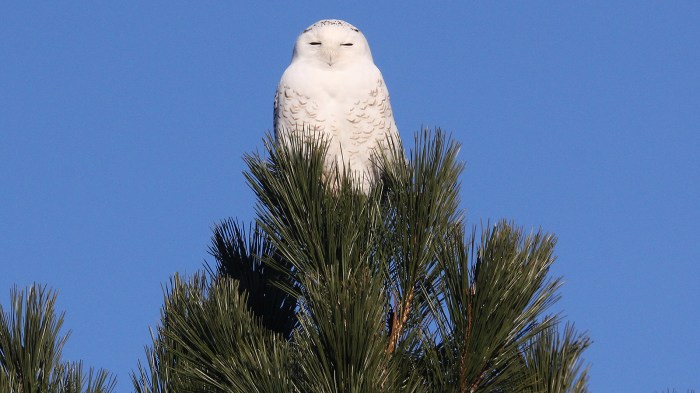
snowy12-28-4, photo by Dan Lockard

What’s on top of your tree this year? Right now in the Absolute Michigan photo group, we’re seeing a ton of snowy owls. While these arctic owls are not found in the summer, we are in their winter range, as the Michigan DNR’s Winter Visitors page shares:

Just because the leaves have fallen from the trees and there is a chill in the air is no reason to put away your binoculars. Winter offers unique viewing opportunities. Many of our summer resident birds migrate to warmer summer climates. Still, there are several species of birds that migrate from Canada and find Michigan the perfect winter temperature. Winter is the only time several of these species can be found in Michigan.

Two of the largest migrants are the snowy owl and the great gray owl. Snowy owls can be found moving into Michigan during winter when the food supply on the arctic tundra is in short supply. Snowy owls have been recorded as far south as Lansing, Michigan. Because they rarely see humans on their northern homes, they are not timid and can be easily viewed for long periods of time.

Friday’s Sault Star reported that about three dozen snowys were sighted during the annual Audubon Christmas Bird count on December 20th. That’s more than average. We’ll know if this is an irruption year after all the bird count numbers are released in January.

View Dan’s photo taken near Muskegon background big and see lots more (including a couple shots of the great gray owl) in his awesome Owls slideshow.

Lots more snowy owl pictures & information (including a couple more by Dan) in the Michigan in Pictures archives!

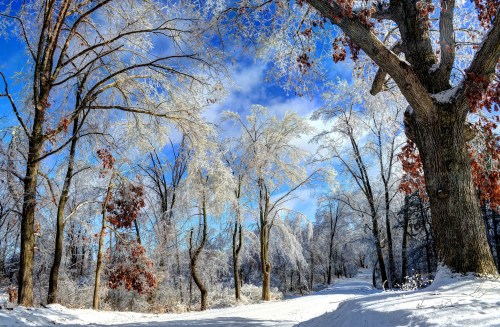
Winter Wonderland

Winter Wonderland

Winter Wonderland, photo by Rodney Campbell

Rodney took this photo on Christmas Eve day last year at the Seven Ponds Nature Center in Dryden.

View it background bigtacular and see more in his Landscapes slideshow.

More winter wallpaper on Michigan in Pictures!


Biodiversity is not a dirty word

Piping Plover

Untitled, photo by Anna Lysa

Sorry to mess up your holiday week with a bit of advocacy on the behalf of Michigan’s natural environment, but yesterday via Michigan Radio I learned of the very disturbing Senate Bill 78 that’s headed to Governor Snyder for signature or veto. The bill would forbid DNR from preserving biodiversity in forests and parks:

More than 130 scientists and the state’s environmental groups are calling on Gov. Rick Snyder to veto a bill they call anti-science. The bill would forbid the Michigan Department of Natural Resources from protecting native wildlife and plants on the pure merits of protecting nature.

  • The bill would prohibit the Department of Natural Resources from managing state lands for biodiversity.
  • It would prohibit the agency from managing forests for restoration.
  • It would end work to eliminate invasive species.
  • It would strike from the law the finding that most losses of biological diversity are the result of human activity.

Read on for more, and here’s the text of Senate Bill 78. If you’re so inclined, feel free to tell Gov. Rick Snyder what you think. I know that messages to our elected officials really do make a difference.

View Anna Lysa’s photo from July of 2012 at Ludington State Park bigger and see more in her Michigan slideshow.

PS: As I read it, piping plover would not be impacted by this as the species with just 8,000 adults is federally protected. I just picked them because they’re a recognizable species that has benefitted from extensive preservation efforts, some of them in the Sleeping Bear Dunes National Lakeshore in Michigan.

Here’s the piping plover and more of Michigan’s endangered plants and animals on Michigan in Pictures.

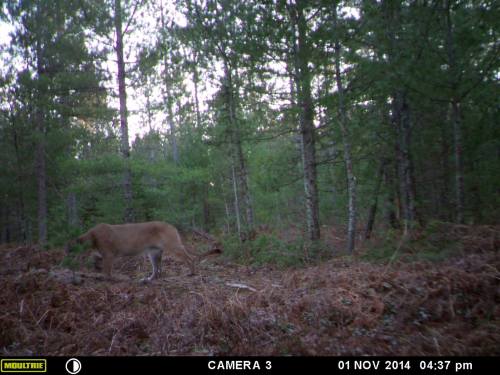
Cougar Cam Confirmation

Cougar Cam

Confirmed Cougar, photo by the Hiawatha Sportsman’s Club

It was just a few years ago that the Michigan DNR vehemently denied the presence of cougars in Michigan, but things have definitely changed. Regarding this photo taken November 1st by an automatic trail cam in the Hiawatha Sportsman’s Club (located near Engadine in the southern Upper Peninsula), the Club writes:

This photo was confirmed by the DNR on November 3rd. The location is the area of S-trail / A-trail, east towards the perimeter of HSC property.

Click to view it big as a cougar and see more photos at the HSC Facebook page including some more trail cam shots and few shared by Denise Conroy of a cougar on someone’s porch near Cedarville!

Follow the whole Michigan Cougar Controversy on Michigan in Pictures.

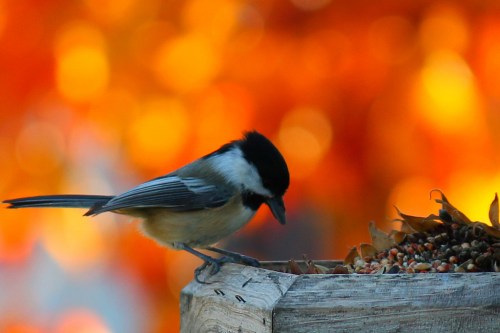
Fall Chickadee

Fall Chickadee

Fall Chickadee, photo by kdclarkfarm1

The UM Animal Diversity Web’s entry for Parus atricapillus (black-capped chickadee) says in part:

Black-capped chickadees prefer deciduous woodlands, open woods and parks, cottonwood groves, and willow thickets. They are most commonly seen near edges of wooded areas. They are a frequent visitor to backyard feeders. Black-capped chickadees nest in cavities, usually in dead trees or stumps, and are attracted to habitats with suitable nesting locations. During the winter, small flocks of black-capped chickadees can be found in dense conifer forests.

…Black-capped chickadees hop on trees (occasionally on the ground), rather than “walking.” These birds are very active during the day, and can often be seen foraging upside-down. Black-capped chickadees form monogamous pairs which usually stay together for several years. The black-capped chickadee social system has two extremes, one shown by territorial pairs during the breeding season, and the other consisting of non-breeding flocks. These are often mixed species flocks including nuthatches, woodpeckers, kinglets, brown creepers, warblers, and vireos. Black-capped chickadees perform short-distance migrations, but remain in the same general region throughout the year.

Read on for lots more including photos and chickadee calls.

View Diane’s photo background big and see lots more autumn goodness in her Fall slideshow.

More birds and more Fall wallpaper on Michigan in Pictures.