Linden Mills on the Shiawassee River

Linden Mill, photo by Patrick T Power

MichMarkers.com has the text from the historical marker at Linden Mills in the village Linden (also a map).

The Linden Mills were a vital source of this village’s economic growth. The first mill, located on land granted to Consider Warner, was used to cut lumber. From 1845-1850 Seth Sadler and Samuel W. Warren, local residents, erected both a saw and grist mill. Operating along with the earlier facility, this complex was called the Linden Mills. The grist mill continued to function for over a century until the machinery was dismantled and sold at auction in 1956. The village then purchased the building for municipal offices and a public Library.

Today the mill is the site of the Linden Mills Historical Museum.

Memorial Day 2008

Memorial Day 2008

Memorial Day 2008, photo by mikeh5856.

Michael says that this was taken at Greenfield Village yesterday during their Civil War Remembrance. More are in his Greenfield Village set (slideshow).

In cities and town all across Michigan, people are remembering men and women who served our state and nation over the years.

I hope you can take the time to remember them today, and also to think about those who are serving now.

Chromatic: Gilmore Car Museum

Chromatic

Chromatic, photo by pairadocs.

Vince made his first visit to the Gilmore Car Museum in Hickory Corners. He says that he spent so much time drooling over the pretty cars, that didn’t stop to take note of what all of them were.

It looks like that would be easy to do:

The Gilmore Car Museum began in 1963 as the hobby of Donald S. Gilmore when his wife, Genevieve, gave him an antique car for his birthday – a 1920 Pierce-Arrow “project car”. With the help of some friends, the auto was placed under a tent and a full restoration followed. The hobby soon grew into a collection of over 30 automobiles. Mr. Gilmore purchased 90 acres of farm property and had several historic barns dismantled piece by piece and moved to the site. It was Mr. Gilmore’s wife who suggested the idea of turning the collection into a museum where future generations could enjoy the restored cars for years to come…

Today, the site includes eight historic barns, a re-created 1930s service station, a small town train station, and nearly three miles of paved roads. It isn’t uncommon for guest to catch a glimpse of one of the vintage cars or the authentic London double-decker bus in motion. And if you visit on a weekend or special show, don’t be surprised if the driver asks you to hop in for a nostalgic road trip!

Today the Gilmore Car Museum houses almost 200 cars, from a 1899 Locomobile to the classic Duesenberg and Tucker ’48 and all the way up to the muscle cars of the 60s and 70s. museum is located between Grand Rapids, Kalamazoo & Battle Creek and is open daily from 9 AM – 5 PM (6 on weekends), May through October and hosts a number of great events throughout the summer and fall.

Be sure to view the above photo larger and here’s a bunch more photos from the Gilmore Car Museum on Flickr (slideshow).

elegance at the Walter P. Chrysler Museum

elegance

elegance, photo by ryan.s o u t h e n.photography.

Ryan writes:

Dave was nice enough to arrange a little photo trek over to the Walter P. Chrysler Museum in Auburn Hills to take some shots of classic Chrysler cars and the museum. Larry, Mike, and Laura also came along and it was a real fun time. Cars arent really my thing and I had never shot them before so I looked at this trek as more of a challenge and opportunity to try some new things. I think I got some good shots and had a great time in the process. Not a bad way to spend a dreary Saturday.

I didnt even pay attention to what automobile this was but I loved the grill and lines and had to photograph it. Im pretty pleased with how this turned out, in fact it may be my favorite shot I took from the entire trek. If anyone happens to know what car this actually is I’d love to know.

You can check this photo out larger, on black and see more photos from Ryan at Ryan Southen Photography. Also check out this slideshow of photos from the Walter P. Chrysler Museum on Flickr

The Walter P. Chrysler Museum is located on the Chrysler Headquarters campus in Auburn Hills. Their web site has a lot of info about the history of Chrysler including this nifty Chrysler Chronology.

More posts about cars on Michigan in Pictures.

Propeller and some Henry Ford HDR

Propeller

Propeller, photo by country_boy_shane.

Shane says …if you view this large, you can see many signatures on the right-most blade. Talk about neat stuff you can find with your camera! Here it is large and on black.

He has a set of photos from his trip to the Henry Ford Museum and he went with several other photographers, most of whom were shooting HDR. See their collected work in this very cool slideshow.

Here’s the web site for The Henry Ford Museum & Greenfield Village.

The Octagon House

wash up

wash up, photo by n.elle.

Nicole writes:

a few of us from exposure detroit took a road trip up to the northern burbs and further. some poked fun that i wanted to stop at the octagon house, but i think it’s a pretty cool building.

tucked behind the octagon house were a few old barns. sitting out it front of one of them was this old claw foot tub and sink. just in case you need to wash up.

The Friends of the Loren Andrus Octagon House say that in 1828, Loren traveled with his father to find a new home in the Territory of Michigan, settling in Washington Township in Macomb County. In 1858 with the help of prominent architect and brother-in-law David Stewart and using Orson Squire Fowler’s book about the wonders of 8-sided houses, A Home For All, Andrus built the Octagon House as his entry in a home-for-show contest between several families to see who could build the most unusual house. He won.

The Octagon House is Italianate in style, surrounded on six sides by a Corinthian-columned porch. A cedar shake shingled roof, with elegant scrolled brackets, supports the octagonal cupola. The house has eight sides with eight-foot windows letting daylight fill the interior. The interior is centered around a dramatic, 55-step cantilevered spiral staircase which winds from the first floor to the third story cupola.

The Friends of the Loren Andrus Octagon House was formed to preserve this structure (which is on the National Register and you can learn a lot more about it, see a slideshow and help them to save the old barns.

Here’s an entry for The Octagon House on the Absolute Michigan map of Michigan.

Exploring the Florida in the Thunder Bay National Marine Sanctuary

Diver exploring the wreck of the Florida

Exploring the Florida, Thunder Bay National Marine Sanctuary

The Thunder Bay National Marine Sanctuary encompasses almost 450 square miles of Lake Huron’s bottomlands off Alpena. It is the thirteenth national marine sanctuary and was established in 2000 to protect a nationally significant collection of nearly 200 shipwrecks, spanning over a century of Great Lakes shipping history. Thunder Bay is the first Great Lakes sanctuary and also the first to focus solely on a large collection of underwater cultural resources. The headquarters of the Sanctuary is the Great Lakes Maritime Heritage Center in Alpena.

The photo above is one of many awesome underwater photos of the Florida and other shipwrecks that can be viewed in their Fieldwork 2007 Gallery. Seriously, this is cool – go look at it and be sure to click the “slideshow” view at the top left to see the larger sized images.

Dave Swayze’s amazing Great Lakes Shipwrecks File includes information on 4,760 great lakes shipwrecks. It says that on May 21, 1897 in dense fog off False Presque Isle, the 271′ package freighter Florida, one of largest boats on the Great Lakes, collided with one of the few that was larger, the steamer George W. Roby. The Roby rescued her crew, but with a large hole in her starboard side, the Florida sank in just 12 minutes in 250′ of water.

There’s more information on the Thunder Bay National Marine Sanctuary and Underwater Preserve over at Absolute Michigan.

Brood XIII Cicadas in SW Michigan?

After 17 years?

After 17 years?, photo by mfophotos.

The Magicicada are the genus of the 13- and 17- year periodical cicadas of eastern North America who display a unique combination of long life cycles, periodicity, and mass emergences. They are classified according to “Brood” and 2007 is the year of Brood XIII, on a 17-year cycle and also known as the Northern Illinois Brood. Wikipedia’s Brood XIII page has a nice picture of the cicadas of this brood.

While Wikipedia and the U-M’s Museum of Zoology cicada page say that Brood XIII has a presence in southwest Michigan, retired University of Michigan entomologist and cicada expert Thomas Moore says (Freep article) that overeager graduate students and sloppy work by a 19th-Century government scientist and irresponsible replication are responsible for the erroneous perception that Brood XIII may make an appearance in Michigan.

Mark O’Brien comments that it’s unfortunate that Tom Moore was quoted as dismissing the work by former UMMZ graduate students John Cooley and David Marshall (who created the useful pages and did state that the maps are “approximate”). On his blog, Six-legged Wonders, Mark has a post about Brood XIII in Michigan where he says:

What needs to be done is to get modern records. Researchers tend to go to where previous records show emergences. So, if you know that Lake County, Illinois has 17-yr cicadas, that’s where you go if you have limited time to do experiments, etc. I don’t doubt that there may have been 17-yr cicadas at some point in SW Michigan — especially inland away from the sand dunes. However, the area has been heavily agriculturized over the past 100 years, and some areas have also gone back to woods. Have small pockets of Magicicada survived? The only way to know is to go and traverse the area and listen. Lacking that… if you live in that area of the state, tell me that you have them and show me the specimens. It would be nice to know, either way. The next emergence would be in 2024. I’m going to be an old man by then.

You can get a ton more information about the cicadas of Brood XIII (and others) including lots of photos and video and all your Brood XIII gear at Cicada Mania.

The Argus Camera Company of Ann Arbor, Michigan

Hey Argus fans – here’s a post with information about the Argus Museum and an event they are having!
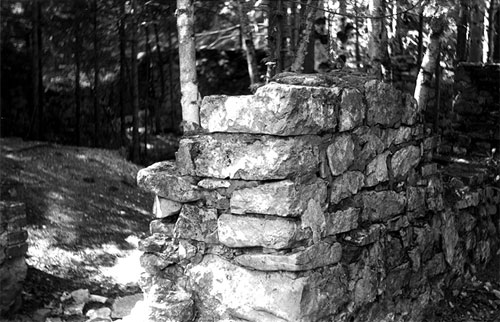
Old Foundation by Mark O’Brien

Lighthouse ruins at Cheboygan State Park, MI, taken with Argus C3 by Mark O’Brien

It’s apparently O’Brien week here on Michigan in Pictures. Yesterday we had a photo from Marjorie and then I received an unrelated email from her dad. He was passing along a request from Bob and Mary Kay Berg of Palindrome Productions:

Our production company, Palindrome Productions, is working on a short film about the Argus Camera Company, originally based in Ann Arbor, MI. To supplement our video footage, we are currently looking for still photos taken by Argus cameras models from 1936 to 1960.

If you have family photos (everyday events, family vacations, recitals, holidays) or photos of Ann Arbor, please contact us no later than Friday, April 13, 2007 at palindromevideo@aol.com.

I’ve never been one to look a gift blog post in the mouth, so without further delay – and with copious thanks to Mark for the links – I bring you:

About the Argus Camera Company of Ann Arbor, Michigan

Argus C3 by Luke HWikipedia’s very much incomplete entry on the Argus Camera Company says:

Argus is an American maker of cameras and photographic products, founded in 1936 in Ann Arbor, Michigan. Argus originated as a subsidiary of the International Radio Corporation (IRC), founded by Charles Verschoor. Its best-known product was the C3 rangefinder camera, which enjoyed a 27-year production run and became one of the top-selling cameras in history. The company’s Model A was the first low-cost 35 mm camera in the United States.

The link above for the Argus C3 (aka “The Brick”) is much more complete and says the simple design and ready availability of the C3 makes it widely used even today. While that entry says the C3 was responsible for establishing 35mm, Stephen Gandy of CameraQuest hands that title to the first camera Argus made – the Argus A, declaring:

Argus SS Notches by ReyGuyIn MY always not so objective mind at least, the Argus A is undoubtedly the 2nd most important 35mm camera of all time– second only to the Leica A. If you think about it, that’s a pretty amazing legacy for a simple little Bakelite camera from a Michigan USA radio factory. It really is.

How does Argus deserve this impressive ranking? Easy, they bribed me. Unfortunately, not with money. Argus paid me off in Photographic Heritage. Building on the astounding sellout success of the Argus A, Argus sold MILLIONS of Argi, thereby establishing 35mm as the serious Amateur’s film format of choice in the largest photography market in the world, America.

If you are interested in repairing, collecting or just learning more about any of the Argus camera models and their accessories, look no further than the Argus Collectors Group. You can get a quicker overview of the Argus line over at Mark’s Argus Cameras Page. Mark also took visit to the Argus Museum located at the old Argus Factory in Ann Arbor and (go figure) he took some photos.

There are a TON of very cool Argus camera advertisements (I learned that Galileo was a 17th century Argus and am definitely going to get an Argus A to take to the next World’s Fair), some detail shots of the cameras on his projects page and the results of a Spring Fever Argus photo contest over at Alexander Rawles argoflex.com. Speaking of photos , you can see some shots of the camera and from the cameras in the Argus Rangefinders Group on Flickr.End of the gumshoe's day by Olivander

You might also want to check the local bookstore for a copy of Argomania: A Look At Argus Cameras And The Company That Made Them by Henry Gambino. The promotional copy explains:

Argus’ founder, Charles Verschoor, did not establish an empire, as did George Eastman. Nor did he enjoy a particularly long tenure as the head of the company he founded. Unlike Oscar Barnack, he did not invent anything particularly new, yet he had a tremendous impact on the photographic industry. He revolutionized the scope of the industry, not only from a technical standpoint, but even more so from a marketing perspective.

Additional photo credits:

Argus C3 by Luke H

Argus SS Notches by ReyGuy (part of a great set of detail shots of Argus cameras)

End of the gumshoe’s day by Olivander

Diego Rivera With Patrons

Diego Rivera With Patrons

Diego Rivera With Patrons, photo by anikarenina.

anikarenina asks Is your cultural institution incendiary?

I assume that’s a reference to the incendiary art of Diego Rivera. The Detroit Institute of Arts is home to one of the most famous collection of Diego Rivera murals. The Diego Rivera Web Museum writes that:

Diego Rivera’s legacy to modern mexican art was decisive in murals and canvas; he was a revolutionary painter looking to take art to the big public, to streets and buildings, managing a precise, direct, and realist style, full of social content.