Ice, Ice, Baby

ice ice baby

ice ice baby, photo courtesy NOAA CoastWatch – Great Lakes Region

Michigan is under the big chill right now, ranging from -4.2 in Escanaba to a balmy 22.8 in Holland.

Check this out big as Michigan and click for some more great satellite photos from this series.

More ice & snow on Michigan in Pictures, including some nifty Michigan winter wallpaper.

Harbor Springs, Michigan

fog in harbor springs 08

fog in harbor springs 08, photo by northern_latitudes.

Wikipedia says that Harbor Springs :

…is in a sheltered bay on the north shore of the Little Traverse Bay on Lake Michigan. The Little Traverse Lighthouse is a historic lighthouse on the Harbor Point peninsula that forms the natural harbor there. M-119 connects with US 31 seven mile east and south at Bay View, with Petoskey just five miles away on the south side of the harbor. The area is known for its historic summer resorts, such as Wequetonsing, which was founded by Illinois businessmen and lawyers Henry Stryker, III, and Henry Brigham McClure, both of whom were interconnected with the Jacob Bunn industrial dynasty of Illinois.

Check out the Harbor Springs Chamber of Commerce and Harbor Springs on the Absolute Michigan Map of Michigan!

Check this out bigger in Tim’s massive Harbor Springs Images slideshow (view the whole set of 600+ pictures!

Your photo contest begins at Michigan.org

Holland, Michigan Lighthouse

Holland, Michigan Lighthouse, photo by Tony Tanoury.

The Pure Michigan Photo Contest is open until June 29, 2009 and offers you a chance to win prizes including a stay at the Gran Hotel on Mackinac Island!

You can get all the details at the link above and check out submitted photos on their map.

Tony took this photo of the “Big Red” lighthouse in Holland last May. Be sure to check it out bigger and also in his Michigan set (slideshow).

Jumping into summertime

Camping - P.J. Hoffmaster State Park

Camping – P.J. Hoffmaster State Park, photo by plounsbury.

Summer is here – jump off!

Memorial Day, Michigan Style on Absolute Michigan has lots of Memorial weekend fun.

Check it out bigger and on the P. J. Hoffmaster State Park entry on the Absolute Michigan map.

Royal Oak, Michigan

Royal Oak, Michigan

Royal Oak, Michigan, photo by paulhitz.

Be sure to check Paul’s photo out bigger and see more of Royal Oak photos in his slideshow. You can also check out about 400 more Royal Oak photos from the Absolute Michigan pool.

On their History page, the City of Royal Oak explains that:

In 1819, Michigan Gov. Lewis Cass and several companions set out on an exploration of Michigan territory to disprove land surveyors’ claims that the territory was swampy and uninhabitable. The beginning of their journey seemed to support those claims until they reached a desirable area of higher ground near the intersections of Main, Rochester and Crooks Roads. Here they encountered a stately oak tree with a trunk considerably wider than most other oaks. Its large branches reminded Cass of the legend of the royal oak tree, under which King Charles II of England took sanctuary from enemy forces in 1660. Cass and his companions christened the tree, the “Royal Oak.” And so Royal Oak received its name.

As early as 1891, when Royal Oak was a small village, there were only a few hundred residents. In the 10-year span from 1900 to 1910 the population grew to over 1,000. By the time Royal Oak was incorporated as a city in 1921, the population had exploded to over 6,000. This was due in large part to new jobs created by the booming auto industry. The development of the super highway, Woodward Avenue, led to greater population expansion. Woodward Avenue replaced the old Indian road, Saginaw Trail, as the connection between Detroit, Pontiac, Flint and Saginaw, making Royal Oak more accessible. Today, the 28-mile Woodward Avenue (M-1), bridging 10 communities from the Detroit River north to downtown Pontiac, holds the honorary designation of Michigan Heritage Route. The designation was awarded because of the historical and cultural significance of some 350 sites along Woodward Avenue, including 42 historic churches.

You can get tons more great Royal Oak history & historic photos from Historic Royal Oak by Dr. David G. Penney.

Wikipedia’s Royal Oak entry says that as of 2000, the city had a total population of 60,062, making it Michigan’s 18th largest city. Michigan in Pictures has a lot of photos that involve Royal Oak (apparently there’s some sort of Photographic Guild that exhibits there).

Check out Royal Oak on Absolute Michigan’s Michigan Map.

Grand Sable Dunes In Winter

Grand Sable Dunes In Winter

Grand Sable Dunes In Winter, photo by mandj98.

James says they rode his brother’s snowmobiles back along H58 to this overlook of Grand Sable Dunes in the Pictured Rocks National Lakeshore last weekend.

Grand Sable DunesHe has more photos from Pictured Rocks in winter & all seasons in his tremendous Pictured Rocks National Lakeshore set (slideshow) with tons of photos including the pic to the right of the same scene in August.

I was a little surprised to find that I hadn’t written anything about Grand Sable Dunes on Michigan in Pictures. In my opinion, it’s one of the most amazing vistas in Michigan, a broad sweeping dune that arcs along the shore of Lake Superior. It’s a great hike, either from the drive-up overlook (where you can view or visit the Au Sable Light Station) or by walking along the base on the Superior shore just a mile west from Grand Marais. Michigan Tech has a nice writeup on the history, geology and natural character of the Grand Sable Dunes. They’re a perched dune like the Sleeping Bear Dunes in lower Michigan that were formed when:

Glacial ice that melted within the Superior Basin produced many large rivers after the last major readvance, The Marquette readvance, in North America. These rivers deposited millions of tons of debris into many different configurations south of the Superior Basin. The Grand Sable Banks may have originated as a glaciofluvial kame terrace along one of these glacial rivers during deglaciation.

Pictured Rocks then became very dry about 9500 years before present due to the Lake Superior basin draining to the north. The outlets to the east were now the low spots. A north facing ice contact bluff and a platform to the south of it remained in place for 4500 years after deglaciation right around the area where Grand Marais is located today.

Isostatic rebound then occurred about 4000 to 6000 years before present. North Bay began to rise which caused water levels to rise rapidly. In fact, Lake Superior rose to about 40 feet higher than it is today! The rise in lake levels formed Lake Nipissing. Lake levels of Lake Nipissing also began to rise which caused the Grand Sable Banks to become unstable. From this point the formation of a perched dune can explain how the dunes formed from the Grand Sable Banks.

When Lake Nipissing water level rose it caused the Grand Sable Banks to become unstable. In turn, the high water eroded the bluffs which left them exposed to wind. A dominant northwesterly wind blew through the Grand Sable Banks which carried the wind from the bluff to the top of the flat upland. This sand was “perched” on top of the upland, hence the name, “perched dune system.”

You can check out Grand Sable Dunes on Absolute Michigan’s Map of Michigan and check out the Grand Sable Dunes slideshow on Flickr. I have written a fair amount on Pictured Rocks that you might enjoy.

Railroad Bridge at Newaygo State Park

Railroad Bridge

Railroad Bridge, photo by kek19.

The DNR’s page on Newaygo State Park says it is:

…a 99-site rustic campground, which sits atop 20-foot embankments overlooking the Hardy Dam Pond, a six-mile flooding of the Muskegon River (view on the Absolute Michigan map). The park caters primarily to campers, anglers and recreational boaters. There are several picnic sites overlooking the reservoir for day users. The campground is nestled in oak and poplar forests and is noted for its large, private sites and scenic beauty. There is a 20-30 foot forested buffer between sites, and each site is provided with a picnic table and a fire ring.

This TTV (through the viewfinder – more TTV on Michigan in Pictures) photo is part of Karri’s Nature set – definitely view it as a slideshow.

View more of Karri’s photos at RedBubble and see more from Newaygo County in the Newaygo County group on Flickr.

Fall color from the top of Michigan

Fall color from summit peak

Fall color from summit peak, photo by mtsn.

Well, Summit Peak in the Porcupine Mountains Wilderness State Park isn’t the highest point in Michigan. However, as the very detailed article on the Porcupine Mountains at climbing, mountaineering, hiking site SummitPost explains:

The Porcupine Mountains rise from the shore of Lake Superior in the far western Upper Peninsula of Michigan. They are not remarkably high by some standards but for this part of the midwest they represent some of the most rugged terrain around. The “Porkies,” as they are known by locals, are actually a series of three ridges that lie parallel to the shoreline. The mountains are preserved within the borders of Porcupine Mountains Wilderness State Park.

The first ridge rises 1000 feet directly from Lake Superior to a maximum elevation of around 1600 feet. The lake-side of the escarpment rises steeply but gradually while the south side is a 300-500 foot cliff overlooking the Big Carp River valley and the famous Lake of the Clouds.

The second ridge is a bit higher, reaching an elevation of 1850 feet at Government Peak. Again, the north slope of this ridge is gradual but steep. The south side however does not drop off like its neighboring ridge to the north. the two Mirror Lake sit in this high valley at about 1500 feet in elevation.

The third, and southernmost, ridge is the highest. The height of land is known as Summit Peak and it is the 3rd highest point in Michigan at 1958 feet. Climb the 50 foot observation tower at the summit, however, and you will be standing higher than even Michigan highpoint Mt. Arvon. Summit Peak does command an impressive view but does not rise from its surroundings as drastically as the ridges to the north because the terrain here averages around 1500 feet in elevation.

Read on for lots more information about hiking in the Porkies, links and photos. For some reason their map didn’t work for me, so here’s Summit Peak on the Absolute Michigan Map!

Speaking of photos, the one above was taken on Tuesday (Oct 7) and is wallpapery fresh for all your computer background needs. Kiyo has plenty more in her Porcupine Mountains State Park set (slideshow). She also operates a Japanese language site with Michigan tourism information.

More fall wallpaper on Michigan in Pictures

Fall Color Tours: Marquette, Negaunee, Au Train

The Start of Autumn by Marjorie Obrien

The start of Autumn, photo by I am Jacques Strappe

You can get 100+ more photos of the Upper Peninsula in autumn from Marjorie (slideshow).

Last fall through Absolute Michigan/Michigan in Pictures we started using the great information compiled in Travel Michigan’s Fall Color Tours as a starting point to point you to some great fall color touring (and fall color photos) around the state.  We’re trying to add to what they’ve put together – not rip them off! As always, if you have links to information or photos that we missed, comments or reports, post them in the comments below!

We’ll start with a driving tour of the Central Upper Peninsula that’s best from mid-September to early October and about 185 miles long. The tour starts in the UP’s largest city, Marquette. Marquette features some amazing architecture. You can read about and see pictures of it courtesy of Marjorie’s blog, Michigan Architecture, especially the beautiful red sandstone.

I recommend wandering around downtown for a while to check out the buildings and maybe grab a muffin from Babycakes and some coffee at Dead River Coffee. Travel Michigan (TM) recommends a visit the Marquette Harbor Lighthouse, home of the Marquette Maritime Museum. The lighthouse (pictured right by n. weaver, part of his UP slideshow) was constructed in 1866 and is the oldest significant structure in the city and more importantly, the lighthouse is one of the most historic navigation beacons on Lake Superior. There’s a nice little park behind it where you can swim if you are totally insensitive to temperature.

TM suggests that Presque Isle Park is also worth a visit and it is, offering a slow, brief jaunt along the rugged Superior shore and lots of nice little trails. It’s also a great bike ride along the shore on an excellent bike path from the lighthouse.
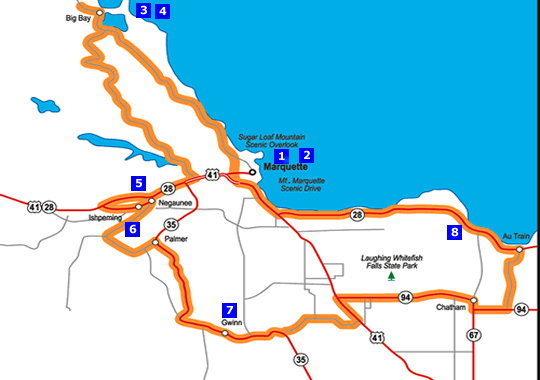
Now’s probably a good time for a map – click TM’s map to see larger. Heading north on County Road 550 to Big Bay takes you on a half hour cruise through some beautiful country rich in trees and views.  You can stop and do the 20 minute or so climb of Sugarloaf Mountain (see some pics from Lake Superior Photo). In Big Bay is the Thunder Bay Inn where you are required by travel writer code to mention  “Anatomy of a Murder” which was filmed there. Unfortunately the Thunder Bay Inn has been shuttered.  You can stop in at some of the other businesses and stay at the Big Bay Point Lighthouse Bed and Breakfast (if you call, they sometimes offer tours).

From Big Bay, head back on County Road 510 through the Huron Mountains and trees that arch over the roadway to form a tunnel of color. At US-41 head right and south into Negaunee (Chippewa word for pioneer) where you can visit the Michigan Iron Industry Museum, site of the first iron forge in the Lake Superior region. Negaunee’s Union Station Depot looks like a neat place to stay.  From Negaunee, continue to Ishpeming, home of the U.S. National Ski & Snowboarding Hall of Fame and the Cliff’s Shaft Mine Museum.

The route takes you down County Road 476 to Palmer and from there on M-35 south to Gwinn. You can enjoy hiking and mountain biking at Anderson Lake West State Forest Campground or continue south on M-35 to Little Lake where you take County Road 456 east to US-41. A left US-41 takes you north to M-94 where you turn right on M-94 to Chatham and can ask “Honey – are you sure we’re not lost?” 3 miles north off M-94 at Sundell are the about 100′ high Laughing Whitefish Falls (photo right by Church of One).

From there it’s east until you reach H-03 located between Chatham and Forest Lake, north on H-03 along the AuTrain River and past AuTrain Lake until you reach the junction of M-28. You can go east 12 miles along the Lake Superior shoreline on 28 to Tyoga Pathway or go west back to Marquette.

Check out more Michigan Fall Color Tours on Michigan in Pictures and also our fall wallpaper collection!

Seney National Wildlife Refuge

Seney, MI

Seney, MI, photo by lilrhgerl.

lilrhgerl took this Holga photo – do yourself a favor and check out her Holga slideshow. She writes that Seney is the most amazing place, and anyone who has spent time there would probably agree.

The Seney National Wildlife Refuge encompasses nearly 100,000 acres in the central Upper Peninsula. Seney was established in 1935 for the protection and production of migratory birds and other wildlife. It supports a variety of wildlife including a profusion of birds: bald eagles, common loons, trumpeter swans, Canada geese, hooded mergansers, mallards, black ducks, ring-necked ducks, wood ducks and sandhill cranes. Animals include black bear, white-tailed deer, coyote, river otter and beaver. There’s also black flies, deer flies, and mosquitoes during warmer months.

The wetlands, which are also known as the Great Manistique Swamp provide a great haven for all these animals and birds have their roots when:

…Over a century ago, lumbering operations altered the landscape of the Upper Peninsula’s great forests. The ring of the lumberman’s axe echoed through the forests as local mills depleted the region’s valuable supply of red and white pine. After the pine forests were cut, mill owners turned their axes and saws to the Refuge’s northern hardwood and swamp conifer communities.Following the lumbering operations, fires were often set to clear away the debris. These fires burned deep into the rich organic soil, damaging its quality and killing the seeds that would have produced a new forest. On many areas of the Refuge, the scars from these lumbering operations remain visible to this day.

After the fires, a land development company dug many miles of drainage ditches throughout Seney. This drained acreage was then sold using extravagant promises of agricultural productivity. But the new owners quickly learned that these promises were unfounded. One by one, the farms were abandoned, and the exploited lands reverted to state ownership.

In 1934, the Michigan Conservation Department recommended to the Federal Government that the Seney area be developed for wildlife. This proposal was accepted and Seney National Wildlife Refuge was established in 1935.

Check out Seney National Wildlife Refuge on the Absolute Michigan map and click for the Seney slideshow from the Absolute Michigan pool!