McGulpin Point Lighthouse on the Straits of Mackinac

McGulpin Point Lighthouse Emmet County

McGulpin Point lighthouse circa 1900, courtesy Emmet County Davenport collection/Terry Pepper

Terry Pepper’s Seeing the Light says that McGulpin Point Lighthouse entry tells the story of this point at the tip of Michigan’s mitten from circa 1000 BC when the great Odawa war chief Sagemaw more or less wiped out the Mus-co-desh tribe for an insult to the Odawa to when John McAlpine and his Native American wife settled on McGulpin Point in the 1760s. Their son Patrick McGulpin was given the patent on this land and the first recorded deed in Emmet County in 1811.

With the opening of the Erie Canal in 1825, Americans started to flood to the Chicago area. During the 1850s, vessel traffic through the Straits of Mackinac was increasing rapidly, and while the Waugoshance Light marked the western entry into the Straits, and the Bois Blanc Island light marked the eastern entry, the absence of a navigational aid within the shoal-ridden Straits themselves made passage during darkness and periods of low visibility extremely dangerous. To answer that need, the Lighthouse Board petitioned Congress for the construction of a lighthouse and fog bell at McGulpin Point, approximately two miles west of Fort Michilimackinac. Congress responded favorably to the request on August 3, 1854 with the appropriation of $6,000 for the station’s construction.

However, as a result of difficulties in obtaining clear title to the land, no action was taken on the station’s construction for more than a decade. With the original appropriation unspent and expired, the Board again petitioned Congress for the construction of a station at McGulpin Point in 1864, this time receiving $20,000 for the project on July 26, 1866.

Work began at McGulpin Point early in 1869, and the station was built as a mirror image of the design used at Chambers Island and Eagle Bluff lights under construction in the Door County area that same year. This plan, which is sometimes referred to as the “Norman Gothic” style, was also later also used at Eagle Harbor in 1871, White River in 1875, and at Passage and Sand Islands in 1882. (click for photos of these lights)

The keepers dwelling and integrated tower were constructed of Cream City brick with the tower integrated diagonally into the northwest corner of the dwelling. The first and second stories of the tower were approximately ten feet square with buttressed corners, while the tower’s upper portion consisted of a ten-foot octagon. Similar to other stations built on this plan, the tower is double-walled with a circular inner wall approximately four inches thick and eight feet in diameter to house a set of cast iron spiral stairs. The tower was capped with a prefabricated decagonal cast-iron lantern and outfitted with a fixed white Third-and-a-half Order Fresnel lens.

You can learn a lot more if you read on at Seeing the Light including the role the light played in knowing when the lakes would be opened for navigation, the role of Keeper Davenport and his 9 children in the rescue of the Waldo A. Avery, how the light was decommissioned in 1906 after the construction of Old Mackinac Point Lighthouse and passed into private hands and its return to the public domain.

Today McGulpin Point Lighthouse is an Emmet County park and open to the public. There’s many resources including the McGulpin Point brochure and some photos from a 2012 CMU archaeological dig.

You can see more photos by clicking through. Also check out the McGulpin Point slideshow from the Absolute Michigan pool on Flickr for some modern day photos!

Many more Michigan lighthouses on Michigan in Pictures.

Mackinac Island’s Devil’s Kitchen and the Red Geebis

mackinaw island

mackinaw island, photo by amanda vanvels

One of my favorite books as a kid was Lore of the Great Turtle by Dirk Gringhuis. The book has some of the rich legends of Mackinac Island. One is the tale of the Red Geebis and Devils Kitchen, retold by Tehuti_88. It begins:

A long time ago an old man, Aikie-wai-sie, was left behind on Mackinac Island when the rest of the tribe departed for the winter hunting grounds on the mainland. Left behind with him was his young granddaughter, Willow Wand, and the old man was greatly upset that she too would have to remain with him since they had no canoe by which to escape the island. Still, Willow Wand had refused to leave the old man behind, since he was blind and couldn’t fend for himself; but her decision pained him.

“You should have returned with them to the mainland, because Keewenaw will seek you there,” he told her, referring to her beloved.

Willow Wand shook her head. “I’ve left a white deerskin with vermillion spots upon the cliff,” she said. “The fishermen will see it, and Keewenaw will come to rescue us.”

That having been done, they moved up onto a cliff projecting from the side of the bluff, to live upon until they should be rescued. This cliff, and the cave upon it, were just above a cave known as the Devil’s Kitchen, for in this cave lived the Red Geebis, who were cannibal giants. The Geebis were known to roast and eat humans inside this cave, and so Willow Wand and her grandfather had to remain upon their ledge and out of the Geebis’ sight in order to remain safe. Because of this, they could not even go down to the lake for water, even though the shore was just below. They had not been left with much food and so the old man knew that their time there would be rough…

And how. Read on for the rest of the story of Devil’s Kitchen on Mackinac Island.

See Amanda’s photo on black.

More from Mackinac on Michigan in Pictures.

The Mighty Mac

The Mighty Mac

The Mighty Mac, photo by mi_kirk

In  6+ years as the author of Michigan in Pictures, it’s safe to say that I’ve seen more photos of the Mackinac Bridge than most people. That said, this is certainly one of the best photos of the Mighty Mac I’ve ever seen.

Since I’m expected to offer a little more, how about this History Channel video about the Mighty Mac or (if you don’t mind the lack of audio) this sweet collection of vintage clips of the days before the bridge at the Straits of Mackinac and the building of the Mackinac Bridge.

Check it out bigger and see more in Kirk’s Michigan slideshow.

Lots more about the Mighty Mac and other Michigan bridges on Michigan in Pictures.

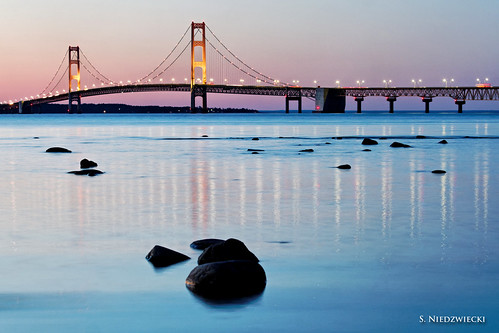
The Mackinac Bridge takes center stage on Labor Day

Bridge at Twilight 1562-12

Bridge at Twilight 1562-12, photo by StacyN – MichiganMoments

Right now thousands of people are participating in the Mackinac Bridge Walk, an Michigan tradition that began on Labor Day of 1958 and has continued every year since then. While just 68 people made that first walk, it now averages over 50,000 people. You can tune in for some shots from the Mackinac Bridge Cam and see one from this morning on the Michigan in Pictures Facebook.

If you’d like a little Labor Day reading, I heartily recommend How Labor Won Its Day from the Detroit News Rearview Mirror.

See Stacy’s photo bigger and see some more cool shots of this Michigan icon in her Mackinac Bridge slideshow.

Much (much) more about the Mackinac Bridge on Michigan in Pictures!

July 10, 1887 was a Grand day

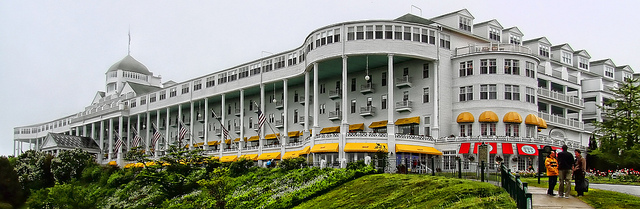
Grand Hotel Pano (3 photo pano)

Grand Hotel Pano (3 photo pano), photo by raddad!

Today is the 125th birthday of the Grand Hotel on Mackinac Island which opened on July 10, 1887. Wikipedia’s Grand Hotel (Mackinac Island) entry explains:

In 1886, the Michigan Central Railroad, Grand Rapids and Indiana Railroad, and Detroit and Cleveland Steamship Navigation Company formed the Mackinac Island Hotel Company. The group purchased the land on which the hotel was built and construction began, based upon the design by Detroit architects Mason and Rice. When it opened the following year, the hotel was advertised to Chicago, Erie, Montreal and Detroit residents as a summer retreat for vacationers who arrived by lake steamer and by rail from across the continent. At its opening, nightly rates at the hotel ranged from US$3 to US$5 a night.

Grand Hotel’s front porch is purportedly the longest in the world at some 660 feet (200 m) in length, overlooking a vast Tea Garden and the resort-scale Esther Williams swimming pool.

Also see the History photo gallery from The Grand Hotel and a cool old travelogue on Mackinac Island.

Be sure to check Randy’s great panorama out bigger and in his Mackinac Island slideshow.

June in Michigan…

Untitled

Untitled, photo by SuzyQ0763

“June is bustin’ out all over.”
~ Oscar Hammerstein II, 1945

We’ve posted our June Michigan Event Calendar on Absolute Michigan. It’s packed full of all kinds of ways to bust out in June. I’m betting we missed some fun ones, so please share your favorite June events in the comments!

One of the events we do have is the annual Mackinac Island Lilac Festival, a celebration of lilacs and Mackinac Island that runs June 8-17th. While March’s crazy weather pushed lilacs elsewhere, the unique climate of Mackinac Island coupled with a cold snap has slowed lilacs down so that they’ll have them there. Check their Facebook page for updates and more photos.

Another microclimate where lilacs are still in force are the Les Cheneaux Islands, an archipelago of 36 islands east of the Straits of Mackinac. See this photo bigger, in Suzy’s slideshow or check it out in the Les Cheneaux Islands group!

Old Mackinaw Lighthouse under the Northern Lights

Old Mackinaw Lighthouse under the Northern Lights

Old Mackinaw Lighthouse under the Northern Lights, photo by yooper1949.

The sun has let off a big flare – read all about it and see a cool time-lapse of the October aurora on Northern Lights a strong possibility! at Absolute Michigan.

Carl shot this in October of 2011 – see the photo bigger on black and in Carl’s gorgeous Lighthouses slideshow.

Many more Northern Lights / Aurora Borealis photos on Michigan in Pictures!

Remembering the Carl D. Bradley

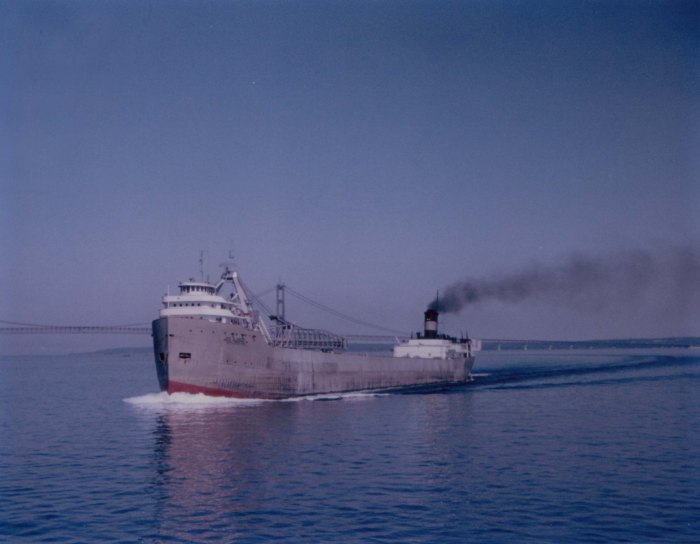
Carl D Bradley on the Great Lakes

Bradley – Color – 300 dpi, photo by Presque Isle County Historical Museum.

23 women became widows in that instant and 53 children lost their fathers.
~Rogers City resident on the sinking of the Bradley

The Edmund Fitzgerald gets the majority of the attention when Michigan shipwrecks are discussed, but it can be argued (very convincingly) that the wreck of the Carl D Bradley on November 18, 1958 was the greatest of Great Lakes tragedies. 33 of 35 crewmen – most from her home port of Rogers City – perished, leaving the small city in northeastern lower Michigan stunned by grief.

Over on Absolute Michigan today we have an excellent feature from the Archives of Michigan on the Wreck of the Carl D. Bradley that includes a riveting video from the documentary November Requiem. An article by Warren J. Toussaint about the sinking begins:

Tuesday, Nov. 18, 1958, at 5:31 p.m., the limestone carrier, Carl D. Bradley, was up bound on Lake Michigan, having delivered her last limestone cargo of the year to Indiana on November 17,1958. She stayed close to the Illinois and Wisconsin shores because of reports of severe weather conditions rapidly developing from the west. As it reached the area of Sturgeon Bay, Wis., it had to turn to the northeast in order to cross the upper area of Lake Michigan on its way to the homeport of Rogers City, Mich., on Lake Huron. Suddenly, the Bradley’s steering wheel went slack, as if the gears had suddenly disconnected. On the course it was on, the winds and waves were striking the ship on the aft quarter of the port side causing the ship to rock severely. First Mate, Elmer Fleming, knew the ship was in trouble. He jerked the radio telephone from its cradle and shouted a desperate call “Mayday, Mayday, – Mayday. This is the Carl D. Bradley. Mayday Mayday Mayday.”

Read on and see much more at carldbradley.org!

The photo is one of the last known photos of the Steamer Carl D. Bradley, taken after she passed under the Mackinac Bridge and was making the turn to the southeast to set a course for Rogers City. Check it out background big and in their great Bradley Transportation Fleet slideshow. Definitely have a look at the Presque Isle County Historical Museum website for more on the Bradley and the history of the region and to order the Bradley DVD!

Kayaking Under the Mighty Mac (and walking over it)

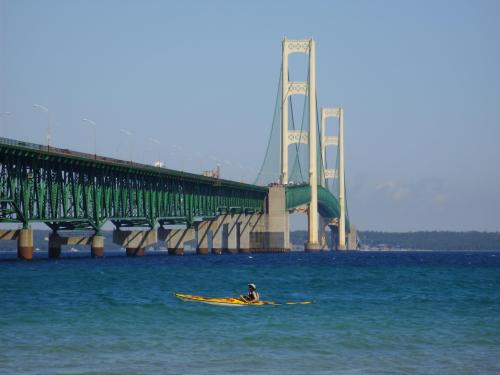
Kayaking Under the Mighty Mac

Kayaking Under the Mighty Mac, photo by Kathleen Swinehart

This Monday (September 5th) it’s time for the annual Mackinac Bridge Walk. 2011 is the 54th annual and the walk is open to all. It starts at 7 AM and you can leave any time up to 11 AM. They have a blog with information for and about the 400 runners who won the lottery for an opportunity to take part in the early morning Mackinac Bridge Labor Day Run. It includes information for how to enter next year and I have to imagine that for a runner, the 5 mile span from the Lower to Upper Peninsula would be a pretty special memory!

Michigan in Pictures has a TON of Mackinac Bridge photos and information.

Kathleen posted this photo to the Michigan in Pictures wall on Facebook. You can see more photos that people have shared with us in our photo album. See it big as the Mighty Mac and see more in Kathleen’s My Pure Michigan album.


Fancy a stay at the Grand Hotel?

Privileged

Privileged, photo by cmu chem prof.

mLive reports:

Mackinac Island’s grande dame of lodging, recently named among the top 50 hotels in North America, is hosting its fourth wildly popular Celebrate Michigan promotion, during which residents of the state can stay for half the hotel’s usual rate.

The package costs $95 per person, per night (taxes and fees are extra), and is offered Sept. 11, Sept. 20-22, Oct. 3 and Oct 23. It includes one night’s lodging, a full breakfast and five-course dinner, Michigan-themed reception and complimentary golf green fees.

I feel like I have to mention a particular movie that was shot here so let me say that if you’re interested, you probably better act fast so you can be somewhere in time for this offer which usually sells out. ;)

Seriously, while there’s no doubt that the Grand Hotel can be a little hoity, but the Mackinac Island landmark is also one of the coolest properties in Michigan. This morning I sorted through photos of the Grand Hotel from the water, the Grand Hotel’s signature front porch (including a very interesting composition on the porch), a panorama of the Grand Hotel and even a sight I’d never seen in quite this way, the Grand Hotel at night. Next year the hotel turns 125, so I’ll return then for some of the history and such.

Check it out big as the Grand and in Phil’s massive Northern Michigan slideshow.