Round Island Run

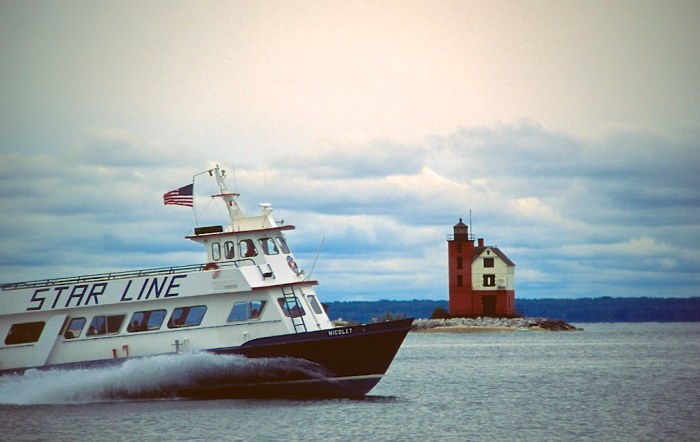
Ferry & lighthouse

Round Island, MI, photo by Bill Johnson

Bill took this photo 21 years ago on September 21, 1995! It shows the Star Line Ferry’s Nicolet speeding past the Round Island Lighthouse. Star Line explains:

Star Line Ferry was started by Tom Pfeiffelmann, Sam McIntire, and others in the late 1970s. They purchased Argosy Boat Line. The company was then renamed Star Line after the 5 original stockholders making up a 5 pointed star. At that time they operated slower ferries including the Nicolet, Treasure Islander and Flamingo.

In 1979 Star Line bought their first fast ferry, Marquette. Over the next few years the old LaSalle and Nicolet were replaced with sisters to the Marquette. In 1987 Star Line decided to take it up a notch with Radisson, an 85-foot fast ferry which was modeled after a luxury yacht.

View Bob’s photo background big and see more in his Lighthouses slideshow.

PS: Check out this cool yesterday and today at Round Island Lighthouse on Michigan in Pictures!

Today & Yesterday at Point Iroquois Lighthouse

point-iroquois-lighthouse-fall-michigan

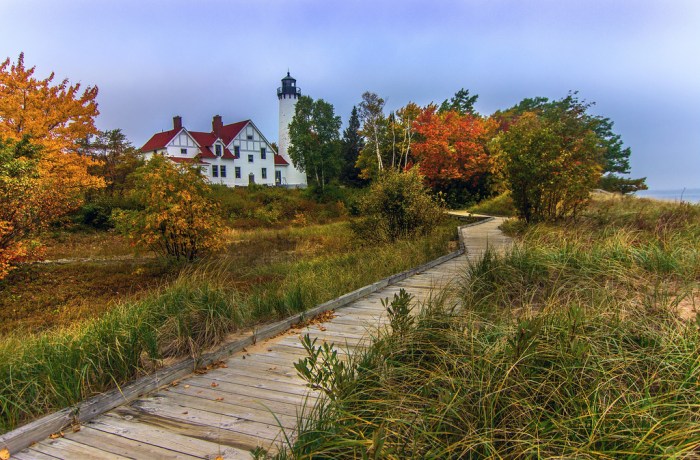
Point Iroquois Lighthouse on Whitefish Bay, photo by Cole Chase Photography

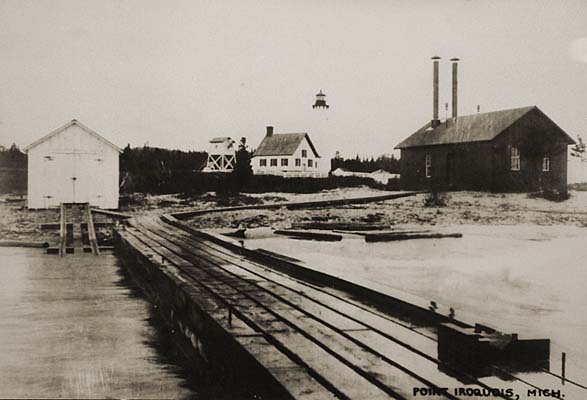
The Point Iroquois Lighthouse page at Terry Pepper’s Seeing the Light has a 100+ hear old photo of the light taken from almost exactly the same angle as Cole’s! View his bigger and see more great shots from fall of 2014 in his Autumn in Upper Michigan slideshow.

port-iroquis-lighthouse-1905

Point Iroquois Light Station in 1905, showing the fog signal building constructed in 1890. Note that the 1885 bell tower is still in place to the immediate left of the dwelling.

The photo is courtesy of the Point Iroquois Lighthouse and Historical Museum, and you can click the link for more about the museum!

Sunrise on McCarty’s Cove & Marquette Harbor Lighthouse

%22mccartys-cove%22-marquette-harbor-lighthouse-marquette-michigan

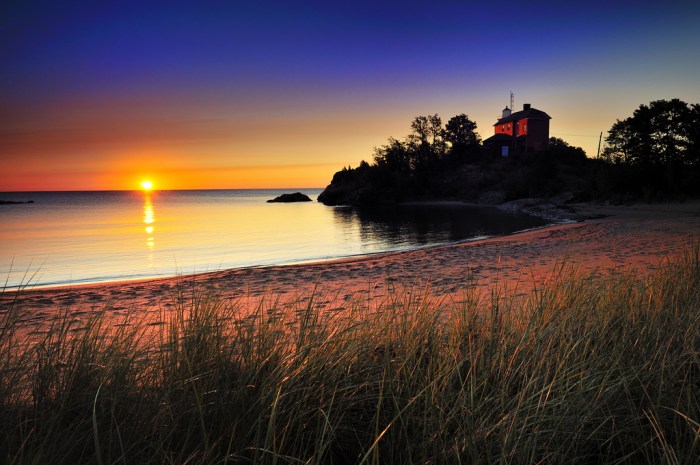
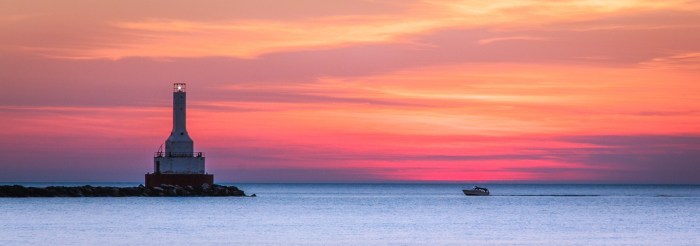
“McCarty’s Cove” Marquette Harbor Lighthouse, photo by John McCormick

Just got back from Marquette, and I have to say, this is one cool city!!

John took this photo back in August of 2011 at sunrise at McCarty’s Cove, one of Marquette’s best beaches according to Travel Marquette. I really had to dig (seriously, a Mining Journal history quiz was all I had to go on) to learn that McCarty’s Cove is named after Mike McCarty whose business, Lake Superior Ice, operated at that location. I’m not sure how long, but in 1919 they took over the Marquette Ice Company. Know more? Post it in the comments!

UPDATE:  Ann Fisher (who is a contributing photographer to Michigan in Pictures) shares:

“McCarty’s ice business lasted at least into my childhood (late 50’s, early 60’s). I remember going there to buy ice when we were making homemade ice cream in our hand-cranked ice cream maker.”

The Marquette Harbor Lighthouse is now a museum – click for more.

View John’s photo bigger, see more in his Sunsets/Sunrises slideshow, and view and purchase his work at michigannutphotography.com (FYI you can buy this photo right here).

Grand Haven Pierfolk

pierfolk-by-jamie-mcdonald

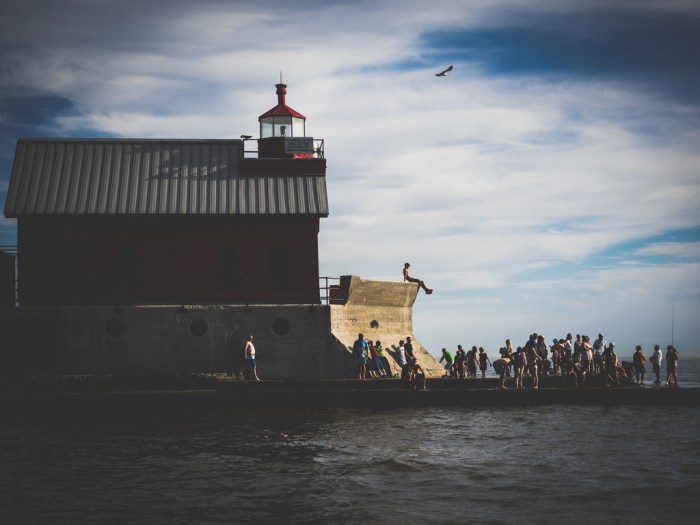
Pierfolk, photo by Jamie MacDonald

View Jamie’s photo of the Grand Haven Pier bigger, see more in his Buildings and Structures slideshow, and view & purchase his work at jmacdonaldphoto.com.

50 Shades of Blue

50 Shades of Blue

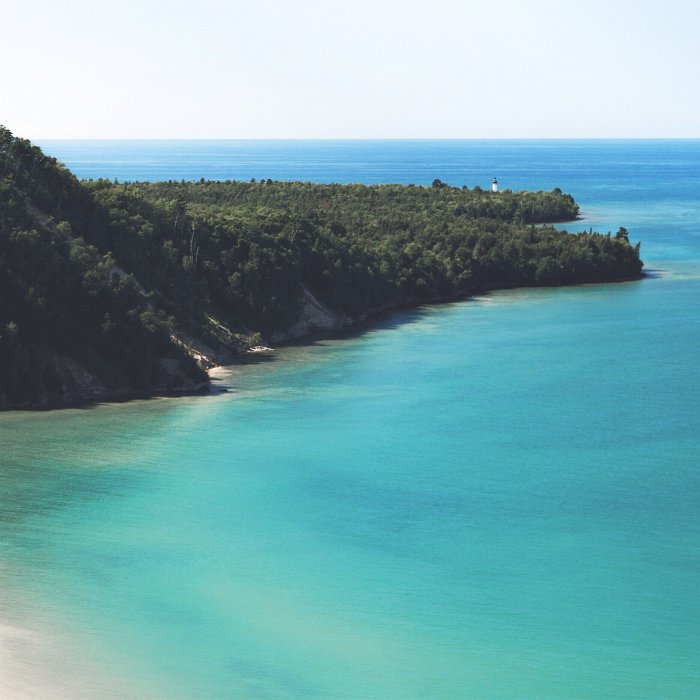
50 Shades of Blue, photo by John Hill Photography

A simply gorgeous shot of Au Sable Point and the Au Sable Light Station in the Pictured Rocks National Lakeshore.

View this photo background big on Twitter and definitely follow John on Instagram!

Sometimes the stars align…

Sometimes the the stars align Frankfort Lighthouse

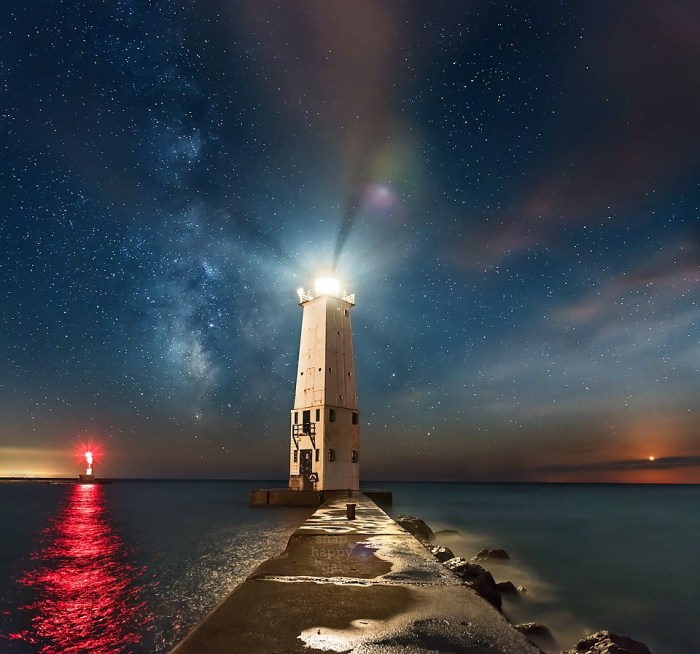
Sometimes the stars align…, photo by Snap Happy Gal Photography

What can you say about an astonishing photo like this? Heather writes:

I went to Frankfort a couple nights ago to shoot the Milky Way at the lighthouse. As I walked out the long pier in the darkness, I passed two groups of swimmers heading home (at 11:30), and then had the entire thing to myself for over an hour. Just enough haze hung in the air to create the light rays from the lighthouse, and the waves splashed just high enough to douse the outside edge of the wall. The setting crescent moon balancing out the south breakwall light was a nice bonus.

View the photo bigger, view & purchase photos at snaphappygal.com, and be sure to follow Snap Happy Gal Photography on Facebook!

UPDATE: Here’s a link to purchase this photo!

More about the Frankfort North Breakwater Light including another nighttime shot by Heather on Michigan in Pictures.

North Manitou Shoal Light and 3 other Michigan lighthouses for sale

via leelanau.com

Tales of the Crib - North Manitou Shoal Lighthouse

Tales of the Crib, photo by Jim

“To pass time, the men watched television, read books and magazines, played board games, and chatted with passing ship captains by radio. One coastguardsman perfected his rappelling skills by using ropes to descend from the gallery outside the lantern room to the concrete deck below.”
~Life on North Manitou Shoal

The last Coast Guard crew left the North Manitou Shoal Light in 1980. It’s located 8 miles off the the Lake Michigan shore from Leland, and growing up I could hear the station’s fog horn from my bedroom. When I was a kid, my parents and their friends would take steaks and beer out to the light and have dinner with the guardsmen.

Now mLive reports that the light is one of four Michigan lighthouses are up for sale to the public: North Manitou Shoal Light, White Shoal Lighthouse, Gray’s Reef Light, and Minneapolis Shoal Light. The auction page explains that proceeds from the public sales go back into the US Coast Guard’s aid to navigation fund for equipment, maintenance, and resources to continue preservation and maintenance of lighthouses that are still active.  On Tuesday, August 30, registered bidders who have paid the $10K deposit can tour the light along with their contractor and they haven’t yet set a closing date for the auction.

Lighthouse Friends notes that the North Manitou Shoal Light was built in 1933 to replace the North Manitou Shoal Lightship:

…anchored two miles off Dimmick’s Point. In 1909, the Lighthouse Board noted that a shoal had developed southeast of Manitou Island in recent years and requested a lightship be placed on the easterly end of the shoal to help mark the six-mile-wide channel between Dimmick’s Point and Pyramid Point on the mainland.

This light station replaces the North Manitou Lightship No. 103 and North Manitou Island Light Station, and serves as an improved mark for the outer end of the shoal projecting southerly from the south end of North Manitou Islands. A substantial saving in annual maintenance cost will be effected. The crib on which the structure is built stands in 22 feet of water, on a hard sand and coarse stone bottom. The crib is 65 feet square by 22 feet deep, and is filled with conveyor stone. The voids around the stone in the 20 outer pockets were pumped full of Portland cement grout. Arch web steel sheet piling driven 24 feet into lake bottom encloses and protects the crib.

The crib supports a hollow pier of reinforced concrete 62 feet square and 20 feet above water, with deck overhanging 2 feet on all sides. This hollow space is occupied by the steam heating plant, coal and oil storage, laundry, etc. Above the pier rises the steel building 37 feet square, two stories high, surmounted by a square tower of three stories additional height. On the top of the tower is a third-order lantern, with its focal plane 79 feet above water. The building and tower are constructed of steel channels 12 and 15 inches wide, standing vertically with flanges turned in and bolted together on the inside.

View Jim’s photo background big and see more in his slideshow.

North Breakwater

Ludington North Breakwater Light

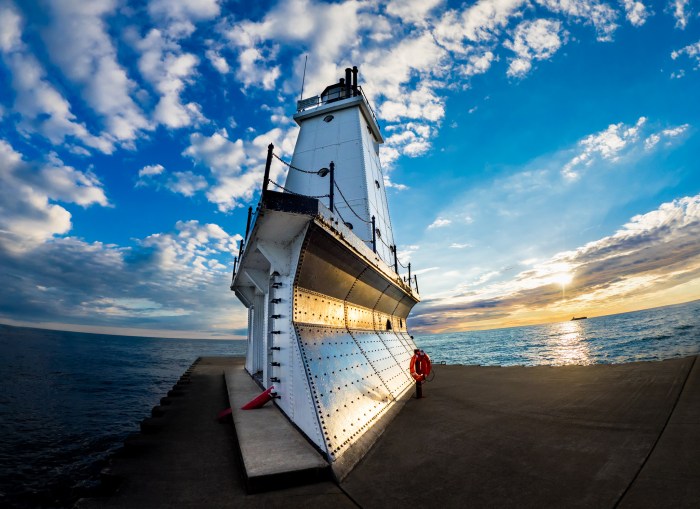
North Breakwater Light, photo by Mark Miller

The entry for Ludington North Breakwater Light at Terry Pepper’s Seeing the Light details a ton of the history of this lighthouse including the reason for its interesting appearance:

Over the summer of 1924, a unique structure took shape at the end of the North Breakwater. The main tower, fabricated of steel plates over an internal steel skeleton, took the form of a four-sided pyramidal tower with four round porthole windows on each of the three decks within. With plans calling for the installation of an air diaphragm fog signal operated by an electrically powered compressor, there was no need for a large fog signal building, and thus the signal building took the form of a relatively small structure integrated into the base of the landward side of the main tower. In order to help protect the structure from the force of waves crashing across the breakwater, the concrete foundation at the base of the structure was formed with angled surfaces designed to deflect the force of wave action up and away from the building.

The white painted tower was capped by a square gallery and an octagonal iron lantern installed at its center. Since the standard lantern design being used by the Lighthouse Service in new construction at this time was of circular conformation with diagonal astragals, it is likely (but unconfirmed) that the lantern used on this new light was transferred from the South Pierhead beacon which the new light was designed to replace.

Click through for more including a number of old photos.

View Mark’s photo background bigtacular and see more in his slideshow.

More lighthouses and more summer wallpaper on Michigan in Pictures.

Fourteen Foot Shoal Lighthouse in Lake Huron

14 foot shoal lighthouse by David Juckett

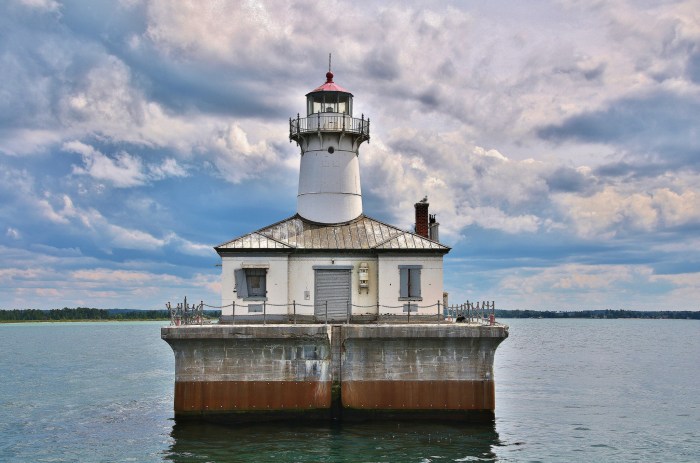
14 foot shoal lighthouse, photo by David Juckett

Terry Pepper’s Seeing the Light remains the gold standard for information about the lighthouses of the Great Lakes. Terry writes (in part) of the process of constructing Fourteen Foot Shoal Light near the entry into Cheboygan Harbor:

With completion of the work at Poe Reef in 1929, the work crew turned their attention to work at Fourteen Foot Shoal. While the new light was of a totally different design, and considerably smaller than the twin lights built at Martin and Poe Reefs, the construction of the crib proceeded in much the same manner, with the construction of a wooden crib at the shore station on the Cheboygan Pier. After an area on the shoal was leveled, the crib was eased down wooden ways into the water, and towed to the shoal by the Lighthouse Tender Aspen. Once over the leveled area, the crib was sunk to the bottom by filling its empty pockets with rocks and gravel.

This timber foundation then served as a core, upon and around which wooden forms were constructed and filled with concrete loaded from the Lighthouse Service scow. As was the case with both the Martin and Poe stations, the upper edge of the crib was formed into a graceful flare, designed to deflect waves away from the pier, in order to help protect the structures which would be erected on the deck. With the completion of the concrete work, the pier stood fifty feet square, and its deck level fifteen feet above the water.

The steel framework for the single story equipment building was erected at the center of the deck. Standing thirty-four feet by twenty-eight feet in plan, on completion, the entire exterior of the building was sheathed with 1/4-quarter inch steel plates, each riveted to the steel framework beneath. Centered on the roof ridge, a cylindrical steel tower was integrated into the roof, standing six feet in diameter and twenty-four feet above the ridge line. The tower was capped with an octagonal cast iron lantern and outfitted with a flashing white Fourth Order Fresnel lens.

Read on for lots more and photos!

View David’s photo background bigtacular and see more in his slideshow.

Many more Michigan lighthouses on Michigan in Pictures!

Houghton’s Keweenaw Upper Entrance Lighthouse

Keweenaw Upper Entrance Lighthouse Houghton Michigan

Homeward Bound, photo by Bobby Palosaari

Terry Pepper’s Seeing the Light is my go-to for Michigan lighthouse lore. His entry for the Keweenaw Upper Entrance Lighthouse says in part:

With the meteoric growth of copper mining in the Keweenaw between 1843 and 1968, increased shipping access to the twin cities of Houghton and Hancock became increasingly important. To this end, the Portage River Canal was cut through a tamarack swamp at its western end in 1860, creating a channel 10 feet deep and 80 feet wide, opening full Portage River navigation for the largest vessels of the day from western Lake Superior.

In 1874, to assist in safely guiding ships into this cut, a large gabled two-story brick dwelling with attached square 33 foot high brick tower was constructed on the west bank at the entrance to the canal. With increasing use of the canal, silting became a major problem, and tolls were levied for its use in order to cover the continuing expenses for repairs and dredging.

For reasons as yet undetermined, the original lighthouse was replaced with the existing fifty foot square steel Art Deco style tower at the end of the breakwater in 1950.

View Bobby’s photo background bigtacular and view & purchase more of his photos including this one at palosaariphotography.com.