Riverfront Redevelopment: Lansing’s Ottawa Street Power Station

Riverfront Redevelopment

Riverfront Redevelopment, photo by Mario.Q.

Mario has a great Ottawa Street Power Station set (slideshow) in which he’s documenting this redevelopment project.

Wikipedia’s entry for the Ottawa Street Power Station says:

The Ottawa Street station provided electricity and steam to the downtown Lansing area from 1939 through the late 1980’s. By 1971, improvements at the Board of Water and Light’s Eckert Station permitted the Ottawa Street Station to operate as a backup station for electric generation. It continued to provide steam service into the 1980s. In 1984, this Board of Water and Light’s Eckert Station began providing steam service, initially as a backup to the Ottawa Street Station, but eventually as the primary steam service source. As equipment became obsolete, it was removed from the Ottawa Street Station, and ultimately it was decommissioned in 1992 for electric and steam.

…In 2007 it was sold to be redeveloped as corporate headquarters for the Accident Fund Insurance Company of America. Massive renovations to convert the plant to an office building are currently underway by The Christman Company, with completion of the entire 7-acre office campus scheduled for the first quarter of 2011.

Lansing City Pulse article about the Ottawa Power Station redevelopment and this great thread on the project from SkyscraperPage (complete with 3D renderings).

What was … and what might have been

Polaris Ring by David Barr

Michigan Library II: Polaris Ring by David Barr, photo by farlane.

Since I’m writing a rant today, I figured I’d use my own photo.

The Freep reports (also Detroit News) that Michigan Governor Jennifer Granholm is expected to announce the disbanding of the Michigan Department of History, Arts & Libraries (HAL) in her State of the State Address tonight at 7 PM.

There’s no word as to how that would impact the libraries, arts organizations and museums that HAL works with, but one can only imagine that it won’t be good. With universities and schools, the State Fair and other state programs facing deep cuts, you can bet that there will be a lot of hand wringing by the Governor and legislators on both sides of the aisle in the days and months to come.

I just want to say that this crisis has been looming for years and as a person with the job of watching Michigan, I’ve watched our elected officials on all sides worry about their political capital, re-election, counting coup on each other and pretty much doing everything but making the hard choices they needed to make. Now, they will face a mountain of unhappy choices and wonder theatrically what they could have done.

My answer? The jobs we elected them to do…

Michigan public television stations will broadcast the address and the Freep will be streaming the State of the State online and I’ll be somehow or other live blogging it at Absolute Michigan.

The sculpture in front of the Library of Michigan is called Polaris Ring by David Barr. Here is the info about it from their “Visions of Michigan” page.

From Easter Island to Africa, from Greenland to New Guinea — David Barr’s work is displayed worldwide. Specializing in project that employ geographic, geometric and geological elements, his Polaris Ring outside the Center’s main entrance often reminds visitors of a modern-day Stonehenge.

Fifty steel columns encircle a five ton kona dolomite boulder. Smaller stones spinout in a spiral pattern on either side.

”The combination of stone and steel represents the interface of prehistoric imagery with man’s technological imagery and strengths,“ Barr notes. The result is a mystical progression of space and volume that draws people toward the facility.

Based on a universal symbol — Polaris, the North Star — viewers are able to stand behind the sculpture’s center stone and look between the two tallest columns to see the star.

”Instead of having to look at the overall sculpture from the outside, I want people to be able to experience if from inside as well,“ he says.

I hope you get a chance to experience this sculpture and this very cool museum.

Happy Birthday, Michigan!

The Capitol of Michigan

The Capitol of Michigan, photo by Ravi Vora.

Today (January 26, 2009) is Michigan’s 172nd birthday. I have to say she doesn’t look a day over 150 – must be all that fresh water!

The Michigan Historical Museum explains the somewhat lengthy process that Michigan took to becoming the 26th State of the Union:

Following the Compromise of 1820 it was the practice to admit a free state and a slave state at the same time. However, when both Arkansas and Michigan were ready for statehood, Michigan was involved in a dispute with Ohio over the Toledo Strip. President Jackson signed a bill on June 15, 1836, that admitted Arkansas but required the people of Michigan to settle the dispute before Michigan would be granted statehood. Michigan would need to consent to a compromise measure drawn up by Congress. The compromise gave the Toledo Strip to Ohio and the western two-third (2/3) of the present Upper Peninsula to Michigan.

A convention to consider the compromise took place in Ann Arbor on September 26, 1836, after delegates were elected. They deliberated for four days; then they rejected the compromise. On December 14 a second “Convention of Assent” was assembled, which—two days later—passed a resolution that accepted the compromise. After this news reached Washington, a bill was introduced to admit Michigan to the Union. Congress passed the bill, and President Jackson signed it on January 26, 1837.

Toledo for the Western U.P.? No offense to Toledo, but I think we made out all right in that one. More about Michigan’s path to statehood from Wikipedia.

Ravi says to check this out larger and cooler.

Coffee Tasting at Paramount Coffee of Lansing

Coffee Tasting, photo by WAXY.

John writes that this is from a coffee tasting session at Paramount Coffee in Lansing. The man on the right is his grandfather, Lawrence B. Weingarten, one of the founders of Paramount. He got this history from a previous version of the Paramount Coffee web site:

In 1935, during the height of the great depression, two established coffee salesmen decided to take a chance. They left their jobs in Chicago and ventured up I-94 to Lansing, Mich., to start their own company. They chose Lansing as they felt it was the ideal location for their new challenge. So on Aug. 14, 1935 the two friends scraped together every penny they had and went after their lifelong dream. What they lacked in money, they more than made up for in enthusiasm and energy. Paramount Coffee Company was born.
You can see this photo bigger in John’s slideshow and more of his work can be found at Waxy Photography.

Creating Cities in Michigan

Lansing, Detroit, Grand Rapids, Flint, Traverse City, Marquette and Kalamazoo are by no means all of Michigan’s cities (or even the largest). Each, however, seems to be an anchor for its region – a center to which people look to for culture, entertainment and commerce.

October 13-15, 2008, lovers of cities large & small from Michigan and all over the country will head to Detroit for the Creative Cities Summit 2.0 (CCS2), an exploration of what our cities could become and how we can work to make them. Organizers have chosen Detroit, a city so deeply forged in America’s industrial fires that it’s been devastated by the flickering of that flame. I’m headed down there and will try to bring some of the ideas back to you through Absolute Michigan – I hope that some of you can join me there.

The Photos (left to right)

Creative Cities Summit 2.0 in Detroit on Oct. 13-15, 2008

CCS2 will present a dynamic and engaging conversation about how communities around the world are integrating innovation, social entrepreneurship, sustainability, arts & culture and business to create vibrant economies. Full conference registration is $300 for the two and half day event, and there’s also a “no frills” registration that is only $100. There’s also a free “Unconference” at the Museum of Contemporary Art Detroit (MOCAD) on the 12th for designers, urban planners, civic leaders, entrepreneurs, artists, students, community leaders to explore and discuss what’s possible for Detroit.
Keynote speakers include:

  • Bill Strickland, MCG-Bidwell Corp.
  • Richard Florida, Author Who’s Your City
  • Charles Landry, Author The Art of City Making
  • John Howkins, Author The Creative Economy
  • Dean Kamen, Inventor, DEKA
  • Majora Carter, Sustainable South Bronx
  • Doug Farr, Architect and Author Sustainable Urbanism
  • Ben Hecht, Pres. & CEO Living Cities
  • Tom Wujec, Fellow, Autodesk
  • Carol Coletta, CEOs for Cities
  • Giorgio Di Cicco, Poet Laureate, City of Toronto and Author, The Municipal Mind
  • Diana Lind, Editor, Next American City magazine

Breakout sessions on topics such as:

  • Race and the Creative City
  • Cities, Universities & Talent
  • Marketing, Media and the Creative City
  • Measuring New Things – ROI in the Creative Economy
  • Creative (Small) Cities
  • New Ideas in Urban Amenities
  • Community Vitality: The Role of Artists, Gays, Lesbians & Immigrants
  • Midwest Mega-region: How the Midwest Can Compete
  • Transportation Innovation for Cities
  • Making the Scene: Music & Economic Development

Much (much) more at creativecitiessummit.com.

Lansing through the lens of R.C. Leavenworth

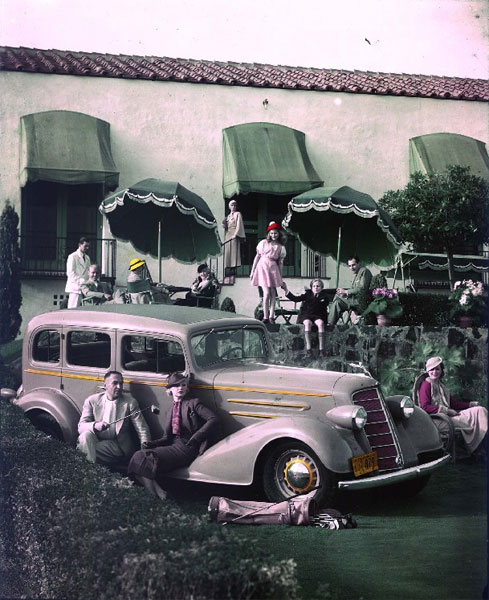
1934 Oldsmobile F-Series Six, photo by R. C. Leavenworth (courtesy Archives of Michigan)

The Archives of Michigan’s Image of the Month for May 2008 was taken by Lansing commercial photographer R.C. Leavenworth, whose Leavenworth Photography of Lansing created one of the largest collections of Oldsmobile photographs. Oldsmobile was founded in Lansing in 1897, and this year is the 100th anniversary of General Motors.

The photo is from a rare Agfacolor glass screen plate in the Leavenworth historical photograph collection. The Afgacolor process was similar to Autochrome process in which the glass plate overlays a mosaic of red, green and blue dyed resin grains. They relate that their scanner is unable to justly reproduce the color tone of these plates and they invite you to attend the upcoming exhibit: “The Picture Man: Lansing through the Lens of R. C. Leavenworth” to see the plates illuminated in person.

…Leavenworth started out photographing lumbering and mining camps in northern Michigan, using a horse-drawn darkroom. He relocated to Lansing in 1919 to document Lansing’s transformation into a major industrial city and automotive capital. For over a century, Leavenworth Photography has shot hundreds of thousands of images that tell the story of industry, business and social life in Michigan’s capital city. With subjects as diverse as street scenes, car parts, workers’ strikes, vaudeville troupes and football games, Leavenworth lived up to the slogan plastered on the door of his company car: “Anything photographed, anywhere, anytime.”

“The Picture Man” runs May 30 to September 30 in the temporary exhibit area on the first floor of the Michigan Historical Center. Admission is free. R. S. V. P. at (517) 373-1408 for the opening reception on May 29, 5pm-7pm.

You can also read Leavenworth Maintains Commercial Niche from the Greater Lansing Business Monthly (July 2003).

William Leabs, Jr. and Michigan’s Black History

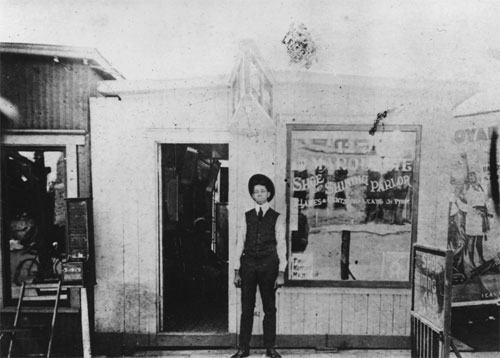
William Leabs, Jr. at his Marquette Shoe Shining Parlor

William Leabs, Jr., photo courtesy the Archives of Michigan

The description from the Archives of Michigan begins:

Here, we see William Leabs, Jr., an African American businessman. He’s standing in front of his store, the Marquette Shoe Shining Parlor (view larger). This business is listed in the Lansing City Directories of 1902 and 1904, and the photo presumably dates from about that same time frame.

Lansing’s African American heritage is as old as the city itself. Lansing’s first black resident of record is James Little, a freed slave from New York state. Little came to Lansing in 1847 (the year of the city’s founding) and started a farm.

Lansing’s black population increased slowly during the remainder of the 19th Century. Many black settlers came from other Northern states and from the upper South. Some were Canadians descended from escaped slaves. Others came from elsewhere in Michigan, with the majority of those hailing from Cass County (Freed slave communities had been established there before the Civil War.).

You can read more at the Image of the Month for February 2008 and also in Robert Garrett’s article The Birth and Death of Lansing’s Black Neighborhoods in the Lansing City Pulse.

February is Black History Month in Michigan and you can get a ton more articles from Absolute Michigan’s Black History in Michigan.

Spartan Stadium at Michigan State University

MSU Aerial Photo by clayton_busbey

MSU Aerial Photo, photo by clayton_busbey

Be sure to take a look at other photos Clayton took on this day – they include aerial views of Lansing & Mackinac Island.

I’ve certainly given the University of Michigan and the Big House ample time here on Michigan in Pictures. Looking back, I see that the football stadium at my alma mater, Michigan State University, has received rather less attention. What can I say – my grandmother was a dyed-in-blue Wolverine fan. As usual, you can get lots of the basic information from Wikipedia’s entry for Spartan Stadium in East Lansing which begins:

In the early 1920s school officials decided to construct a new stadium to replace Old College Field. The resulting stadium was ready in the fall of 1923 with a capacity of 14,000. Over the years the stadium grew. In 1935 the seating capacity increased to 26,000 and the facility was dedicated as Macklin Field. John Macklin, football coach from 1911-15, put Michigan State football on the map with a 29-5 record over five seasons with victories over big name programs such as Michigan, Notre Dame, Ohio State, Penn State and Wisconsin. After admittance into the Big Ten in 1948, Michigan State increased stadium capacity to 51,000 and the field was renamed Macklin Stadium. With Spartan football attracting national attention under Clarence “Biggie” Munn and Hugh “Duffy” Daugherty, 9,000 seats were added in 1956. The following season upper decks were added to the east and west sides boosting the capacity to 76,000. That same season Michigan State dropped the name Macklin Stadium in favor of Spartan Stadium.

In August of 2005 a press box and luxury seating were added – here are photos and renderings of the addition to Spartan Stadium and the page on Spartan Stadium at Ballpark.com (has a cool view of the stadium on game day).

For more photos, head over to Flickr where Patrick Power (love the Spartan Stadium Sundown!) and Alex (excellent Spartan Stadium Panorama) each have a ton of photos of the stadium. Also look in of the Michigan State University Fans pool on Flickr and get some shots of on the field action from the Spartans Football photo gallery at MSU.

Fall Color Tours: Lansing – Grand Ledge – Hastings – Battle Creek – Eaton Rapids

maplepath by Aunt Owwee

maplepath, photo by Aunt Owwee

Our next fall color tour from Travel Michigan, Lansing – Grand Ledge – Hastings – Battle Creek – Eaton Rapids, starts where the above photo was taken: at the Fenner Nature Center in Lansing (once known as the Fenner Arboretum). The park is named after biologist Carl G. Fenner and has 130 acres with 4 miles of trails winding through maple groves, pine forests, swamp forests, old fields and 3 different ponds. This weekend (Oct 20 & 21) they’re having an Apple Butter Festival. Aunt Owwee (Shirl) has a cool four seasons view from here and lot more great shots of autumn in Michigan.

If you’ve got the nature center bug, you can stop at the Woldumar Nature Center, located along the Grand River not far southwest of Lansing. From there, head out M-43 to Grand Ledge. Fitzgerald Park aka “The Ledges” are absolutely gorgeous in the fall, as evidenced by this photo from Rein Nomm of Fall at the Ledges that appeared last year on Michigan in Pictures. Not convinced? Search fall at Grand Ledge on Flickr. Last weekend, the city of Grand Ledge held their annual Color Cruise, but there’s still plenty of color to be found.

Thornapple River by hansendmThen it’s on to Hastings and Historic Charlton Park, a re-creation of a 19th century town. The structures are open only Memorial Day to Labor Day but you can certainly enjoy strolling along the river. For a little more exercise, jump on the non-motorized vehicle only Paul Henry – Thornapple Trail (see photos of the trail on Flickr). When complete, the trail will be a 42-mile route from Grand Rapids to Vermontville. The photo to the right of the Thornapple River was taken by hansendm.

The it’s on to Gull Lake and the W.K. Kellogg Bird Sanctuary. The sanctuary is one of the North America’s pioneer wildlife conservation centers and offers a chance to see birds in the wild, bird displays and birds of prey enclosures featuring rare and common raptors including a bald eagle, red-tailed hawks and eastern screech owl.

Travel Michigan suggests a possible detour to the Fort Custer Recreation Area, located between Battle Creek and Kalamazoo. It features three lakes, the Kalamazoo River and an excellent trail system that includes 16 miles of mountain bike trails. The 3000+ acre area was farmland that was acquired by the federal government to establish Camp Custer, an induction and military training center for the US Army during WWII.

If it’s raining or all this outdoor stuff doesn’t sound fun, consider stopping at the Gilmore Car Museum in Hickory Corners which features almost 200 vehicles spanning over 100 years of automotive heritage from a 1899 Locomobile to the muscle cars of the 60s and 70s.

Kalamazoo river from the Nature Center bridge by cathieContinuing south, we come to the city of Battle Creek where recommended stops include the Sojourner Truth Monument (check out this set of photos of the Monument), Binder Park Zoo, the Leila Arboretum and Children’s Garden and the Battle Creek Linear Park. The park is a walkable, bikeable and billed as “the world’s largest classroom,” featuring signs that tell about plant, animal, cultural and historical points-of-interest along the park.

If you’re hungry as you head out on Old 27, consider Cornwell’s Turkey House aka Turkeyville USA. A bit further south is the town of Marshall. In addition to being a shopping mecca, Marshall’s downtown is designated as a National Historic Landmark District and features a wealth of historic attractions including the American Museum of Magic.

The photo to the right is of the Kalamazoo river from the Nature Center bridge by cathie and it’s just one of the places you can stop as you ease on down the road back to Lansing through the towns of Albion, Springport & Eaton Rapids. They recommend a stop at The English Inn of Eaton Rapids for dinner. Having eaten there before, I can only say “got room for another?”

Just so it’s clear, these fall color tour entries are produced by Absolute Michigan & Michigan in Pictures using the great information compiled in Travel Michigan’s Fall Color Tours as a starting point. We’re trying to add to what they’ve put together – not rip them off! As always, if you have links to information or photos that we missed, comments or reports, post them in the comments below!

Don’t miss our Michigan Fall Wallpaper series and see more of Travel Michigan’s Fall Color Tours.

“L” is for Lansing Tower … or is that a “B” for Boji?

Lansing Tower.

Lansing Tower., photo by Corey (a.k.a. ten0fnine).

Corey writes that this was formerly the Michigan National Tower and you must look at this photo bigger.

When I went a-Googling for the history of the building, I stumbled upon L is for Lansing:

…an online community for Lansing students, teachers, parents and anyone interested in hearing the stories of how this area, its neighborhoods, businesses, families, and citizens of note contributed to the history of “the land of the big bend” we call Lansing, Michigan.

The site looks to be one of the innumerable “ghost sites” that you find around the net where some energy and thought was applied to a topic before it was abandoned by its creators (the Young Spartans Program, who have themselves vanished). While the Lansing Timeline was never completed, their Lansing Tour, letter by letter, is kind of cool with some photos from the recent and distant past and links to more info as on ““O” is for Olds“.

Now where was I? Emporis says that this 341′ tall building is tallest in the Capital City and now known as the Boji Tower. Completed in 1931:

The Michigan National Tower was originally named the Olds Towers in honor of industrialist Ransom E. Olds. The brick and stone tower, with its tall, narrow profile topped with a spire and beacon, was typical of American skyscraper design in the early 1930’s. Four engraved panels in the portals of the main passenger elevators also reflect themes of labor and industry typical of the time.

Here’s the Boji Group’s page on Boji Tower and some more photos of Boji Tower.