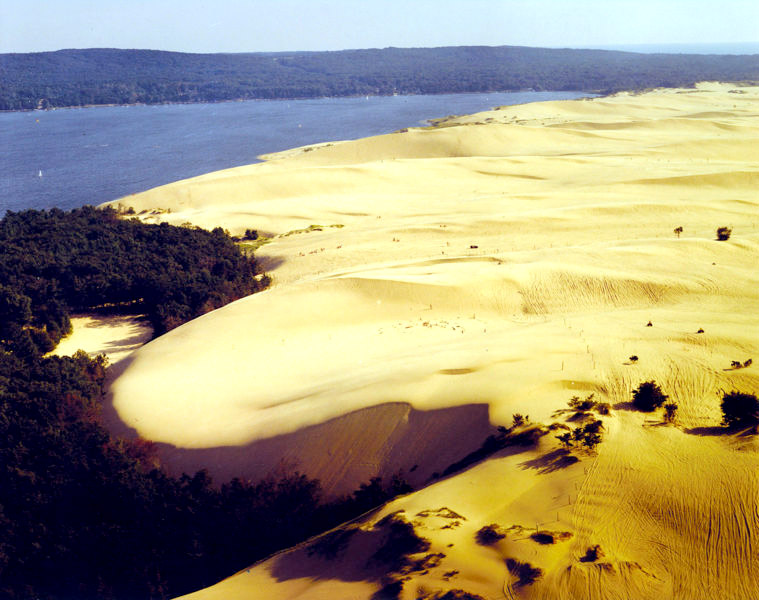
Silver Lake Dunes and the Silver Lake State Park


Silver Lake Dunes State Park, photo by Dale Fisher, US Army Corps of Engineers

Unlike the Sleeping Bear Dunes, the Silver Lake Sand Dunes allow private motorized vehicles. The Think Dunes area info site says that in fact, they’re the only dunes East of Utah that allow you to drive a private motorized vehicle (April 1st through October 31st). There are fees and restrictions that you’ll probably want to read about. You can also have Mac Woods Dune Rides drive you through the dunes! Driving not your cup of tea? Fear not – in the middle of the Silver Lake State Park there is a non-vehicle area they call the Walking Dunes.

The State of Michigan’s Dunes Information Page says that the Silver Lake Dunes are a type known as:

Parallel dunes are series of low, linear dunes formed parallel to the shores of large shallow bays. The parallel dunes along the eastern shore of Lake Michigan were formed about 4,000 years ago during the Lake Nipissing stage of Lake Michigan, when water levels were 25 to 30 feet higher than present day Lake Michigan water levels. Rivers entering the bays carried abundant sand, which was then moved along the shore by lake currents.

On shore winds formed these sands into low lying dunes. As the water level of ancient Lake Nipissing dropped, a series of parallel dunes were created. They occurred in areas that were formerly wide bays in Lake Nipissing.

Today, some examples of parallel dune complexes can be seen at the mouth of rivers, including the Muskegon, Kalamazoo, and Grand. Remnants of several ancient bays now are coastal lakes, such as Hamlin Lake in Mason County, Silver Lake in Oceana County, and White Lake in Muskegon County.

Check the photo above out bigger. Dale also had this great shot of the Sliver Lake Dunes from high above Lake Michigan.

More about Michigan dunes on Michigan in Pictures!

M is for Michigan (and Memorial Day Weekend)

M is for Michigan

M is for Michigan, photo by David Belo.

Absolute Michigan reports that 1.1 million Michiganians will hit the roads over Memorial Day Weekend 2010. I hope a good number of them get to hold hands and take in one of our stunning make that magical sunsets, and that some of them are you!!

David writes that this shot (and sunset) from the last stop of a wonderful 4th of July weekend getaway through Northern Michigan was most definitely worth the 3 am arrival back home in Ann Arbor. Be sure to check it out bigger in his Interesting slideshow and have and awesome make that marvelous weekend!

Enter the Great Lakes Forever Photo Contest!

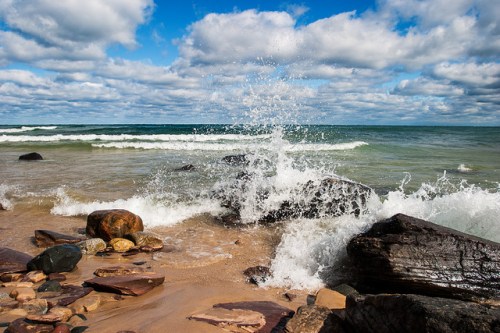
Crashing Wave

Crashing Wave, photo by James Marvin Phelps (mandj98).

When I was posting information about the Absolute Michigan Summer Photo Celebration to some Flickr photo groups, I came across another cool contest. Rebecca Dill from Great Lakes Forever writes:

With summer vacations to the Lakes just around the corner, the sixth annual Great Lakes Forever Photo Contest is accepting submissions from May 20 – July 18, 2010. Through the 2010 Great Lakes Forever Photo Contest, photographers can help defend the Great Lakes with their cameras – and get noticed throughout the Great Lakes region.

Biodiversity Project’s Great Lakes Forever program has again partnered with Budweiser to sponsor a photography contest that celebrates the beauty of the Great Lakes through the incredible talent of local photographers. Great Lakes Forever is a non-profit education and activism campaign designed to raise awareness about our vulnerable and valuable Lakes.

The grand prize winner in both the professional and amateur categories will be featured on the 2010 Great Lakes Forever/Budweiser beer coasters. These coasters will be distributed to bars and restaurants throughout the Great Lakes region…

Interested photographers can visit the Great Lakes Forever website for contest rules and submission details. The submission deadline is July 18, 2010.

The Grand Prize is a kayak and portable navigation system and you can get all the details on their 6th Annual Photo Contest page!

Check this out bigger and in James’ Pictured Rocks National Lakeshore set (slideshow). You can also purchase it if you like!

100,000 photos in the Absolute Michigan Pool

Can You See Me Now...?(.142/365) by Sydney Marie Photography

Can You See Me Now…?(.142/365) by Sydney Marie Photography

Sometime over the weekend, the 100,000th photo was added to the Absolute Michigan pool on Flickr.

One hundred thousand.

What an amazing gift you nearly 2400 photographers have shared with Absolute Michigan and Michigan in Pictures over the last four and a half years. Whether it’s dandelions or Detroit Lions, hill sides or mud slides, if it’s Michigan, chances are there’s a photo of it in the Absolute Michigan photo group!

Check this out bigger and in Sydney’s 365 slideshow.

Support Michigan in Pictures with Patreon

Pirates of the Caribbean 4 … in Traverse City?

Schooner Morning

Schooner Morning, photo by ETCphoto.

Under the “Is that Johnny Depp behind that moonbeam” heading comes the rumor making the rounds that Pirates Of The Caribbean 4: On Stranger Tides will film part of the movie in Traverse City, Michigan. Before the Trailer says that they have heard from several sources that the new Pirates of the Caribbean movie will be filming parts in the Traverse City area:

Before dismissing it, for those that have been to Lake Michigan shores in Traverse City, the water and the beaches are as beautiful and crystal clear as any you will find in the Caribbean. It could easily double for any tropical paradise. With Michigan having the best incentives in the country for filming, it would also make sense that producers and filming scouts would consider Traverse City as an ideal location to film parts of Pirates of the Caribbean 4.

While /Film notes that word on the street is that Jerry Bruckheimer is scaling back Pirates 4 to accommodate a smaller budget, /Film’s own Russ Fischer says:

They’ve pretty loudly talked up the deal that has them shooting in Hawaii, where they’ll take advantage of big tax breaks. I know Michigan has its own advantage systems in effect, and the lake there is amazing, but I’d guess it’s a hopeful rumor.

Whatever ends up happening, you have to wonder how long the beautiful Great Lakes of Michigan will go without a starring role in a major Hollywood film.

Terry took this photo of a marina full of schooners at the inaugural Michigan Schooner Festival last September. See it bigger or in his Michigan Schooner Festival slideshow. For many more photos showcasing the beauty of wild Lake Michigan, check out the Sailing Lake Michigan pool.

Sunset on Ice

moments that make you stop and take it all in

moments that make you stop and take it all in, photo by zakzorah

Earlier this week on Absolute Michigan we had a little tribute to ice on Michigan’s four Great Lakes that you might enjoy. Hopefully you are also enjoying the hopefully final departure of the ice of 2009/2010.

Cris and some friends went to Holland, which was apparently this exciting. More in her Holland set and still more in her ice slideshow.

Harbor Point Lighthouse aka the Little Traverse Light

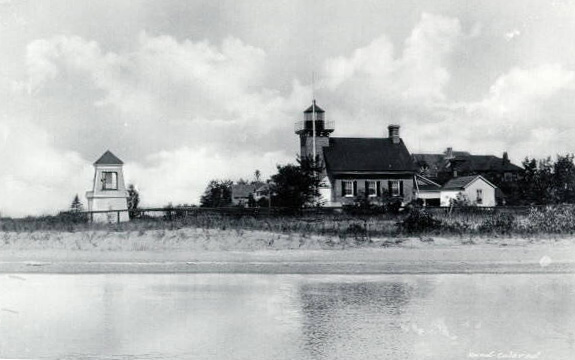
Little Traverse Light (Harbor Point Lighthouse), photo courtesy Archives of Michigan

One of the many Michigan lighthouses at Seeking Michigan is the Little Traverse Light (decommissioned 1963). The Little Traverse Light page at Terry Pepper’s Seeing the Light says:

For centuries the area around Little Traverse Bay had been the home of Ottawa Indians. Around 1700, French Jesuits arrived in the area and constructed a mission at the famous L’Arbre Croche village, a huge native village which stretched from Cross Village to Harbor Springs. Dependent on agriculture, fishing and trapping in 1847, the village of L’Arbre Croche was home to the largest concentration of natives people in what would become the state of Michigan.

…As was frequently the case, treaties with the native Americans were frequently and expeditiously “modified” after their original signing, and with the passage of treaty limitations in 1875, the land around Little Traverse Bay was opened-up for settlers, and the flood gates opened. Harbor Springs was formally incorporated as a village in 1880. After the opening of land availability, land lookers moved through the area, claiming huge tracts of forest for their respective companies, with lumbering operations following quickly on their heels. Simultaneously with this commercial boom, word of the beauty of the bay, its sunsets, clean air, cool breezes and clear water spread throughout the Midwest, and an ever increasing number of moneyed individuals, their pockets bulging with the bounty of the industrialization of the southern Michigan cities began pouring into the area, building summer cottages, mansions and hotels.

With this unprecedented boom in commercial and recreational activity, there was a massive increase in vessel traffic in Little Traverse Bay, and local interests again began petitioning for the construction of the lighthouse recommended almost ten years previously.

Read on and see pictures and get more from Wikipedia’s Little Traverse Light entry. The West Michigan Tourist Association has a cool article on Elizabeth Whitney, who was a keeper at the Little Traverse Light that you might enjoy as well.

Get more shots of the Harbor Point Lighthouse from seekingmichigan.org, including a better shot of the fog bell tower (the structure to the left of the photo).

Way Back When… (we had a chance to stop Asian Carp)

Way Back When...

Way Back When…, photo by oliviaburger08.

Grand Traverse Band of Ottawa and Chippewa Indians tribal chairman Derek Bailey had this Op-Ed in the Traverse City Record-Eagle this week. I know it’s kind of long but I wanted to share it with you

Forum: Work together against Asian carp
By Derek Bailey

Three decades ago many thought that the Great Lakes fisheries resources would be ruined by American Indian tribes exercising “treaty-fishing” rights. After the federal courts confirmed these treaty-reserved rights, the tribes demonstrated their primary concern is protection of the Great Lakes fisheries.

Ironically, these “treaty-fishing” rights now might prove crucial in protecting fisheries resources for all of Michigan’s citizens against the Asian carp invasion.

The United States Supreme Court has denied Michigan’s request for an injunction closing the shipping locks outside of Chicago to prevent any further migration of Asian carp into the Great Lakes. In the midst of the competing claims debating the economic losses of closing shipping to the Mississippi River system compared to potential harm to Great Lakes fisheries, all parties — Attorney General Cox, Gov. Granholm, the Army Corps of Engineers and other federal agencies — agree that the damage to the Great Lakes fisheries will be profound.

It has been almost six years since the U.S. Fish and Wildlife Service estimated that “Asian carp could have a devastating effect on the Great Lakes ecosystem and a significant impact on the $7 billion fishery.” During this time the Army Corps of Engineers failed to act promptly, in effect fiddling while Rome burned. To the extent the Army Corps is responsible for the impending disaster, the tribes may be better situated than the state to challenge the federal government.

In the scramble to stop Asian carp, the issue of American Indian “treaty-fishing” rights has not been considered at all. The 1836 Treaty tribes (the Bay Mills Indian Community, the Grand Traverse Band of Ottawa and Chippewa Indians, the Little River Band of Ottawa Indians, the Little Traverse Bay Bands of Odawa Indians and the Sault Ste Marie Tribe of Chippewa Indians) retain rights to fish for commercial and subsistence purposes in vast areas of lakes Michigan, Superior and Huron.

Historically, fishing played a central role in the spiritual and cultural framework of American Indian life. As the Supreme Court noted a century ago, access to fish and wildlife was “not much less necessary to the existence of the Indians than the atmosphere they breathed,” United States v. Winans, 198 U.S. 371, 381 (1905).

The precedent for American Indian tribes intervening to protect their property interests in disputes between states was clearly established in 1960’s California v. Arizona litigation involving allocation of Colorado River water rights, and confirmed in the Grand Traverse Band’s 1990s litigation assuring access to fishing grounds.

Given the Supreme Court’s refusal to act in the state’s litigation filed against Illinois, the tribes are considering an alternative litigation strategy to combat the latest and perhaps most serious threat to the Great Lakes from invasive species.

The issue isn’t just protecting tribal property rights. It’s past time for the state and tribes to put aside perceived differences, and to begin concentrating on how together we can cooperate to preserve the Great Lakes for all Michigan citizens.

I hope that we don’t look back on what we had for a fishery, recreational resource and amazing gift from whatever powers who bestow gifts on people bestowed upon us and say “Way Back When…”

Check this out on black and in Olivia’s Let’s Go Exploring set (slideshow).

In this home on ice

In this home on ice 2

In this home on ice 2, photo by Alan Medina.

Check it out bigger and in Alan’s slideshow.

Too cold for you? Stay warm with paczki and The Twist over on Absolute Michigan!

80 years of ice on the Straits of Mackinaw

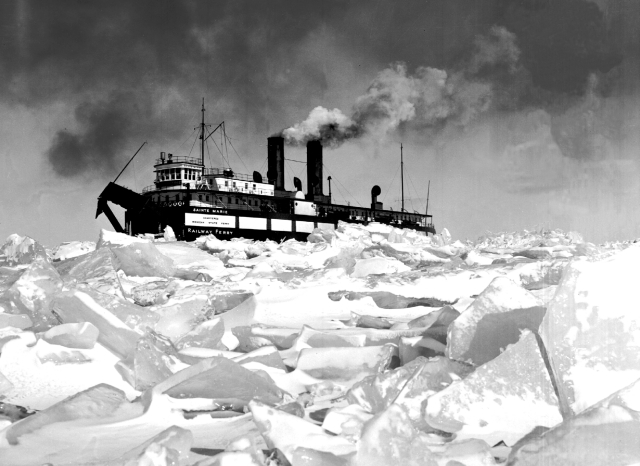
Winter Service, photo courtesy Mackinac Bridge Authority

The Michigan State Ferry Album says:

Winter service began in 1931 when the Highway Department arranged with the Mackinaw Transportation Company to carry cars across the Straits on a railroad icebreaker during the cold months. This arrangement turned out to be poor business for the State, so in 1936 the Highway Department leased the railroad icebreaker “Sainte Marie” for winter operations on a regular schedule.Winter service began in 1931 when the Highway Department arranged with the Mackinaw Transportation Company to carry cars across the Straits on a railroad icebreaker during the cold months. This arrangement turned out to be poor business for the State, so in 1936 the Highway Department leased the railroad icebreaker “Sainte Marie” for winter operations on a regular schedule.

In case you’re wondering, the ice on the Straits of Mackinaw hasn’t changed a whole lot in 80 years, as this photo from February of 2008 titled Triangles by Dominique shows. See it bigger in her Snow/Ice slideshow or check out the whole set.

Triangles