In the past two weeks Chicago has been the center of a rare commodity in the Great Lakes region: Forward-looking thought. And I mean the future, not just until the next election or fiscal year.
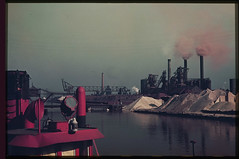
Steel Mills at mouth of Calumet river Chicago by IMLS DCC
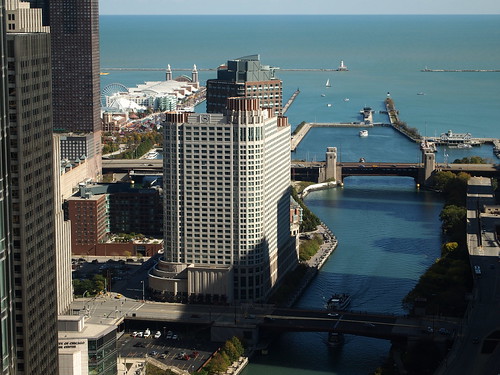
First, architect and MacArthur Foundation “Genius Award” winner Jeanne Gang presented her vision for transforming the Chicago River from that of an “open sewer” and invasive species highway to becoming a model of a 21st century urban waterway.
Gang’s proposal is conceptual, not an engineering plan. It’s meant to generate interest by the public and discussion that has been lacking. And judging by the large crowd that came to hear her speak, that interest exists.
At the same time Chicago Public Radio was also looking to the future.
Its Front & Center series that focuses on the Great Lakes hosted a one hour program about whether the region can truly collaborate for the greater good of the eight Great Lake states. Or will it continue to play in a zero sum economic game by competing with each other while the region’s combined strengths go untapped?
The consensus of the expert commentators is that the region’s governors see no political gain by collaborating. They’re focused on winning the jobs takeaway game that makes for nice press releases and ribbon cutting ceremonies when they win, but does nothing to strengthen the region.
Excellent questions. Read on for his thoughts about where the leadership to protect the amazingly interconnected wonder that are Lakes Michigan, Huron, Superior, Erie and Ontario may (or may not) come from .
There’s no doubt that it will take all the states on the lakes and the governments of the United States and Canada and their citizenry to do it. I’m pretty confident that the character & vision of our leaders and all of us on the Great Lakes will be important to generations yet unborn.
Editor’s note: this isn’t the first time that Michigan in Pictures has featured multiple photos – more in the Sunday Study section. These also aren’t the first photos from outside of Michigan’s borders to appear on Michigan in Pictures – at least one is the Christmas Ship at the dock in Chicago.
The Watershed Center advocates for clean water in Grand Traverse Bay and protects its 1,000-square-mile watershed across Grand Traverse, Leelanau, Antrim and Kalkaska counties. Today’s photo by Christopher Morey was the winning shot from their 2011 photography contest. You can see a few at that link and see all of them and meet the photographers at the Art of the Watershed opening reception next Thursday (Dec 1) from 5-8 PM.
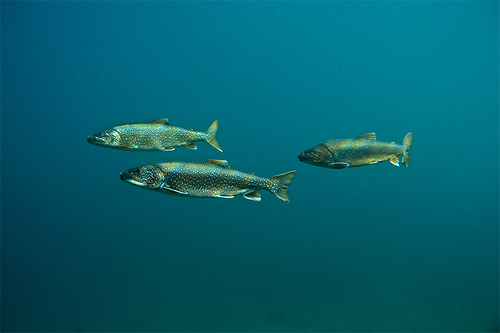
This picture was taken near the end of October off the north breakwall of Clinch Marina. In fall, as water temps drop into the upper forties, the Lake Trout come in to spawn. They are quite challenging subjects for photography, requiring very long, completely motionless breathholds in cold water.
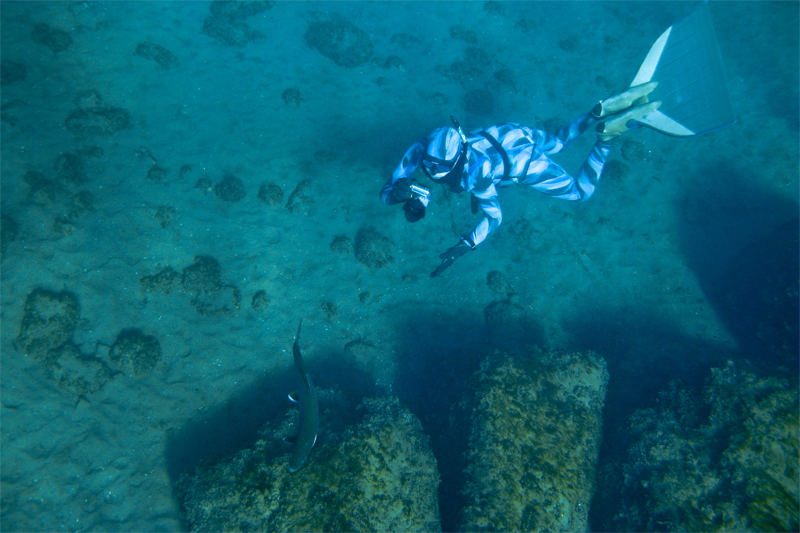
I spent quite a bit of time observing these fish before I finally figured out how to get near them with some consistency. My first attempt at implementing my strategy took place at the cooling intake cribs from the old power plant, about 300 yards off the open space and about 33 feet deep.
With a school barely in sight near one of the cribs I dove directly down. Kicking perhaps 3 times with my monofin, I let myself slowly glide the remaining distance; like a carp settling to the bottom. The sight of me disappearing behind the crib was too much for them and two large Lake Trout appeared overhead, quickly swimming very close. (click this photo by Alicia Higham to see it bigger)
The one I got the best shot of was so close it would not fit in my wide-angle lens.
Since then I’ve noticed, usually about once a year, that they sometimes inexplicably come very close, as if recognizing me. I wonder about this, since these are always older fish and since they live to be nearly 30.
Here’s one of a fantastic series of black & white photos from Pere Marquette Beach in Muskegon taken after it had been swept smooth by the surf.
In 2011, Pere Marquette Beach was named one of the nation’s Blue Wave Beaches by the Clean Beach Coalition along with Esch Beach & South Manitou Island in the Sleeping Bear Dunes National Lakeshore and Sand Point Beach in Pictured Rocks National Lakeshore. Of course there’s no doubt that Michigan has miles and miles more pristine beaches, but this is still something to shout about.
At the dawn of the 1880’s, the volume of maritime traffic passing between harbors on the western shore of Lake Michigan and Green Bay and the Straits of Mackinac exploded. While the St. Helena Island light station lighted the eastern entry into the Straits, mariners were forced to navigate blind along 100 miles of unlighted upper peninsula coastline before the Poverty Island light came into view at the western end of the passage. With treacherous storms frequent at both ends of the navigation season, mariners frequently chose to ride out such storms in the lee of points protruding into the lake along this 100-mile stretch of unlighted shoreline.
Seeking to both make identification of such a refuge easier, and to mark the shore at an interim point between the two existing lights, the Lighthouse Board recommended that establishment of a light station on the end of Point Patterson, approximately midway between St. Helena Island and Manistique.
It took nearly 20 years to complete – read on for more about what was apparently the Cadillac of lighthouses. The light is also reputed to be haunted, and you can read a lot more about that in The Haunting of Seul Choix Point Lighthouse on Michigan in Pictures.
Invasive species, pollution, diversion – the threats facing the Great Lakes are legion.
This week (October 11-14) is Great Lakes Week, a partnership to improve the places around the Great Lakes basin basin where people live, work, learn and play. This week’s activities, meetings and conferences bring representatives of the U.S. and Canadian governments together in Detroit along with a broad coalition of public and private groups to highlight efforts to implement solutions for the lakes’ most pressing problems. It’s one of the most wide-ranging Great Lakes summits in history and you can watch it LIVE today starting at noon through Friday on Absolute Michigan or at greatlakesnow.org.
There is no other festival like it in the United States. The organizers have done a fantastic job of drawing both vendors and lighthouse buffs from around the globe to what has become the largest and best lighthouse festival in the nation. October is a wonderful time of the year to visit Michigan, with the beautiful fall colors, close proximity to Mackinaw City and Mackinac Island and lots of lighthouses, what more could one ask for?
~Tim Harrison, President of the American Lighthouse Foundation
The four-day event provides activities for the young and old, including lighthouse tours by personal vehicles, a helicopter tour, or boat tour, entertainment, auctions, dining events, lighthouse exhibits, and shopping. The festival boasts more than 75 maritime-related vendors, including lighthouse preservation groups, artists, nautical crafters, photographers, and authors. This year’s featured guest speakers include Terry Pepper, executive director of the Great Lakes Lighthouse Keepers Association, national gold medal award winning photographer and author Larry Wright, and Sandy Bihn, president of the Toledo Harbor Lighthouse Society, which operates the 2011 featured attraction, the Toledo Harbor Lighthouse.
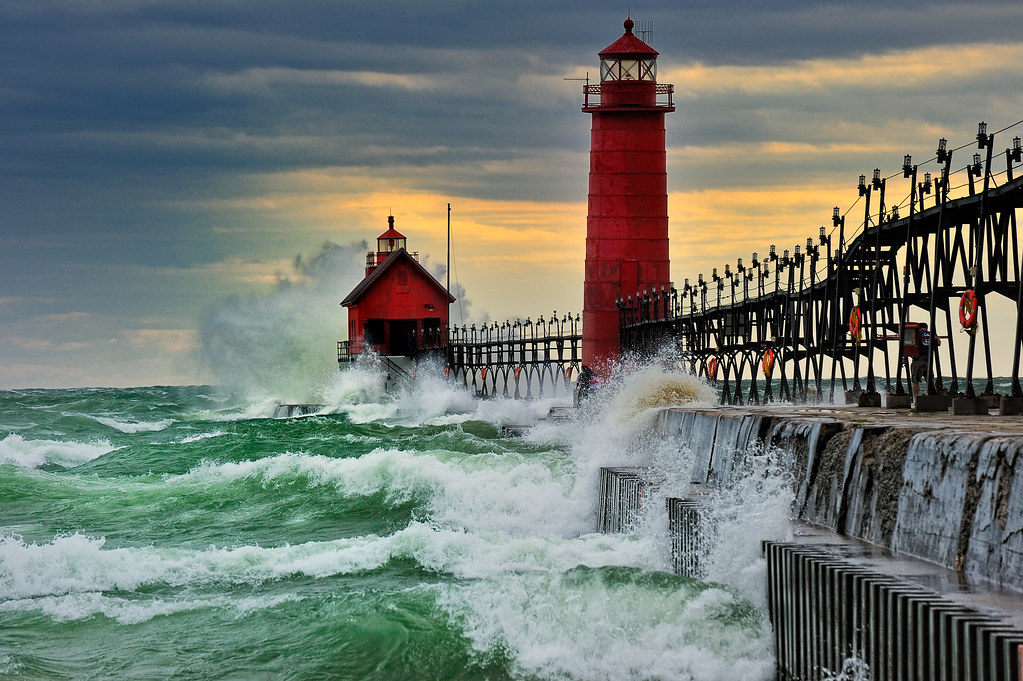
If the name Terry Pepper sounds familiar, he’s the authority we turn to for our lighthouse features and his books on lighthouses are fantastic. Check out Terry Pepper’s Seeing the Light and read much from him in the lighthouse category on Michigan in Pictures including our post on the Grand Haven Pier Light.
John took this photo last September. He says to note the guy with the pink surfboard (then see him in the waves in this shot). Check it out bigger and in his fantastic Michigan Lighthouses slideshow.
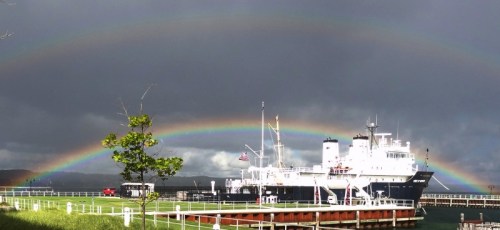
It was quite the double rainbow last Thursday in the Traverse City area. I was off to the right end of the bow in Suttons Bay but I couldn’t fit it all in in any of my photos.
The boat is the State of Michigan at the Great Lakes Maritime Academy in Traverse City, a training ship that allows cadets to put into practice the theory and skill sets taught in the classroom. The vessel is a:
…224-foot former Navy submarine surveillance ship Persistent, which is now T/S State of Michigan. The vessel is relatively new, having been built in 1986 as part of a series of 18 Stalwart-class T-AGOS vessels designed to tow highly sensitive sonar arrays for the tracking of Soviet submarines. As the Soviet threat diminished in the 1990s, the Navy decided to decommission the T-AGOS fleet, and in 1998 Persistent and sister ship Vindicator were transferred to the U.S. Coast Guard for primary use in drug interdiction.
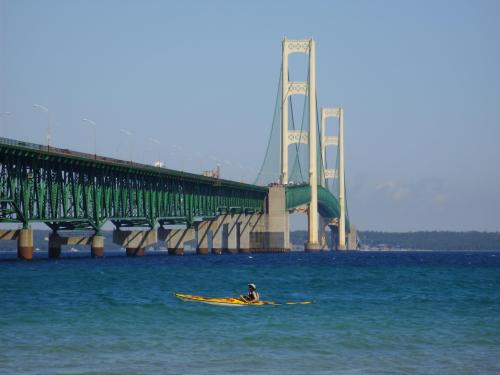
This Monday (September 5th) it’s time for the annual Mackinac Bridge Walk. 2011 is the 54th annual and the walk is open to all. It starts at 7 AM and you can leave any time up to 11 AM. They have a blog with information for and about the 400 runners who won the lottery for an opportunity to take part in the early morning Mackinac Bridge Labor Day Run. It includes information for how to enter next year and I have to imagine that for a runner, the 5 mile span from the Lower to Upper Peninsula would be a pretty special memory!
When I saw these photos I thought they were from Sleeping Bear, then I realized they were from Grand Mere State Park near St. Joseph, which the state of Michigan says is characterized by magnificent sand dunes, deep blowouts and one mile of Lake Michigan shoreline. Another page adds:
The magnificent high-relief dunes in Grand Mere were formed approximately 10,000 years ago during the recession of glacial lakes. They are a natural phenomenon not found anywhere else in the world. Located between Lake Michigan and several inland lakes and unique wetlands, the dunes afford an excellent perspective of the surrounding region. The lakes and wetlands provide a unique ecological area that encompasses the full range of open water aquatic to closed forest terrestrial communities. The wetlands and lakes are significant waterfowl and songbirds migrating areas.
More about Lake Michigan coastal dune structures in this really great Sand Dune Inventory.





 Michigan in Pictures