Fogbow: a White Rainbow over Big Red

fogbow-at-big-red-by-steven-karsten

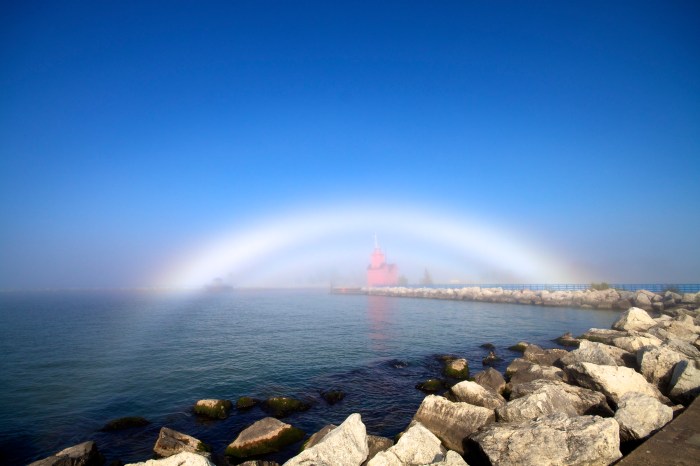
White Rainbow, photo by stevedontsurf.

Today’s photo shows a fogbow. According to the Fogbow entry from Atmospheric Optics:

Fogbows form in the same way as rainbows. A small fraction of the light entering droplets is internally reflected once and emerges to form a large circle opposite the sun.

But… …beyond that there are major differences. Rainbows are formed by raindrops which are so large that rays passing through them follow well defined ‘geometrical optics’ paths. Fogbows are formed by much smaller cloud and fog droplets which diffract light extensively.

…Fogbows are almost white with faint reds on the outside and blues inside. The colours are so washed out because the bow in each colour is very broad and the colours overlap.

Read on for more, including some photos and get a little more at Wikipedia’s page on fog bows.

Steven shot this at the Holland Harbor Lighthouse aka Big Red and writes that he’s still amazed he was able to stumble upon one of these. Check his photo out big as the sky and in his Holland slideshow.
Sleeping Bear Dune Rides

Sleeping Bear Dune ride

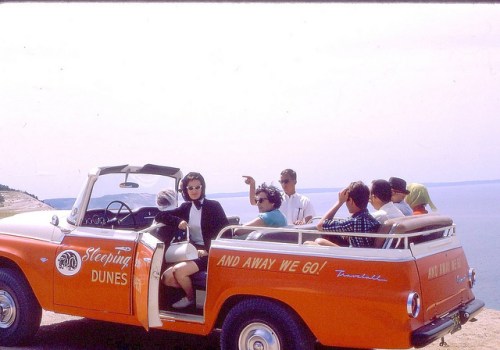
Dune rides, photo by creed_400.

This photo prompted me to dig out a ton of information & photos about this vanished part of the Sleeping Bear Dunes experience. Enjoy Sleeping Bear Dune Rides: Remembering the Dunesmobiles at Leelanau.com.

See it background big and in creed_400s Sleeping Bear Dunes National Lakeshore slideshow.

Iced Roots

Iced Roots

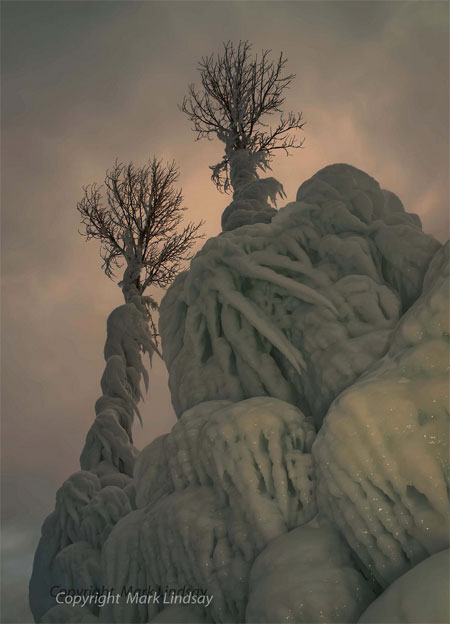
Iced Roots, photo by Happyhiker4

See this photo from the Lake Michigan shore at Point Betsie bigger on Mark’s Facebook, where you can also see the trees from the other side! About these photos, Mark writes:

Sometimes gifts just appear in the strangest places. In this case it was the gift of the most beautiful trees, wrapped and protected with the most beautiful layers of ice, with a most amazing lake in the background. I watched as the waves crashed and delivered the next layer. It certainly was a gifted and blessed day. Blessed in Nature, What a Life.

What a life indeed.

Lake Michigan was first

Lake Michigan

Lake Michigan, photo by GLASman1.

This coming Thursday (January 26) is Michigan’s 175th Birthday (#mich175 on twitter). We’re making a big fuss of it with a 175th Birthday Bash on Absolute Michigan, and this morning I inadvertently stumbled on a piece of Michigan’s heritage that I guess I never really thought about.

Wikipedia’s Lake Michigan entry begins:

Lake Michigan is one of the five Great Lakes of North America and the only one located entirely within the United States. The other four Great Lakes are shared by the US and Canada. It is the second largest of the Great Lakes by volume and the third largest by surface area, after Lake Superior and Lake Huron (and is slightly smaller than the U.S. state of West Virginia).

Hydrologically, the lake is a large bay of Lake Michigan-Huron, having the same surface elevation as Lake Huron (among other shared properties). It is bounded, from west to east, by the U.S. states of Wisconsin, Illinois, Indiana, and Michigan. The word “Michigan” originally referred to the lake itself, and is believed to come from the Ojibwa word mishigami meaning “great water”.

It makes complete sense to me that the Lake was first. However, since I’m pretty much never able to leave ambiguities un-investigated, I dug up a discussion thread about the origin of “Michigan” from the Ojibwe Language Society Miinawaa. One member listed a few variants:

mishigami = large lake
mishigamaa = large lake
mishi’igan = large lake
mishigaam = large shoreline

and then another member wrote

my understanding of the word ‘Michigan’–which may be different from others’–is that it comes from ‘michi-zaaga’igan’, which means ‘only/just/nothing else but a lake’ [michi ‘only, just, that’s all there is’ + zaaga’igan ‘lake’].

If you think about Lake Michigan and Lake Huron and how you might perceive them before aerial capability or maps, wouldn’t they seem like one big lake to someone questing to walk or paddle the shoreline of Michigan’s Lower Peninsula? The “only lake”? Love to hear your thoughts in the comments.

Check this out bigger and in Mark’s Point Betsie Lighthouse slideshow.

More Lake Michigan on Michigan in Pictures.

January Ice

January Ice

January Ice, photo by ER Post.

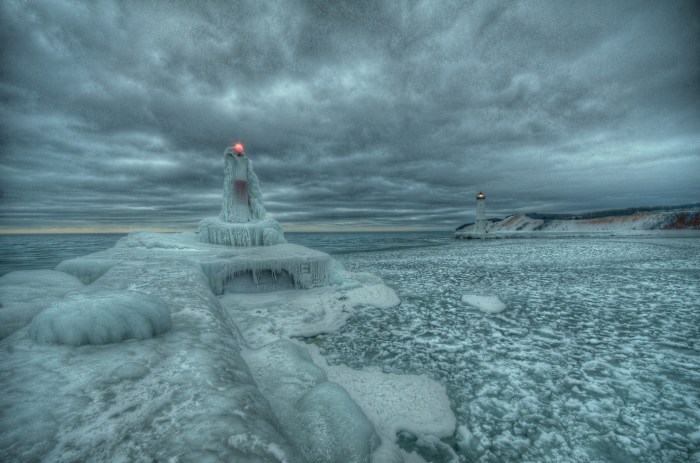
January ice frames the Grand Haven Pier Light.

Check this out bigger and in Terry’s Michigan Lighthouses slideshow.

Michigan in Pictures turns six

NC0B8495-Edit-Edit-2-1

NC0B8495-Edit-Edit-2-1, photo by [DennisT].

On December 30, 2005 Michigan in Pictures posted its first photo, a pond on Bald Mountain. 1881 posts later, Michigan in Pictures is still one of the highlights of my day.

I simply love this blog. The experience of looking through the photos shared in the Absolute Michigan pool and learning about Michigan’s waterfalls and lighthouses, points of interest like the Eben Ice Caves or Big Boy Graveyard, and everything from the history of our state to the mysteries of the northern lights is one of the most enriching and rewarding pursuits in my life.

Thanks for sharing it with me.

Dennis took this shot in Saugatuck. See it background bigtacular or in his slideshow.

Much more Michigan wallpaper can be found on Michigan in Pictures!

Frankfort North Breakwater Light

Frankfort Lights by Jason Lome

Frankfort Lights, photo by lomeranger.

The Detroit Free Press reports that Coast Guard has given the Frankfort Lighthouse to the City of Frankfort under the National Historic Lighthouse Preservation Act. It’s one of 15 historic light stations in Michigan that have been transferred at no cost to nonprofits and government agencies.

The Frankfort North Breakwater Light entry at Terry Pepper’s Seeing the Light details the long history of the lights at Frankfort Harbor and says that:

By 1924, the total car ferry tonnage through Frankfort Harbor was twenty five times greater than that prior to the establishment of the ferries. To better serve this vital commerce, the Army Corps of Engineers began construction of a pair of reinforced concrete arrowhead-type breakwaters at the harbor entrance in order to create a large stilling basin to protect the opening into the harbor. With the completion of these breakwaters in the early 1930’s, the twin piers at the entry into Lake Betsie no longer served any purpose. With plans in place to shorten them into short stub piers, the North Pierhead Light was lifted from the pier onto the deck of a barge and carried out to the end of the North Breakwater. A square steel base 25 feet in height had been erected on the end of the breakwater to receive it, and the tower was lifted onto the new base. After being bolted into position, the new tower stood 67 feet in height from the upper level of the pier to the top of the lantern ventilator ball. By virtue of its location on the concrete pier, the light stood at a focal plane of 72 feet, and the 17,000 candlepower incandescent electric light within the Fourth Order Fresnel was visible for a distance of 16 miles in clear weather.

Be sure to click for much more including some very cool old photo of the South Pier fog bells and the story of captain George Tifft, who more or less founded Frankfort when his schooner was driven into Lake Betsie.

See this photo bigger, in Jason’s fantastic ice slideshow, and purchase prints on his photography website.

Michigan in Pictures has a great vintage postcard of the Frankfort Light in winter and you can see the tower in this shot by jimflix from the Absolute Michigan pool.

The Lake in Winter

DSC_0136

DSC_0136, photo by jsorbieus.

It changes every day, every hour. It is a thousand lakes, changing faces with every shift in wind and light – flurried by offshore wind, whitecapped in squalls, colored flannel gray or pearl-white or stormy black beneath the winter clouds, a dozen blues when the sky is blue.
~Jerry Dennis on Lake Michigan

Over on Absolute Michigan today we have an excerpt from The Windward Shore, the new book from Michigan outdoor writer Jerry Dennis. It’s titled The Lake in Winter and you should definitely take the time to read it!

Check this out background big and see more shots of the Lakeshore in winter in Jim’s slideshow.

More winter wallpaper on Michigan in Pictures!

The Light at Point Aux Bec Scies

 Pt. Betsie Lighthouse

Pt. Betsie Lighthouse , photo by GLASman1.

Point Betsie Light is one of the most photographed lighthouses in the world. The Friends of Point Betsie website notes that the point was originally known by the French as “Point Aux Bec Scies,” meaning “sawed beak point” and that it was was built in 1858 at a cost of $5000. If you want to get a taste of life at a lighthouse, you can rent the Assistant Keeper’s apartment in the summertime.

Check it out bigger and in Mark’s slideshow.

Much more about Point Betsie Lighthouse on Michigan in Pictures!

Waiting on Winter

Sunset on Ice
Sunset on Ice, photo by Happyhiker4

While we wait and wonder when winter will wander in, many folks including Mark are digging through their archives for helpful pictures to remind Old Man Winter to get busy. About this photo from last January Mark writes:

I had traveled to the icy shores looking for a chance to see the sunset from an icy shoreline. Little did I know I would be blessed in incredible beauty. I wanted to feel the ice and the textures were just incredible. I ran my fingers over the smooth solid ice. The ice held such a deep color as the sun put on an incredible show. Blessed in Nature. What a Life!

Check it out on black and see more of Mark’s amazing work in his Ice slideshow.