Big Sable Sunset

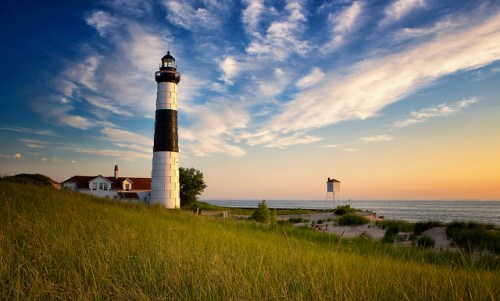
Big Sable Sunset

Big Sable Sunset, photo by Robby Ryke

Terry Pepper’s Seeing the Light has all the history on Big Sable Point Light Station. One interesting fact is that it holds the distinction of being the last Great Lakes light to become electrified in 1949.

Terry notes that electrification was always a double-edged-sword, because it paved the way for automation in 1968 which in turned paved the way for vandalism and deterioration. In 1977 waves came perilously close to undermining the tower before the seawall could be replaced, but the Sable Point Lighthouse Keepers Association has helped restore this light to its former glory.

Check this photo out bigger and in Robby’s great Pure Michigan slideshow.

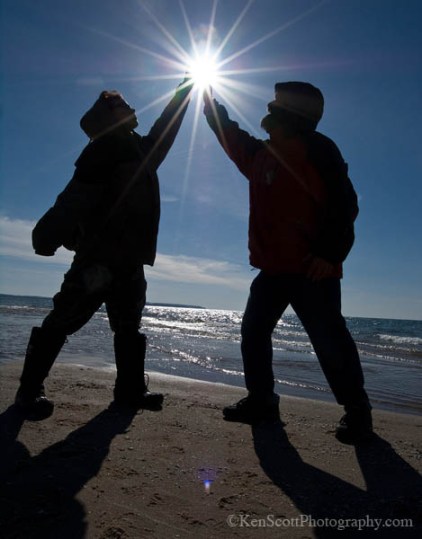
High Five for Dads

Spring Sun … III, photo by Ken Scott

Here’s hoping that all the fathers out there are having an especially nice weekend.

Check Ken’s photo out bigger and see more in his sky stuff slideshow.

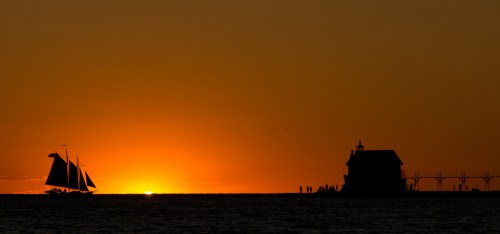
almost there

almost there

almost there, photo by randyr photography

I’m pretty sure this is the schooner Wind Dancer approaching the Grand Haven Lighthouse. Here’s another shot of the Wind Dancer from the Absolute Michigan pool by Dan Johnson.

Check this out bigger and see some more in Randy’s slideshow.

More Michigan boats & ships on Michigan in Pictures!

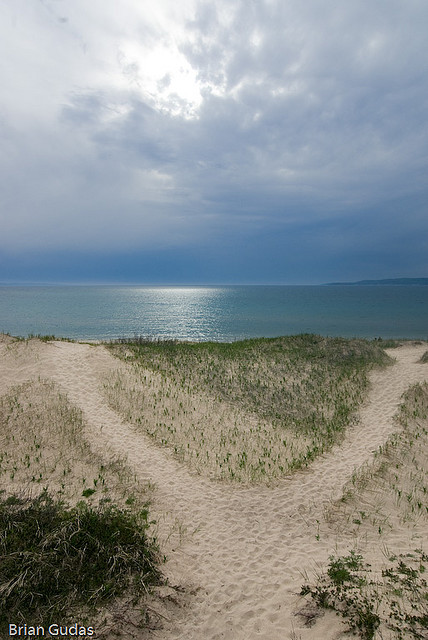
Best Lake Beach: Petoskey State Park

Petoskey State Park - Smile

Petoskey State Park – Smile, photo by Brian Gudas

TV 9&10 News reports that Weather Channel viewers have named the beach at Petoskey State Park as the Best Lake Beach in America.

The Michigan DNR’s page on Petoskey State Park explains that:

Petoskey State Park, located on the north end of Little Traverse Bay, is situated on 303 scenic acres and offers a beautiful sandy beach on the bay. The park has two separate modern campgrounds. Tannery Creek offers 98 campsites, and Dunes offers 70 campsites.

The park land was originally deeded to Pay-Me-Gwau under an Ottawa Indian treaty in July of 1855. Later, much of the land was the site of the W.W. Rice Company. In 1934, the City of Petoskey purchased the land and named it the Petoskey Bathing Beach. In April of 1968, the beach was sold to the State of Michigan. On May 21, 1969, the state was given the title to the land. The campground opened its sites to the first campers in July of 1970.

Check Brian’s photo out on black and in his North Camping Trip slideshow.

You can see some more shots in the Petoskey State Park slideshow from the Absolute Michigan pool, and more great Michigan beaches from Michigan in Pictures.

What do you think? What’s your favorite beach in Michigan?

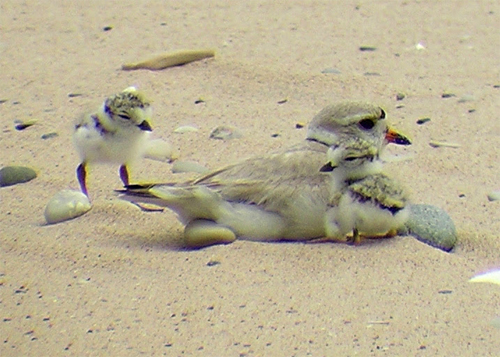
Piping Plover (Charadrius melodus)

Adult Piping Plover caring for her chicks, photo courtesy National Park Service

The Sleeping Bear Dunes National Lakeshore page on piping plovers begins:

The Piping Plover (Charadrius melodus) is an endangered shorebird. They are sand-colored on the back and white below. During the breeding season adults have a black forehead band between the eyes and a single black band around the neck. (Its larger relative the Killdeer is commonly seen at parks, playgrounds, and golf courses, and has two dark bands around the neck.) Piping Plovers nest only on beaches and prefer beaches with cobble. There are three small populations: one in the Great Plains, one on the Atlantic Coast, and the one here in the Great Lakes. They winter together on the Gulf Coast but travel to the separate areas during the breeding season. It is a special opportunity to be able observe Piping Plovers since there are only between 50 and 60 nesting pairs in the entire Great Lakes area and less than 5000 individuals worldwide.

You can read more about piping plovers at All About Birds where they also have some photos, a plover call and a video. You can also check out a video of a piping plover feeding from the other side of the state on Saginaw Bay.

The Sleeping Bear Dunes National Lakeshore reports that four pairs of this federally endangered shorebird have made the Glen Haven beach their home for the summer. It’s an easily accessible location that provides visitors an excellent opportunity to view a rare bird in its natural habitat. While the entire shoreline will be open for walking, certain areas of the beach will be temporarily closed to all entry.

More photos of piping plovers from Alice van Zoeren and the Sleeping Bear Dunes National Lakeshore.

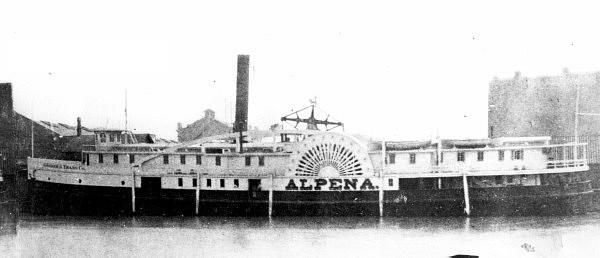
Michigan’s Titanic: The S.S. Alpena

SS_Alpena

S.S. Alpena, photo from Wikimedia Commons

Over on Absolute Michigan we have a feature from the Archives of Michigan about two Michigan couples who were aboard the Titanic. I thought it would be interesting to see what the worst Michigan maritime disaster was. You might think it would be the immortalized Edmund Fitzgerald but with “only” 29, it’s down on the list. Or perhaps the tragic Carl D. Bradley in which 33 men perished, most from her home port of Rogers City.

It’s actually the sidewheel steamer S.S. Alpena. Michigan Shipwrecks says that this 197 foot Goodrich side wheel steamer was built in Marine City, Michigan in 1866. She was lost with about 80 crew & passengers in the “Big Blow” of 1880.

The Alpena left Grand Haven, Michigan bound for Chicago on Friday evening, October 15, 1880 at 9:30 PM. The weather was beautiful — Indian Summer like. But the barometer was indicating a storm was coming and storm signals were out. She was met on her southwest journey by the steamer Muskegon at about 1:00 AM and everything seemed normal.

At about 3:00 AM Saturday, October 16, 1880 the “worst gale in Lake Michigan recorded history” swept across the lake. The Alpena was seen at 6:00 AM, 7:00 AM and at 8:00 AM by the schooner Irish and by Captain George Boomsluiter of the barge City of Grand Haven about 35 miles off Kenosha, Wisconsin, laboring heavily in the high seas.

She was seen later by several other vessel captains –one of whom reported her lying on her side with one of her paddlewheels out of the water. Ten car loads of apples were stowed on her main deck and some speculate this cargo became unmanageable in the storm, shifted, and led to the capsizing.

…The weekly Holland City News reported on October 23: “The wreck is complete. She is broken into small fragments. The stern part of her hull lies near the harbor. The whole coast for 20 miles is strewn with the debris, freight, etc.” The largest piece to land near Holland was the piano, “it being barely able to float, our sailors concluded that she did not come very far. And the arrival of other heavy pieces of the wreck would seem to corroborate this.”

The wreck has never been found and you can read on for more. FYI, the Great Lakes Shipwreck database pegs the loss of life close to 100 and adds that the first indication that she was lost was when masses of wreckage began washing ashore along the coast near Manistee. It took several days for the magnitude of the disaster to be realized. Her paddlebox nameboard washed ashore at “Alpena Beach” in 1909, after a storm.

The largest loss of life in open water on the Great Lakes was 300 aboard the Lady Elgin that was rammed by the schooner Augusta in September of 1860 off Highwood, IL . An interesting note is that this shipwreck led to the requirement for sailing vessels to carry running lights. The Smithsonian relates that the worst shipwreck on the Great Lakes:

In terms of loss of life, hands down, that’s called the SS Eastland, which went down in the Chicago River on July 24, 1915. For whatever reason, the ship turned over onto its port side right there in the river. Passengers either wanted to see something in the river and they went to port side, or the engineer improperly ballasted the ship, or it wasn’t a stable ship to begin, but she flipped over right into the Chicago River, not terribly deep water maybe 20-30 feet, and killed 844 passengers and crew. It still remains the worst loss of life on any single shipwreck in the Great Lakes.

More shipwrecks on Michigan in Pictures.

South Fox Island Lighthouse

South Fox Island ... tower view, spring panorama

South Fox Island … tower view, spring panorama, photo by Ken Scott

The South Fox Lighthouse Association maintains this light, has lots of great history and photos and is a worthy target for your donations.

Recently, I made the acquaintance of Terry Pepper. Terry’s Seeing the Light is hands-down the best Great Lakes Lighthouse website out there and I’ve used him as a resource for years in dozens of lighthouse features on Michigan in Pictures. Terry told me I could lean on him (even more) for photos and information. It seems a shame to waste that gift, so here goes. On his South Fox Island Lighthouse page he begins:

South Fox Island is located approximately seventeen miles off Cat’s Head Point, at the tip of the Leelanau Peninsula. The story of this Island light began with Congress’s appropriation of $18,000 for the construction of a lighthouse there on March 2, 1867.

Work on the light station began immediately, with the construction of the Cream City brick tower. With walls thirteen inches in thickness, the square tower topped-out at forty-five feet in height, and contained a forty-eight step cast iron spiral staircase leading to the lantern room.

The lantern was outfitted with a flashing red Fourth Order Fresnel lens, and the station’s first keeper Henry J. Roe climbed the tower steps to exhibit the light for the first time on November 1, 1867.

Read on for much more including Keeper Warner’s battle with drifting sands and snow that piled so high as to interfere with access to the station’s buildings and more about that Cream City brick from Milwaukee.

View Ken’s photo bigger and see more in his slideshow from South Fox Island.

March is the new May

Beach

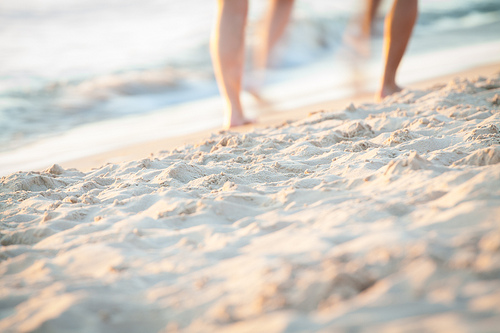
Beach, photo by Second Glance Photos Kevin Ryan.

What a crazy weekend, with sunny & 70s recorded all over Michigan on St Patrick’s Day weekend and record temps set in many places yesterday including 82 degrees in my home of Traverse City.

82. In March. Add to that mosquitos biting, forsythia blooming and even spring peepers peeping and it’s clear that March IS the new May!!

Kevin shot this on Saturday in 75 degree weather at the beach in Grand Haven. Check this out bigger and in his pier/sunset slideshow.

Into the Maelstrom: Winter Surfing in Frankfort

Frankfort Winter Surfing

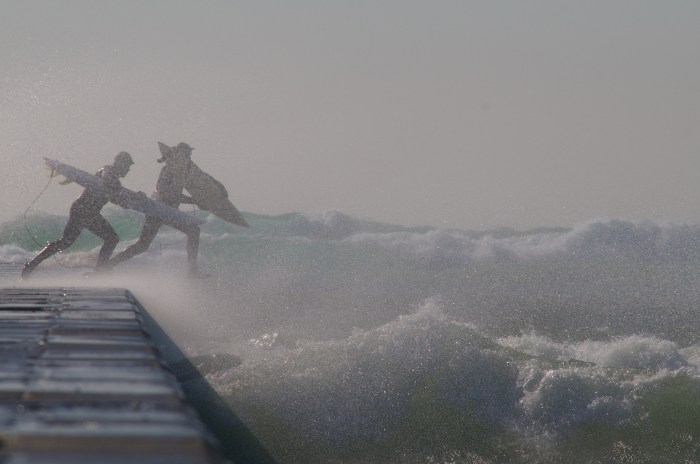
Frankfort Winter Surfing, photo by lomeranger.

Sure, you’re crazy. But are you crazy enough for 17′ waves and 40 degree water?

See this photo from Frankfort bigger and purchase if you want at Jason’s Zenfolio.

More Michigan surfing on Michigan in Pictures!

Good Harbor Bay … aurora borealis panorama

Good Harbor Bay ... aurora borealis panorama

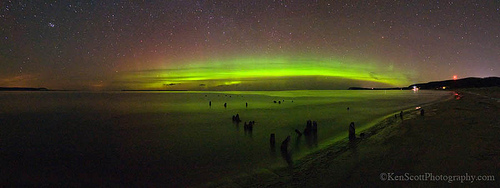
Good Harbor Bay … aurora borealis panorama, photo by Ken Scott.

The northern lights made an appearance over the weekend, and Ken Scott was one of the Michigan photographers who made the scene!

Click to see it on black and see more in his northern lights slideshow.

A couple others were Shawn Malone of Lake Superior photo and Guy Strong who nabbed a SWEET time-lapse of the northern lights!

Click for many (many) more photos of the Northern Lights in Michigan!