Great Lakes approaching record ice cover

Leland & Lake Michigan by Elijah Allen

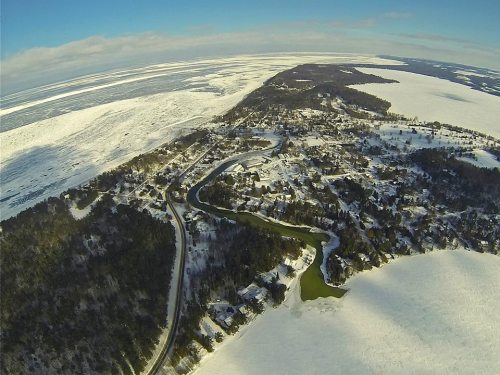
Drone over Leelanau (at Leland), photo by Elijah Allen

Mark Torregrossa writes at mLive that the Great Lakes are nearly 90% ice-covered:

The total ice cover on the Great Lakes continued to increase in the past seven days. At the rate the ice is growing, ice cover would reach record levels sometime next week.

We also had a mostly clear day Tuesday February 11, 2014. The high resolution satellite was able to generate some fascinating images.

The total ice cover on the entire Great Lakes system is reported at 87.3 percent today, according to the Great Lakes Environmental Research Laboratory(GLERL). The ice cover is up from 77 percent covered seven days ago.

The highest recorded total ice cover on the Great Lakes is 94.7 percent back on February 19, 1979. It should be emphasized that the most modern data set only goes back to 1973.

So the entire Great Lakes system has gone from 77 percent ice covered last week to 87 percent ice covered today. At that rate of increase, the Great Lakes would set a new modern day record for ice cover sometime next week.

Click through to mLive for a Lake by Lake report on ice cover and some sweet satellite shots.

My friend Elijah has been having entirely too much fun in and above the snow this winter. Lately he’s been flying a drone above the Leelanau Peninsula to see what he can see. View his photo bigger and (if you can) see more in his Drone over Leelanau Facebook gallery.

More aerial photography on Michigan in Pictures!
A Lighthouse a day keeps the winter away

Frankfort Lighthouse by 22 north

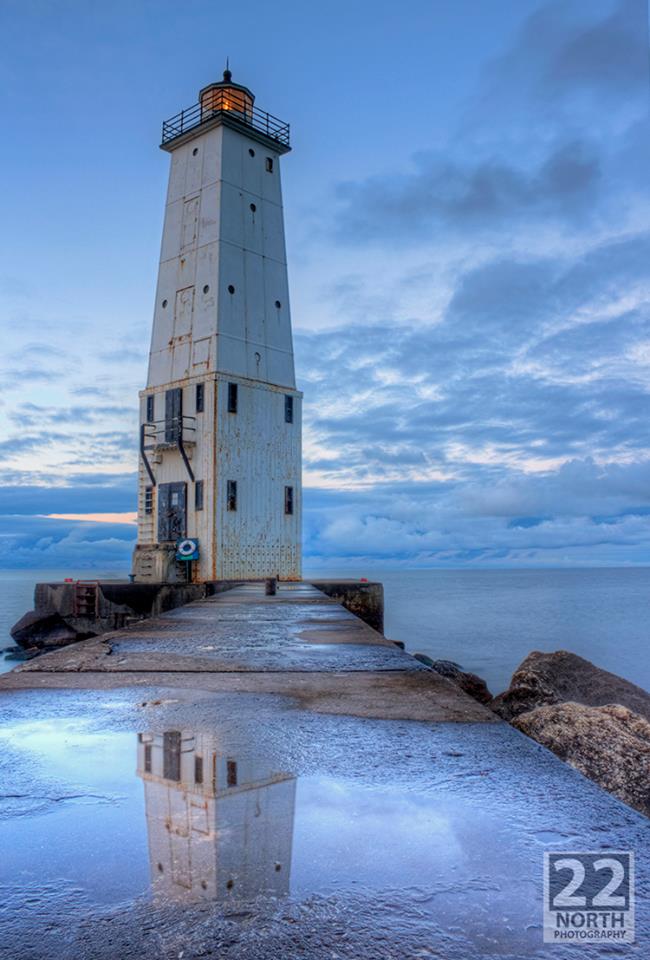
Dawn at Frankfort North Breakwater Light, photo by 22 North Photography

22 North Photography has declared February as Lighthouse Month, sharing 28 Michigan lighthouses in 28 days. Day 1 is the Frankfort North Breakwater Light which marks the entrance to Betsie Lake and the Betsie River in Frankfort.

View the photo bigger on Facebook, keep up on their Facebook page and also see the 22 North Photography website.

Many more lighthouses on Michigan in Pictures.

In between the dark and the light on Empire Bluffs

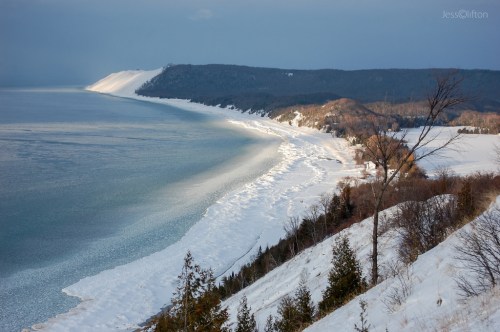
Sun Spill, Empire Beach

Sun Spill, Empire Beach, photo by jess_clifton

Recently Michigan in Pictures regular Jess Clifton and her family made a wintertime excursion to Empire in the heart of the Sleeping Bear Dunes National Lakeshore. She writes (in part):

At Empire, the beach was already sprinkled with about 10-15 other folks and the scene was surreal. Kids were crawling in and out of caves carved into the thick, massive ice formations built up along the water’s edge. Clouds intermittently descended and receded, offering up dramatic skies that beckoned you out.

…Once I finally convinced myself the beach was “safe” to venture out onto after watching about 14 other people successfully make the trek, I was off cresting mini ice mountains at a snails pace until I could finally peer into the water.

It was there that I finally got a sense of just how still the water was. Pancake ice floated gently on the barely breathing lake. The revelation of something so calm in such a harsh environment was almost jarring. (In a really good way.)

Read on for more and lots of stunning photos in her Why Michigan? blog.

View Jess’s photo background bigtacular and see more in her Winter in Northern Michigan slideshow. She also has a comparison photo from last year.

Lots more winter wallpaper on Michigan in Pictures.

Shoreline Wonders

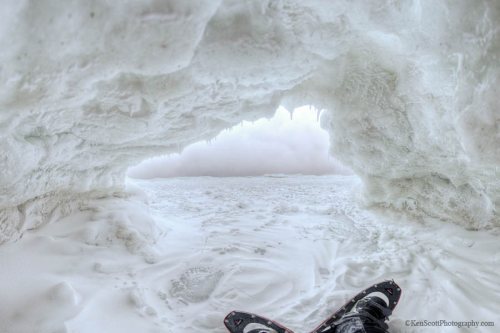
Winter ... shoreline wonders!

Winter … shoreline wonders!, photo by Ken Scott

As you may have realized from his last photo, Ken enjoys winter quite a lot – a useful trait for a photographer! He says that he crawled in here to get out of the arctic blast yesterday when he was exploring the ice by the Grand Traverse Lighthouse at the tip of the Leelanau Peninsula. If you want to get a sense of what it’s like right now, he also shot a fantastic video!

View his photo bigger, see more in his Winter slideshow and if you’d like to chat with Ken about the photo, check it out on his Facebook page.

PS: I thought this photo was a nice counterpoint to Shawn Malone’s last pic.

Onekama Sunset

Onekama Sunset

Onekama Sunset, photo by lomeranger

I hope you all had a great week and that you’ll have a chance to get out and enjoy Michigan this weekend.

Wikipedia says that Onekama is a village in Manistee County located on the shores of Portage Lake, and that the town’s name is derived from “Ona-ga-maa,” an Anishinaabe word that means “singing water.” Here’s a Google map.

View Jason’s photo background bigtacular, see more in his Landscape IV slideshow and (if you like) purchase it right here.

More winter wallpaper on Michigan in Pictures.

Ice Balls on the Sleeping Bear Lakeshore

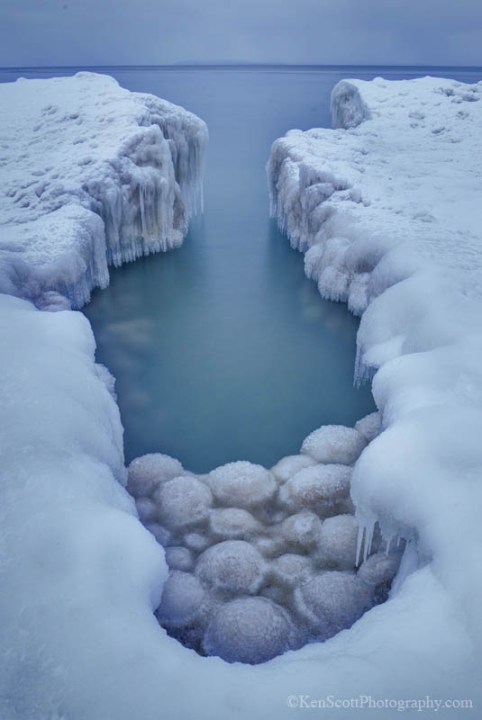
Lake Michigan ... ice balls III

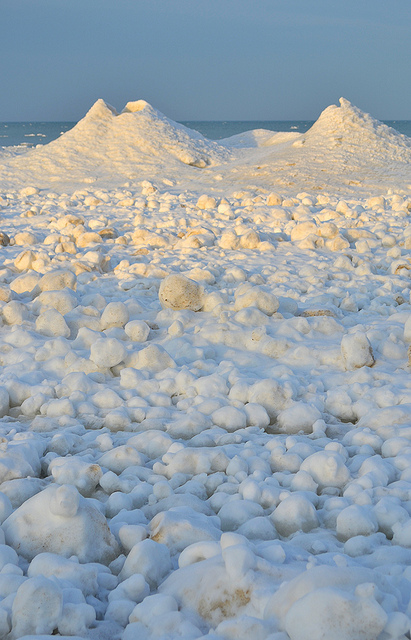
Lake Michigan … ice balls III, photo by Ken Scott

You may recall the Lake Michigan ice balls that were seen at the Sleeping Bear Dunes lakeshore last March.  Well, they’re baaaaack. You can see a great video of the ball ice at Accuweather. Here’s the explanation of how balls ice form that I  put together from AIR PHOTO INTERPRETATION OF GREAT LAKES ICE FEATURES by Ernest W. Marshal & Frazil ice at Wikipedia:

Ball ice consists of roughly spherical masses of slush and frazil ice that accrete in turbulent water. Frazil ice is a collection of loose, randomly oriented needle-shaped ice crystals that form in open, turbulent, supercooled water. Lumps that form in the less turbulent zones are typically flattened discs, while those formed in the extremely turbulent zone near the shoreline ice where wave action is strongest form into spheres.

The author explains that ball ice is a feature common to all of the Great Lakes and can occur at any time during the winter where water turbulence breaks up a slush layer. You can read more about this in Great Lakes Ice Features.

View Ken’s photo bigger, check them out in his ice balls slideshow and see this shot with Ken in it for a sense of the scale.

Blue Anticipation

Blue Anticipation

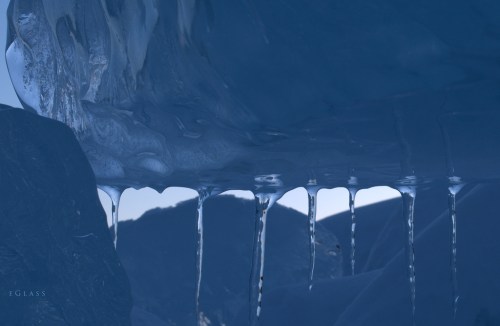
Blue Anticipation, photo by Elizabeth Glass

I dug way back through the over 13,000 winter photos in the Absolute Michigan pool on Flickr for today’s photo.

Liz Glass took it at the Straits of Mackinac in 2011. She says that the color is real and recommends you check it out bigger to see the details on Fluidr. It’s also a cool way to look at her Ice set (or view the slideshow on Flickr).

More ice on Michigan in Pictures.

Ice Volcanoes in Michigan

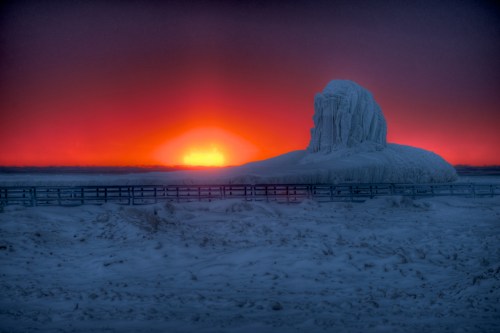
Shore Ice

Shore Ice, photo by timmerschester

The Weather Notebook has this to say about Ice Volcanoes:

Ice volcanoes can form during winter on the Great Lakes. They are not lava-spewing mountains of ice, but water-spouting ice cones.

As winter ice begins to build along the shores of large lakes such as Lake Superior, it is jostled, broken, and shifted by the winds and wave motions on the waters. When winds blow onshore, they can build an ice shelf, a jumble of ice chunks that anchors on the shore but extends some distance back into the water. Amongst the numerous ice blocks comprising a shelf, many open tunnels lead back to the lake waters.

To build a good ice volcano cone, the surface air temperature must be several degrees below freezing and lake waves should be several feet high and breaking onshore. As the waves strike the edge of the ice shelf, pulses of wave energy flow beneath the ice. Upon reaching the open end of a tunnel, the wave forces water to erupt out through the ice. If the hole has been covered with snow, the eruption may spray snow outward like a volcanic gas cloud.

As the ejected water falls back onto the ice, it quickly freezes and begins the formation of an ice cone, a process very similar to the building of a lava cone surrounding a geologic volcanic vent. A study of ice volcanoes on Lake Superior’s southern shore by students from Michigan Tech measured ice cones ranging from three to 25 feet in height.

Like rock volcanoes, ice volcano vents can heal over and become dormant during periods of low wave action. They lie in wait for a strong wave surge to awaken them back to explosive activity.

Also see the Ice Volcanoes page from Michigan Tech and a video of an ice volcano from Great Lakes Echo.

Kathy took this photo on November 29th on Lake Huron in Caseville – pretty early for ice this big! Check it out background bigtacular and see more in her Winter slideshow.

More icy goodness on Michigan in Pictures.

lighthouse snowman

lighthouse snowman

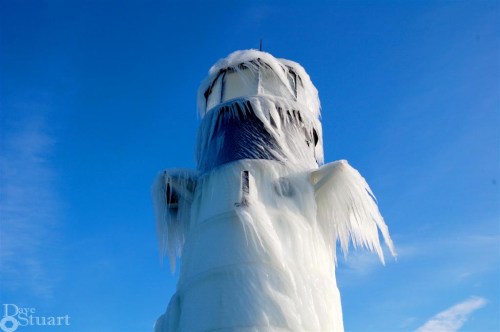
lighthouse snowman, photo by kiwirat

Frosty’s got nothing on the St. Joseph Lighthouse.

View Dave’s photo bigger or in his St. Joseph, MI slideshow.

Lake Effect Snow Season in Michigan

Lake Effect 4794-09

Lake Effect 4794-09, photo by StacyN – MichiganMoments

Many in Michigan are waking up to frigid temps, high wind and snow – the perfect conditions for lake effect snow. Meteorologist Robert J. Ruhf has an excellent article on Lake-Effect Precipitation in Michigan that explains lake effect snow and rain are common in Michigan, especially in late fall and early winter as cold polar air moves across the warmer Great Lakes. 

The unfrozen waters are relatively warm when compared with the temperature of the wintertime air mass. Therefore, the temperature of the air that comes into contact with the water increases. The warmed air expands and become less dense, which causes it to rise. This is an “unstable” situation. As the air rises, the temperature decreases until it reaches the dew point, which is the temperature at which the air becomes saturated.. Ice crystals or water droplets will then begin to collect until the force of gravity pulls them down. The result is “lake-effect” precipitation. When the cP air mass is very cold, as is often the case between December and February, the precipitation falls as snow. During late autumn, however, the polar air mass may be warm enough for the precipitation to fall in the form of rain.

“Lake-effect” precipitation can cause substantial intensification of snowfall amounts in very narrow bands, often referred to as “snow belts,” along the leeward (downwind) shores of the Great Lakes. The prevailing wind direction in the Great Lakes region is westerly; therefore, most “lake-effect” precipitation events occur to the east of the lakes.

…An interesting feature of “lake-effect” is that the heaviest bands of snow do not usually occur along the immediate shoreline, but tend to fall several miles inland. Snowfall accumulations are enhanced inland because the air experiences more uplift when it is forced over hills and higher terrain. 

Read on to learn lots more about lake effect snow in Michigan including four narrow bands  – Keweenaw Peninsula, Leelanau Peninsula, the Thumb and the southwest Lower Peninsula – where geographic features and the shape of the shoreline contribute to more intense snowfall. Hang on to your hats – winter is here!

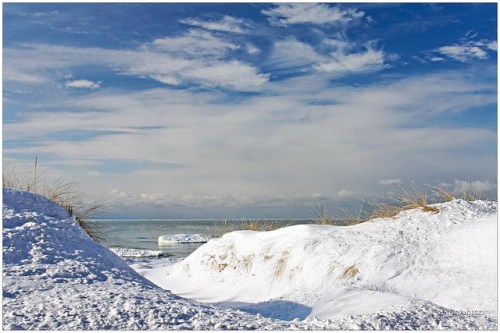
Stacy took this photo of Lake Michigan from the North Muskegon shoreline in January of 2009. See it bigger and see more in her awesome Michigan BLUE Winter 2012 slideshow.

Need a winter background?