Dredging Michigan’s Harbors

great lake - dredging

great lake – dredging, photo by j image.

Jim captured folks working at one of the many under-appreciated tasks in the world: dredging our harbors. As a lifelong resident of a coastal village, I anticipated the arrival of the dredging crew as a sign that summer was on the way. The US Army Corps of Engineers Detroit District explains why dredging is necessary on the Great Lakes:

Nearly all Federal harbors on the Great Lakes are located at the mouth of a river or along a coastline, utilizing natural or dredged navigation channels. Lake and river currents transport sand and silt eroded from the coastline and watershed. Some of this material may become deposited in navigation channels. Dredging is necessary to allow for safe commercial navigation and recreational boating. These natural processes would eventually lead to the filling of our harbors and waterways with rock, sand, mud, or clay. Harbors and major rivers, so vital to commercial, recreational and defense activities, would eventually fill in, leading to vessel delays and grounding. Today’s ore carriers, container ships, oil tankers and Coast Guard vessels need deep channels and docking facilities to move freely. Dredging is necessary to maintain Americas waterborne commerce and defense capability.

In addition, many recreational harbors need to be dredged regularly to remain open for small craft.

The page also explains something called “Beach Nourishment”, which I thought was a pretty unique term. Here’s a few dredging photos from the Absolute Michigan pool (slideshow)

Taking the Long Shot

Long Shot by Muvv

Long Shot, photo by Muvv

Matthew says that this dock sits on Point Lookout in AuGres, Michigan (on Lake Huron). It’s part of his My Photographic Love Affair set (slideshow).

I’m not old enough to remember a summer starting on a more down note in Michigan (and the rest of the country). A war with no end in sight, sour economy, mortgage crisis, assorted disasters and $4 a gallon gas have created a mood that suggests the best thing to do right now is huddle at home and wait for things to get better.

As I drove through Farwell the other day, I heard an unknown AM talk show host ask:

“Are you going to trade the memories of your children, husband, wife or yourself for an extra $50 in your pocket?

Gas is $4. It will be $5 or more by the end of the summer, but the memories will still be worth a hundred times more.

That made me think of how many times we as a nation have faced times when things weren’t easy, when everything wasn’t neatly laid out, when we had to work a little harder to make it all work out. I don’t think that any one of those challenges was overcome by choosing to seek less out of life for ourselves and those we love.

Here’s hoping we can take the long shot, beat the odds and win this game. All of us.

Have a magnificent weekend!

Step

Step, photo by Muvv

Step, photo by Muvv

Gotta view it bigger … and here’s hoping that you get out and make your own footprints on Michigan’s shoreline sometime soon.

Canadian Freeze Ray encases Mackinac Bridge!

Canadian Freeze Ray encases Mackinac Bridge!

Canadian Freeze Ray encases Mackinac Bridge!, photo by farlane.

Unfolding details of this shocking story at Canadian Freeze Ray wreaks havok on Michigan!!

(and yes, we mention Kwame so it qualifies as news)

Frozen

Frozen

Frozen, photo by smiles7.

May I have the envelope for for Best Michigan Snowmobile Photo?

This is part of her great set of Winter photos from the Charlevoix, Petoskey & Mackinac area (slideshow).

Head over to Absolute Michigan for a ton more Mackinac Bridge info.

Pickerel Spears, Ice Shanties and the Fishing History of Saginaw Bay

Saginaw Bay Ice Shanty c.1925

Saginaw Bay Ice Shanty c.1925, photo by oldog_oltrix.

Larry writes that this photo was taken by his grandfather at his ice shanty on Saginaw Bay (probably near Bay Park) in the mid-1920s. The 6′ bar between the shovel and the axe is a “spud” used with the axe to make the hole in the hole in ice and the pole coming from the top of the shanty is likely a “pickerel spear”. The This is one of the photos in his Oldog’s OLD PHOTOS set, and it also appears in the Michigan Thumb Memories group.

Over on Michigan Sportsman, Capt. Dan Manyen has written a nice little article titled The Fishing History of the Saginaw Bay. In it, he shares a number of old photos and provides a nice overview of the last few centuries of fishing on what I’m going to guess is Michigan’s largest bay. Capt. Manyen writes that walleye was mis-identified by many back then as pickerel and sold in great numbers to both local fish market outlets and buyers from the eastern states. He says that for many in the area, the burgeoning auto industry…

…did not stop or ease the pain of the Great Depression during this time. What did for many though, including my own Grandfather, was the plentiful fishing and hunting resources the Bay area offered. When Grandpa couldn’t get a job unloading the (Bean Boat) as he called it for .50 cents a day, he’d be out hunting or fishing for a meal for his family. Grandpa talked often about spending all winter out on the ice on Saginaw Bay in a (Pickerel Shanty) spearing pickerel.

I’m not sure where you might want to take this, so here’s the Wikipedia entries for Pickerel, Walleye and Saginaw Bay. You might also be interested in the Saginaw Bay Watershed Initiative Network, the Saginaw Bay Fishing Report and a more recent photo of ice fishing on Saginaw Bay.

Also see Saginaw Bay on Absolute Michigan’s Map of Michigan.

Exploring the Florida in the Thunder Bay National Marine Sanctuary

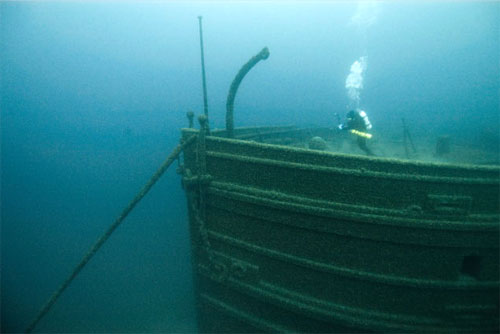
Diver exploring the wreck of the Florida

Exploring the Florida, Thunder Bay National Marine Sanctuary

The Thunder Bay National Marine Sanctuary encompasses almost 450 square miles of Lake Huron’s bottomlands off Alpena. It is the thirteenth national marine sanctuary and was established in 2000 to protect a nationally significant collection of nearly 200 shipwrecks, spanning over a century of Great Lakes shipping history. Thunder Bay is the first Great Lakes sanctuary and also the first to focus solely on a large collection of underwater cultural resources. The headquarters of the Sanctuary is the Great Lakes Maritime Heritage Center in Alpena.

The photo above is one of many awesome underwater photos of the Florida and other shipwrecks that can be viewed in their Fieldwork 2007 Gallery. Seriously, this is cool – go look at it and be sure to click the “slideshow” view at the top left to see the larger sized images.

Dave Swayze’s amazing Great Lakes Shipwrecks File includes information on 4,760 great lakes shipwrecks. It says that on May 21, 1897 in dense fog off False Presque Isle, the 271′ package freighter Florida, one of largest boats on the Great Lakes, collided with one of the few that was larger, the steamer George W. Roby. The Roby rescued her crew, but with a large hole in her starboard side, the Florida sank in just 12 minutes in 250′ of water.

There’s more information on the Thunder Bay National Marine Sanctuary and Underwater Preserve over at Absolute Michigan.

A Letter from Downstream

In the Michigan Immense Public Park, photo by Andy McFarlane

In the Michigan Immense Public Park, photo by Andy McFarlane

Welcome to a “Soapbox Saturday” on Michigan in Pictures, where your host takes you a little ways past “ain’t it cool” towards “ain’t it a shame.” Don’t worry though – it’s still cool. If it doesn’t seem cool – please click the photo above. I figured that since I was going to be sharing some personal feelings, I probably should use one of my own photos. This photo of my daughter exploring something on the Lake Michigan beach was taken a few years ago at the base of Pyramid Point in the Sleeping Bear Dunes National Lakeshore. I had posted it in gratitude to the Michigan Supreme Court for upholding our right to walk the Great Lakes shore.

Flash forward to the present day when Michigan’s regulators appear poised to permit the first metallic sulfide mine in Michigan. Several years ago, my friend Dick Huey and a few others started a group called Save the Wild UP when Kennecott Minerals, a subsidiary of mining giant Rio Tinto (one of the world’s largest polluters), began the process of securing a permit for a sulfide mine north of Marquette. The proposed mine is located directly under the Salmon-Trout River on the wild and beautiful Yellow Dog Plains. This is state land, our land, and the Salmon-Trout flows just a few miles through it and then empties into Lake Superior. Over that time I’ve been working for them to maintain their web site and have learned a thing or two about “acid mining”.

Iron and copper mining are things that helped forge the character of the Upper Peninsula. You can think of traditional mining as picking the chocolate chips out of a cookie. Sulfide mining is like getting the sugar out of a cookie – a chemical rather than mechanical process that yields a dust as a by-product. If this dust mixes with water and air, it forms sulfuric acid aka battery acid. There has never been a sulfide mine with the potential to pollute ground or surface water that failed to do so. Sulfide mining has polluted 40% of the watersheds in the West, and you can read more of the facts about metallic sulfide mining at Save the Wild UP (has a nice video if you prefer).

Sulfide Mining waste in PennsylvaniaA process with 100% failure rate of protecting water located directly under a pristine river that flows into the largest body of freshwater in the world seems like a bad idea. When you realize that they also plan to blow the sulfide dust into the air and that there are hundreds of other prospected sites waiting in the wings, it becomes terrifying. Michigan and the UP have a lot of challenges right now, but something we do have going for us is our water and wild places and the tourism dollars and jobs they generate. The picture to the right is a result of sulfide mining from Sudbury, Ontario. Multiply that across Michigan’s Upper Peninsula and consider how many thousands of tourism jobs and millions of tourism and tax dollars might be lost.

One of the people who has considered this is a wonderful musician named Daisy May. She has donated a song called A Letter from Downstream to Save the Wild UP and I hope you take the time to listen to it and see the photos that folks have shared about what Michigan’s water means to them.

If you’re a Flickr member, consider adding a photo to the Downstream group.

Yesterday & today at Round Island Lighthouse

Since yesterday was technically not Michigan in Pictures, here are two photos for today!

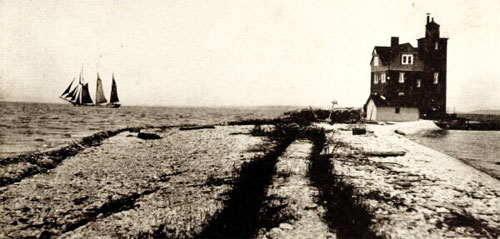
Round Island Lighthouse, c 1920

Round Island Lighthouse c. 1920, courtesy Archives of Michigan

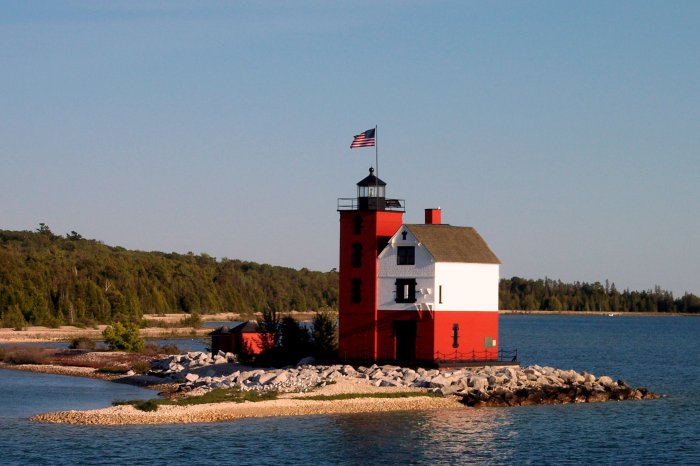
round-island-lighthouse-mackinac

Light House, photo by frostman721

You can see more historical photos of Round Island Lighthouse in the Archives of Michigan’s Lighthouse Collection. Terry Pepper’s Seeing the Light has a great history of the Round Island Lighthouse that begins:

The area around the Straits of Mackinac is riddled with islands and reefs, which made vessel traffic at the transition from Lakes Huron, Michigan and Superior particularly difficult. While the construction of the Old Mackinac Point Light in 1892 eased the situation, the Lighthouse Board requested funds from Congress to augment the Mackinac Light with a second light in the Straits to be located on a shoal off Round Island.

Congress responded to the request with an appropriation of $15,000 for the construction of such a light in 1894. The construction contract was awarded to the local contractor Frank Rounds. The construction was completed, and the light first exhibited on May 15.

Terry has a number of views of the light, including the one above which he dates around 1900 (which might make more sense in light of the schooner pictured). There’s also a shot of the Round Island light nearly destroyed following a violent 1972 storm. For many of Michigan’s lighthouses, such an event was a death knell, but Mackinac Islanders rallied and work continues through the Boy Scouts and the Great Lakes Lighthouse Keepers Association. You’ll probably also want to see check out Wikipedia’s entry on Round Island (info about the uninhabited island and a cool aerial view of the light!), the Mackinac Visitors Bureau photos of the light, this page with interior and exterior photos of Round Island Lighthouse and this view of restoration work and Round Island (he also has a cool shot of the lighthouse in the fog).

Speaking of lighthouses, if you’re in the Alpena area this weekend (Oct 11-14), be sure to check out the annual Great Lakes Lighthouse Festival.

Not much remains of Grindstone City

grindstone03.JPG

grindstone03.JPG, photo by smartee_martee.

Marty Hogan writes:

One of the few remaining grindstones on the beach. This one is about 3.5 feet in diameter. The beach used to be covered in the old Grindstones; from 1.5 feet to six feet in diameter. Bad, bad thieves plundered them all away.

This photo is part of Marty’s great Huron County, Michigan photo set (slideshow)

I went looking for a photo and details on Grindstone City so I could feature a site I found the other day, but there was little to be found from Michigan.org’s page on Grindstone City or the Port Austin Chamber.

UPDATE: March 2012: The best resource I found at the time of this post was willett.org, which featured piles and piles of photos and information about Michigan and its history. Among their were some postcards and old photos from Grindstone City, from which I learned that Grindstone City had a quarry and stone mill and made and shipped a whole lot of grindstones. Nothing at willett.org seemed to have been updated, and it felt like going up to an attic in an abandoned farm and poking through partially labeled boxes. Sadly the digital room has since fallen in, leaving nothing.

Fortunately, there are other resources, so check out today’s post Truing up a 3 ton stone in Grindstone City.

If you have anything to share about Grindstone City, post it in the comments!