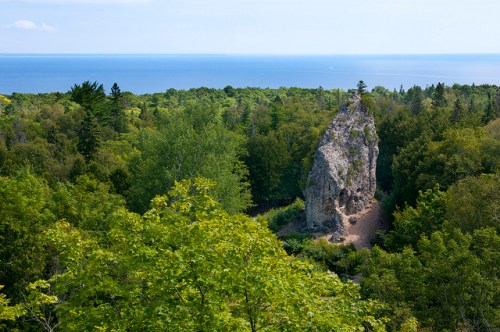
Sugar Loaf Rock on Mackinac Island

Untitled

Untitled, photo by *Alysa*

I was surprised to learn that I haven’t posted anything about Sugar Loaf on Mackinac Island. Here’s a summary with help from Wikipedia’s entry for Sugar Loaf Rock, the Mackinac State Historic Parks geology page and some other sources I’ve linked to.

Located not far from the shoreline on the east side of Mackinac Island, Sugar Loaf is a 75′ breccia limestone stack. Thousands of years ago Lake Algonquin covered all but the center of Mackinac Island. When it receded, this tower of rock remained. The people of the region packed maple sugar into cone-shaped baskets of birchbark, and Sugar Loaf Rock was named for its resemblance to one of these cones.

Sugar Loaf was said by some to be the home of Gitchi Manitou, while another tale explains that the rock was the final form taken by a man who asked for immortality and received it, albiet not as he expected. A distinct profile remains in the limestone face of Sugar Loaf Rock. The rock was also used as a site of ritual burials. In 1831, Alexis de Tocqueville and his friend Gustave de Beaumont visited Mackinac Island. De Beaumont reported that the rock was filled with “crevices and faults where the Indians sometimes deposed the bones of the dead.” A natural cave passes through Sugar Loaf from side to side, but it’s too small for any but children.

Check out Anna Lysa’s photo out bigger and see more in her Mackinac Island slideshow.

More from Mackinac on Michigan in Pictures!

Great Lakes Waves offer beauty, power & danger

DSC01071P

Untitled, photo by Scott Glenn

“These are not lakes, these are the world’s eighth seas, and her bottom is littered with the wreckage of over six thousand ships.”
~The Three Sisters, Song of the Lakes

This gorgeous shot of the St. Joseph Pier Lighthouses demonstrates the incredible power of Great Lakes waves. I live in Traverse City, and this summer it feels like Lake Michigan has claimed the lives of more people than normal. Whether or not that’s true (it’s not), I thought this photo offered the perfect opportunity to share some tips and tools for staying safe on Lake Michigan, Lake Huron, Lake Superior and Lake Erie!

  • Thinking of any of the Great Lakes as anything like any lake you’re familiar with is a mistake. They are freshwater seas that can pack  incredible power. They are stronger than you and can end your life in an instant if you don’t respect them.
  • The Great Lakes Surf Rescue Project is a nonprofit dedicated to drowning prevention that keeps track of drowning statistics: 74 in 2010, 87 in 2011, 101 in 2012 and 39 so far in 2013. (you can also keep up with them on Facebook)
  • Life jackets can save your life.  U.S. Coast Guard statistics show that 90% of the people who drown in a boating or water accidents would survive with a life jacket.
  • Cold kills! Hypothermia is a danger all year round on the Great Lakes. Click that link for tips on how to stay alive if you do end up in the water.
  • Rip Currents (sometimes called “undertow” or “rip tide”) are a big danger on Michigan beaches accounting for the majority of drownings. Michigan is 4th in rip current related fatalities behind Florida, California, and North Carolina – we have “ocean force” rip currents. Learn how to beat them in this video.
  • The National Oceanic and Atmospheric Administration (NOAA) offers comprehensive Great Lakes marine forecasts.
  • The MyBeachCast smarthphone app can predict waves and warn you of hazardous conditions.
  • Do you have more tips? Share them in the comments!

Check it out bigger and see more in Scott’s Lighthouses slideshow and also check out a winter view of the pier that Scott shot.

Catch a Michigan wave on Michigan in Pictures!

Swimming the Straits of Mackinac

Mackinac Dusk

Mackinac Dusk, photo by ShelNf

The Traverse City Record-Eagle reports that Cathy Nagler will be attempting to swim across the Straits of Mackinac tomorrow (Wednesday, July 24):

Worry isn’t a word Nagler uses to talk about the upcoming distance swim, which is expected to take place Wednesday between Michigan’s Upper and Lower Peninsulas, on the west side of the mighty Mackinac Bridge. But she does have legitimate concerns, chiefly hypothermia from the cold water.

“That’s the hard one,” she said. “I went in Lake Michigan on June 12 and the water temperature was 58 degrees.”

Nagler will wear a lightweight wetsuit, of the sort tri-athletes wear, to combat that problem. Combined with dive boots, it should keep her warm enough.

“The heavier wetsuits, like water skiers wear, make me too buoyant in the water,” she said.

Nagler, who summered at her family’s cabin in Northport as a child, has been a life-long swimmer. She has several distance swims to her credit, both in the United States and England. But her goal to swim across Lake Michigan has the most meaning for her.

You can read on for more and also check out Nagler’s crosslakemi.org where she discusses the preparation for the swim.

I thought I would try and figure out how many people have swum the 4.1 mile distance across the Straits of Mackinac, but it appears that the answer is “a lot.” This feature in the St. Ignace News about a group of 5 who swam the Straits in 2011 has some great information about swimming the Straits, and notes that the Coast Guard receives about 10 special marine requests specifically for swimming the Straits.

View ShelNf’s photo bigger and see more from the Straits in their slideshow.

Detour Reef Lighthouse

DeTour Reef Lighthouse, MI

DeTour Reef Lighthouse, MI, photo by hatchski

Today’s post is from the “What Are the Odds?” category. Some weeks I will sit down on Sunday evening and write a few posts. I wrote this one last Sunday and then on Tuesday, the State Historic Preservation Office announced 2013 recipients of Michigan Lighthouse Assistance Program. Three lighthouses will receive dollars for preservation efforts: the Manistee North Pier Light, the St. Clair  South Channel Range Lights (already profiled on Michigan in Pictures) and the DeTour Reef Lighthouse!

Terry Pepper’s Seeing the Light tells of the history of the DeTour Reef Lighthouse. He begins:

As freighters plying the St. Marys River grew in length and depth, a reef lying 24 feet below the surface off the entrance to the river between Detour Point and Drummond Island became a menace to safe passage between the lake and river. Without funding to erect a lighthouse, an acetylene buoy was placed to mark the reef on September 29, 1897 as a temporary measure.

As part of a major project to improve aids to navigation in the Straits of Mackinac at the end of the 1920’s, the Lighthouse Bureau had proven its ability in the efficient construction of offshore crib-based lights at Martin Reef in 1927, and Poe Reef 1929. With success already in its back pocket, after receiving an appropriation for the construction of a first-class light station on Detour Reef, the Bureau was immediately able to focus its attention on construction of the new station.

The first order of business was the establishment of a land-based camp as close as possible to the reef. Here, the crib which would form the submarine foundation for the structure could be built, and housing could be obtained for the construction crew. By the twin virtues of having deep water close to its shore and its proximity to the construction site, Detour Village was selected as the best location for the base of operations.

You can read on at Seeing the Light for details and photos of the fascinating construction process of this “crib lighthouse” that culminated with the official lighting of the new tower on the night of November 10, 1931. In 1974 the light was automated and in 1997 the lighthouse was declared excess property by the U.S. Coast Guard, but community members were able to come together to for the DeTour Reef Light Preservation Society (Facebook). This successful partnership renovated the lighthouse and now offers YOU the chance to be a volunteer keeper and stay at the lighthouse!

View Mark’s timely photo background big and see more in his massive Mark’s lights slideshow.

Many more Michigan lighthouses on Michigan in Pictures.

A birthday card from the Grand Hotel

View from West Bluff of The Grand Hotel

View from West Bluff of The Grand Hotel, photo by MI photographer

126 years ago today on July 10, 1887, The Grand Hotel opened for business on Mackinac Island. In honor of Michigan’s most famous hotel, here’s a seldom seen view.

Check it out bigger and see more in MI photographer’s Mackinac Island slideshow.

PS: The lighthouse you can see in the distance is Round Island Lighthouse – click the link to get closer with Michigan in Pictures.

Fighting for Michigan’s Environment

"Bridge to Nowhere" Foggy Mackinac Bridge - Mackinaw City , Michigan.

“Bridge to Nowhere” Foggy Mackinac Bridge – Mackinaw City , Michigan, photo by Michigan Nut

“Unless we move without delay to halt the deterioration of our land, our water and our air, our own children may see the last traces of earth’s beauty crushed beneath the weight of man’s waste and ruin.”
~Governor William Milliken to the Michigan legislature, January 1970

While “environmentalism” has become a polarizing term, it seems to me to be a concept that’s at the core of loving & caring for the Great Lakes State. One of my personal heros, Michigan Governor Bill Milliken, recognized this and he and his wife Helen fought strongly throughout their careers to enshrine protection of the natural bounty that they loved into the fabric of Michigan’s laws. It’s no surprise that every year the Michigan Environmental Council recognizes an individual for outstanding leadership, enduring commitment and extraordinary public service in protecting natural resources at the local, state and national levels with the Helen & William Milliken Distinguished Service Award.

The 2013 recipient has been announced, Dave Dempsey. Dempsey is the author of numerous books, a former member of the Great Lakes Fishery Commission, environmental policy adviser to former Michigan Gov. James Blanchard, and member of the state’s Natural Resources Trust Fund Board.

“Dave Dempsey is the rare leader who is able to move effortlessly from talking about the arcane technical details of some issue, to explaining in vivid and powerful terms why that issue is so critical to the quality of life for the generations that come after us,” Chris Kolb, MEC president, said in a press release Monday.

“Dave’s contributions to a better Michigan through his public policy advocacy alone deserve our recognition and gratitude. However, when you add in his authoritative chronicling of Michigan’s environmental history through his books, it’s clear he has made a special, positive, and lasting impact on our state.”

There’s no doubt that Dempsey has been a champion of the Great Lakes, and this Sunday (July 14) you have a chance to do some championing of your own as dedicated groups from all over the state host Oil & Water Don’t Mix: A Rally for the Great Lakes to raise awareness about climate change and the dangers posed by an oil pipeline that runs through the Mackinac Straits. Enbridge Energy – the company responsible for the devastating July 2010 Kalamazoo River oil spill and over 800 other spills since 1999 – has been pumping oil through the Straits for 60 years. They are seeking to pump even more oil through the aging Mackinac pipeline – possibly including tar sands, the most toxic and hard to clean up if spilled.

The rally this Sunday, July 14 at noon at Bridge View Park in St. Ignace (just across the bridge) and there are numerous busses heading there from Kalamazoo, Lansing, Traverse City and other locations. Click for details or view the event on Facebook!

Check John’s photo out bigger and see more in his Bridges / Covered Bridges slideshow.

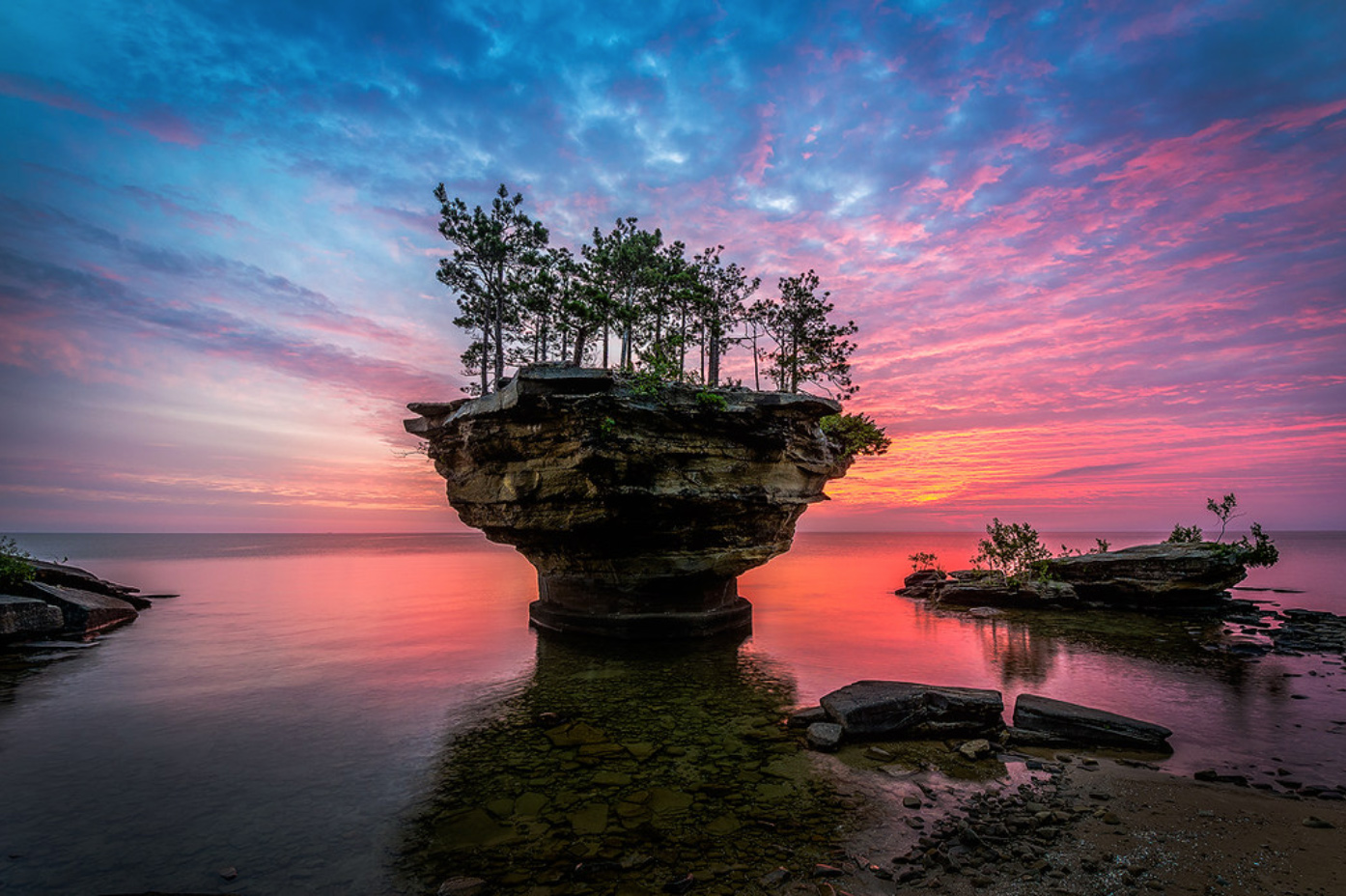
Turnip Rock Sunrise

Turnip Rock Sunrise (3 of 3)

Turnip Rock Sunrise by David Frey

You may recognize this photographer from his photo of Chapel Rock last month. Turnip Rock has been featured a few times on Michigan in Pictures, but this is definitely the most dramatic photo of it! He writes:

Taking these pictures of “Turnip Rock”, located near Port Austin at the tip of Michigan’s thumb region, was a bit of an adventure. I had seen day time pictures of it before, but thought that it would look its best at sunrise. I decided to make a project of it during the 4th of July weekend. I traveled to Port Austin and in talking to folks there confirmed what I had already read – since it is located just offshore a large private property the only way to visit it is by kayak (about 7 miles round trip). I hesitated a bit since it was my first time in the area and I have not kayaked in decades. Also, in order be there by sunrise meant I would have to paddle out there in the pre-dawn darkness. Having a chance to see it at sunrise turned out to be too tempting, so after finding a hotel room 20 miles away in Bad Axe (closest one available because of the holiday), I put my alarm clock on for 3:45am.

I was on the water by about 4:30am and arrived at Turnip Rock just before the sky started to light up. I have had several outings before where the weather didn’t cooperate, but this time I was lucky and despite the clouds there were some nice colors in the sky. I am pleased with the pictures, but the experience of kayaking out on Lake Huron in the early morning hours is something I will always remember. Look forward to other outings like this, which is one of the reasons I have enjoyed taking up photography again.

Indeed! Your camera is like a dog – it will make you get outside and see cool things! Check this out background bigtacular and see a couple more shots from his kayaking adventure in his slideshow.

Beaches? Sunrises? Lake Huron? Summer wallpaper? Tons more on Michigan in Pictures. Enjoy your holiday weekend!

On Vacation!

cruising into the sunset

cruising into the sunset, photo by suesue2

Michigan in Pictures will be taking a break this week – see you again on July 1st!

Sue caught the last ferry of the night as it headed to Mackinac Island. Check it out bigger and see more in her Up North slideshow.

Turnip Rock in Lake Huron

Turnip Rock

Turnip Rock, photo by SimsShots Photography

A page about the Point Aux Barques – Turnip Rock geocache had the best information I found about this Lake Huron Landmark. The author explains:

This cache is accessible by a kayak, canoe, jet ski or boat on Lake Huron. Port Austin is the closest harbor which is approximately three miles west. The land around this feature is a gated community. I must stress that this cache is only accessible by a water craft via Lake Huron. If you are not comfortable navigating the waters of Lake Huron, do not attempt to do this cache. Lake Huron can be dangerous at times for small water craft such as kayaks or canoes.

…Everyone that received their grade school education in Michigan learned that glaciers pushed their way over Michigan several times. The result is glacial drift averaging 200 to 300 feet deep covering on top of the bedrock. The thickness of drift has measured over 1,000 feet in a few Michigan locations. Rarely can we see exposed bedrock that has been sculptured by non glacier forces. This is one of the locations in southern Michigan where the sandstone bedrock is exposed at the surface. The amount of shoreline that has exposed sandstone is about one mile, but a lot of beauty has been sculptured in the stone.

The locals call the main structure here “Turnip Rock”, because of it’s shape. Geologists call it a “Sea Stack”. A definition of a sea stack is an isolated pillar-like rocky island or mass near a cliff shore, detached from a headland by wave erosion assisted by weathering. Waves force air and small pieces of rock into small cracks, future opening them. The cracks then gradually get larger and turn into a small cave. When the cave wears through the headland, an arch forms. Further erosion causes the arch to collapse. This causes a pillar of hard rock standing away from the coast. Generally occurring in sedimentary rocks, sea stacks can occur in any rock type.

Read on for more and also see the Atlas Obscura entry for Turnip Rock has a map and photos. Michigan in Pictures favorite Lars Jensen has some great photos of Turnip Rock as well, and you should definitely check out Jason Glazer’s panoramic photos of Turnip Rock.

Check this out background big and see more in Rob’s Landmarks slideshow.

More Michigan landmarks on Michigan in Pictures.

Poe Reef Lighthouse

Poe Reef Light

Poe Reef Light, photo by joeldinda

Terry Pepper has (as usual) a very detailed entry for Poe Reef Lighthouse on his Seeing the Light website. This crib style lighthouse is located off Bois Blanc Island in Lake Huron. The reef is very close to the surface and posed a significant threat to navigation until the decision was made in the 1890s to anchor a lightship there. This served until Lighthouse Service decided to build a permanent station on Poe Reef in 1927:

The station building at Poe Reef was to be an exact duplicate of that which the crew had previously completed at Martins Reef. The main twenty-five foot square structure consisted of a steel skeletal framework to which an exterior sheathing of riveted steel plates was applied. Thirty-eight feet tall, it contained three levels, or “decks”, as the crews assigned to the station knew them. The two upper decks were set up as living quarters, while the main lower deck served as housing for the machinery required for powering the lights, heating system and foghorn.

Centered atop the main structure stood sixteen-foot square, ten-foot high watch room of similar construction, with a single observation window on each side. Finally, a decagonal cast iron lantern room was installed on the roof of the watch room, and outfitted with a Third Order Fresnel lens. The combination of pier and tower provided the Fresnel with a seventy-one foot focal plane, and a visibility range of almost twenty nautical miles in clear conditions. Work was completed at the station and the light exhibited for the first time on the evening of August 15, 1929.

At some point in time, in order to eliminate the possibility of the Poe Reef Light being mistaken for the identical all white structure at Martin Reef, the main deck and watch room of the Poe structure were given a contrasting coat of black paint.

Terry has some cool shots of this light as well including this wide shot with cormorants.

Check Joel’s photo out background bigtacular and see more shots from Poe Reef and elsewhere in his Lighthouses slideshow.

More Michigan lighthouses on Michigan in Pictures.