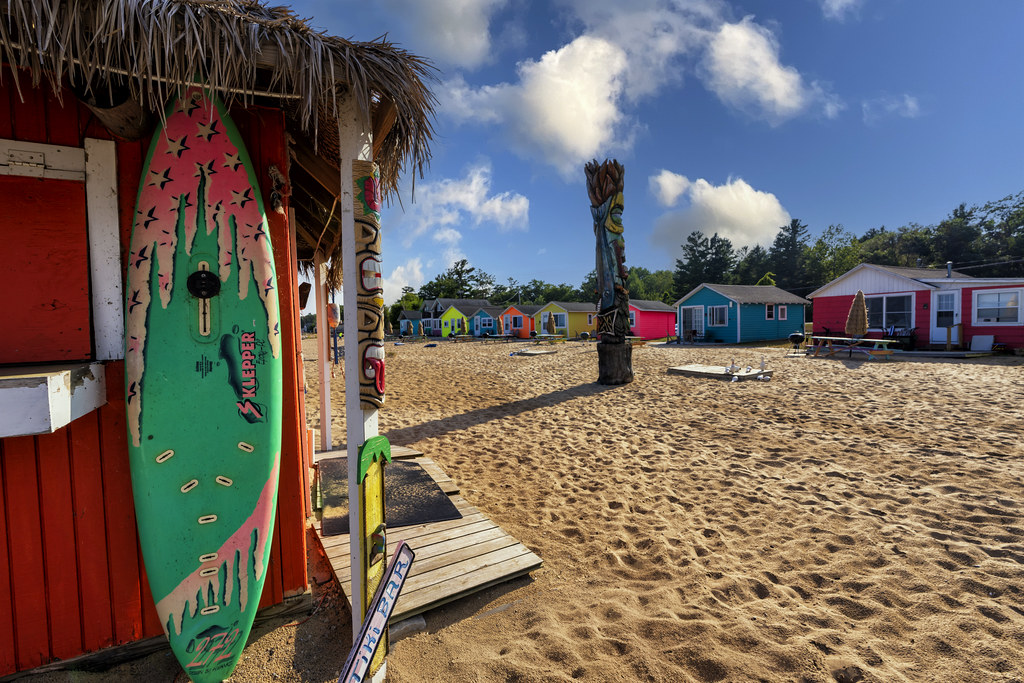
Here are two pics from Charles of the joyfully painted Mai Tiki Resort on Lake Huron in Oscoda demonstrating that you can find a little spot of summer in Michigan even on the coldest day. See his latest on Flickr & stay warm!
Back in the day, Linda Godfrey would regularly share stories with me from her classic book Weird Michigan and her other works. Linda has regrettably passed on and her Weird Michigan website is lost, but here’s a seasonally appropriate tale of shipwrecks & lost love from my archives…
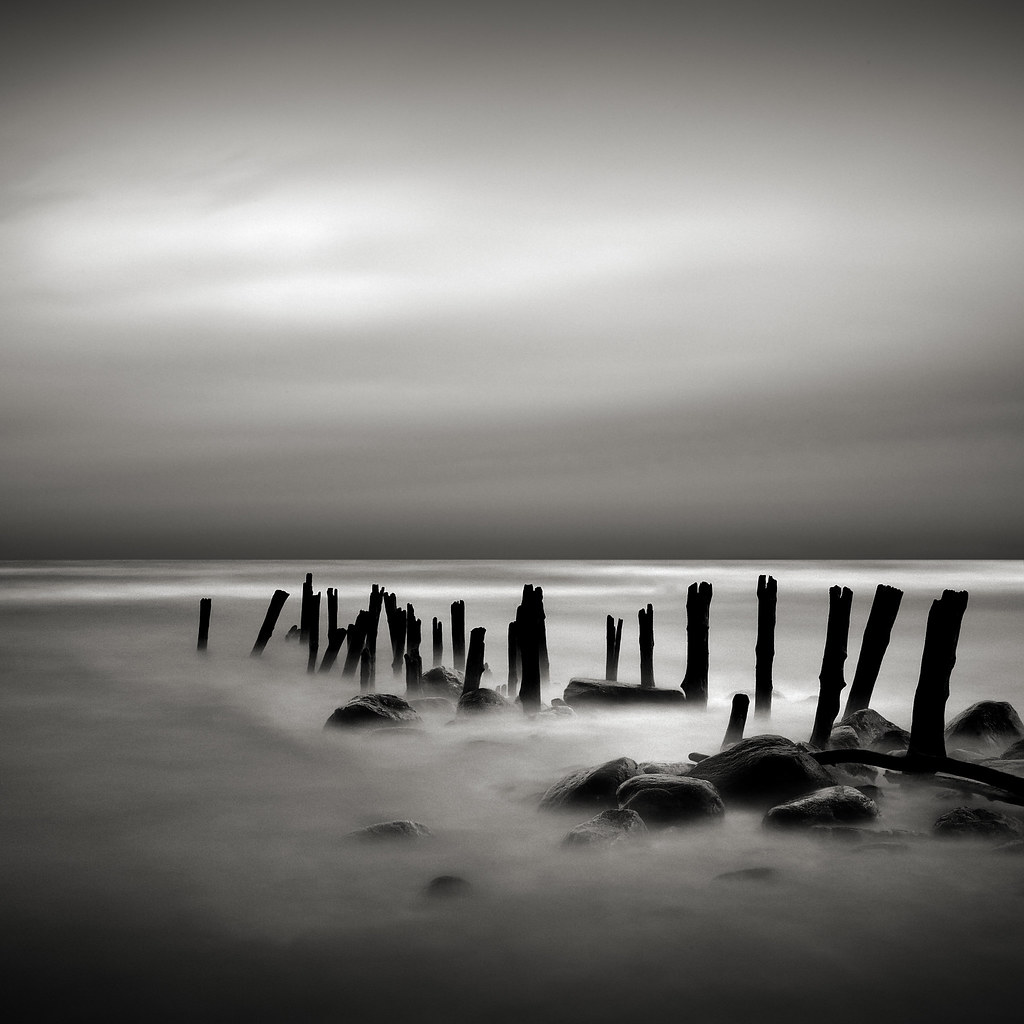
In the mid-1800s, the Lake Huron port and lumber town of Forester was a far cry from the sleepy, near ghost town it is today. The remains of huge pilings just off the scanty beach now stand as crumbling reminders of the great pier that once bustled with Great Lakes ships and sailors.
One of those sailors unwittingly started the legend that would be Forester’s main claim to fame after the lumber ran out and the ships stopped coming.On shore leave one day, the unnamed young man took up with a local girl named Minnie Quay, whose folks, James and Mary Ann Quay, owned the town tavern.
The Quays forbid Minnie to see her beloved, but the order proved tragically unnecessary after his ship became one of many that succumbed to Great Lakes gales. Minnie made one more visit to the forbidden pier after learning that news, and on April 26, 1876, at the age of 16, she threw herself into the water in hope of joining him in the afterlife. She lies in a waterfront cemetery now, next to the bodies of her father, mother and brother.
Legend says that she still wanders the beaches, moaning for her lost sailor, and that some have seen her standing waist deep in the water, beckoning others to join her. The former Quay home and bar still stands, giving Minnie’s ghost even more reason to linger.
I got a lot of enjoyment from walking around the house yesterday saying “Super Beaver Moon” so it is with sadness & regret I share that EarthSky’s Deborah Byrd explains that if a full moon of November falls after November 7, it’s the Beaver Moon but if it’s before the 7th, it’s the Hunter’s Moon. Deborah writes:
Nature is particularly cooperative around the time of the autumnal equinox to make the fall full moonrises special. On average, the moon rises about 50 minutes later each day. But when a full moon happens close to the autumnal equinox – either a Harvest or a Hunter’s Moon – the moon (at mid-northern latitudes) rises about 30 minutes later daily for several days before and after the full moon … The result is that there’s a short-than-usual lag time between successive moonrises around the Hunter’s Moon adding to the brightness of evening twilight.
The moon has for sure been looking huge when it’s risen the last couple of nights! To add to the fun, EarthSky shares that the South Taurid & North Taurid meteor showers are both happening right now! While they aren’t a very active shower with just 5-10 meteors per hour, they can produce really intense fireballs like this one from Monday night over Glen Lake in the Sleeping Bear Dunes National Lakeshore.
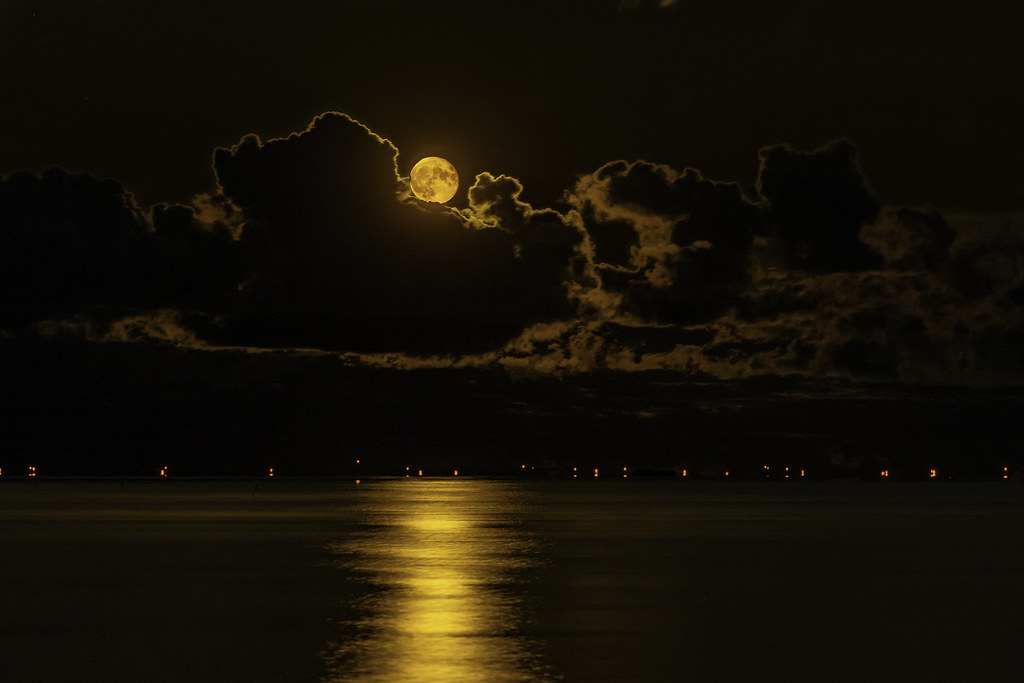
This moon is neither Hunter nor Beaver: it’s the August 2020 Sturgeon Moon as seen over Lake Huron. See more in kare hav’s Point Lookout / Au Gres gallery on Flickr including the first pic I ever shared from this awesome photographer on Night and Light.
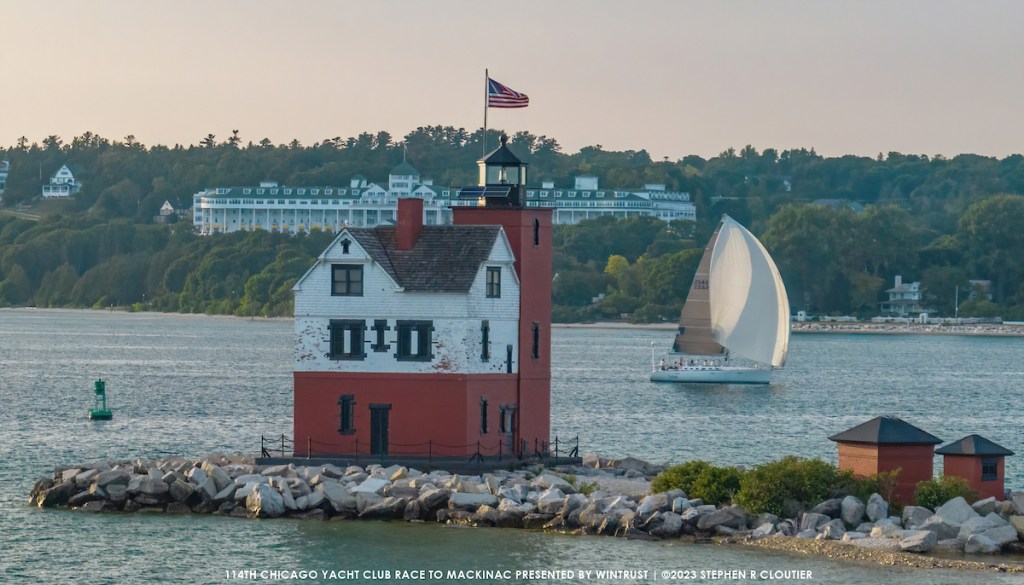
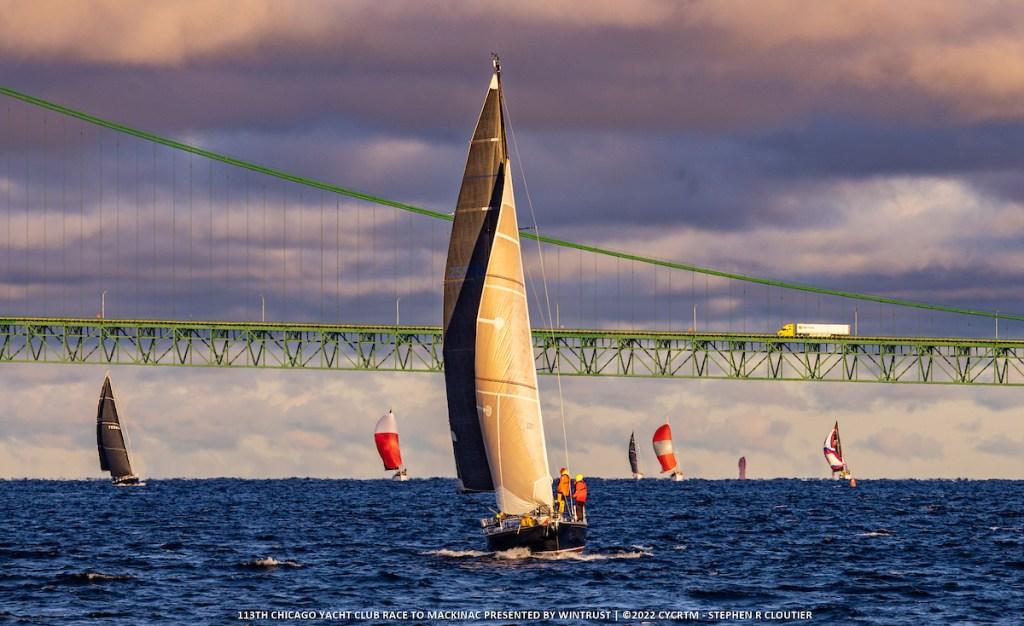
The Chicago Yacht Club Race To Mackinac starts Friday morning (July 18). The Chicago to Mac is the longest annual freshwater sailing race in the world, spanning 333 statute miles from the start at the Chicago Yacht Club, up the western shore of Lake Michigan, passing under the Mackinac Bridge to finish at Mackinac Island. They explain that:
…the race’s unpredictable weather and shifting winds on Lake Michigan make it a supreme test of sailing skill, rivaling many offshore ocean races. What first began in 1898 with just five boats has now evolved into a world-class sporting event. The origins of the Race to Mackinac date back to 1898, when Joseph Myers designed two fin-keel sloops, Siren and Vanenna. These vessels sparked a competition between their owners, George Peate of Siren and W.R. Crawford of Vanenna, and after three races in June of 1898, Vanenna remained undefeated. This prompted the idea of a unique, challenging race – one that would forever change the history of sailing.
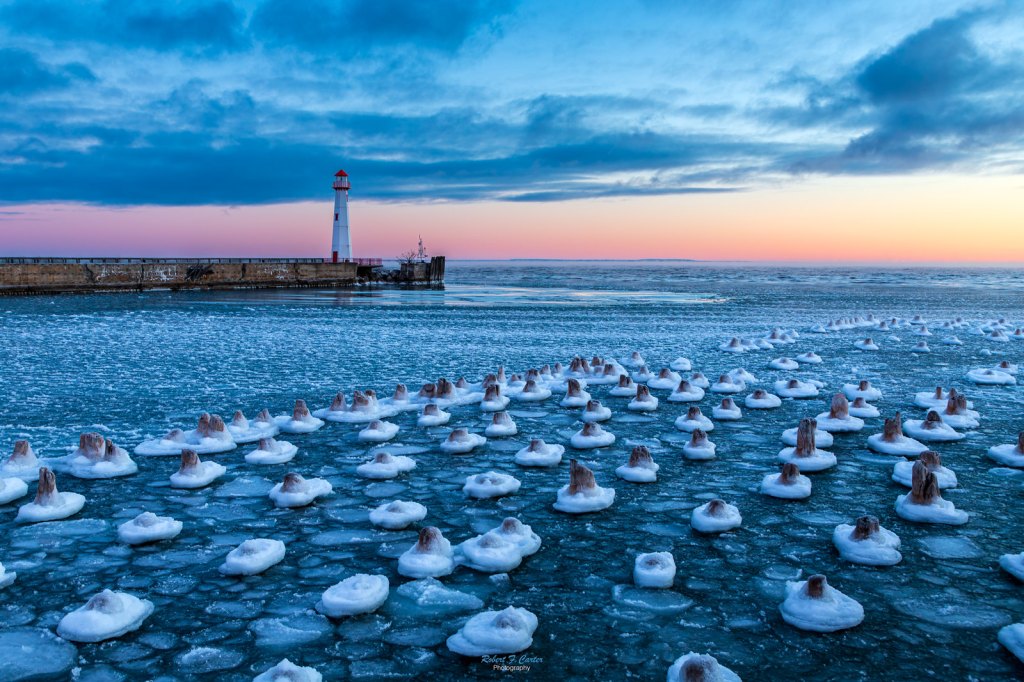
Pure Michigan shares that Wawatam Lighthouse started life in 1998 as a Michigan Welcome Center travel icon at Monroe, Michigan. In 2004, the Monroe Welcome Center was being revamped and the lighthouse was put up for relocation. The City of St. Ignace was the lucky recipient and the structure was trucked north in five pieces. It stayed on the Chief Wawatam Dock for a time, awaiting the construction of its new platform … The Wawatam Lighthouse beacon was first lit on August 20, 2006. Visible for more than 13 miles out over Lake Huron, it is now an official aid-to-navigation. The 250 millimeter Fresnel lens casts its light in a 152 degree arc.
Robert writes “Four of us from my camera club decided to visit Michigan’s U.P. in search of the Snowy Owl. We left early and before we got up to the hunting grounds, we stopped by St. Ignace to see the sunrise. This area of Lake Huron was not frozen over yet even though it was about -5 degrees this morning. One did not stay outside the car very long with the blowing breeze.”
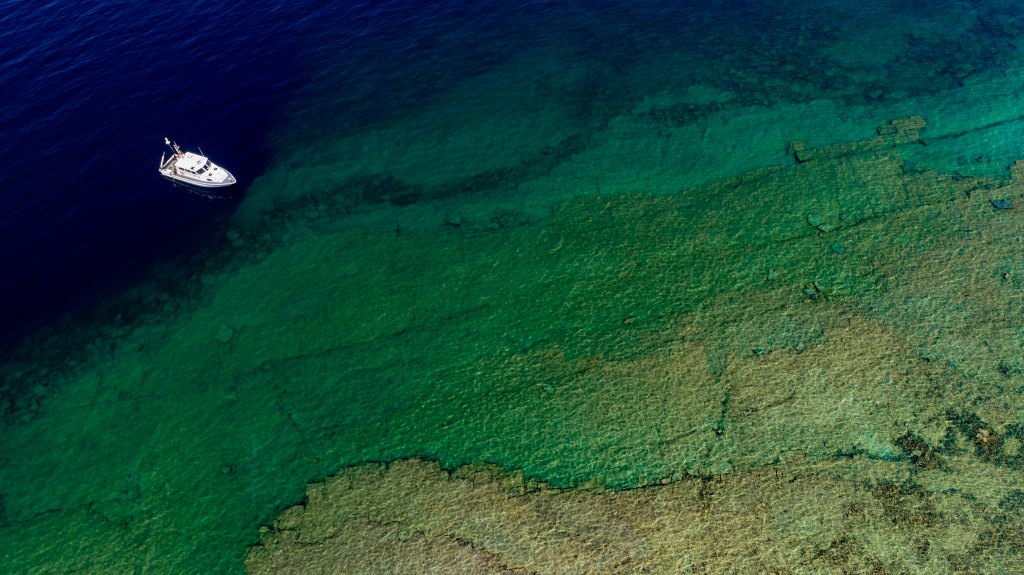
What really piqued my interest was learning that that this isn’t the first time sinkholes have been found in the Great Lakes! In 2001, scientists found sinkholes at the bottom of Lake Huron in Michigan’s Thunder Bay National Marine Sanctuary, and I was able to find an award winning Great Lakes Now segment with Steve Ruberg, an observing systems researcher with NOAA’s Great Lakes Environmental Research Laboratory exploring the Lake Huron sinkholes in this very vessel!!
The National Oceanic & Atmospheric Administration’s Great Lakes Environmental Research Laboratory (NOAA GLERL) is dedicated to scientific research on the Great Lakes and coastal ecosystems. They share a lot of amazing photos of their work on Flickr & you can see more from this trip in their Buildings & Vessels gallery on Flickr.
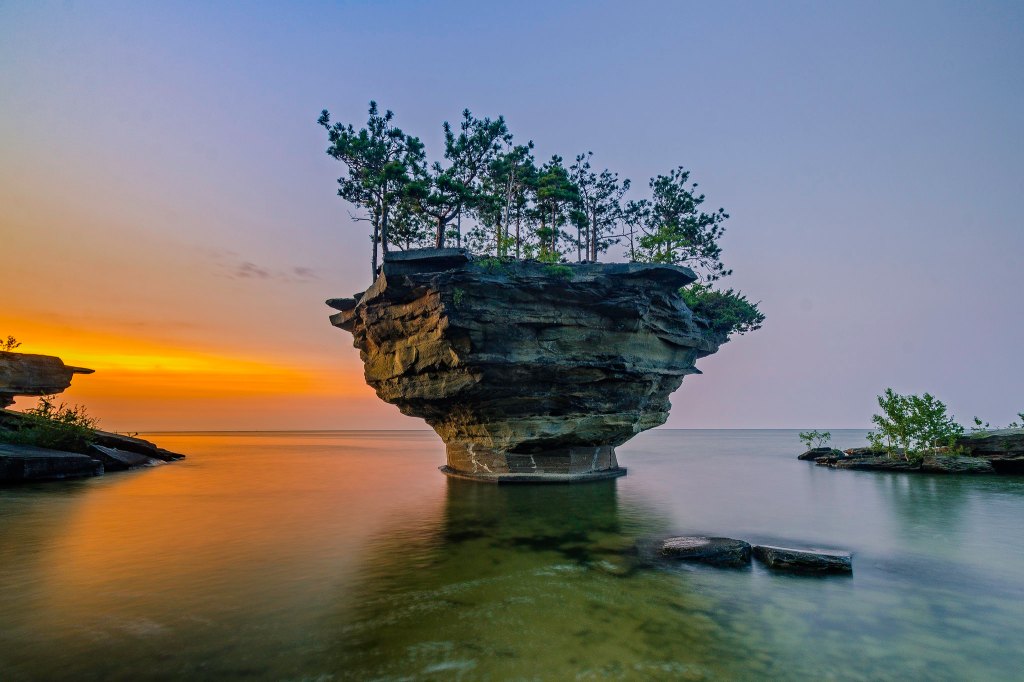
Tom shares that Turnip Rock is a beautiful, wondrous land formation off the coast near Port Austin:
The gigantic stone developed its signature look after millennium of being worn away by waves thumping across its bow. After being separated from the mainland in prehistoric times, Turnip Rock is an island inhabited by some trees and very little else.
Turnip Rock was one of twenty finalists in the 2013 “Seven Wonders of Michigan” contest sponsored by the Detroit Free Press and the Lansing State Journal, but it wasn’t selected as one of the final ten.
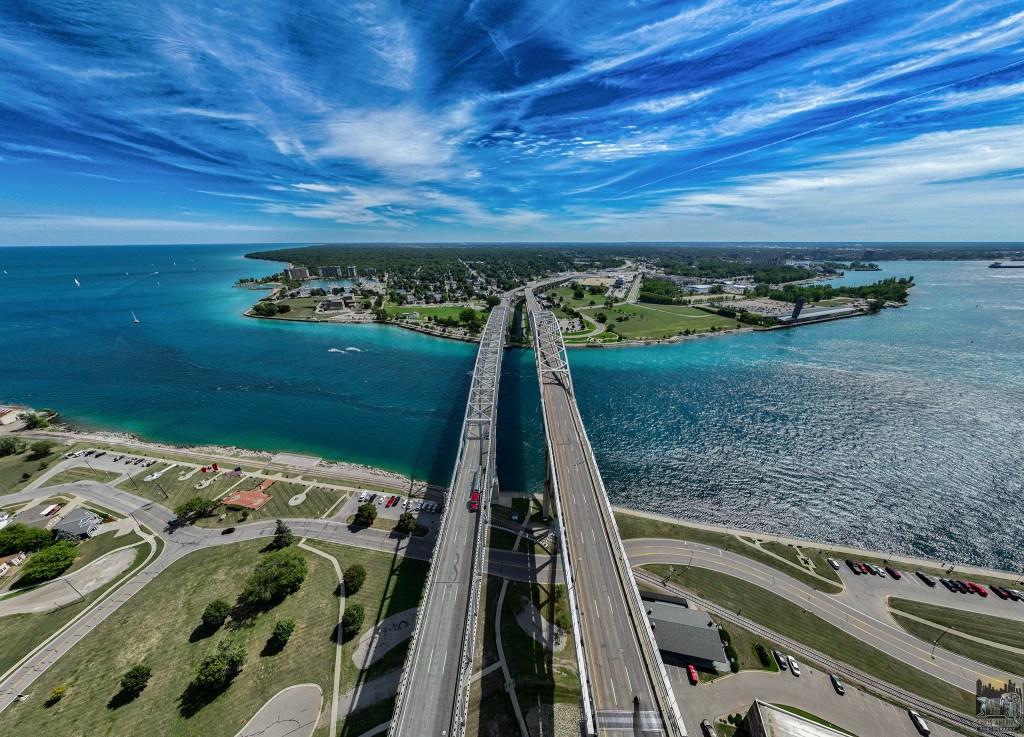
The Gordie Howe Bridge is (rightfully) getting a lot of attention these days, but another beautiful span connwcting Michigan with Canada is the Blue Water Bridge across the St. Clair River at the southern end of Lake Huron from Port Huron to Sarnia, Ontario. The Blue Water Bridge Authority shares:
The first bridge was opened to traffic on October 10, 1938. The lead engineer was Ralph Modjeski. This bridge originally had two lanes for vehicles as well as sidewalks; the latter were removed in the 1980s to make room for a third lane for automobiles. The third lane for each direction started from the apex of the bridge in order to accommodate long lineups entering each sides’ respective border crossings.
…In the early 1990s, bridge authorities decided to add a second arch in order to accommodate the high traffic. During the debate over the form of the second span, five possible designs were purposed from 1994-95. Over half of public opinion had mostly favored a duplicate of the first bridge, while the cable-stayed bridge came in second with around 21%. The Blue Water Bridge Authority had rejected both designs, due to the duplicate creating a false sense of history, while the cable-stayed option was feared to overshadow the existing bridge. Another cost-effective but unpopular design was the parallel truss. The continuous-tied arch design, which was a distant third place in polls, was chosen for two reasons. One was that it blends in with the original span yet stands out on its own, and the other is lower maintenance costs because fewer spans are involved.
Chris Ahern is a professional photographer & licensed commercial drone pilot who works in and around Detroit. Follow him on Facebook or Instagram & for sure check out his website.
The Presque Isle Township Museum Society reminds you that it’s never too early to start planning your summer Michigan Lighthouse Tour! The drive from Tawas to Mackinaw City along Heritage Route 23 will let you explore the lighthouses of the Sunrise Side. Click that link for a map & much more!!
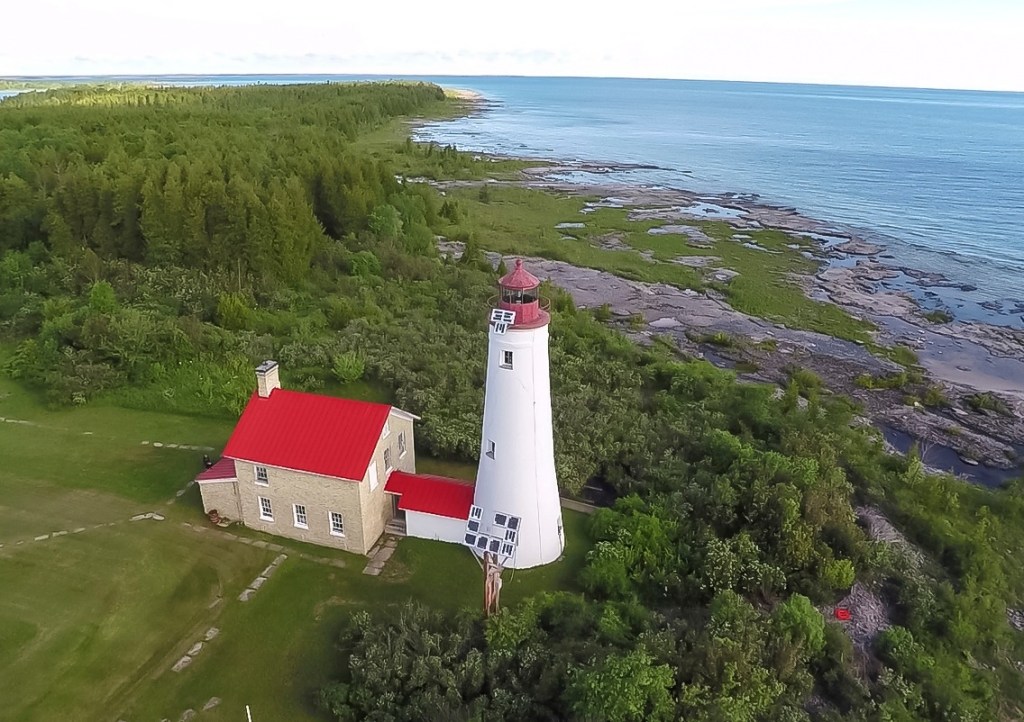
Lighthouse historian Terry Pepper is no longer with us, but his words still illuminate the rich history of Michigan lighthouses at Seeing the Light. His entry on the Thunder Bay Island Lighthouse says (in part):
Thunder Bay Island sits just three miles East-northeast of the north point of Thunder Bay, and thirteen miles from the harbor at Alpena. This 215-acre limestone island is the outermost of a group of islands connected to the shore by a shallow rocky shoal. As such, it represented both a significant marker for Northbound vessels making the turn toward the Straits, and stood ready to chew the wooden hulls of vessels unlucky enough to stray too close to its rocky shores.
…With rapidly increasing maritime traffic through the 1850’s, the Lighthouse Board determined that the combination of inefficient Lewis lamps and the diminutive 40-foot height of the tower provided a less than effective aid to mariners relying on this important station. To rectify the situation, plans were formulated to increase the height of the tower and to install an improved French Fresnel lenses of the type currently being installed throughout the system. Over 1857, the upper 14 feet of the tower was encased in brick and continued above the upper limits of the old structure to a height of 50 feet, effectively increasing the total height of the tower by 10 feet. The entire exterior of the tower was then given a veneer of Cream City brick to provide a smooth, weather-proof surface. At completion of the masonry work, the renewed walls at the base of the tower stood a massive 79 inches thick, and tapered to a thickness of 20 inches at their uppermost.
Atop this renovated tower, a new gallery with a cast iron hand railing was installed, and a ten-sided prefabricated cast iron lantern installed at its center. Within this new lantern, a Fourth Order Fresnel lens manufactured by Sautter of Paris equipped with six bulls-eye flash panels was installed on a cast iron pedestal and equipped with a clockwork rotating mechanism. This new improved illuminating apparatus provided a characteristic fixed white light varied by flashes, and its enhanced focal plane of 59 feet provided an increased range of visibility of 14 miles at sea.
Read on for much more! Also, a very big thank you to the Great Lakes Lighthouse Keepers Association who have been sharing some great pics in our Michigan in Pictures group on Facebook! They do so much to preserve Michigan’s lighthouse and maritime legacy!!



 Michigan in Pictures