

curvilinear, photo by powerbooktrance.
Grand Rapids, Michigan … though I’m told the judges would have accepted Willie Wonka’s Chocolate Factory and Pink Floyd: The Lost Album Cover.
curvilinear, photo by powerbooktrance.
Grand Rapids, Michigan … though I’m told the judges would have accepted Willie Wonka’s Chocolate Factory and Pink Floyd: The Lost Album Cover.

Propeller, photo by country_boy_shane.
Shane says …if you view this large, you can see many signatures on the right-most blade. Talk about neat stuff you can find with your camera! Here it is large and on black.
He has a set of photos from his trip to the Henry Ford Museum and he went with several other photographers, most of whom were shooting HDR. See their collected work in this very cool slideshow.
Here’s the web site for The Henry Ford Museum & Greenfield Village.

Spinners 1, photo by n8xd.
Keith (n8xd) took this photo at Harvest, Michigan’s first commercial wind farm. The farm is owned by John Deere Wind Energy and located near Elkton in the Thumb.
Read more (and see another photo from Keith) in Harvest, Michigan’s first commercial wind farm starts spinning on Absolute Michigan. You can also check out keithdelong.com andbe sure to click through to the photo to see it bigger!
[PHOTO GONE]
Sorry. This was a photo that Lexie took this photo of Mazda’s Taiki Concept at the 2008 Detroit Auto Show aka the North American International Auto Show aka The Place Where Car Designers Get To Go Crazy. She had a few more too but they’re now gone because she quit Flickr.
I thought it was probably the quintessential concept car because is made me ask that all important question: Are we ever going to be driving cars that look like this? while simultaneously thinking It would be pretty darned cool if we did!.
Kicking Tires at cars.com took a look at a few 2008 Detroit Auto Show concept car winners and losers and you can read more about the Taiki at Jalopnik.

Hanna furnaces of the Great Lakes Steel Corporation, Detroit, Mich. Coal tower atop coke ovens (LOC), photo by The Library of Congress.
Yesterday I learned through a couple of emails, an IM, Lifehacker and even this post in the Absolute Michigan pool (yay!) that the Library of Congress has embarked on a new project to increase access to their photographic collection and also to more completely “tag” their photos. From My Friend Flickr: A Match Made in Photo Heaven on the Library of Congress blog:
The project is beginning somewhat modestly, but we hope to learn a lot from it. Out of some 14 million prints, photographs and other visual materials at the Library of Congress, 3,000 photos from two of our most popular collections are being made available on our new Flickr page, to include only images for which no copyright restrictions are known to exist.
The real magic comes when the power of the Flickr community takes over. We want people to tag, comment and make notes on the images, just like any other Flickr photo, which will benefit not only the community but also the collections themselves. For instance, many photos are missing key caption information such as where the photo was taken and who is pictured. If such information is collected via Flickr members, it can potentially enhance the quality of the bibliographic records for the images.
This photo was taken in November of 1942 by Arthur Siegel of the Hanna furnaces of the Great Lakes Steel Corporation in Detroit (now U.S. Steel’s Great Lakes Works). You can see (and perhaps help to classify) more photos tagged as Michigan right here.
Much as I love Detroit’s rich industrial history, I really hope that the good people at the Library of Congress can toss up a few photos from elsewhere in the state, including some that highlight Michigan’s natural beauty!
LOC Call Number: LC-USW36-811 (link)
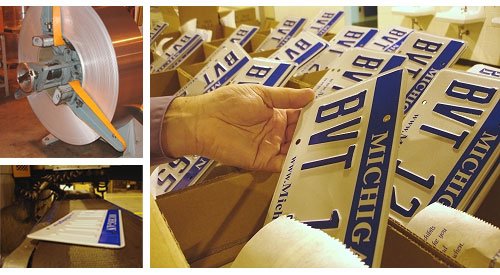
Inside the Michigan License Plate Factory, photos by Bob Nelson
I’d always heard about convicts making license plates, but until I happened upon this site, I really had no concept of how that process took place. Bob writes that All motor vehicle license plates in Michigan are made by inmates at the Parr Highway Correctional Facility at Adrian, one of many secure facilities operated by the Michigan Department of Corrections.
To see a ton of photos from start to finish, click through to the tour of the Michigan License Plate Factory.
I can’t tell you much about Bob, but I can guess that he’s wearing green & white on Saturdays!
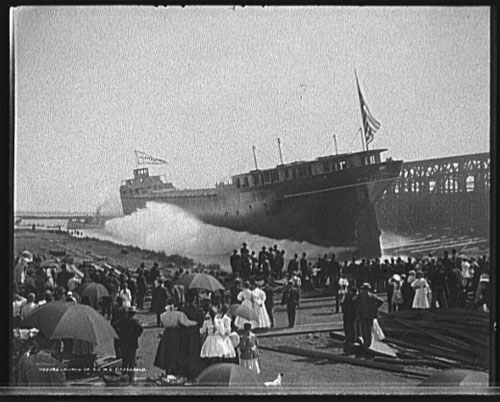
Launch of the S.S. W.E. Fitzgerald at Wyandotte, Detroit Publishing Co.
I have no idea how I ended up at this photo (and why I suddenly feel like Paul Harvey), but here’s what I’ve learned through Boatnerd.com and a forum with a brief article from Boatnerd by Dick Wiklund about the “Little Fitz.”
William and Julia Fitzgerald of Marine City, Michigan sired six sons. The sons were fascinated by the wooden sailing ships and early steamboats on the St. Clair River, and all six became captains of Great Lakes ships. The youngest of these was John Fitzgerald, who started a shipyard in Milwaukee. His son, William E. Fitzgerald, took over the business in the 1890s but died just a few years later. William’s close friend, Captain Dennis Sullivan, built and christened the W.E. Fitzgerald in Wyandotte in his honor in 1906.
The Wyandotte Historical Museum’s history page says that Wyandotte’s shipbuilding industry was started by Eber B. Ward:
Wyandotte produced over 200 ships, varying from small tugs to large steamers and passenger ferries. Under the name of the American Shipbuilding Company the Wyandotte yards flourished. Hulls were constructed in Wyandotte and were taken up the Detroit River to Detroit, Michigan were they were outfitted. Smaller companies such as the E.H.Doyle Hoop & Stave Works(1889)who provided the city’s first electric power, the Regeant Stove Company, the McCord Corp. and the Beals & Selkirk Trunk Company soon made Wyandotte a famous industrial town.
In 1953, the WE Fitzgerald became known as the Little Fitz when the massive freighter named after William’s son was launched. His name, of course, was Edmund Fitzgerald.
The Library of Congress index of Wyandotte photos is heavy ships & shipyards (you may need to go to this page and search for “Wyandotte”). If you’re in the mood for a ton of Great Lakes freighter information (and a little music and “Laker” cooking), head over to Absolute Michigan’s word of the week: Freighter.
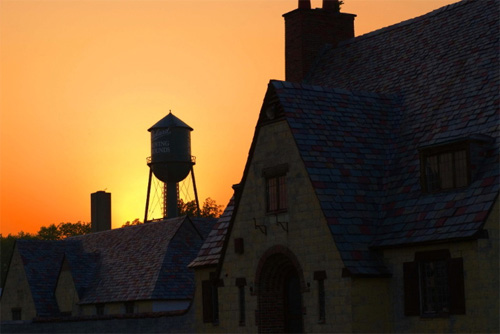
Packard Proving Grounds Lodge, photo by Sibylle Basel, Casting Shadow Photography
Sibylle says that photograph is a great art that washes away the dust of every day life. Click the photo above to see more of how she washes the dust away.
The Shelby Township Historical Committee is managing renovations at the Packard Proving Grounds and has some great information and old photos about the site including the text from the front and back of the Michigan Historical Marker:
The Packard Motor Car Company began building a proving ground on this site in 1926. Packard, like its competitors, had previously tested cars on city streets. Architect Albert Kahn designed the principal buildings. By 1929 the complex included the Gate Lodge, warehouses, laboratories, a high-speed test track, and twelve miles of roads simulating the worst conditions of the day. During World War II (1941-1945) Packard built aircraft and marine engines while leasing the grounds to Chrysler for tank testing. Packard ceased production in 1958, and the Ford Motor Company purchased the site in 1961. In 2000 Ford and the Packard Motor Car Foundation began working to preserve the design complex portion of the site.
(back) In 1899 brothers James Ward and William Doud Packard founded the Ohio Automobile Company in Warren, Ohio. In 1902 Detroiter Henry Joy and several other local investors purchased the company, moved it to Detroit and renamed it the Packard Motor Car Company. During the 1920s and 1930s, Packard set the standard for luxury and design. Under the direction of chief engineer Jesse G. Vincent, Packard, known as “America’s Master Motor Builder,” also made advances in aviation technology. Vincent contributed to the development of the Liberty aircraft engine during World War I and predicted the growth of commercial aviation. He considered a proving ground to be essential to high quality.
If you want to get an idea of the full layout, check this aerial photo. Also see Michigan Auto Racing – Packard Proving Grounds, Utica, Michigan at Water Winter Wonderland, Wikipedia’s Packard entry and the National Packard Museum in Warren, OH.

Shaft entrance at the abandoned Hiawatha Iron Ore Mine, U.P. Michigan, photo by dietrichlawrenz.
Dietrich writes that the cement is stained from iron ore dust that came out from the shaft.
This photo is part of a great set rusty/snowy photos of Upper Michigan and you absolutely must view it large.

Ford Airstream, photo by Spencer Olinek.
Spencer calls this a wonderfully crazy concept from Ford and Airstream. As a former Airstream owner, I have to agree!
You can get many more photos of the Ford Airstream Concept on Flick and also in this Ford Airstream photo gallery at Airstream.com. If this wacky ride isn’t your style, you’ll probably find something to your liking in the 2007 North American International Auto Show pool.
Also, as a part of our auto show coverage, we have posted our latest Michigan Automotive History feature on the Ford Motor Company.
 Michigan in Pictures