Wind, Water & Light: Turn your photos into energy

Wind on the Water

Wind on the Water, photo by jimflix!.

GE has an interesting project under their $10 billion dollar Ecoimagination initiative. The Ecoimagination Photo Project lets you upload photos to Flickr tagged with “Wind,” “Water,” or “Light”. For each photo, they donate a certain amount to three related charities to help build fresh water wells, donate solar powered lanterns, and build small-scale wind turbines for communities in need.

Click the photo project link above to see the photos and click for the ecomagination photo project group on Flickr.

Jim took this photo at the Sleeping Bear Dunes National Lakeshore in October. He writes:

Late evening light on the bluffs of the Sleeping Bear Sand Dunes. About 30 minutes after a storm, and there’s still lots of wind coming in. At over 400 feet above Lake Michigan, it takes 30 seconds to run down this bluff, but often takes 30 minutes or more to climb back up! Those are the Empire Bluffs down the coast on the left. And the distant point on the right is Point Betsie.

A complement to this photo, and here’s a photo in the middle.

Check it out background bigtacular and in his Sleeping Bear Dunes slideshow.

High Speed Internet – the new Mackinac Bridge?

Mackinac Bridge.....I-75

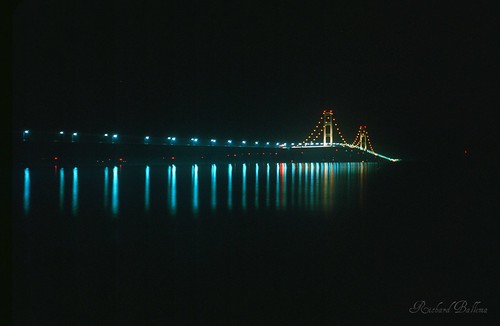
Mackinac Bridge…..I-75, photo by bitsorf.

In this week’s Traverse City Area Chamber of Commerce e-News, Laura Oblinger wrote :

In 1957, the Mackinac Bridge connected the state to new economic and social opportunities. More than a half-century later, high-speed Internet service (broadband) can have a similar impact by connecting all regional businesses to the global marketplace. Statewide broadband deployment is projected to result in a $400 billion increase in the state’s gross state product over 10 years.

If tourists can remain connected to their work, it could mean an additional $52 million to the Traverse City area economy due to stays being extended by just two days.

You can check out the Chamber’s Regional Broadband Initiative page and learn a lot more about Michigan’s Broadband Initiatives and even check connectivity across the state through Connect Michigan.

Check this out bigger!

Much more about the Mighty Mackinac Bridge from Michigan in Pictures!

Hand-building automobile bodies: Michigan’s Automobile Factories, 1900-1961

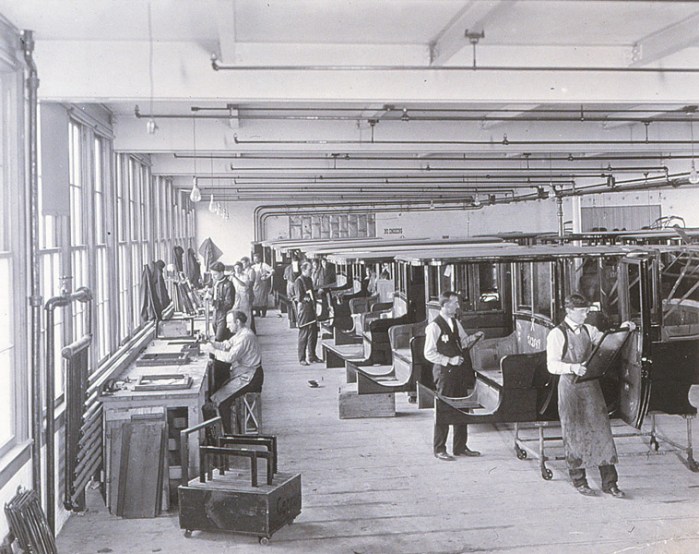
Packard Factory, Detroit, 1910, courtesy of the National Automotive History Collection, Detroit Public Library

The Michigan Radio Picture Project has a new feature titled Michigan’s Automobile Factories, 1900-1961 edited by Doug Aikenhea. It’s a fantastic tour through Michigan’s automobile heritage, that takes you from hand-built wooden auto bodies to sheet metal & assembly lines. It features well known factories in Detroit, Flint & Lansing like Ford, Buick and Chrysler along with lesser known ones such as Durant-Dort, Fisher, Chalmers & Maxwell. They write:

The industrial adventurers and entrepreneurs who launched Michigan’s automobile industry came from various backgrounds. Some of them began as carriage makers, like William C. Durant who would go on to found General Motors in 1908. The earliest automobiles, like their horse-drawn predecessors, were constructed largely from wood and were built individually until the assembly line evolved to accelerate production and incorporate standardized, mass-produced parts. As automobile manufacturing progressed, the role of the worker changed from traditional craftsman to skilled assembly line specialist. This series of historical photographs traces the evolution of Michigan automobile factories from 1900 until 1961.

Click through for more!

Red Dawn: (re)Made in Michigan

Made in Michigan

Made in Michigan, photo by mjo62000

The remake of the 1980s invasion film Red Dawn is being filmed in Mt. Clemens – one of many movies that are being shot in Michigan right now thanks to our industry leading film incentive. The movie is directed by Dan Bradley, stars Chris Hemsworth, Josh Hutcherson, Isabel Lucas, Connor Cruise, Josh Peck, Adrianne Palicki and is scheduled to be release September 24, 2010.

Mary Jo has a few more photos from the film in her slideshow and you can see a few more from RIPizzo.

You can get all kinds of Red Dawn information from Beyond Hollywood including some YouTube videos from the filming (explosions!)

Speaking of explosions, here’s the trailer for the original Red Dawn.

Wolverines!!!

Wire Watching!

Wire Watching!

Wire Watching!, photo by mdprovost ~.

Be sure to check it out bigger.

The New “New” GM

camo car

camo car, photo by daveraoul.

Dave’s take on the “new” GM. Be sure to check it out bigger.

Check out Chapter & Verse on the General Motors Bankruptcy on Absolute Michigan for much more.

Industrial Haven

Industrial Haven

Industrial Haven, photo by Jesse Speelman.

Attention superheroes: if you’re looking for a cool & moody hideout, Detroit has you covered!

Be sure to view it bigger, on black. Chancellor Monnette has a cool photo of the tunnel and a map.

Michigan road salt & the Detroit Salt Mine

Salt Mountain, photo by otisourcat

In the battle against snow and ice that is waged every winter day on Michigan’s roads, salt remains and essential ingredient. MDOT records for 1991 show that 442,223 tons of road salt were applied to 10,000 linear miles of trunk line maintained under MDOT’s jurisdiction. The Wayne County Road Commission notes that a single salt run for a truck can use up to 12 tons of salt, depending upon the truck size. That page has several more bits of trivia including the fact that at temperatures below 20 degrees, salt begins to lose its effectiveness. It becomes almost completely ineffective at 0 degrees or colder.

The Salt Institute’s page on Michigan salt says that estimated salt deposits in Michigan are astronomical. In the Detroit area alone, it is believed that there are over 71 trillion tons of unmined salt. Geological studies estimate that 55 counties of the Lower Peninsula cover 30,000 trillion tons of salt.

Our largest salt mine is actually the Detroit Salt Mine, operated by the Detroit Salt Company (closed for a time but now re-opened, comes with an annoying & loud Flash warning) and I suppose is makes sense that in 1940 Detroit became the first major city to use rock salt for snow and ice control. The Great Lakes Radio Consortium’s Ann Murray has a great report titled Exploring a Great Lakes Salt Mine that takes you inside the Cleveland salt mine that extends under Lake Erie. The best exploration of the mine is via The ghostly salt city beneath Detroit in the Detroit News:

In a 1925 Detroit News article, miner Joel Payton told about his salt mine job. “The only dirty part of this job is going down to work,” Mr. Payton explained.

“I have to wear this old outfit because the big buckets that take us down get smudgy from the action of the sulphur water on the iron of the buckets.

“The mine itself is dry and clean as pure rock salt in a solid vein 35 feet thick is bound to be. The high vaulted rooms that we have hollowed out have sparkling white floors, walls and ceilings.”

Payton continued, “One reason we don’t have any rats in our Detroit mine is because the rats would have nothing to eat except the leavings of our lunch pails. And by the way, not only are there no rats or cockroaches or other living creature in our mine, but also no remains of living things from past ages. The salt vein is, of course, a dried up sea that once covered this section for hundreds of miles. You’d naturally suppose that some fish or vegetation would have been pickled or fossilized in the brine as it hardened. But I’ve never seen a single fossil or sea shell or any remains of that kind”

The photo above was taken at the Verplank salt dock, Muskegon and you can see more photos of otisourcat has taken of Michigan road salt.

Stuffed animal road trip: The Big Three return to Washington

Stuffed animal road trip

Stuffed animal road trip, photo by caterpillars.

Today it’s possible that the future of Michigan gets decided in Washington DC as the CEOs of Ford, GM & Chrysler return to Washington. They’re driving themselves this time (though each in their own cars). Word is that if they fail again, they will all pile onto a solar powered unicycle … or go out of business. (update: see the cartoon!)

Laura writes that this is from The Heidelberg Project in Detroit during a meet-up with Exposure.Detroit on December 20th, 2007 .

The book Connecting the Dots: Tyree Guyton’s Heidelberg Project is pretty cool too if you want to learn more about this unique Detroit project.

Abandoned Mill, Ripley, Michigan 1997

Abandoned Mill, Ripley, Michigan 1997

Abandoned Mill, Ripley, Michigan 1997, photo by Bill Schwab.

A number of years ago, I built a site for an excellent local photographer, Greg Seman. I remember him praising the work of Detroit photographer Bill Schwab.

It was a pretty cool feeling when I saw some lovely black & white photos roll into the Absolute Michigan pool on Flickr and realized that they were Bill’s.

This photo is part of Bill’s Michigan set (slideshow), but don’t stop there