
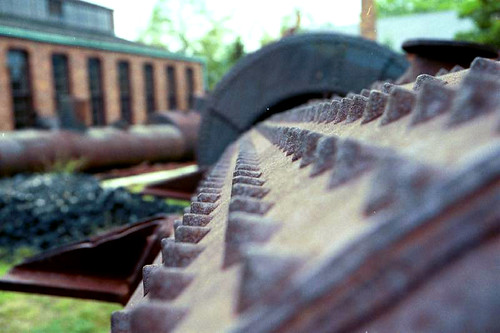
Industrial rev., originally uploaded by G0Da.
Part of a set of photos with an industrial edge from Greenfield Village.
G0da’s pics also appear on Destination: Michigan’s visit to The Henry Ford Museum and Greenfield Village.
Industrial rev., originally uploaded by G0Da.
Part of a set of photos with an industrial edge from Greenfield Village.
G0da’s pics also appear on Destination: Michigan’s visit to The Henry Ford Museum and Greenfield Village.
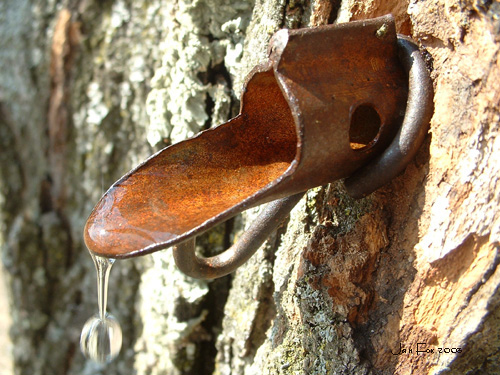
Spile, photo by Jan Fox ©
In an ideal world, I’d be able to lay out the process of making maple syrup using nothing but Michigan photos. Unfortunately, I can’t. I should be able to as my family used to sugar when I was a kid. I can only find a couple of the photos my dad took though. Such is life. I find maple sugaring a fascinating subject, so I’ll try and pull off a whirlwind tour of how it gets made. Bear in mind that we are discussing maple syrup here, Mrs. Butterworth, get outta here!
The roots of maple syrup start with the first Americans, and the fact that somewhere along the line, someone discovered that the sap of maple trees is sweet. If you ever get a chance to taste ice-cold sap in the spring, please do! Be warned that once the trees have budded, sap tastes bitter.
The process of sap collection is relatively simple. A hole is drilled in a maple tree and a spile like the one in the photo above is hammered into the hole. A bucket (or buckets) is then hung on the spile into which sap drips. Cold nights and warm days produce the best sap flow. For a few trees, folk will use a larger bucket while the big sugaring operations use a network of plastic lines.
In any case, the sap is collected and stored until such time as you are ready to boil it down (photo part of a great set of pictures!). This takes hours and hours and it takes 30 or 40 gallons of sap to make one gallon of maple syrup. Anyone who has ever made this knows that there’s no way sugar and carmel coloring are ever going to equal real maple syrup atop a stack of pancakes.
If all goes well, you will be able to see some or all of the photos featured here at the “sweetcycle” tag on Flickr.
View a Collection from 1940 by Marion Post Wolcott in the Library of Congress
How to Make Maple Syrup from the Michigan Maple Syrup Association
Native American Maple Sugaring: One Drip at a Time on Michigan in Pictures
Great information about Michigan maple syrup and maple syrup events from Absolute Michigan
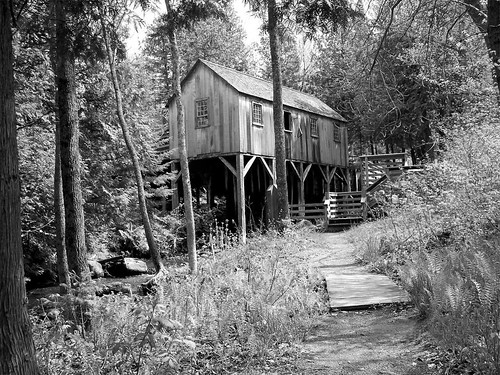
Black and White Saw Mill, originally uploaded by ~flutterby~.
A photo of Historic Mill Creek, located near Mackinaw City. The photo is also available in color.
As the Straits of Mackinac’s first industrial complex, Mill Creek provided sawn lumber for the settlement of Mackinac Island in the 1790s.
Today at the 625-acre state park, you can enjoy an exciting blend of living history demonstrations and nature interpretation along the many scenic trails.
More about Historic Mill Creek from Mackinac State Historic Parks
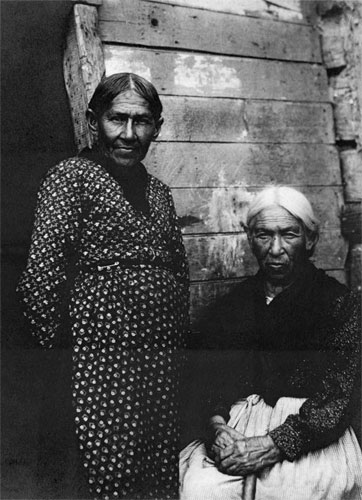
Today’s photo is from the Frances Benjamin Johnston Collection at the Library of Congress.
According to the Library, Frances Benjamin Johnston (1864-1952) was one of the first American women to achieve prominence as a photographer. Trained at the Academie Julian in Paris, she studied photography upon her return to Washington, D.C., in the mid-1880s and opened a professional studio circa 1890. Her family’s social position gave Johnston access to the First Family and leading Washington political figures and launched her career as a photojournalist and portrait photographer. Johnston turned to garden and estate photography in 1910s.
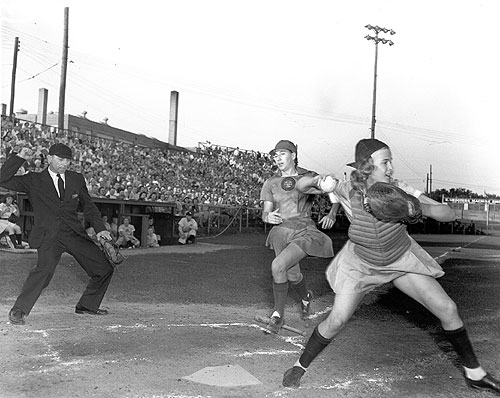
Photo by Robinson Studios of Grand Rapids
March is Women’s History Month and while the idea that the legacy of accomplishment of 50% of our population can be handled with a single month seems a bit of a stretch, it’s a good excuse to check out some great historical photos.
The web site of the Grand Rapids Public Library features an online exhibit of images and information of the All-American Girls Professional Baseball League (AAGPBL). According to the site, the AAGPBL was the 1942 brainchild of Chicago Cubs owner Philip K. Wrigley, intended to serve as close-to-home entertainment for fans limited by World War II travel restrictions and as a temporary replacement should the war-time draft force cancellation of major league baseball. The Grand Rapids team was known as the Grand Rapids Chicks and your really need to go to the site to look through all the photos in their gallery.
You might also want to read The Girls of Summer from Michigan History Magazine for more details on the league like this passage:
Many of these women set records any major leaguer would treasure. Racine Belles player Sophie Kurys, dubbed the Flint Flash for her amazing ability to steal bases, stole a total of 1,114 bases during her career. Racine Belles pitcher Joanne Winter set the record for consecutive scoreless innings at 63, one even Los Angeles Dodger pitcher Orel Hershiser fell shy of with his record of 59 in 1988. Grand Rapids Chicks pitcher Connie Wisniewski earned her nickname Iron Woman because in 1945 “she once pitched and won both ends of a doubleheader, started forty-six games, and ended the season with a 32-11 record,” according to historian Barbara Gregorich. Wisniewski’s performance as a pitcher made her a natural choice as the league’s Player of the Year.
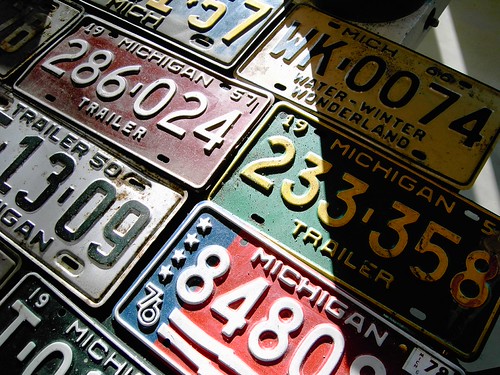
Michigan’s History, originally uploaded by sgsteffens_83.
This photo by Sarah Steffens is just the thing to look at over a steaming cup of coffee on a windy, wintry Michigan morning.
According to the Michigan Historical Center’s MI License Plates pages, Michigan cities started issuing license plates in 1903. Two years later (no doubt with visions of DMV lines stretching to infinity) the Legislature passed Public Act 196 requiring statewide vehicle registration. A sample of the trivia contained in the MHC’s pages:
After June 28, 1907 (P.A. 304), two (2) homemade license plates were required (1 front and 1 rear). “Homemade” license plates went commercial as Sears Roebuck and other mail order companies produced license plate kits. “Billy, did you make the licence plates??”
Of course now the license plate process has pages and pages dedicated to it and your plate can support Michigan Universities and special causes. And of course, you can use your license plate as a roving mini-blog.
Also be sure to check out G. William Whitworth’s Michigan License Plate page.
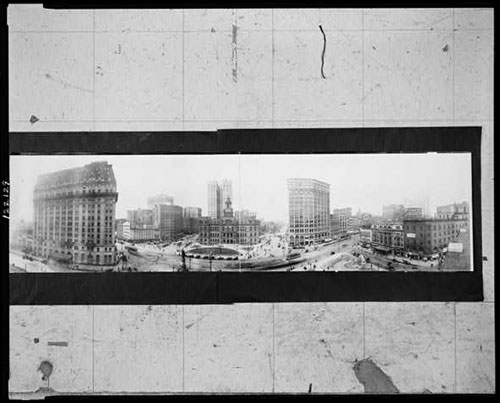
The Library of Congress has this amazing panorama of Detroit's Campus Martius taken in 1914. You can click the photo above for a large panorama and get details on the photograph here (and a link to a 12 MB tiff of the panorama)!!
From the Campus Martius Park web site:
In 1788, Campus Martius served as a drill ground for militia training. Campus Martius means "military ground" and was named after the Campus Martius at Marietta, Ohio, a 180-foot stockade.
After the fire of 1805, Judge Woodward was appointed to oversee the plan to lay out the streets, squares and lots with the assistance of the best surveyors from Canada. They placed their instruments and astronomical devices on the summit of a huge stone. He viewed the planets and meteors in order to determine "true North". Today we still call this point the "Point of Origin" which is located in center of Campus Martius at the junction of Woodward and Monroe. It is from this point that the City of Detroit's Coordinate system was created.
UrbanTiki explains that when it's not hosting the Motown Winter Blast, Campus Martius's hydraulic concert stage allows it to host concerts (photo by ifmuth) and serve as an ice rink (photo by mainegal). SNWEB.org has a great shot of the Point of Origin. (sorry to get all link-happy on you there)
Speaking of link-happy, here's a look by Michigan in Pictures at the Michigan Soldiers & Sailors Monument which is located in Campus Martius.
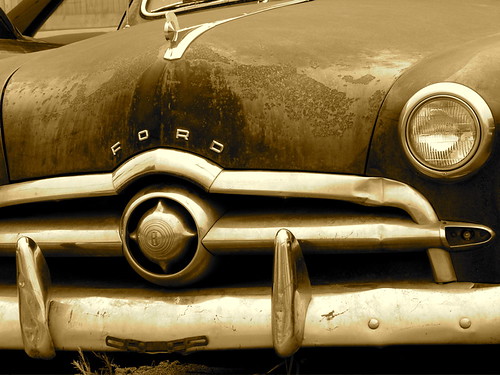
ford, originally uploaded by argusmaniac.
Great shot of an old Ford. Here’s hoping that Ford (and Michigan’s auto industry as a whole) can rise from the ashes.
If you click the photo, there’s some discussion and links to what the year of the model might be.
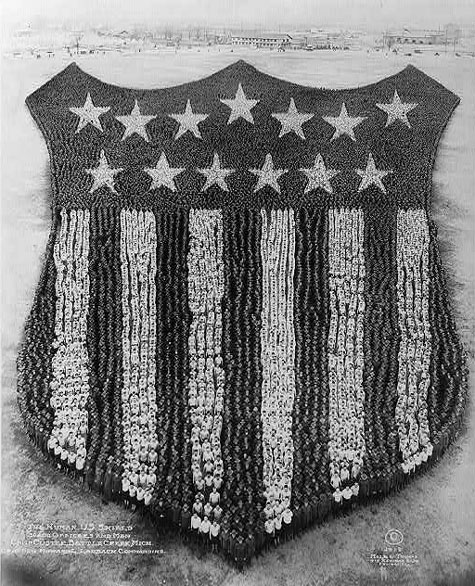
Apparently, we’ll end the week on a military theme. This morning, I stumbled upon a page with some amazing examples of “patriotic photographs in true perspective” produced by Mole & Thomas, a Chicago photography studio. The one above was taken at Camp Custer in Battle Creek, Michigan.
Now if you’re anything like me, you won’t mind a bit more detail on the above photo provided by the George Glazer Gallery of NYC:
Aerial photograph of 30,000 military officers and men at Camp Custer, Battle Creek, Michigan, forming an emblem based on the shield that is part of the design of the great seal of the United States, with 13 stars and 13 vertical stripes. The shield is in front of the bald eagle in the seal design, which was officially adopted by the U.S. Government in 1787. This photograph was taken by Mole & Thomas, a Chicago firm famous for such patriotic bird’s-eye group shots at military bases after World War I. The Library of Congress has eight such photos in their collection, including this one.
Arthur S. Mole was a British-born commercial photographer who worked in Zion, Illinois. During and shortly after World War I, Mole traveled with his partner John D. Thomas from one military camp to another, posing thousands of soldiers to form gigantic patriotic symbols that they photographed from above. The formations depicted such images as the Liberty Bell, the Statue of Liberty, the Marine Corps emblem and a portrait of President Woodrow Wilson. The Wilson portrait, for example, was formed using 21,000 officers and men at Camp Sherman in Ohio and stretched over 700 feet. His “Human Liberty Bell” was composed from over 25,000 soldiers, arranged with Mole’s characteristic attention to detail to even depict the crack in the bell. Mole and Thomas spent a week or more preparing for these immense works, which were taken from a 70- or 80-foot tower with an 11- by- 14-inch view camera. When the demand for these photographs dropped in the 1920s, Mole returned to his photography business in Zion. Photographs by Mole and Thomas are in the collections of the Chicago Historical Society, the Museum of Modern Art and the Library of Congress.
The Glazer Gallery sold this print, but they may have others.
Image Courtesy Library of Congress.
 Michigan in Pictures