Harry Houdini put the rabbit in Jack Rabbit Beans

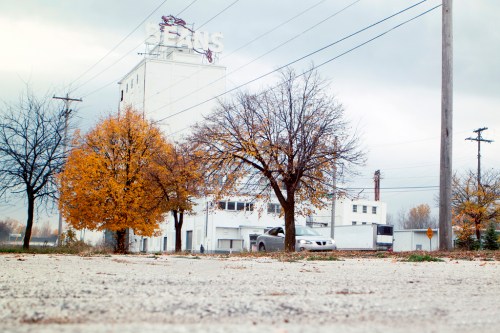
Fall in Saginaw

Fall in Saginaw, photo by Urban Gurl

March 24 is Harry Houdini’s birthday and a great time to share the story of Harry Houdini and Jack Rabbit Beans via Waymarking.com:

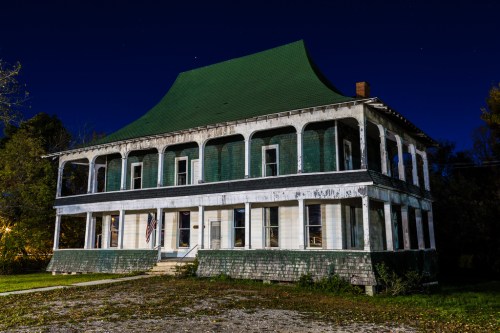
We showed up at 9:00 am, after a two hour drive, to take a little tour of a few neon gems in Saginaw, MI. Our tour guide was local historian Thomas Mudd. This was the first one on our tour. After our tour, we spent the day looking around until it was time to go back for the night shots. According to Mr. Mudd, you can thank Harry Houdini for this sign.

Houdini performed the “Rabbit-in-the-hat-act” at the Jeffers-Strand Theater in Saginaw in the late 1920’s. He needed a volunteer and whoever helped him would get to keep the rabbit. A young girl named Phyllis R. Symons volunteered, and when the act was over she waited for her rabbit.

Houdini tried to get her off stage and told her he would give her something else afterwards. But she would not leave the stage until she received the rabbit. Houdini eventually gave her the rabbit, which in 1937 would become the symbol of Jack Rabbit Beans. Phyllis’ father, Albert L. Reidel, co-founded Port Huron-based Producers Elevator Co. It later became Michigan Bean Co., the maker of Jack Rabbit Beans.

Sadly, Phyllis could not keep the rabbit in town, so it got sent to her grandparents in Minden City. They too were unable to put up with the rambunctious bunny, and one day Phyllis and her parents paid a visit and found the rabbit on the menu. Phyllis was in shock that they could eat the rabbit. Albert Reidel thought it was funny.

Check Kimberly’s photo out big as a building and see more in her Michigan slideshow.

There’s more history and more Saginaw on Michigan in Pictures!
The DN Ice Boat and the 2014 Central Regional Ice Boating Championship

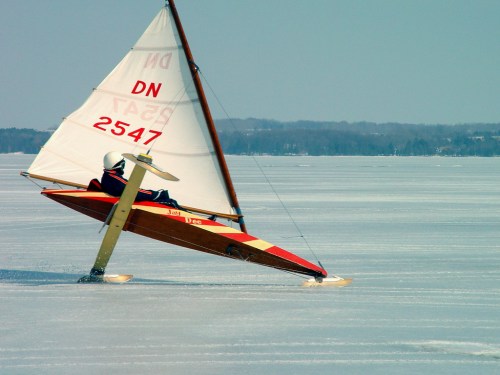
DN hiking it, Elk Lake- Elk Rapids, Michigan

DN hiking it, Elk Lake- Elk Rapids, Michigan, photo by rickrjw

Last night I learned from my iceboating friend Andy that the 2014 Central Regional DN Iceboating Championship will be held this Saturday & Sunday (March 15-16, 2014) on West Grand Traverse Bay. The primary launch site will be the DNR launch at Hilltop Rd. and M-22, approximately 9 miles north of Traverse City and 5 miles south of Suttons Bay on the Leelanau Peninsula. More details at DNA America.

Wikipedia explains that the International DN is a class of ice boat:

The name stands for Detroit News, where the first iceboat of this type was designed and built in the winter of 1936-1937. Archie Arrol was a master craftsman working in the Detroit News hobby shop, and together with iceboaters Joe Lodge and Norman Jarrait designed a racing boat they called the “Blue Streak 60”, later to become known as the “DN 60”. In 1937 a group of 50 laymen worked with Archie in the hobby shop to produce the first fleet of the new iceboats. These first boats broke during the initial season, and after Norm and Joe modified the design to increase the strength, the group got back together to build a second set of iceboats in 1938.

This design, featuring a narrow, single-person cockpit, three steel blades in tricycle style arrangement and a steeply raked mast, remains to this day the most popular ice boat design in use.

…The class has a devout following. The International DN Ice Yacht Racing Association (IDNIYRA) is the governing body for the class. It publishes standards for boat design and allows enthusiasts to assemble for races and to share good ice locations. The DN is raced extensively in the northern United States, Canada, and throughout Northern Europe, with World Championships alternating between North American and Europe each year.

One of the reasons that the DN Ice Boat Class has become so popular over the years has been largely in part to how transportable and fast they truly are. With a steady 10-12 mile per hour wind and good ice conditions, the DN, when piloted properly, can reach speeds in excess of 50 miles per hour. And with just a 12-15 mile per hour steady wind, the DN ice boat can reach a readily attainable 55–65 miles per hour, providing a thrilling rush of purely unadulterated bone chilling wind powered ice sailing.

Rick took this photo of a DN on Elk Lake almost exactly 5 years ago, and March is prime season for ice boating in Michigan due to typical snow melts that lay the thickest ice of the year bare. GT Bay is nearly in my front yard and I can assure you that the ice is thick and almost like glass this year! View his photo bigger and see lots more in his Iceboating slideshow.

More ice boating on Michigan in Pictures including one of my favorite videos, Ice Boat vs Chevy!

Heavy Space Weather Ahead?

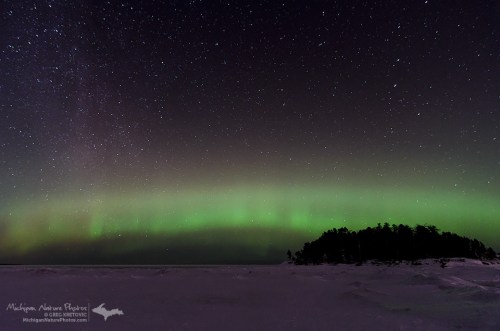
Frigid Auroras Over Superior

Frigid Auroras Over Superior, photo by Michigan Nature Photog

NOAA’s current space weather forecast reports an M Class (moderate) solar flare from solar region AR2002. Spaceweather.com adds that AR2002 has destabilized its magnetic field, making it more likely to erupt, and that NOAA forecasters are estimating a 60% chance of M-class flares and a 10% chance of X-class flares during the next 24 hours. X-class flares are major solar events that can spawn incredible auroras visible far to the south of us, planet-wide radio blackouts and long-lasting radiation storms. Click to Space Weather for a video of AR2002 development.

While there’s not much chance of a major event, I thought it was interesting that 25 years ago this week,  one of the most significant solar storms in memory created a spectacle in the skies as it demonstrated the power and danger of solar weather to modern society. A Conflagration of Storms begins:

On Thursday, March 9, 1989 astronomers at the Kitt Peak Solar Observatory spotted a major solar flare in progress. Eight minutes later, the Earth’s outer atmosphere was struck by a wave of powerful ultraviolet and X-ray radiation. Then the next day, an even more powerful eruption launched a cloud of gas 36 times the size of the from Active Region 5395 nearly dead center on the Sun. The storm cloud rushed out from the Sun at a million miles an hour, and on the evening of Monday, March 13 it struck the Earth. Alaskan and Scandinavian observers were treated to a spectacular auroral display that night. Intense colors from the rare Great Aurora painted the skies around the world in vivid shapes that moved like legendary dragons. Ghostly celestial armies battled from sunset to midnight. Newspapers that reported this event considered the aurora, itself, to be the most newsworthy aspect of the storm. Seen as far south as Florida and Cuba, the vast majority of people in the Northern Hemisphere had never seen such a spectacle. Some even worried that a nuclear first-strike might be in progress.

…Millions marveled at the beautiful celestial spectacle, and solar physicists delighted in the new data it brought to them, but many more were not so happy about it.

Silently, the storm had impacted the magnetic field of the Earth and caused a powerful jet stream of current to flow 1000 miles above the ground. Like a drunken serpent, its coils gyrated and swooped downwards in latitude, deep into North America. As midnight came and went, invisible electromagnetic forces were staging their own pitched battle in a vast arena bounded by the sky above and the rocky subterranean reaches of the Earth. A river of charged particles and electrons in the ionosphere flowed from west to east, inducing powerful electrical currents in the ground that surged into many natural nooks and crannies. There, beneath the surface, natural rock resistance murdered them quietly in the night. Nature has its own effective defenses for these currents, but human technology was not so fortunate on this particular night. The currents eventually found harbor in the electrical systems of Great Britain, the United States and Canada.

You can read on for more about how the storm spawned a power outage in Quebec and pushed US systems to the brink of collapse. If you want to totally geek out on auroral science, check this article out about how the Earth’s magnetosphere actually extends itself to block solar storms.

Greg took this shot in late February in Marquette in -17 temps! View his photo bigger and see more in his northern lights slideshow. You can purchase Greg’s pics at MichiganNaturePhotos.com.

There’s more science and much (much) more about the Northern Lights and Michigan on Michigan in Pictures.

Waugoshance Morning

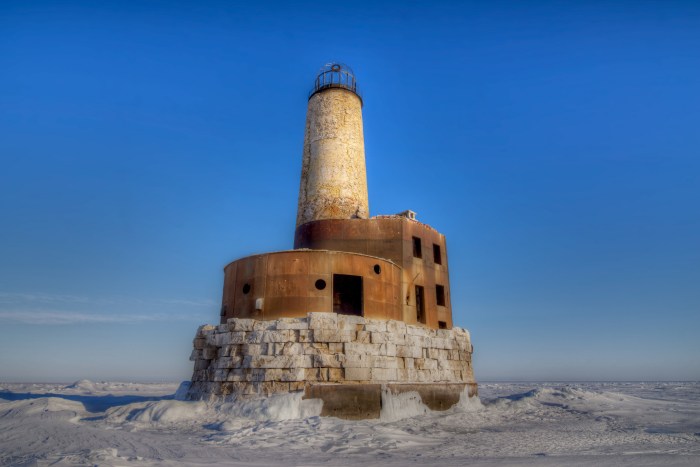
Waugoshance Lighthouse - Morning

Waugoshance Lighthouse – Morning, photo by lomeranger

You can today’s photo under “dedication” as photographer Jason Lome hiked 18 miles hauling his camping gear in temperatures ranging from 0 to -20F to get this shot! You can purchase right here.

The Waugoshance Shoals entry at Terry Pepper’s fantastic Seeing the Light website tells the origin of this ruined light and of the significance of this site in Great Lakes Lighthouse history:

After a number of groundings in the early 1820’s, mariners began petitioning the Federal Government to construct an aid to navigation on Waugoshance Shoal. While the construction of underwater cribs had been attempted with success on the East Coast, the relatively short shipping seasons and thick winter ice of northern Lake Michigan appeared to make such an undertaking a daunting challenge.

As an interim measure, the wooden vessel LOIS MCLANE, which had been converted into a lightship, was placed on Waugoshance Shoal in 1832, thus taking her place in history as the first lighthouse to serve on all the Great Lakes.

In 1850, the decision was made to construct a more permanent light on the shoal, and work began with the construction of a timber crib on St. Helena Island. The crib was then towed to Waugoshance and sunk in place through the addition of large rocks.

…Exposed as it was to the full fury of Lake Michigan and to the great breaking fields of ice every spring, the crib began to deteriorate. Reacting to this deterioration in 1865, the Lighthouse Board appropriated the funds required to make the repairs necessary to ensure the station’s continued structural integrity, and quickly completed the work.

While the repairs of 1865 were considerable in their scope, they were no match for the relentless fury of the lake, and by the late 1880’s the crib and the soft brick of the tower had once again deteriorated to the point where major repairs were needed.

There’s much more to found at Seeing the Light including the construction of this edition of the Waugashance Lighthouse and how it came to be a ruin.

Check Jason’s photo out background bigtacular and see more in his Lighthouse slideshow.

There’s lots more about the colorful history of Waugoshance Shoals Lighthouse on Michigan in Pictures, and dozens and dozens of Michigan lighthouses.

Waters Tigers

NE Cheboygan Waters MI RARE RPPC BASEBALL BEEN BERRY BERRY GOOD TO ME The Waters Tigers Photographer BLAIN & YEOMANS Lower Corner NBD bend1

The Waters Tigers (Photographer BLAIN & YEOMANS), photo by UpNorth Memories – Donald (Don) Harrison

According to this page, Water’s Tigers were the baseball team from Waters, Michigan.

In the course of figuring that out, I stumbled upon the saga of Ne-naw-bo-zhoo, legendary prophet, warrior and clown. In addition to water tigers, the story has sea serpents and an ark in it so you can be assured it’s quite a tale.

View Don’s photo background big and see more of his baseball photo right here.

Ice Harvesting in Michigan

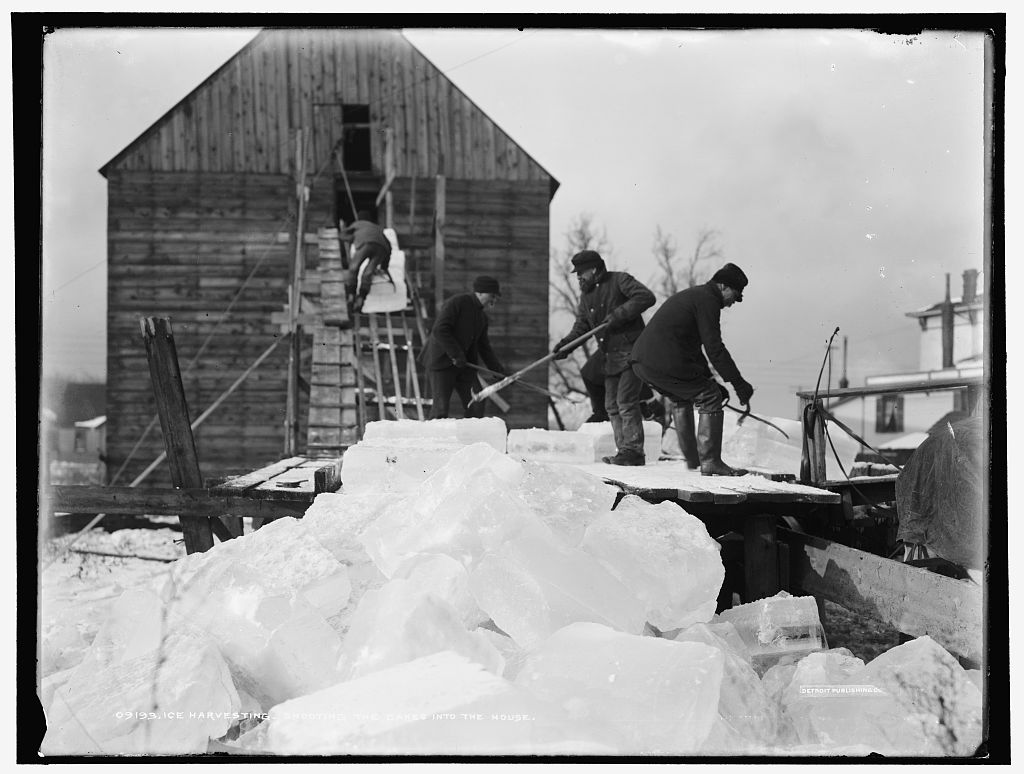
Ice Harvesting, Shooting Cakes into the House

Ice Harvesting, Shooting Cakes into the House, photo courtesy Detroit Publishing Co / Library of Congress

Today’s feature comes via eatdrinkTC, and you can head over there for some photos of ice harvesting in Traverse City and a cool video!

There was a time when the winter ice harvest was as critical as any other harvest, allowing folks in Michigan and elsewhere to enjoy & keep fresh food in summertime. Knowlton’s Ice Museum of North America in Port Huron is dedicated to chronicling what was once a huge industry for Michigan that is now almost forgotten. They explain:

Michigan was one of the main sources of ice harvesting because in those times people cherished the clear hard ice harvested from the beautiful Great Lakes. In the winter months farmers would make money to feed their families by working on the ice fields (rivers, ponds and lakes). Using primitive ice tools they would scrape snow off of the field, measure ice thickness, and saw ice cakes or blocks of ice.

The 300 lb. blocks would then be loaded onto horse drawn flat-bed type wagons and moved off the ice field. The horses hauled the load to stick built ice houses created along rivers and lakes where the ice was stored until the summer months when it could be sold. The ice was stacked and packed inside the ice house. Sawdust was used for insulation and placed in between layers of ice. Some ice houses stored over 1,600 ton of ice. The work these men did each long day was dangerous and cold. Once a luxury, ice became a common household and business commodity by 1900. The ice delivery man would weigh ice blocks and deliver ice by horse drawn covered wagon to homes and businesses. Each order was carried into the home and placed into the top shelf of an ice box to keep food fresh.

We found the above photo from the Detroit Publishing Company via Emily Bingham’s excellent Found Michigan website that has a really nice article about ice harvesting in Michigan.  Also check out an article about ice harvesting and ice saws from the Greater West Bloomfield Historical Society.

Snow Days like the Olden Days

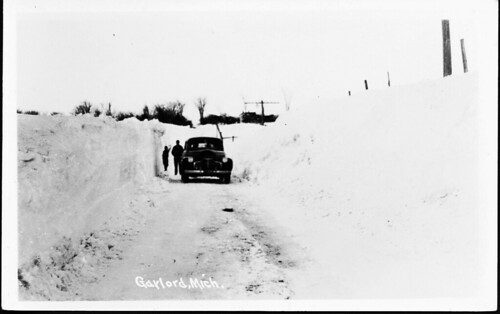
Otsego Gaylord Mi Winter Drifts in the 1940s RPPC

Otsego Gaylord Mi Winter Drifts in the 1940s, photo by UpNorth Memories – Donald (Don) Harrison

Winter 2014 has been a real throwback with many school districts already past the maximum number of snow days and no sign that winter is slowing down. Seeking Michigan has a feature on two large snowstorms in recent memory—the blizzard of January 1967 and the one in 1978 about which they say:

On January 26-27, 1978, snowstorms with fifty-to-seventy-mile per hour winds pummeled much of Michigan. Snowfall totals ranged from eighteen inches in Lansing to an incredible fifty-one inches in Traverse City. More than 100,000 cars were abandoned on roads and highways, and travel was impossible for days. Governor William G. Milliken declared a state of emergency on January 26 (See the image below.) and activated the National Guard to assist with the cleanup. The governor also requested financial assistance from the federal government and estimated damage totals to be more than $25 million, not including lost productivity from workers who were unable to get to their jobs.

Seeking Michigan is the website of the Archives of Michigan. If you’re interested in the wild & wooly side of Michigan, the Michigan Historical Museum has a special exhibit “Lake Effects: Exploring Michigan Weather” where you can learn about winters past and share stories of your winter memories. They ask that you share a favorite winter photograph on the Michigan Historical Center’s Flickr page by e-mailing it to icy27ran@photos.flickr.com with the photo title in the subject line.

View the photo background big and see more snow photos from Don & UpNorth Memories.

Winter wallpaper? We have it if winter hasn’t beaten you yet!

Early One February Morning at Little Girl’s Point

Early One February Morning (2)

Early One February Morning (2), photo by siskokid

Jim caught a gorgeous sunrise last February on the shore of Lake Superior at Little Girl’s Point. The article Legendary Little Girl’s Point from the Ironwood Daily Globe says it is located about 21 miles north of Ironwood and was used by the Chippewas for fishing, hunting and a camping place during trips to the Porcupine Mountains. As to the name:

According to Burnham, Mary Amoose (Little Bee), an unusually intelligent Chippewa woman of Bad River, told Burnham the story of the lost girl of Little Girl’s Point as she had often heard it told by her grandmother more than a half century ago.

She told Burham how a party of hunters returning from a trip to the Crouching Porcupine rounding the point of land now known as Little Girl’s Point, thought they saw the form of a girl among the trees. She was clad in green. The hunters, thinking that it was some girl that had become lost, beached their canoes, but on climbing the steep shore, only caught one or two glimpses of the green girl, who glided further back among the stately pines, and vanished.

Burham said he was interested in this story for it gave the name to Little Girl’s Point, and it was told to him by this Chippewa woman, much as it had been told to Henry R. Schoolcraft, the historian, and discoverer of the source of the Mississippi River. Burnham said the story was told to Schoolcraft by his half-breed wife, Julia (Jane) Johnson, granddaughter of the great chief Waubojeeg, who lived on the mainland near where Bayfield now stands.

I can’t tell if the “unusually intelligent” is sexist or racist, but there is a lot of interesting historical information to be found if you read on. The article is housed on the Gogebic Range City Directories which looks to be a treasure trove of historical information about the region that includes Michigan’s northwestern corner and Wisconsin’s northeastern.

Check it out bigger and see more in Jim’s Little Girl’s Point slideshow.

There’s more history (and more ice) on Michigan in Pictures.

A Dream Begins in Detroit: Remembering Martin Luther King

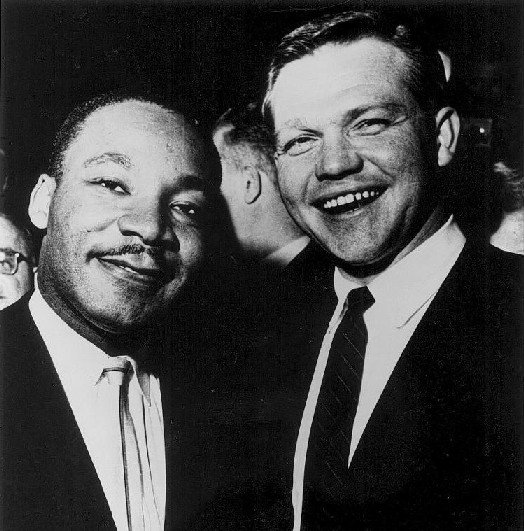
John Swainson and Martin Luther King

John Swainson and Martin Luther King, photo courtesy Archives of Michigan

Today’s post is by Bob Garrett of Seeking Michigan and the Archives of Michigan…

A Dream Begins in Detroit

In the above photo, Dr. Martin Luther King, Jr. appears with John Swainson, Michigan governor of 1961-1962. The photo is undated but was most likely taken on Sunday, June 23, 1963. On that date, Dr. King and former governor Swainson both participated in the Detroit “Walk to Freedom.”

The Detroit Walk to Freedom

Dr. King was then in the midst of a tour (begun that spring) from California to New York. His Detroit stop proved the tour’s biggest success. Police estimated the Freedom Walk crowd at 125,000. The day after the event, The Detroit Free Press labeled it “the largest civil rights demonstration in the nation’s history.” The walk began at Woodward and Adelaide and continued down Woodward to Cobo Hall. It lasted about an hour and a half, as marchers carried signs and sang songs (Songs included “We Shall Overcome” and “The Battle Hymn of the Republic.”).

The Detroit Council for Human Rights organized the Walk. The Council’s director, Benjamin McFall, and its Chairman, Rev. Clarence L. Franklin, marched in a line with King and Swainson. That line also included Detroit Mayor Jerome Cavanaugh, United Auto Workers President Walter P. Reuther and State Auditor General Billie S. Farnum. (Then-current governor George Romney, a Mormon who avoided public appearances on Sundays, did not directly participate. He did, however, proclaim the day “Freedom March Day in Michigan.”)

Speech at Cobo Hall (“I Have a Dream…”)

At the walk’s conclusion, King gave a speech at Cobo Hall. According to the contemporary Detroit Free Press report, approximately twenty-five thousand people sat in attendance, with African Americans comprising about ninety-five percent of that total. They listened as King spoke of non-violence and an end to racial segregation. The June 24, 1963 Free Press report notes that King “ended his speech by telling of a dream.” According to the Free Press, King described his dream of whites and blacks “walking together hand in hand, free at last.”

In his book King: A Biography, David Levering Lewis states that King repeated the phrase “I have a dream” several times during that Cobo Hall speech. Lewis notes that when King addressed a crowd in Washington, D.C. two months later, he “kept the refrain from the Detroit speech: I have a dream.” (See Lewis’ King: A Biography, second edition, Urbana: University of Illinois, 1978, pg. 227).

Conclusion

King’s Washington speech of August 28, 1963 became famous as his “I have a dream speech.” It was a defining moment in the American civil rights movement. In one sense, however, the seeds of Dr. Martin Luther King, Jr.’s dream were planted in Michigan – in Detroit’s Cobo Hall.

Editor’s Note: You can click to read the full text of Dr. King’s speech in Detroit and see a photo from the walk on Michigan in Pictures. Interestingly enough, Gov. Swainson had a harder road than many to participate in the walk – he lost both his legs in a land mine explosion in Alsace-Lorraine in WW II and had to learn to walk again on artificial legs. More on the Wikipedia entry for Governor John Burley Swainson.

The Onaway Rim Fire and the biggest little town in northern Michigan

nightfall

nightfall, photo by Marty Hogan

The Onaway Historical Museum has an article on the Lobdell Fire that begins:

On the morning of Thursday, January 14, 1926 fire broke out in the company’s sanding machine and spread spontaneously through the blowers to different parts of the room.

In the few hours that followed, Onaway’s main means of livelihood went up in smoke and although the city still exists, it has never reached the proportion it was on that historical day. With the presence of the American Wood Rim Co. and its sister company, the Lobdell Emerey Manufacturing Co., Onaway experienced tremendous growth in its early year. The big industry, along with the profitable timber business made Onaway the biggest little town in northern Michigan.

According to one report, Onaway had two newspapers, three lawyers, four doctors, three large hotels, 17 saloons, nine churches, two bakeries, a fairgrounds, racetrack and an opera house in the pre-fire days. The figure varies, but Onaway’s population was approximately 4,000 and the two huge industries employed anywhere from 1200 to 1500 persons.

The Lobdell Emery Manufacturing co. was involved in lumbering, sawmill operations and the making of such products as dowels, broom handles, and coat hanger stock. The American Wood Rim Co., was the world’s largest and finest producer of automobile steering wheels and bicycle rims. For a number of years the company made all the steering wheels with either malleable iron or aluminum spiders. The aluminum spiders were all molded and finished in the plant while the malleable iron castings were purchased from outside sources.

During its last few years in Onaway, the American Wood Rim Co. introduced the all-wood steering wheel with only the hub made of steel. Some of the automobile rims were made of maple or beech, but the better ones were of black walnut with a black walnut or mahogany finish. The bicycle rims were made of hard rock maple or beech. All the wood used in manufacturing the wheels and rims was from the surrounding forests owned by Lobdell-Emery.

Read on for more and here’s a map to Onaway.

View Marty’s photo background big and see more in his September 2012 Road Trip slideshow.

If you like this sort of thing, Michigan in Pictures has lots more of Marty’s up north historical explorations!