Lovers Leap in the Pictured Rocks

Lovers Leap in the Pictured Rocks

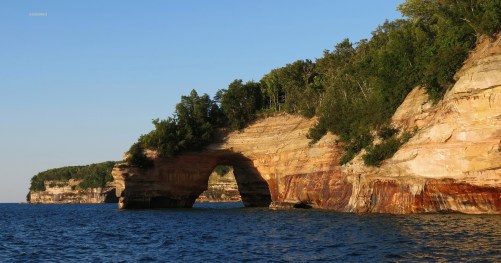
Lover’s Leap, photo by siskokid

Pictured Rocks Tours say legend has it that an Indian couple displayed their love for one another by jumping off the top of this rock arch together. They stress that the water at the base is only a few feet deep, so don’t try it!

While Myths and Legends of our Own Land  by Charles M. Skinner (online e-book from Project Gutenberg here) doesn’t have a story about this Lovers’ Leap, Skinner does detail three tales from Mackinac Island in his chapter on Lovers Leaps that says (in part):

So few States in this country—and so few countries, if it comes to that—are without a lover’s leap that the very name has come to be a by-word. In most of these places the disappointed ones seem to have gone to elaborate and unusual pains to commit suicide, neglecting many easy and equally appropriate methods. But while in some cases the legend has been made to fit the place, there is no doubt that in many instances the story antedated the arrival of the white men…

When we say that the real name of Lover’s Leap in Mackinac is Mechenemockenungoqua, we trust that it will not be repeated. It has its legend, however, as well as its name, for an Ojibway girl stood on this spire of rock, watching for her lover after a battle had been fought and her people were returning. Eagerly she scanned the faces of the braves as their war-canoes swept by, but the face she looked for was not among them. Her lover was at that moment tied to a tree, with an arrow in his heart. As she looked at the boats a vision of his fate revealed itself, and the dead man, floating toward her, beckoned. Her death-song sounded in the ears of the men, but before they could reach her she had gone swiftly to the verge, her hands extended, her eyes on vacancy, and her spirit had met her lover’s.

From this very rock, in olden time, leaped the red Eve when the red Adam had been driven away by a devil who had fallen in love with her. Adam, who was paddling by the shore, saw she was about to fall, rushed forward, caught her, and saved her life. The law of gravitation in those days did not act with such distressing promptitude as now. Manitou, hearing of these doings, restored them to the island and banished the devil, who fell to a world of evil spirits underground, where he became the father of the white race, and has ever since persecuted the Indians by proxy.

Read on for more. It’s a great book – I highly recommend it!

Jim shot this last summer. Check his photo out bigger and see more in his Pictured Rocks slideshow.

Much (much) more from the Pictured Rocks National Lakeshore on Michigan in Pictures. I also want to stress that while the price tag on the boat tour might give you pause, this is hands-down the best boat tour I’ve ever done and gives you a view of the Michigan natural wonder that is the Pictured Rocks National Lakeshore that will stay with you forever.

Memorials & Memory

U.S. Flag

U.S. Flag, photo by Anne Savage

I hope everyone gets a chance today to remember those they know and those they dont who gave their lives in service to country.

View Anne’s photo bigger and see more of her work at annesavagephotography.com.

You can look back on past Memorial Day posts on Michigan in Pictures including how Michigan was the first state to make Decoration Day a state holiday and Michigan’s role in the creation of Memorial Day.

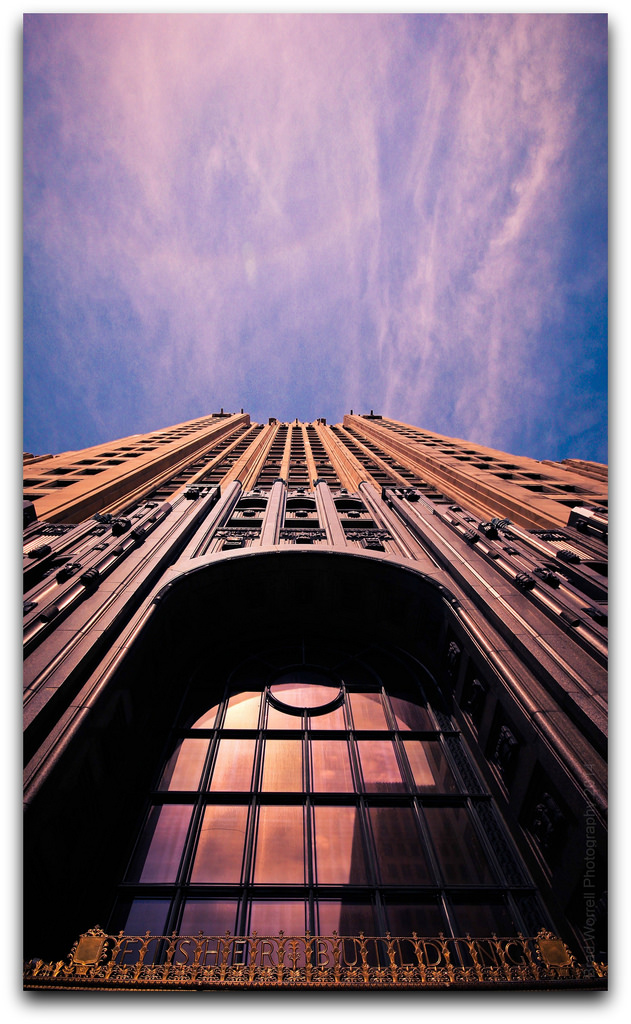
Fisher Brothers Legacy

Fisher Brothers Legacy...

Fisher Brothers Legacy…, photo by Brad Worrell

On his excellent Historic Detroit site, Dan Austin’s excellent & comprehensive article on the Albert Kahn designed Fisher Building says:

The late 1920s were a time of unprecedented growth in Detroit, especially when it came to skyscrapers. From the Penobscot Building to the Fox Theatre, 1928 saw landmark after landmark rise in the Motor City.

The 29-story Fisher is one of three National Historic Landmarks in Detroit, along with the Fox and the Guardian Building.

“The gold-capped tower has taken its proper place in Detroit’s ever-changing skyline,” the Detroit News wrote of the Fisher in October 1928, when the finishing touches were being put on the building. “This will be the most beautiful building of its kind ever created. … It is an outstanding example of the new American school of architecture, which has arisen to typify the spirit of modern progress. No expense, Mr. Kahn said, has been spared to make the Fisher building the very epitome of things beautiful.”

To achieve this feat, the Fisher was built — with only slight exceptions — entirely out of granite and marble, including on the exterior. More than 40 kinds of marble from all over the world were used. From the base of the building to 50 feet up — the first three floors — the exterior is finished in polished Minnesota pink marble and Oriental granite. Above that is Beaver Dam marvilla marble (named such because it was harvested from the Beaver Dam Quarry at Cockeysville, Md.) on the street fronts and Carthage marble on the courts. The marble was cut and positioned to give varying textures across the exterior. “The sun (plays) on differences of saw markings and grain on each block that identify the individual pieces from their neighbors,” the Michigan Manufacturer and Financial Record wrote in October 1928.

Read on for much (much) more about the Fisher Building including a sweet gallery of historic photos (including one looking up at this angle).  you can also visit the Fisher Building website.

View Brad’s photo bigger and see more in his Detroit slideshow.

More architecture on Michigan in Pictures.

Diego Rivera & Frida Kahlo exhibit coming to the DIA

Detroit Institute of Arts: "Detroit Industry" Murals, South Wall--Detroit MI

Detroit Institute of Arts: “Detroit Industry” Murals, South Wall–Detroit MI, photo by pinehurst19475

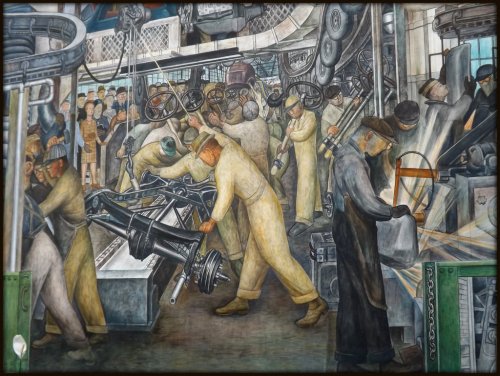
Michigan Radio Reports that the Detroit Institute of Arts is planning an exhibition that highlights Mexican artists Diego Rivera and Frida Kahlo and the year spent in Detroit. Between April 1932 and March 1933, Rivera created the Detroit Industry murals at the DIA and the museum will also show works created by Kahlo during that time.

The show is scheduled to run from March 15, 2015 to July 12, 2015, and you can click through to Michigan Radio for more including a film of Rivera working on the murals. Also check out photos of the Rivera Court murals at the DIA.

About this photo, pinehurst19475 writes: This section of the South Wall depicts line workers assembling tires, axles and wheels with a factory tour in progress. The Rivera murals were recently named a National Historic Landmark.

View the photo background bigtacular and see more in his Wayne State and the Cultural Center slideshow.

More art and more Detroit on Michigan in Pictures.

New Presque Isle Lighthouse

Presque Isle lighthouse (new)

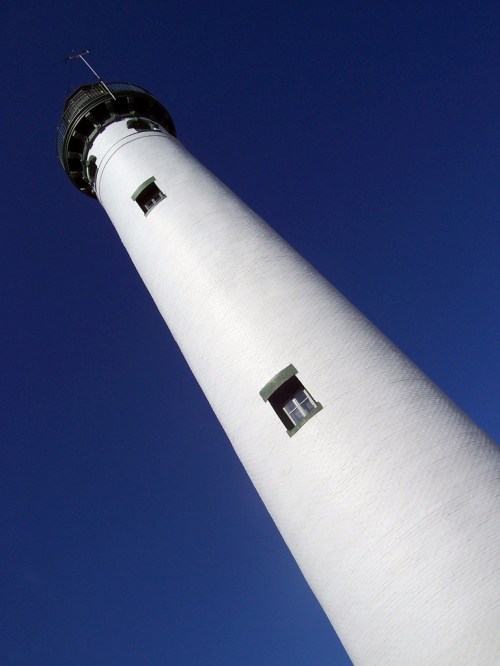
Presque Isle lighthouse (new), photo by Jeff Rozema

Terry Pepper writes that the first Presque Isle Light was established in 1840 to serve as a guide to mariners seeking the harbor on Presque Isle, the spit of land protruding from the eastern shore of Lake Huron French trappers named “almost an island.” By 1866, the dwelling was judged to be a tear-down candidate and in March of 1967, Congress appropriated $28,000 for construction of the New Presque Isle Light according to the plan of District Engineer Orlando M Poe:

Poe’s classic design for the new tower was atypically elegant for such a utilitarian structure, and was so successful that it would be duplicated at a number of stations throughout the district, including Outer Island and Au Sable Point on Lake Superior, and at Little Sable, Big Sable and Grosse Point on Lake Michigan. Erected on a limestone foundation that extended almost ten feet below grade, the red brick tower stood 113 feet in height. 19 feet 3 inches in exterior diameter at the base, the structure tapered gracefully to a diameter of 12 feet beneath the gallery. Constructed with a double wall system, the outer walls stood 5 feet three inches in thickness at the base and the inner wall one 1 foot thick with a 2 foot three inch air space between. The inner walls did not reflect the taper of the exterior, but were erected as a pure cylinder, encasing a spiral cast iron stairway consisting of 138 steps and incorporating five landings and a watch room with four windows immediately below the gallery. Each of these windows featured a graceful arched top section, typical of Poe’s groundbreaking design.

Supported by a series of ornate cast iron corbels, the gallery provided a convenient location from which the keepers could observe vessels out on the lake during fair weather, and created a natural location from which to suspend a boatswain’s chair to conduct maintenance on the gallery supports and the masonry of the tower walls. Centered on the gallery, a prefabricated cast iron apparatus room was erected with a smaller encircling gallery. Centered within this secondary gallery, a cast iron lantern with vertical astragals was equipped with hand-holds to provide the keepers with an extra measure of safety while standing on the narrow upper gallery when cleaning or scraping ice from the plate glass lantern panes. A large cast iron pedestal to support for the lens was erected in the mechanical room below the lantern, and the massive Third Order Fresnel lens, which had been ordered from Henry LePaute Cie. of Paris assembled at its upper flare. Consisting of a brass support structure standing 8 feet in diameter, ten prismatic panels, each six feet in height and 2 feet 6 inches wide were carefully assembled within the frame to create the “crystal beehive” look typical of such lenses.

Read on for more about this lighthouse including some old pics.

View Jeff’s photo bigger and see more shots from here and far in his Lighthouses slideshow.

Many more Michigan lighthouses on Michigan in Pictures!


Fancy Feathers, Fashion and the Dawn of Bird Conservation

Spring Arrival Egret

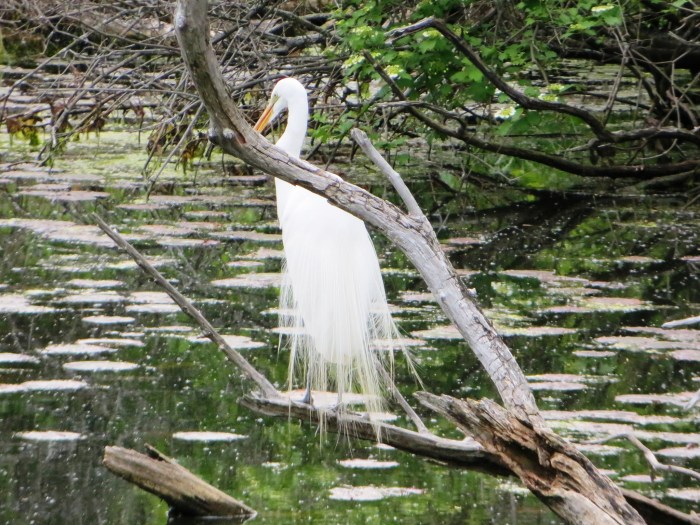
Spring Arrival, photo by Cowboy*

How the Great White Egret Inspired Bird Conservation in the Smithsonian says:

One particular group of birds suffered near extermination at the hands of feather hunters, and their plight helped awaken a conservation ethic that still resonates in the modern environmental movement. With striking white plumes and crowded, conspicuous nesting colonies, Great Egrets and Snowy Egrets faced an unfortunate double jeopardy: their feathers fetched a high price, and their breeding habits made them an easy mark.

To make matters worse, both sexes bore the fancy plumage, so hunters didn’t just target the males; they decimated entire rookeries. At the peak of the trade, an ounce of egret plume fetched the modern equivalent of two thousand dollars, and successful hunters could net a cool hundred grand in a single season. But every ounce of breeding plumes represented six dead adults, and each slain pair left behind three to five starving nestlings. Millions of birds died, and by the turn of the century this once common species survived only in the deep Everglades and other remote wetlands.

This slaughter inspired Audubon members to campaign for environmental protections and bird preservation, at the state, national and international levels. The Lacey Act passed Congress in 1900, restricting interstate transport of wild fowl and game. In 1911 New York State outlawed the sale of all native birds and their feathers, and other states soon followed suit. Passage of the Weeks-McLean Act (1913) and the Migratory Bird Act (1918) took the protections nationwide and mirrored legislation in Canada, Britain, and Europe, effectively ending the fancy-feather era.

More about Great Egrets on the UM Animal Diversity Web.

You can view Cowboy’s photo from last May background big and see more in his Animals & Wildlife slideshow.

More birds and more Spring wallpaper on Michigan in Pictures!

The Wizard of Belle Isle’s Scott Fountain


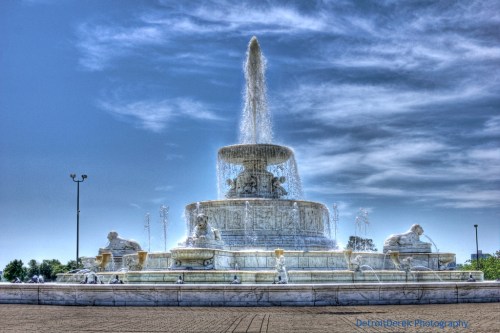
A Cheat, A Liar, a Cad, But A Damn Fine Fountain, photo by Derek Farr

A Cheat, A Liar, a Cad, But A Damn Fine Fountain, photo by Derek Farr

Sherri Welch has a great feature (with video) in Crain’s Detroit entitled Underneath Belle Isle with the Wizard of Scott Fountain:

Far, far below Belle Isle, in a domed-ceiling building few know exist, Robert Carpenter keeps watch, switching levers, hitting buttons and adjusting valves like a modern-day Wizard of Oz.

But his motions aren’t designed to produce an apparition.

They’re focused on producing a plume of water that jets 20, 30, 40, 50 feet or higher into the air, along with countless other smaller bursts of water.

Carpenter is the unofficial caretaker of Belle Isle’s massive, antique James Scott Memorial Fountain.

It’s not a paying gig for him, but, truly, a labor of love.

Carpenter and his team did, restoring the pearly sheen to its marble basin, sculpted faces, animals and all five tiers.

Being the engineer he is, Carpenter couldn’t stop there.

He began scrutinizing the antique valves, pipes and drains, practically living in the domed structure under the fountain as he prepared it for operation through maintenance that included gingerly flushing its corroded, cast iron pipes and rushing to clean the resulting red water from the fountain’s marble bowl.

Read on for more at Crain’s and definitely check out the video – very cool to see what’s below this beautiful Michigan landmark!

Derek is one of my favorite Detroit photographers, and if you like his photos you can head over to his Flickr page for information about how to get them. In addition to taking great pictures, he often includes a brief story of the subject as is the case with this photo:

A Cheat, A Liar, a Cad, But A Damn Fine Fountain

Not exactly loved by all during his time on this planet, James Scott inherited a fortune from his real-estate-baron Father. He attempted to spend the majority of it during his lifetime, Building a large house ( it wasn’t large enough, he wanted his neighbors house as well. The neighbor declined so James built a huge addition to the front and top of his house, blocking out the sun for 3/4 of the day to get back at him ) , throwing large Gambling Parties oblivious to the amount he may have lost, suing any business partners ( or competitors ) that attempted to move in on what James thought should be his. He was described even by his friends as vindictive.

When he died in 1910 he left his sizeable fortune to the city under the specification that a memorial be created to honor him. It took 10 years for the city to agree to use the money for this purpose, and another 5 to complete this fountain – located on Belle Isle in Detroit. It was designed by Cass Gilbert and completed in 1925.

View Derek’s Scott Fountain photos or settle back for more fountain and more Belle Isle in his Belle Isle slideshow.

There’s more Belle Isle and more sculpture on Michigan in Pictures.

Throwback Thursday: Birth of the National Trout Festival

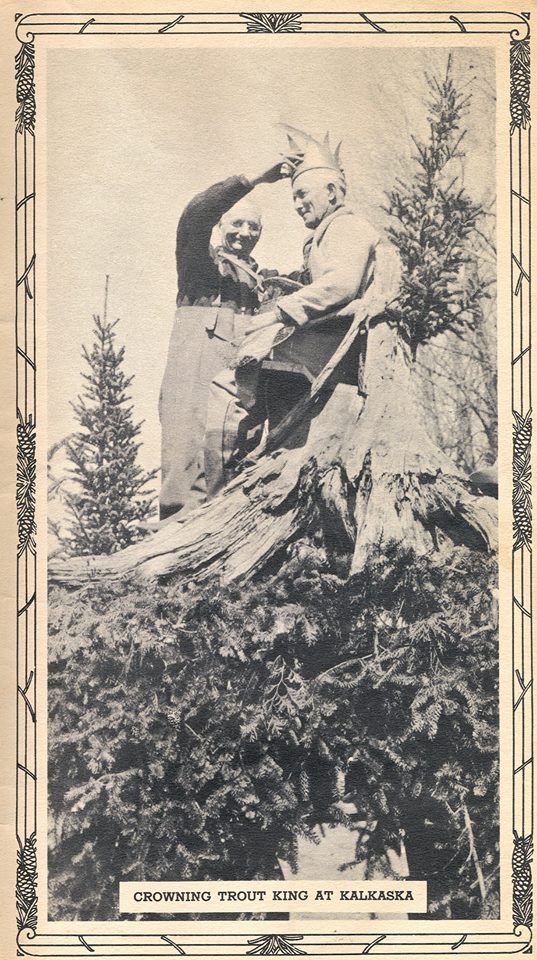
Crowning-the-Trout-King-by-UpNorth-Memories

Crowning the King at Kalkaska, photo by Don Harrison/UpNorth Memories

Peter E. Ummel, of Grand Rapids, was the first King, chosen and crowned by myself. The Coronation ceremony dragged out a little too long to suit Harold Jors, who had lined up the parade and was waiting at the school grounds for word for the parade to start. He finally sent down a message, “Cut the comedy and hurry up as we are freezing to death.”
~author Fred H. Tomkins

Today’s post comes via the eatdrinkTC Culinary Almanac where I am the editor.

Michigan’s trout season opens this Saturday (April 26) and as it has for 78 years, the people of Kalkaska will mark the occasion with the annual National Trout Festival from Wednesday, April 23 – Sunday, April 27 (persistent music warning on that link!).  After Don Harrison posted a couple of cool old postcards, we decided to dig through the internet to discover the festival’s origins.

From Big Trout Black Gold, Dawn Triplett, editor and published by Kalkaska Genealogical Society:

In 1935, the National Trout Festival made its first official debut with two days of festivities held on April 30 and May 1. Forty floats made up the parade held on the first day.

The Trout King was crowned in the bandstand where evergreen boughs were arrayed. Mr. Peter Emanuel Ummel of Grand Rapids was chosen to rule the festival. With great ceremony he was put under oath and given a crown. Fred H. Tompkins swore the ruler in, making him repeat the long comic sketch swearing his allegiance to Kalkaska County. King Ummel’s throne was a pine stump from the plains of Kalkaska mounted on a trailer and drawn by a car. He took his place on the throne and was driven around the block and up and down main street (Cedar Street) before the parade.

…The prize for the funniest float went to S. C. Shumsky who appeared in full fishing regalia but had his feet clad in skis. Stormy weather had brought some snow showers into the area the day before.

View Don’s photo bigger on Facebook along with several more pics and be sure to check out his collection of Trout Festival pins and pics on Flickr. If you head over to the eatdrinkTC Natinal Trout Festival feature, there is a slideshow of the Festival through its 7+ decades.

Hundred Mile High City: Detroit’s Penobscot Building

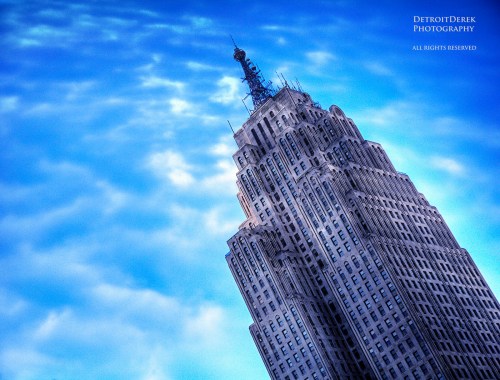
Hundred Mile High City by Detroit Derek


Hundred Mile High City, photo by Derek Farr

When I saw Derek’s photo, I remembered that I had posted a photo of the Penobscot several years ago. I found that photo has been deleted from Flickr and therefor from Michigan in Pictures as well. So here then is the definitive Penobscot post.

The Wikipedia entry on the Penobscot Building says:

Upon its completion, it was the eighth tallest building in the world and the tallest outside New York City and Chicago. Like many of the city’s other Roaring Twenties buildings, it displays Art Deco influences, including its “H” shape (designed to allow maximum sunlight into the building) and the sculptural setbacks that cause the upper floors to progressively “erode”. The building’s architect, Wirt C. Rowland, also designed such memorable Detroit skyscrapers as the Guardian Building in the same decade. At night, the building’s upper floors are dramatically lit in floodlight fashion, topped with a red sphere.

Although the Penobscot Building has more floors than Comerica Tower at Detroit Center (45 above-ground floors compared to Comerica Tower’s 43), Comerica’s floors and spires are taller, with its roof sitting roughly 60 feet taller than Penobscot’s (566′). The opulent Penobscot is one of many buildings in Detroit that features architectural sculpture by Corrado Parducci.

The Penobscot Building served as a “compass” for pilots in airplanes during its early years, due to its position of facing due north. The building also served as an inspiration of sorts for the Empire State Building in New York City, and many individuals worked on the construction of both towers.

The Penobscot Building web site says that the building serves as the fiber-optic hub for the entire Detroit area and touts it as the place for office space. You might also enjoy Historic Detroit’s page on the Penobscot Building, the Emporis page on the Penobscot and this 3D model of the Penobscot Building for Google Sketchup.

View Derek’s photo bigger and see more in his massive Detroit slideshow. He says the title of his photo came from the Ocean Colour Scene song, Hundred Mile High City.

More architecture on Michigan in Pictures.

Happy 113th Opening Day, Tiger Fans!

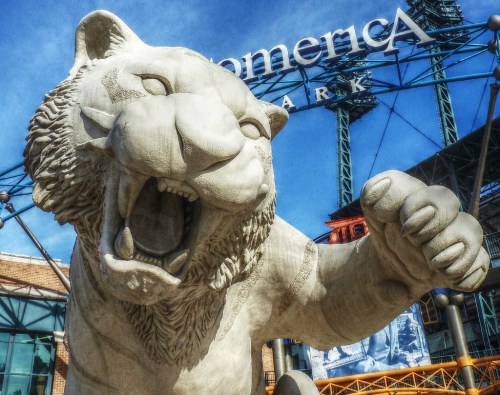
Happy Opening Day Detroit!

Happy Opening Day Detroit!, photo by kellyanne berg

The Detroit Tigers open the 2014 season today at 1:08 PM at Comerica Park vs the Kansas City Royals. The Tigers got their start as a charter member of the Western League in 1894 and played their first American League game in 1900 when the Western League changed its name. It wasn’t until 1901, however, that the American League decided not to renew the original National Agreement, declare itself a second major league and compete with the National League for players. The Detroit Tiger timeline says:

On April 24, 1901, the Tigers prepared to take to the field for their first official American League game. A standing room only crowd was anticipated at Bennett Park, but unpredictable weather postponed the opening by a day.

On that historic afternoon, April 25, 1901, in front of 10,000 fans, the Tigers entered the ninth inning trailing Milwaukee, 13-4. A series of hits and miscues followed, moving the score to 13-12 with two runners on. With two out, Tiger Frank “Pop” Dillon faced reliever Bert Husting, and the lefthanded hitter rapped a two-run double to complete a 14-13 comeback win.

Kellyanne posted this shot from Comerica Park a couple of years ago. See it bigger and see more of her Detroit Tigers photos (which are mostly real tigers eating meat).

More Detroit Tigers and more Comerica Park on Michigan in Pictures. Play ball!