#TBT: The Boblo Boat aka the Ste. Claire

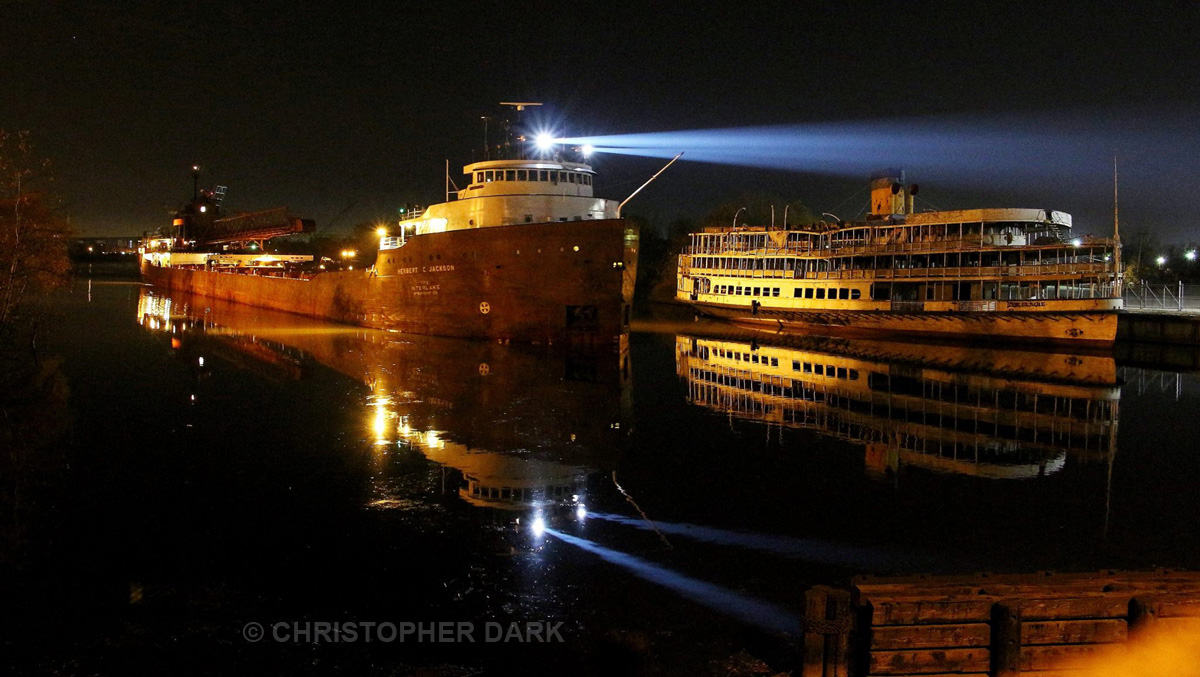
Herbet Jackson and Boblo Boat Ste Claire

Herbert C Jackson and the Bob-Lo Boat, photo by Christopher Dark

One of the Boblo Boats, the Ste. Claire, is shown here at its new berth, where it was moved a couple of weeks ago.

The Ste. Claire Restoration Project’s History page explains:

The steamer Ste. Claire represents the typical propeller-driven excursion steamer of the turn of the century, a type once found in many parts of the country. Excursion steamers are steamships built primarily for passengers for day trips. Ste. Claire and her running mate Columbia represent the “ocean-going” type of excursion vessel although they were used on lakes.

The steamer Columbia and Ste. Claire are the last two remaining classic excursion steamers in the country; and the last essentially unaltered passenger ships designed by Frank E. Kirby; and for their essentially unaltered propulsion machinery of a type becoming increasingly rare ; as the two last vessels of the Detroit and Windsor Ferry Co.; as two of the few surviving vessels built by the Detroit Dry Dock Company, and for their unaltered propulsion machinery, which is of a rare type. Columbia is the oldest passenger steamer in the United States, excepting vessels properly classed as ferries. Columbia and her running-mate Ste. Claire are the last two steamers of their type with integrity left in the United States. The pair shared their original run from Detroit to Bob-Lo Island for 81 years, a record of service on a single run unequalled in U. S. history

There’s a ton of cool stuff on the Boblo Boat website including their media center, plans for the restoration and of course donations!

Christopher got this great shot of the Herbert C Jackson upbound on the Rouge River as she passed the Ste. Claire. Click to view it bigger and see more of his photos on Facebook.

More great night photography and more ships on Michigan in Pictures.

November 18, 1958: The Wreck of the Carl D Bradley

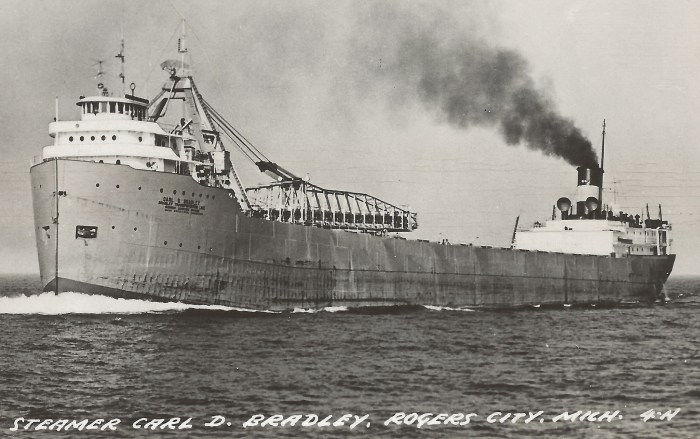
Steamer Carl D Bradley Rodgers City Mich

Steamer Carl D Bradley Rogers City Mich, photo by UpNorth Memories/Don Harrison

Every year, I revisit the story of the Edmund Fitzgerald on November 10th. I do this because I remember the ferocity of the winds on the day of the wreck vividly from my childhood, because as a Michigander Lightfoot’s song is probably coded in my DNA by now, and also because it’s very popular with readers. Nonetheless, the feature Should musicians decide the shipwrecks we know? from IPR News Radio by Peter Payette & Morgan Springer definitely struck a chord. There are thousands of ships that have gone down the world’s eighth sea, and so many families that have felt the loss when a sailor doesn’t return from one of the most dangerous jobs there is. We’d do well to remember some of the others as well!

On this day in 1958, my vote for the most devastating Great Lakes shipwreck of the modern era took place. 33 of 35 crew members perished in the wreck, and 23 of them were from the town of Rogers City that boasted a population of less than 4000 people. The Presque Isle County Historical Museum’s website for the Steamer Carl D. Bradley tells the tale of the wreck of the Bradley:

The steamer was 638 feet long overall, with a 65-foot beam, a depth of 33 feet and a cargo capacity of 14,000 tons of crushed stone. The unloading boom was 160 feet long. The engineering and propulsion plant on the Carl D. Bradley was similar to that on the T.W. Robinson which was built two years before the Carl D. Bradley.

…The Carl D. Bradley, traveling light departed Buffington, Indiana around 9:30 pm, Monday, November 17, and headed up Lake Michigan bound for the Port of Calcite. Roland Bryan, a sailor since age fourteen, was the master. This trip was the last for the season and the steamer was going home. The Bradley never made it. In less than 24 hours the Carl D. Bradley was on the bottom of Lake Michigan and 33 of the 35-man crew were dead or missing.

When the vessel left Buffington, the winds were blowing up to 35 miles per hour from the south. The storm that was about to engulf the Bradley was developing over the plains when a cold front from the north met a warm front over the plains. The temperature in Chicago had dropped about 20 degrees that day. The forecast warned of gale winds. The crew prepared for severe weather by securing the unloading boom and the hatches. The steamer followed the route up the Wisconsin shore to Cana Island then changed course and cut across Lake Michigan toward Lansing Shoal. As the wind velocity increased, the crew filled the ballast tanks to maximum practical condition. By 4:00 pm of the next day, the 18th, the winds had reached 65 miles per hour. Even though the lake was rough and the winds high, the boat rode the heavy seas with no hint of the laboring.

Captain Bryan had asked the cooks to serve an early dinner. He knew the turn from Lake Michigan toward Lake Huron would put heavy weather broadside of the vessel. He wanted to give the mess crew the opportunity to clean up and secure before turning. The mess room was full of crewmembers anticipating going home.

About 5:30 pm First Mate Elmer Flemming radioed Calcite that the Bradley would arrive at 2:00 am. Then a “loud thud” was heard. In the pilothouse Captain Bryan and Flemming looked aft and saw the stern sag. Flemming immediately sent a distress signal over the radio. “Mayday! Mayday! This is the Carl D. Bradley. Our position is approximately twelve miles southwest of Gull Island. We are in serious trouble! We’re breaking up!” Captain Bryan sounded the general alarm, signaled the engine room to stop the ship, and blew the whistle to abandon ship. The power system failed and the lights in the bow section went out. The Bradley heaved upward near amidships and broke in two. The forward section rolled over and sank. The stern end plunged to the bottom. Within a few minutes the Carl D. Bradley was gone.

Read on for much more including theories of how the ship sank and the story of how deckhand Frank Mays & Elmer Flemming survived the wreck. At the website you’ll also find some cool old photos of the ship, newspaper clippings and photos of the crewmen lost at sea. The Wikipedia entry for the Carl D Bradley is particularly good as well with a lot more details!

This trailer for November Requiem, a DVD about the Carl D Bradley, the impact on Rogers City and the dive to the Bradley:

View Don’s photo big as the Bradley, check out more of his freighter postcards & pics, and friend him up on Facebook for lots more great old photos of Michigan.

PS: I added a new category that I somehow didn’t have already: Michigan shipwrecks – enjoy!

PPS: Apparently great minds this alike – check this out from today’s Interlochen Public Radio!

The Great Storm of 1913 and the Last Voyage of the Henry B. Smith

Henry B Smith Great Storm of 1919

Henry B Smith LOC det 4a16048, photo by Detroit Publishing Co. (via Library of Congress)

In November I like to share stories of some of the ships that have been lost in the most dangerous month of shipping on the Great Lakes. November is a month when owners and captains have historically sought to bet the margins in their favor. Sometimes their gamble doesn’t pay off…

The Great Lakes Storm of 1913 is one that caught many ships in the wrong place at the wrong time. More or less via Wikipedia’s page:

The Great Lakes Storm of 1913 is historically referred to as the “Big Blow,” the “Freshwater Fury,” or the “White Hurricane.” It was a blizzard with hurricane-force winds that ravaged Michigan, Ontario and much of the Midwest from November 7-10, 1913. The storm was most powerful on November 9, battering and overturning ships on four of the five Great Lakes, particularly Lake Huron. Deceptive lulls in the storm and the slow pace of weather reports contributed to the storm’s destructiveness.

The deadliest and most destructive natural disaster ever to hit the lakes, the storm killed more than 250 people, destroyed 19 ships, and stranded 19 others. The financial loss in vessels alone was nearly US $5 million (or about $120 million in today’s dollars).

There’s so much more about this storm on the Wikipedia page and definitely check out this Michigan in Pictures post on the unique weather pattern on the Great Storm.

One of the ships lost to the lakes was the Henry B. Smith, a 525′ steel-hulled, propeller-driven lake freighter. Well…

The Smith arrived at Marquette on November 6 to take on iron ore. Over the next two days a southwest gale swept over Lake Superior, dropping the temperature to 24 degrees Fahrenheit. The cold weather caused the ore to freeze inside the hopper cars, requiring men to knock them loose by hand. This resulted in a loading delay for the Smith. Captain James Owen had been plagued by misfortunes all year that had resulted in the Smith being delayed or late for its destinations. Rumors abounded, then and now, that the owners of the boat made it clear to Owen that he better make this last trip on time, or else.

Around 5 p.m. on November 9, the Smith loaded its last car of ore. Since the gale seemed to be in a brief lull, the big freighter immediately backed away from the dock and began to leave. As soon as the Smith left Marquette Harbor, the fierce wind returned and the storm’s lull ended. Witnesses on shore noted that the deckhands were frantically trying to close the Smith‍ ’​s hatches. The freighter had a total of 32 hatches; each hatch required individual attention with locking bars, clamps, and tackle. It was a couple hours’ work for even the most skilled crew. And so it was that Captain James Owen was piloting the Henry B. Smith into one of the worst storms in memory with unsecured hatches.

After about twenty minutes, the full force of the gale hit the Smith as huge waves crashed over her deck, drenching the hapless deckhands who were still struggling to close the hatches. Instead of turning to starboard on the usual course for the Soo Locks, the Smith hauled to port, rolling greatly as she did so. Witnesses on shore concluded that Owen had realized his error and was heading for shelter behind Keweenaw Point to the north. With the encroaching darkness and thick snow squalls, the Smith was then lost from view.

Two days after the storm blew itself out, the beaches along Chocolay Bay, Shot Point, and Laughing Fish Point were littered with debris from the Smith. The wreckage was found high up on the beach, indicating it came ashore at the height of the storm. The body of the second cook, H.R. Haskin, was found floating about fifty miles west of Whitefish Point some days later. Only one other body of the Smith‍ ’​s crew was ever recovered; the skeleton of third engineer John Gallagher was found on Parisian Island in the spring of 1914.

A note in a bottle, allegedly from the Smith, was found in June 1914. In it, the author claimed the ship had broken in two 12 miles east of Marquette. After a long debate, the boat’s owners decided the note was a phony; it was dated 12 November, when the Smith sank either on the 9th or the early morning hours of the 10th.

Read on for more about the Smith. In May of 2013, the wreck of the Henry B. Smith was rediscovered in about 535 feet of water roughly 30 miles north of Marquette. The article is less kind to Captain “Dancing Jimmy” Owen – so named for his habit of frequenting local dance halls – than the Wikipedia version.

View the photo background big at Wikimedia.

More of the Freshwater Fury and more Michigan shipwrecks on Michigan in Pictures.


Haunted Michigan: The Devil’s Grist

Just another pretty face

Just Another Pretty Face, photo by Gary Tucker

In the spring of 1712, the English sent a war party of Fox & Macoutin to try and take Fort Pontchartrain in Detroit from the French. Over 1000 were massacred by tribes loyal to the French near Windmill Point at the mouth of the Detroit River on Lake St. Clair, effectively destroying the Fox nation.

My new favorite book, Legends of Le Détroit by Marie Caroline Watson Hamlin with illustrations by Miss Isabella Stewart, details the episode. If I were you, I would click over to the book right now and read it there – it’s not nearly as long as Tuesday’s tale ;)

We’ll join the story…

Years after the dreadful massacre which converted the beautiful spot called Presque Isle into the grave of the Fox nation, a stone mill was built there by a French settler, who came to reside with his sister Josette, undaunted by the ourrent traditions which peopled it with the spirits of the departed warriors. Jean was a quiet, morose man, different from the laughing, careless, pleasure-loving Canadian, — for rare were his visits, to the fort, and it was noticed that he never lingered over his cidre, nor spoke to the smiling, piquante daughters of the habitants.

…Josette was much older than her brother, and by dint of thrift and economy had saved enough to become a half owner in the mill. … Naught disturbed the monotony of their lives ; each day was but a repetition. The river flowed calmly on, the birds sang their songs – for nature has no moods, they belong to man alone.

At last Josette fell sick. Jean attended her as carefully as he could, and like a prudent man, would frequently ask her to whom she would leave her interest in the mill. Irritable from suffering, she became annoyed at his importunities, accused him of taking care of her for the sake of obtaining her money, and told him ‘she would leave it to the devil.” Jean tried in his clumsy fashion, to soothe her. He sent for some of his kindred to reason with her, but they only infuriated her the more, and she solemnly declared that not one of them should have her share in the mill, but “she would sooner leave it to the devil.”

Josette recovered, however, and with that perversity born of stubbornness, would not relent. A few months afterwards she was found dead in her bed, having died suddenly. That same night, whilst the candles threw their dim shadowy light in the room of the dead, a furious storm arose, lashing the waves against the shore, the winds howling fiercely around the point, the black clouds chasing each other across the lowering skies, as lurid gleams of lightning and deafening reverberations of thunder, made all the habitants shudder while they crossed themselves and told their beads. All at once there came so tremendous a shock that it seemed to swallow the island. The old stone mill was rent in twain. A pungent smell of sulphur filled the air, and a fiendish, laugh was heard loud above the raging storm from the shattered ruins. The arch fiend had come to claim his share.

For years afterwards when a northeast storm blew from the lake, making night hideous by its echoing peals of thunder, it was said that a hairy figure, with a horned head and forked tail tipped with fire, his mouth and eyes darting forth ruddy flame, could be seen in the mill, trying to put together the ruined machinery to grind the devil’s grist. And the lonely wayfarer to Grosse Pointe would see the marshes around Presque Isle all illuminated by flames, called by the hab- itants feu-follet (Will-o’-the-Wisp), which would try to inveigle the unhappy traveler and bring him to help grind the devil’s grist.

View the photo background big and see more of Gary’s haunted photos at that link.

More ghost stories & haunted tales on Michigan in Pictures!

Haunted Michigan: Le Loup Garou

Moon and Clouds by eyesontheskies

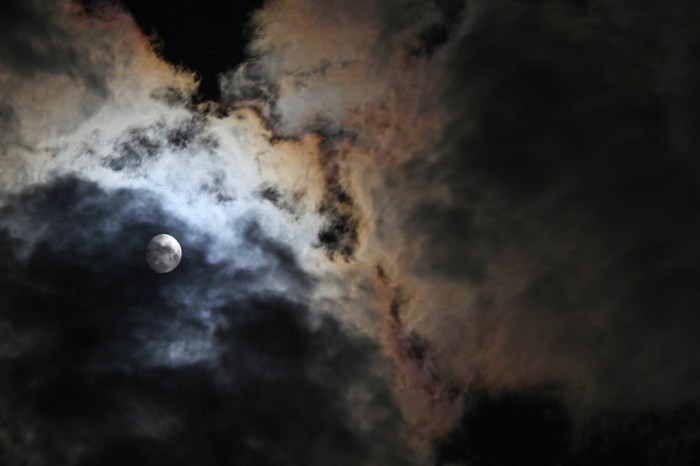
Moon and Clouds, photo by eyesontheskies

He was beloved by all, and most of all by the children.
For he told them tales of the Loup Garou in the forest.
And of the goblin thai came in the night to water the horses.
And of the White Letiche, the ghost of a child who unchristened
died, and was doomed to haunt unseen the chambers of children.
 ~Henry Wadsworth Longfellow, Evangeline

My new favorite book is Legends of Le Détroit by Mary Carolyn Watson Hamlin, illustrated by Miss Isabella Stewart, and published in 1894 in Detroit by Thorndike Nourse. In addition to Ms. Hamlin’s descriptive prose that really sheds light on what life was like for early settlers in the Detroit area, it’s especially appropriate to kick off how I’m going to enjoy the week of Halloween, with stories that raise your hackles spark a feeling that Michigan is wilder and more wonderful than you may have known.

As the first of several spooky tales from Michigan, I offer Le Loup Garou which is a lot longer than usual. I’ve tried to share the highlights of the story, but you really should click that link to read it all! We begin at Grosse Pointe where:

…a trapper named Simonet had settled near there on the margin of the lake.

His young wife had faded away in the early years of their married life, but as if in compensation, had left the little prattler Archange to wean him from his grief and to cheer his loneliness. And the strong, hardy man, with his sunburnt face and brawny arms hardened by toil and exposure, in his yearning love for his child, learned to soften his rough manners and soothe her with the gentle ways of a woman. Anxiously he watched the unfolding of his “pretty flower,” as he called her, and with a solicitude touching in its simple pathos, he would select the softest skin of the bear to keep her feet warm, search for the brightest wings of the bird to adorn her hat. When she grew up he taught her to skin the beaver, muskrat and deer which he brought home, and to stretch them out on the drying frame near the house. He was wont to boast that no one could excel Archange preparing the poisson blanc (whitefish), poisson dore (pickerel), or give that peculiar shade of brown which is in itself an art, to the savory cochon au lait (sucking pig).

She was as light-hearted as the cricket that chirped on the hearth, and her cheery voice could be heard caroling away to the music of her spinning wheel. In the long winter evenings her deft fingers would plait the straw into hats which found a ready sale, and which, added to the sum she gained by her knitted socks and dried corn, enabled her to secure many little articles that her vanity suggested to enhance her charms. For the Canadian girl, in the rude surroundings of her forest home, was as anxious to please and be witch by her toilet as her more favored Parisian sister ; the instincts of the sex still lived in the wilderness. At the corn-huskings and dances on the greensward Archange was the reigning belle, and held her little court of homespun dressed youths fascinated by the magic of her dark eyes, her brunette complexion with its warm glow, her raven tresses and piquante tongue. Many admiring eyes followed her lithe form as she tripped in marvelous rapidity la jig a deux or as she changed into the more graceful, swaying motion of la dance ronde.

Enter the capable young farmer Pierre La Fontaine, whose marriage proposal was happily accepted by Simonet, was building a cabin for his bonnie bride, and apparently driving his fragile canoe along the rippling waters lit up by elfish moonbeams (Ms. Hamlin’s words) as they made wedding plans that included the gift of a red cow from Archange’s god-father. Well…

One evening as Pierre placed Archange on the beach near her home and she lingered, following him with her loving eyes as he swiftly rowed away until he had disappeared and only the faint echo of his Canadian boat song floated towards her, she was startled by a rustling sound near by. Looking up a wild shriek escaped her, for a monster with a wolf’s head and an enormous tail, walking erect as a human being, crossed her path. Quickly the cabin door was thrown open by Simonet, who had been roused by his daughter’s scream. Archange flew into her father’s arms and pointed to the spot where she had seen the monster, but the animal surprised by the light, had fled into the woods. Simonet’s face grew pale as Archange described, as accurately as her fears had allowed her to see, the apparition, and he recognized the dreaded Loup Garou.

Did I mention long?

Simonet worried about the Loup Garou (werewolf), but soon the wedding day arrived:

…Soon after she (Archange) joined Pierre and hand in hand, followed by all the habitants in their holiday attire, they entered the little church of logs hewn square, the interstices chinked in with clay, the roof of overlapping strips of bark. In front of the altar, decorated with flowers arranged by loving hands, they knelt. Father Freshet, who had baptized Pierre and Archange and prepared them for their first communion, now came to unite them in the holy bonds of matrimony. After the ceremony they went to the sacristy and inscribed their names in the registry, then hurried off to Pierre’ s new house, where the festivities were to take place. On the green lawn in front of her new cabin the blushing Archange greeted all her friends. The Seigneur of the neighborhood came to claim the right of premier baiser (first kiss). The refreshments were in abundance and all gave themselves up to the enjoyment of the moment, for the Canadians dearly loved a wedding and kept up its festivities for days.

Whilst the merry making was at its height the dreaded Garou with a rush like the wind sprang into their midst, seized Archange and escaped with her into the forest. All were paralyzed by the sudden, daring deed. But Pierre recovering, started in quick pursuit guided by the despairing cry of Archange, followed by all the men, whilst the women and children said their prayers and gave vent to loud lamentations. Long after the shadows had fallen they returned to report to the anxious, trembling crowd, and their sad, dejected faces spoke of the fruitlessness of their search. The monster had baffled them. But Pierre returned not. He was shortly after found by his friends wandering around and around a swamp, and clutching a piece of white batiste. When questioned as to how he had obtained this clue to Archange, he returned a maniacal stare and with a blood-curdling shriek, would have juimped into the swamp if he had not been held back by his companions, who with sorrowful accents said “La folie du bois.”* He would always return to the same swamp, remaining there for hours gazing vacantly in the weird reflections of its slimy, stagnant waters, until some friend led him home.

At the marriage of his sister, which occurred about a year afterwards, Pierre, always dead to the outside world, seemed to be roused by the preparations. After the ceremony he rushed into the woods as if in pursuit of something. He did not return until nearly sunset when he was seen, with wild eyes, flying hair, his clothes torn as if lay briers, chasing a Loup Garou to the very edge of the lake. All stood petrified by the strange apparition and feared a repetition of Archange’s fate. But the animal, seeing no escape, stood on one of the boulders strewn along the shore and stretched out his arms as if beckoning to some mysterious one. A large catfish was seen to rise on the surface of the water and open its mouth, into which the Loup Garou vanished. To this day no Canadian will eat catfish. The footprint of the wolf is still shown at Grosse Pointe, indelibly impressed on one of the boulders.

As I said, read the story in full and if anyone has a shot of the footprint in the boulder, please send it to me!!

View eyesontheskies photo bigger an see more in his Astro slideshow.

More ghost & spooky stories on Michigan in Pictures!

*La folie du bois (the folly of the woods) alludes to the well- known insane tendency which prompts those lost in the woods to go round in a continuous circle, instead of following a direct path which would lead to a clearing.

The Colors of Omena

The Colors of Omena

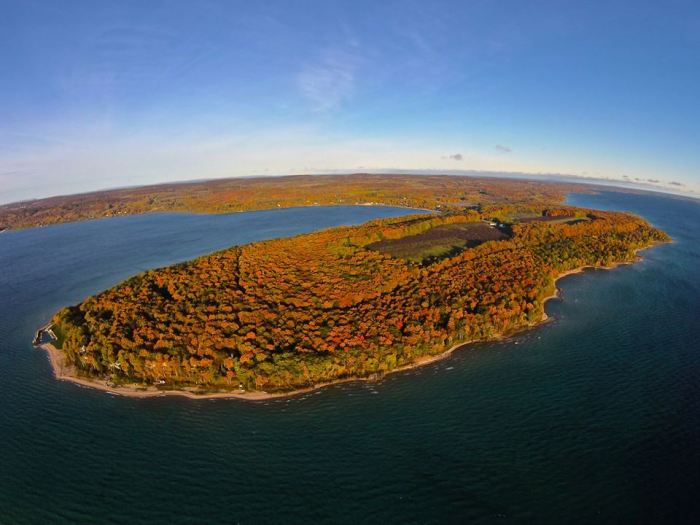
The Colors of Omena, photo by Elijah Allen

Here’s a shot by a friend taken just north of me showing the incredible fall color that’s still out there along the Lake Michigan coast. It was taken from off Omena Point at the northern part of the Leelanau Peninsula, so how about a little Omena history courtesy the Omena Historical Society?

The Omena settlement had its beginnings when Aghosa Indians started arriving in 1850. In 1852, the Reverend Peter Dougherty and a band of Ottawas and Chippewas led by Chief Ahgosa moved from the present-day Old Mission Peninsula to a beautiful little bay on the Leelanau Peninsula’s eastern side. Chief Shabwasung and his Ottawa band were already encamped on the point to the north of the bay, on land Chief Ahgosa and his families from Old Mission had purchased. Ahgosa settled a little to the north, and his village became Ahgosatown. Both bands became part of the New Mission, soon to be called Omena.

Young George A. Craker came with Dougherty and taught farming to students in the mission school, and he and his descendants became active workers in Dougherty’s Grove Hill New Mission Church. Now called the Omena Presbyterian Church, it was dedicated in 1858 and has stood as the oldest Protestant Church in Leelanau County and one of the oldest historical landmarks in Northern Michigan. The Ahgosa family was also very active and some are now buried in the mission cemetery.

Click through to read more and for some historical photos of Omena.

View Elijah’s photo bigger on Facebook and scroll though when you get there for more!

More aerial photos, more history and more Leelanau on Michigan in Pictures.

#TBT: Comet Biela and the Great Michigan Fire of 1871

House fire

House fire, photo by Ogedn

“The proponents of the cometary explanation cite many fascinating details confirmed by eye witness reports: the descent of fire from the heavens, a great ‘tornado’ of fire rushing across the landscape and tearing buildings from their foundations, descending balls of fire, a rain of red dust, great explosions of wind accompanied by blasts of thunder, buildings exploding into flame where no fire was burning, and a good deal more.”
~thunderbolts.info

We all probably know of Mrs. O’Leary’s cow and the Chicago Fire that burned over three miles of the city to the ground, but perhaps you’d care to take “Fires beginning October 8, 1871” for $500? Four fires began 144 years ago on this day in 1871: the Great Chicago Fire, the Great Michigan Fire, the Peshtigo (Wisconsin) Fire and the Port Huron Fire.

I’m going to let the crew of thunderbolts take it away with an excerpt from their fascinating feature The Comet and the Chicago Fire:

Contrary to popular folklore, the Chicago fire is not the worst in U.S. history. It was not even the worst to occur on October 8 that year. The same evening—in fact, at the same time, about 9:30—a fierce wildfire struck in Peshtigo, Wisconsin, over 200 miles to the north of Chicago, destroying the town and a dozen other villages. Estimates of those killed range upward from 1200 to 2500 in a single night. It was not the Chicago fire but the simultaneous “Peshtigo Fire” that was the deadliest in U.S. history.

And there is more. On the same evening, across Lake Michigan, another fire also wreaked havoc. Though smaller fires had been burning for some time—not unusual under the reported conditions—the most intense outburst appears to have erupted simultaneously with the Chicago and Peshtigo fires. The blaze is said to have then burned for over a month, consuming over 2,000,000 acres and killing at least 200.

Concerning the Michigan outburst, it is reported that numerous fires endangered towns across the state. The city of Holland was destroyed by fire and in Lansing flames threatened the agricultural college. In Thumb, farmers fled an inferno that some newspapers dubbed, “The Fiery Fiend.” Reports say that fires threatened Muskegon, South Haven, Grand Rapids, Wayland, reaching the outskirts of Big Rapids. A steamship passing the Manitou Islands reported they were on fire.

There can be no doubt that weather conditions at the time favored wildfires. But never before, and never since, has the U.S. seen such wildly destructive simultaneous conflagrations. This “coincidence”, combined with many unusual phenomena reported by eyewitnesses, has led some to conclude that an extraordinary force, one not of the earth, was a more likely “arson” than either a misbehaving cow or a regional drought.

In 1883, Ignatius Donnelly, author of Ragnarok: the Rain of Fire and Gravel, suggested that in early historic times our Earth suffered great catastrophes from cometary intruders. To this claim he added: “There is reason to believe that the present generation has passed through the gaseous prolongation of a comet’s tail, and that hundreds of human beings lost their lives”. He was referring to the conflagration of 1871.

Definitely read on for much more about the possibility of a comet’s tail, perhaps Comet Biela, fueling the fires.

Ogedn took this photo of a controlled burn by the local fire department, who practiced on this house before letting it burn. View the photo background big and see this and lots more in their slideshow.

Tons more Michigan history on Michigan in Pictures.

PS: I definitely did more research on this than I should have on this, and while the cometary theory and Comet Biela was observed to be broken apart on its pass in 1846, it may be that Biela’s Comet returned in September of 1872. In any case check the article out and also their Picture of the Day for a lot more than you’ve probably thought about.

Waterfall Wednesday: Catching Fire at O Kun de Kun Falls

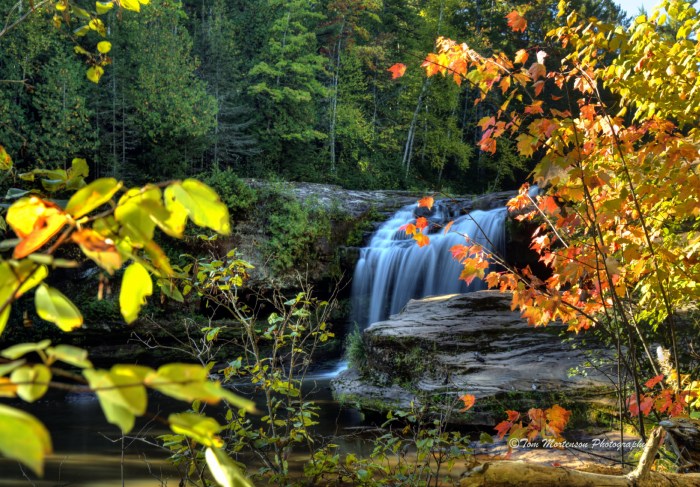
O Kun de Kun Falls falls on the Baltimore River

O Kun de Kun Falls, photo by Tom Mortenson

GoWaterfalling’s page on the O Kun de Kun Falls says in part:

O Kun de Kun Falls is one of the largest of the waterfalls in Ontanagon county. It is not as large as Bond Falls or Agate Falls, but it is just as scenic and far wilder. It is a mile plus hike to O Kun de Kun Falls and there are no fences or signs. The waterfall is also unusual in that it is an actual plunge falls. Only a handful of the many waterfalls around Lake Superior are plunge falls. You can go behind the falls if you want, but you need to be careful and sure footed.

Read on for more including directions. You can also check out the Ottawa National Forest page on O Kun de Kun Falls for a satellite map of the area.

If you’re wondering about the name of the falls, it was after a famous chief, Kun de Kun meaning “To Keep Up the Net” from the Leach Lake band of Ottawa. Here’s a picture of him!

Last Tuesday Tom took us to Bond Falls, and he returns this morning with a shot from O Kun de Kun showing that fall color is finally kicking off! View it background big and view lots more of his waterfall photos on Flickr.

More fall wallpaper and more waterfalls on Michigan in Pictures.

Marquette Lower Harbor Ore Dock

Marquette Lower Harbor Ore Dock

Lower Harbor Ore Dock, photo by Rudy Malmquist

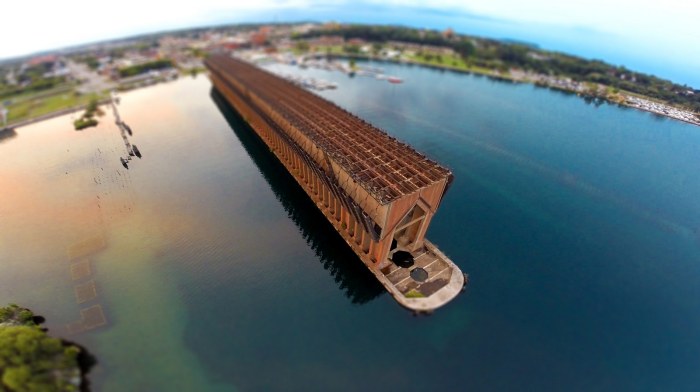
Travel Marquette shares the story of the Iron Ore Dock in Marquette’s Upper Harbor is also known as the Presque Isle Dock.

The dock was built in 1911 and is still commercially active. Each year approximately 9.5 to 10 million tons of ore are shipped from this dock. The dock is owned and operated by the Cliffs Natural Resources. This steel-framed dock is 1,250 feet long and 60 feet wide, with the top deck sitting 75 feet above the water level. It contains 200 pockets, each of which has a capacity of 250 tons of ore, for a total storage capacity of 50,000 tons. Supporting the dock is a foundation of 10,000 wooden piles enclosed by a 12-inch thick timber sheet plank wall filled with sand.

After being mined the ore is crushed and the iron separated out with either a chemical or magnetic process. The iron is combined with a binding agent (a glorified cornstarch) and rolled into small balls roughly an inch in diameter. The balls are fed through a kiln and fired by temperatures exceeding 2,000 degrees F. The result is Taconite Pellets which are loaded on the ore boats and shipped. Most of the pellets shipped from the Presque Isle dock go to Algoma Steel in Sault Ste. Marie, Ontario the largest integrated steel mill. These pellets, which are roughly 70% iron, will be combined with coke and limestone at the mill to make steel.

The ore comes to the dock via railcars and is dumped into steel “pockets” or bins beneath the tracks. To load the boat, the chute is lowered to the open cargo hatch and a door at the bottom of the pocket opens, allowing the pellets to run into the boat shown in the picture. Loading time is variable, depending on the size of the boat and how prepared the dock is to load. Four hours is typical. Loading is the responsibility of the First Mate. It is important to load the ore in a proper sequence to avoid over-stressing the boat unevenly. Each chute (or drop of ore) is about 20 tons.

View Rudy’s photo big as the sky and see more in his slideshow.

More Marquette and more aerial photography on Michigan in Pictures.

Heavenly curtain at the Phoenix Church

A special Sunday “I changed the cover of the Michigan in Pictures Facebook” edition of Michigan in Pictures.

God is Light

God is light, photo by Jiqing Fan

The Keweenaw County Historical Society page about their Phoenix Church in Houghton explains:

St. Mary’s Church was built in 1858 to serve the Catholic residents in the nearby mining community of Cliff, scene of the area’s first major copper discovery in 1844. Services continued until 1899 when the church was dismantled and reassembled in Phoenix, where it was renamed The Church of the Assumption. Masses were held until 1957, when the last service marked a century of providing spiritual guidance to mining families and their descendants.

In 1985 the Keweenaw County Historical Society took over the property and began extensive repair and restoration work. The church now appears much as it did when folks from another century knelt in prayer, a fitting memorial to one chapter of Keweenaw’s proud heritage. Although now deconsecrated, the church is still used for weddings and memorial services.

More on Pheonix Church from the Keweenaw County Historical Society.

View his photo bigger on Flickr and see more in his Houghton & UP Mich slideshow.

More northern lights and more churches on Michigan in Pictures.