Big Change for Labor Day Mackinac Bridge Walk

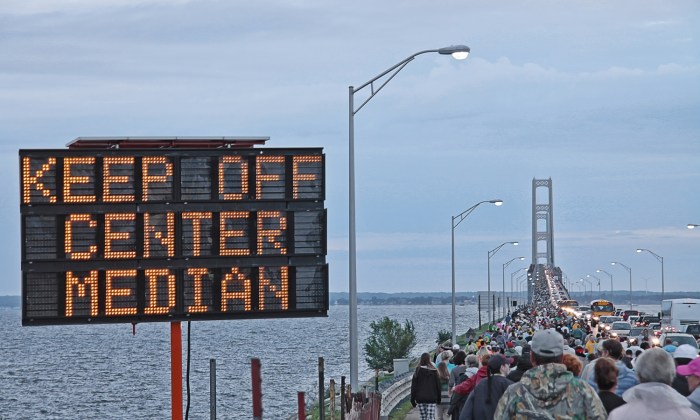
FINAL INSTRUCTIONS, photo by Dave Trapp

Next Monday (September 4, 2017) is the annual Mackinac Bridge Walk, and you can click that link for all the details on the walk. This year is the 60th annual walk, and there will be a major change that the Northern Express explains:

“Because of threats happening across the country … We met with Homeland Security and the Michigan State Police, and it was decided that for the first time, we will not be allowing public [vehicle] traffic to drive across the bridge during the walk, for everyone’s safety and security,” said Bob Sweeney, executive secretary of the Mackinac Bridge Authority (MBA).

In prior years, the northbound bridge lanes were open to vehicles during the walk; this year, following incidents in London, Barcelona, and Charlottesville, Virginia, in which terrorists drove vehicles into crowds of pedestrians, the only vehicles allowed on the bridge will be law enforcement, emergency vehicles, and the shuttle buses that transport participants.

A total of 13 different law enforcement agencies — members of Homeland Security, the Michigan State Police, regional and local police, and the Native American Chippewa Tribe — will be on site for the event, including 240 troopers. Boats also will be deployed in the waters below the bridge.

Officials are quick to point out that there is no known threat to the event; they are simply taking precautions. Between 35,000 and 50,000 walkers are expected to participate.

Dave took this at the 2010 Bridge Walk which was attended by over 40,000 people. View it background big and see more in his Bridge Walk Weekend slideshow.

Lots more about the Mackinac Bridge on Michigan in Pictures!
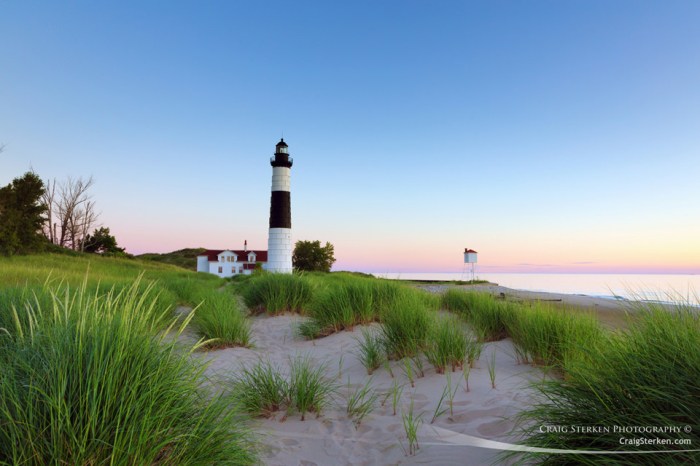
Michigan Lighthouse Festival celebrating 150 Years at Big Sable Point

Summer Evening at Big Sable Point Lighthouse, photo by Craig Sterken Photography

This weekend is the 2nd Annual Michigan Lighthouse Festival featuring Big Sable Point Lighthouse’s 150th Anniversary! The festival features lighthouse tours throughout the weekend, a vendor show on Saturday and Sunday, Friday Night dinner with special guest speakers, topped off with Ric Mixter performing “The Storm” on Saturday night.

Terry Pepper’s Seeing the Light has some great information about the history of Big Sable Point Lighthouse including an explanation of the light’s unique appearance:

Construction began in early 1867 with the arrival of Lighthouse Board and Army Corps of Engineers workers, who immediately began the construction of a dock at which to unload the necessary supplies for the project. Next, a temporary cofferdam was constructed to keep waster from entering the foundation, which consisted of tightly fitted cut stone blocks beginning a depth of six feet below grade and extending three feet above.

On this sturdy foundation, the skilled masons began to raise the tower. Constructed of cream city brick, the walls were laid five feet thick at the foundation, tapering to a thickness of two feet thick immediately below the gallery. Within the tower, a circular inner wall, eight feet in diameter supported the cast iron spiral staircase. On its’ vertical climb, the stairway passed through three landing areas.

…In 1898, the District Inspector reported that the cream city brick used in constructing the tower was found to be flaking as a result of exposure to the elements, and voiced concern that if left as-is, the integrity of the tower would likely be compromised. This flaking grew so severe, that in 1899 a contract was awarded to the J. G. Wagner Company of Milwaukee to construct the necessary steel plates to encase the tower. The plates were satisfactorily test assembled at the Milwaukee Lighthouse Depot, loaded onto lighthouse tenders and then shipped to Big Sable. With the arrival of the plates, the process of riveting the plates together around the tower, and filling the void between the brick and the plates with cement began. The construction was completed in June 1900 at a total labor and materials cost of $4,925. In order to increase the visibility of the tower during daylight hours, the new cladding was painted white with a contrasting black band around its’ middle third.

View the photo bigger, see more in Craig’s Big Sable Lighthouse slideshow, and view & purchase photos at craigsterken.com.

More Michigan lighthouses on Michigan in Pictures!

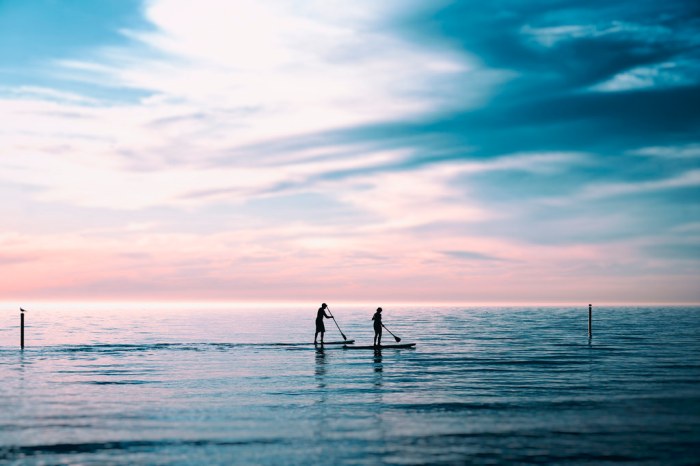
Into the Sunset

Into the Sunset, photo by paulh192

Hope everyone has a great weekend. I’m guessing more sunsets and more time on the water with friends & loved ones is a good way to make that happen.

View the photo bigger and see more in Paul’s slideshow.

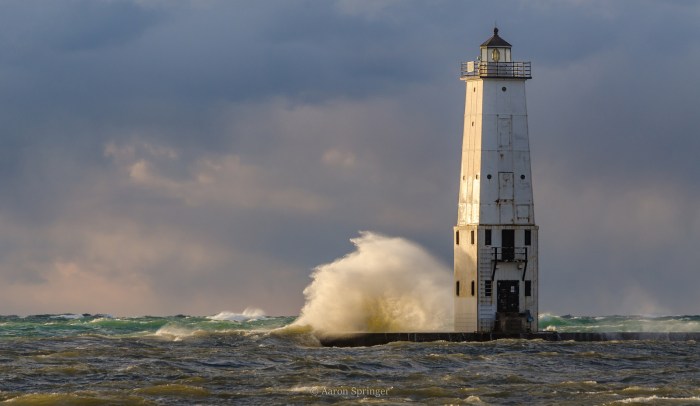
Even Mr. Brightside has a dark side

Mr. Brightside, photo by Aaron Springer

The Frankfort North Pier Head Light marks the entrance to Betsie Lake. It’s a popular fishing spot, but on Friday afternoon as UpNorthLive reports, a fisherman learned to pay a little more attention to his surroundings:

The Coast Guard says the man was fishing when the weather picked up. He then became stuck on the pier due to crashing waves over the break wall. The Coast Guard was notified by the Benzie County Central Dispatch around 9:25 p.m.

Coast Guard Station Frankfort then launched a 25-foot response boat, a small crew and a Coast Guard Air Station Traverse City MH-60 jayhawk helicopter crew. The response boat arrived on scene first and confirmed the man was on the wall. The boat could not help with the rescue due to the shallow water.

The Coast Guard says the MH-60 helicopter crew hovered over the lighthouse on the pier and lowered a rescue swimmer who then basket-hoisted the man to safety with no injuries before flying to Frankfort Dow Memorial Airport where local EMS were standing by.

Click through for more including a video of the man and the pier taken from the Coast Guard helicopter.

View the photo bigger and see more in Aaron’s slideshow.

More from the Frankfort Light on Michigan in Pictures.

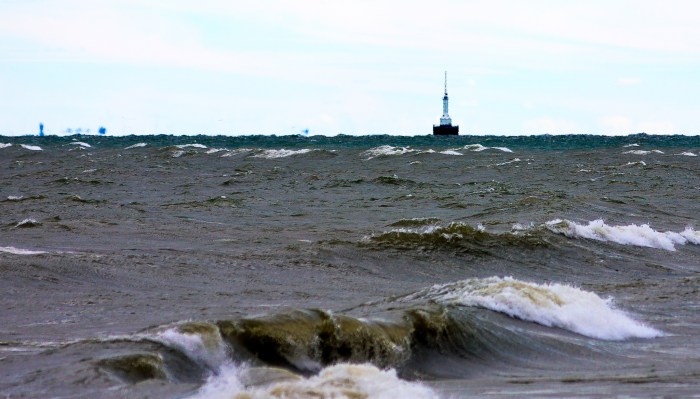
Michigan Lighthouses: Gravelly Shoal Light

Gravelly Shoals offshore Light in Saginaw Bay, photo by George Thomas

The entry on Gravelly Shoal Light at Terry Pepper’s Seeing the Light begins:

Point Lookout juts from the shore on the western shore of Lake Huron, approximately half-way between the mouth of the Saginaw River and Tawas Point. With only five to eighteen feet above it, Gravelly Shoal extends some 3 miles southeasterly from Point Lookout towards Big Charity Island. To help guide down-bound vessels headed for Saginaw Bay through the deeper water lying between the southeast end of Gravelly Shoal and Big Charity Island, Congress appropriated $5,000 to construct a lighthouse on the northwestern shore of Big Charity on August 18, 1856. Work began at the site that year, but as a result of being started so late in the season, the station was not completed and lighted until the following year.

Perhaps as a result of its exposed location, or as a result of its keeper’s dwelling being one of the few of wooden frame construction on any of the Great Lakes, the station was a constant source of maintenance problems, and was not surprisingly one of the first to be automated through the installation of an acetylene illumination system in 1900. At this time an occulting white Pintsch gas buoy was also placed at the southeastern end of Gravelly Shoal to better mark the western edge of the passage between the shoal and Big Charity Island.

As a result of the combination of increasing vessel size, improvements in offshore light construction and the growing adoption of radio direction finding equipment, it became plain in the late 1930’s that the old Charity light and the gas buoy on Gravelly Shoal had outlived their usefulness, and consideration turned to the construction of a state-of-the-art offshore aid to navigation at the eastern end of Gravelly Shoal to better mark the deeper water of the passage.

View the photo background big and see more in George’s Lighthouses slideshow.

More Michigan lighthouses on Michigan in Pictures.

Great Lakes on the line: It’s time to act on Asian carp

Doing it again this summer, photo by Kevin Povenz

If Asian carp ever get into the Great Lakes, fun in boats as shown above could well be a thing of the past. These invasive fish jump out of the water when disturbed by noise and vibrations. With an average weight of 30-40 pounds and some weighing in over 100 pounds, they can cause injury or death to boaters.

The Freep reports that a plan tentatively recommended by the Army Corps of Engineers to keep Asian carp from the Great Lakes would cost $275 million plus annual costs for maintaining and operating it of nearly $20 million a year:

Of all the options considered by the Army Corps for blocking the advance of Asian carp at the Brandon Road Lock and Dam in Joliet, Ill., the tentatively selected plan was the most expensive. It would use noise to block the fish, along with an electric dispersal barrier, water jets, a flushing navigation lock and more.

…The plan, however, doesn’t guarantee success: The Army Corps estimated the species known as Asian carp would still have a 10%-17% probability of becoming established in the Great Lakes, down from 22%-36% if no action was taken.

The Corps estimated that closing the navigation lock altogether would have the greatest likelihood of stopping bighead carp and silver carp — the two invasive species that are known as Asian carp — from reaching Lake Michigan, bringing the probability down to 1%-3%. But the cost to inland shippers and the companies they serve would be in the hundreds of millions of dollars with some shippers going out of business.

I hate to be a jerk, but PUT THOSE SHIPPERS OUT OF BUSINESS. Asian carp in the Great Lakes would be a disaster* and seriously impact BILLIONS OF DOLLARS in wages tied to the health and recreational value of the Great Lakes.

View the photo bigger and see more in Kevin’s slideshow.

*Don’t take my word for it. Jet skiing or pleasure boating anyone? Note that this video is 3 years old and also is PG-13 for language.

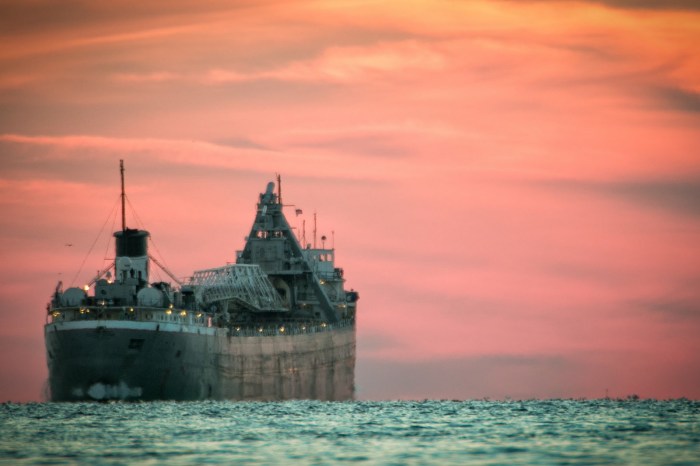
Into the sunrise, into the weekend

Into the Sunrise, photo by Tom Hughes

The sun rose on Lake St. Clair at about 6:30 AMthis morning. If you were there, maybe you were lucky enough to see something like Tom’s photo of the Cuyahoga headed into the sunrise. If not, at least we can be happy that there’s folks like him willing to get up and out for incredible shots like this.

Have a great weekend everyone!

View the photo bigger and see more in Tom’s slideshow.

Night … and light

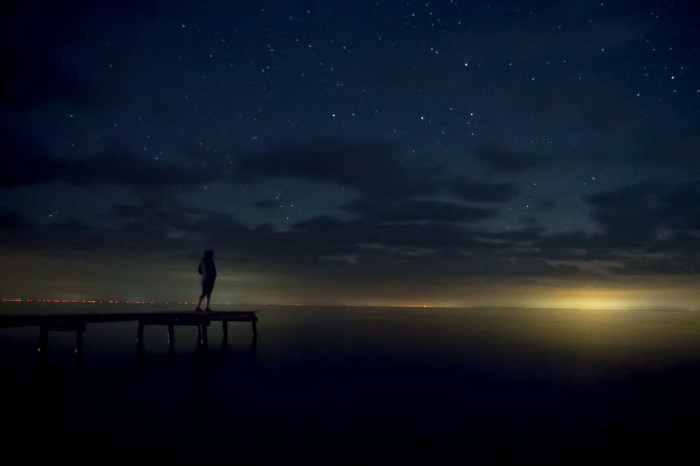
night, photo by kare hav

While the lights of distant Bay City across Saginaw Bay from Point Lookout make for a beautiful photo, I feel for the photographer who wishes they’d shut them off at night.

If you’re interested in making your community more “night friendly” check out How to Start a Local Dark Skies Group from the International Dark Sky Association. In addition to miles and miles in the UP, Michigan has six designated Dark Sky Preserves and the Headlands International Dark Sky Park.

View the photo background big and see more in kare hav’s Pt. Lookout/AuGres slideshow.

Lake Michigan: Port Oneida Edition

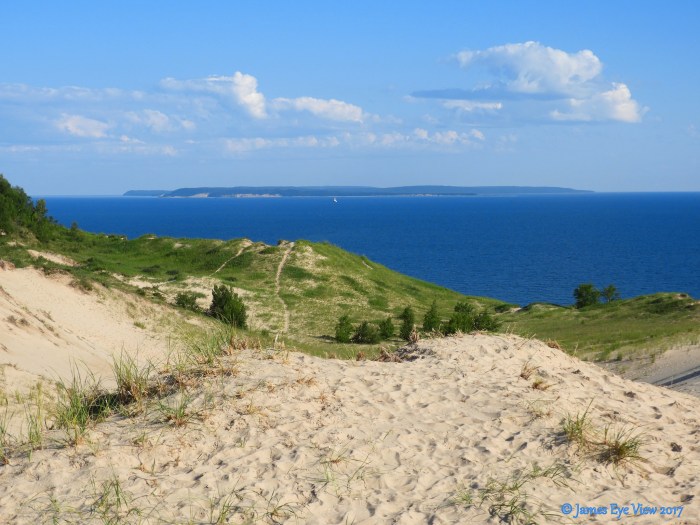
Port Oneida, photo by JamesEyeView Photography

Just one of the many staggering vistas that await you on the Pyramid Point Trail in the Sleeping Bear Dunes National Lakeshore.

View the photo background bigtacular and see more in James’ The Great Lakes slideshow.

PS: If you head this way the weekend of August 11-12, be sure to check out the annual Port Oneida Fair. presented by the Sleeping Bear Dunes National Lakeshore.

S.S. Aquamara: The Great Lakes’ Largest Liner

aquarama-unloading-detroit

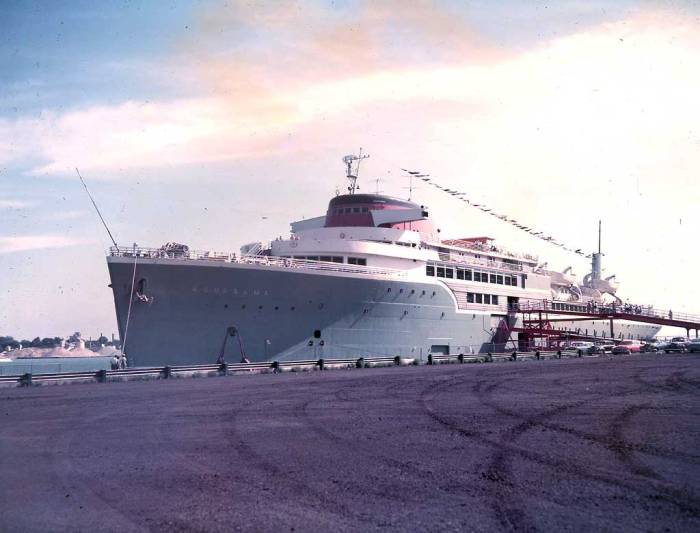
Aquamara unloading in Detroit, courtesy Marine Historical Society of Detroit

The S.S. Aquarama was the largest passenger ship ever to operate in the Great Lakes. We’ll head to Ohio (gasp) for this article on the Aquamara from Cleveland Historical:

The Aquarama began its life in 1945 as a transoceanic troop carrier called the Marine Star: 520 feet and 12,733 tons. It made only one Atlantic Ocean trip before combat ceased. Eight years later, the ship was purchased by Detroit’s Sand Products Company and taken to Muskegon, Michigan, where it underwent an $8 million, two-year conversion, and was reborn as a nine-deck luxury-class ferry capable of carrying 2,500 passengers and 160 cars. The rechristened Aquarama also touted five bars, four restaurants, two dance floors, a movie theater, a television theater, and a playroom. Special events often were held in conjunction with day or evening cruises. For example, on June 10, 1962, passengers were treated to a style show from Lane Bryant’s Tall Girl Department. The next month, evening cruisers on the Aquarama could watch the Miss World finals. Regular shipboard entertainment included musical performances, dancing, marionette shows, games, and contests.

The cruise portion of the ship’s life actually began in 1955, with tours to various Great Lakes ports and a brief stint as a “floating amusement palace” docked along Chicago’s Navy Pier. Soon after, service began focusing solely on runs between Cleveland and Detroit: six hours “door to door” with Cleveland-based passengers embarking in the morning from (and returning in late evening to) the West 3rd Street pier. For the next six years, the Aquarama was extremely popular but never profitable. Part of the problem may have been frequent “incidents”: One summer, the Aquarama backed into a seawall. A year later, it hit a dock in Cleveland. A week after that, it banged into a Detroit dock, damaging a warehouse. Alcohol issues also were recurrent: Accusations included untaxed booze and liquor sold in Ohio waters on Sunday. Still, the ship’s most likely death knell was simply high operating costs.

The Aquarama made its last trip on September 4, 1962. It then was towed back to where it had been rebuilt–Muskegon, Michigan, ostensibly to continue as cruise vessel. Unfortunately, a prohibitively large dredging investment was needed to accommodate the harbor. The Aquarama thus sat dockside—residing (but not operating) later in Sarnia, Ontario, Windsor, Ontario, and Buffalo, New York, where entrepreneurs hoped in vain to convert it to a floating casino. In 2007 the Aquarama was towed to Aliağa, Turkey, where it was broken up for scrap.

This photo from Boatnerd shows the Aquarama unloading passengers from Cleveland at Detroit’s city park next to the J.W. Westcott Co. dock, 1963. Another view.  Hartland Smith, William Hoey collection. More pics at Boatnerd.com.

Read more about the Aquamara at Wikipedia.