Today’s the Day for the Michigan Apple Crunch!

grand-traverse-bay-apples

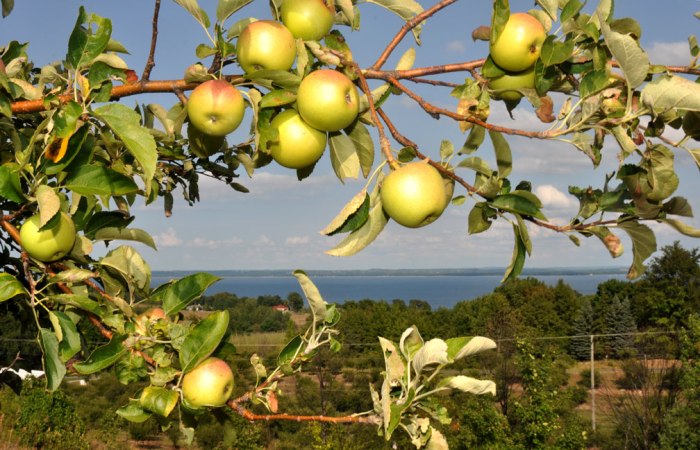
apples, photo by Diane Greene Lent

A Healthier Michigan is a pretty cool blog with some state-specific tips for better health. Their post on the annual  Michigan’s Apple Crunch Day (Thursday, October 13)  says that every October, schools, organizations, and businesses bite into Michigan apples on the same day, setting records for apples eaten.

It’s a partnership between the Michigan Department of Education, Michigan Farm to School, Cherry Capital Foods and Cultivate Michigan as a reminder of the importance of agriculture and knowing where your food comes from. Last year 400,000 people in Michigan ate a Michigan-grown apple on Apple Crunch Day!

The Michigan Apple Committee notes that with 11.3 million apple trees covering 35,500 acres on 825 family-run farms, Michigan is the nation’s third largest producer of apples!

View Diane’s photo of apples overlooking Grand Traverse Bay background big and see more in her Best 2012 slideshow.

Here’s a video with photos from last year’s Apple Crunch by Cherry Capital Foods!

First Day of Fall Puffballs

first-day-of-fall-puffballs

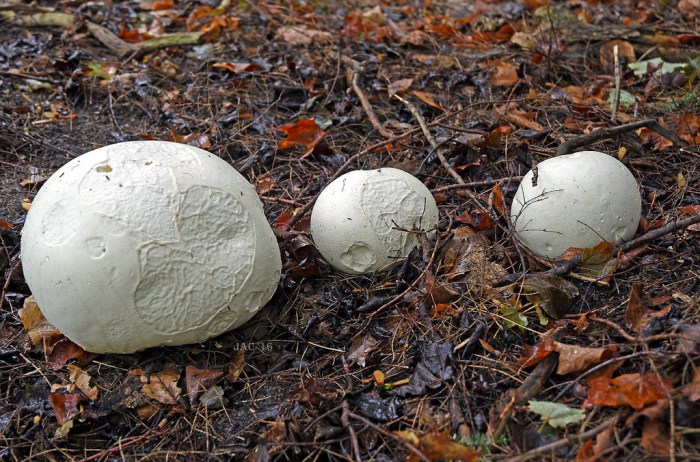
Happy First Day of Autumn, photo by Julie

The spring, summer, is quite a hectic time for people in their lives, but then it comes to autumn, and to winter, and you can’t but help think back to the year that was, and then hopefully looking forward to the year that is approaching.
-Enya

Happy second day of fall everyone. I’m usually pretty good about marking that seasonal stuff, but in my defense, I DID eat some puffballs the day before yesterday and marked a few today.

In case you’re interested in exploring edible, wild mushrooms, the giant puffball is considered one of the “Foolproof Four” – widespread and easy to identify mushrooms. Mushroom Appreciation’s page on Giant Puffball mushrooms has lots of pictures, puffball facts, and identification tips and says (in part):

Giant puffballs are saprotrophs, meaning they feed on dead organic matter. They’re more likely found in meadows and grasslands than in the forest. They are always found growing on the ground rather than up in trees.

Giant puffballs are aptly named. They are usually quite large, reaching soccer ball size or bigger. They usually have a circumference (distance around) of 4 to 30 inches, although larger ones are not uncommon. There is no distinct cap and stem with these mushrooms; instead they exist as just large, white globes. They may not be perfectly round. Giant puffballs are white with firm white flesh inside. If they appear yellowish or brown is means that the mushroom is about to/has gone to spore, and is not edible anymore.

…Correct identification is crucial. If you think you’ve found a giant puffball the first thing to do is cut it open. It should have thick, hard, white flesh inside. Don’t eat anything with a brown, black, purple, or yellow interior. It may be an earthball (Scleroderma citrinum) or some other gastric distress inducing mushroom.

This white flesh should be solid with no gills. If you see any evidence of gills disregard immediately. Some species, including the deadly Amanita, have a “universal veil” of tissue that surrounds the mushroom when young. This can make it look like a puffball.

Inexperienced hunters should check with someone knowledgeable if they think they’ve found a giant puffball. An incorrect guess can kill if it turns out to be an Aminita! Please be careful.

Julie shared the Enya quote above, and she shares a ton of great photos in the Absolute Michigan pool. Check her photo out bigger and get yourself in the spirit of the season with her Fall slideshow!

If you do find a giant puffball, here’s a recipe from the Mycological Society of San Francisco’s excellent page on Puffballs from Hope Miller, coauthor of the book Mushrooms in Color.

  • 1 teaspoon salt
  • 1 cup flour
  • About 1 pound puffballs, peeled and cut into 1/2-inch slices
  • 1 egg, slightly beaten with 2 tablespoons water
  • 1 cup freshly grated Parmesan cheese
  • 4 tablespoons butter or more if needed
  • 2 tablespoons oil or more if needed

Mix the salt with the flour. Dip the mushroom slices in the flour, then in the egg, and last, in the cheese. Melt the butter and oil in a sauté pan or skillet and sauté the mushrooms slowly until golden brown. Drain on paper towels. Serve at once.

OK. I can do that.

July Blueberries

july-blueberries-by-mark-obrien

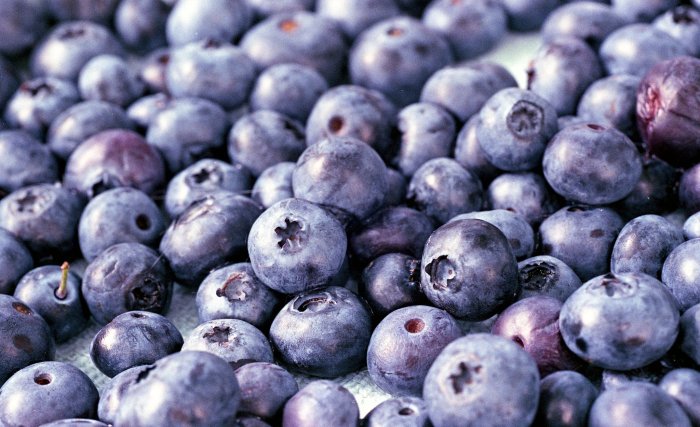
July Blueberries, photo by Mark O’Brien

Mark took this back in July with Fuji Superia 400 color film. He says these blueberries have gone on to a better place … a blueberry pie to be precise.

View it background bigilicious and follow Mark on Twitter @nikonfm2n for lots more!!

Wienerlicious

Wienerlicious, Mackinaw City

Wienerlicious, Mackinaw City, June, 2016, photo by Norm Powell

Remember folks: I don’t take the photos, choose the titles … or name businesses Wienerlicious. That said, have a Wienerlicious Wednesday Friday!

View Norm’s photo bigger, click for more of his Pure Michigan photos, and view & purchase photos at normpowellphotography.com.

More Roadside awesomeness on Michigan in Pictures.

Top Dog: Detroit Michigan’s Coney Island Hot Dog

On Any Given Night Lafayette Coney Island

On Any Given Night, photo by Derek Farr

When mLive writer Emily Bingham realized that Michigan didn’t have an official state food, she set out to determine what their readers thought. The winner was the coney island hot dog which squeaked by my personal favorite, the pasty. Share what you think Michigan’s signature food is in the comments!

The Encyclopedia of Detroit entry for the Coney Dog says:

Many people think that the Coney dog, also called the Coney Island hot dog, got its start on Coney Island, NY where the hot dog was created. In actuality, this popular food got its start in Michigan, although the exact location is still disputed. Three locations in Michigan all claim to be the birthplace of Coney dogs: American Coney Island in Detroit, Lafayette Coney Island in Detroit and Todoroff’s Original Coney Island in Jackson.

In 1917, Gust Keros opened American Coney Island. A few years later Keros’s brother opened Lafayette Coney Island next door. Both of these Detroit Coney Islands are incredibly popular to this day, where there is an on-going argument over which establishment serves the best Coney dog. The dispute has been featured on several food television shows, including Food Wars and Man v. Food.

A Coney dog is a beef hotdog, topped with an all meat, beanless chili, diced white onions, and yellow mustard. A true Coney dog uses made-in-Michigan products.

Lots more about the coney dog on Absolute Michigan.

View Derek’s photo bigger where you can also read about the history of friendly competitors Lafayette Coney Island & American Coney Island. See more in his massive Signs & Billboards slideshow.

Michigan food on Michigan in Pictures!

Blackcaps: Blackberry or Black Raspberry?

Blackcaps Michigan Blackberries

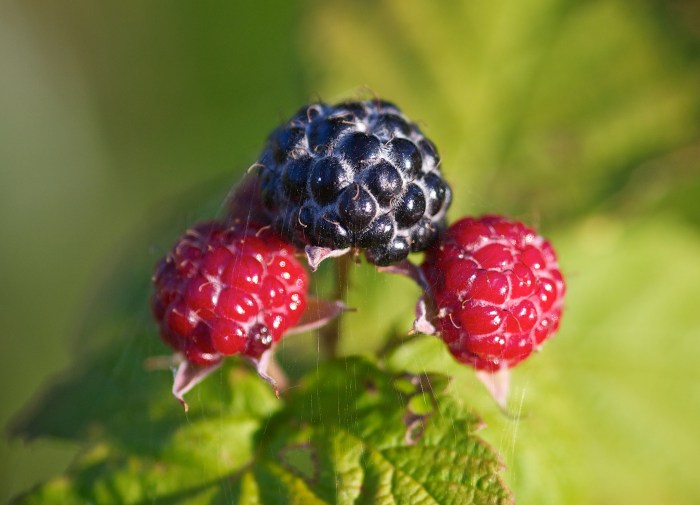
Blackcaps, photo by David Marvin

When I first saw these, I was sure they were blackberries, but after reviewing Blackberry or Black Raspberry? from Identify that Plant, I’m changing my mind. They say that Blackberry (Rubus allegheniensis) is frequently confused with Black raspberry (Rubus occidentalis).

I’m leaning towards Black raspberry based on the appearance of the berry, but I could certainly be wrong. What do you think?

View David’s photo background bigilicious and see more in his macro goodness in his slideshow.

More summer wallpaper on Michigan in Pictures!

Strawberry Season, Strawberry Moon

Fresh Picked Strawberries

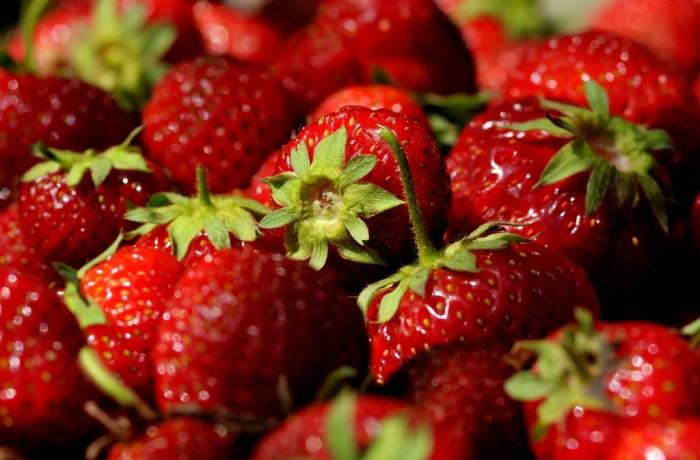
Fresh Picked Strawberries, photo by Dee

June’s moon is full on full on June 20 at 7:02 AM. It was known as the Strawberry Moon by Algonquin tribes, and it’s looking like Michigan’s strawberry season will be ramping up right on schedule. Here’s a couple of strawberry tidbits via Michigan Strawberries are Ready to Pick on Absolute Michigan:

Strawberries are grown in every county of Michigan and your fun fact of the day is that 53% of seven to nine year olds say strawberries are their favorite fruit. Strawberries are high in iron and Vitamin C – Eight strawberries will provide 14% of the recommended daily intake of Vitamin C for kids – and have less than 60 calories per cup.

Strawberries were a symbol of perfection and righteousness that medieval stone masons carved on altars and around the tops of pillars in churches and cathedrals. In parts of Bavaria, country folk still practice the annual rite each spring of tying small baskets of wild strawberries to the horns of their cattle as an offering to elves. They believe that the elves, who are passionately fond of strawberries, will help to produce healthy calves and abundance of milk in return.

View Dee’s photo bigger and see more in her slideshow.

More strawberry goodness on Michigan in Pictures!

2016 Michigan Morel Season Underway!

Backyard Morels

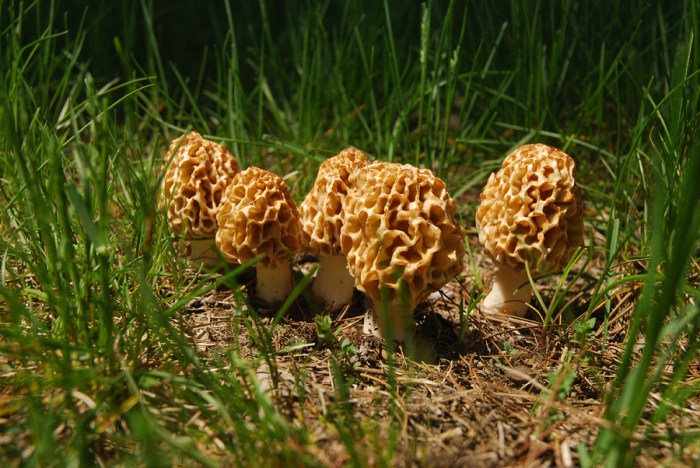
backyard morels, photo by Jason Rydquist

I’ve been getting word from various parts of the state that morel mushrooms are being found! They’re one of my favorite Michigan foods, and over on Absolute Michigan today I’ve put together Five Things you need to know about Michigan Morels. It includes a new online tool that could be of use to morel hunters so check it out!

View Jason’s photo bigger and see more in his slideshow.

Lots more morels on Michigan in Pictures.

Make Mine a Michigan Thanksgiving: High Bush Cranberry Edition

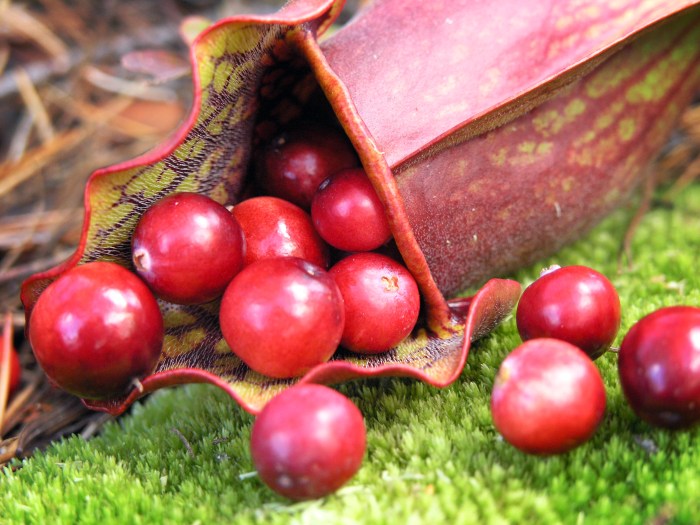
Highbush Cranberries by Blondieyooper

Cranberries, photo by Blondieyooper

One thing that I love is Thanksgiving dinner, and another is Michigan grown food. Dianna at Promote Michigan brings those together with 15 things that make Thanksgiving Pure Michigan. From starters like Koeze nuts, McClure’s Pickles, Koegel Meats, and Leelanau Cheese to sides like Michigan potatoes & squash to Michigan-raised turkeys and (of course) pumpkin & apple pie and ice cream!

One Thanksgiving staple that Michigan is producing more of are cranberries, and you can get all kinds of information from the US Cranberry Marketing Committee. While it’s too late to get them this year, we have another cranberry that grows in Michigan you might not be aware of. Green Deane’s Eat the Weeds is a great blog, and his page on the High Bush Cranberry says (in part):

The High Bush Cranberry is actually a Viburnum (Viburnum trilobum) and a cousin of the elderberry. Both are in the greater Honeysuckle Family and have a characteristic musky odor. That family by the way straddles the edibility line, with some members edible and others not, some tasty and some not. As one might suspect by the name, the High Bush Cranberry has tart fruit. Bradford Angier, a well-known Canada-based forager along side Euell Gibbons, wrote they require a “conditioned palate” to appreciate.

In North America the High Bush Cranberry is found in Canada and the northern half of the United States plus, oddly, New Mexico. It is not as that friendly to wildlife as one might suspect. The fruit persists into the winter because they are not on the top of birds’ preferred food. Birds like the berries after they soften and ferment. White-Tailed deer also browse on the twigs and leaves. For humans the berries are high in Vitamin C, about 30 milligrams per 100 grams.

Viburnum trilobum has several disputed botanical names and several mistaken common names including Pimbina, Mooseberry, Cranberry Tree, Cranberry Bush, American Cranberry, and Squashberry.

Read on for lots more including identification tips. There’s much more Michigan Thanksgiving to feast on at Michigan in Pictures too!

Blondieyooper says she picked over 8 pounds of these gorgeous highbush cranberries in the UP back in October of 2011. View her photo background bigilicious and see more in her Fall 2011 slideshow.

Farm Market Friday: Red Haven Peaches

Red Haven Peaches

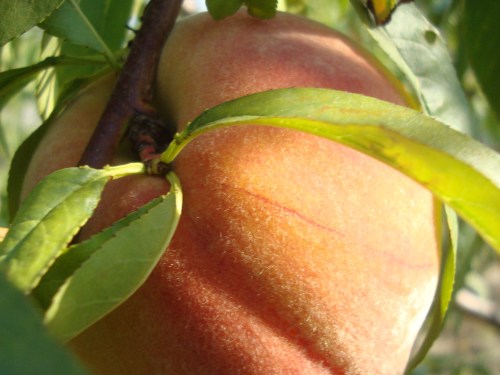
Peaches, photo by alyssa g

I’ve shared the story of the Redhaven peach before on Michigan in Pictures. Strangely enough, it featured a photo by a photographer named Alissa!

Peaches are rolling in at farm markets all across Michigan.  A favorite article that Michigan History Magazine shared on Absolute Michigan tells the story of A Peach of a Man:

Many people have contributed to Michigan’s fruit industry, but Stanley Johnston stands above the rest. Johnston not only developed a new peach that is the most widely grown peach in the world today. He also made Michigan the nation’s leading producer of blueberries.

Johnston was the superintendent of Michigan State University’s (MSU) experiment station in South Haven from 1920 to 1969. There, he developed a better peach. Johnston took peaches that had good features, like ones that ripened at different times or did not turn brown when canned or frozen. He took pollen from the male plant and joined it to the flower of the female plant. When the fruit grew, he collected seeds and started a new tree. When the tree produced fruit five years later, he could see if he made a better peach.

During his career, Johnston grew and studied more than 20,000 peach trees. Eight different types, called “havens” (for South Haven), were planted by farmers. Havens ripened earlier, so the peach-growing season was longer, which meant more peaches could be grown and sold. One of these peaches, named Redhaven for its nice red color, is the most popular peach in the world today.

Read on at Absolute Michigan and definitely get down to your local farmer’s market for some peachy goodness!

View Alyssa’s photo background bigalicious and see more in her Blake Farms slideshow.