Waterspout Weather

Waterspout moves across the Manitou Passage in the Sleeping Bear Dunes National Lakeshore

Waterspout moves across the Manitou Passage, photo by farlane

I don’t usually blog my own photos to Michigan in Pictures, but yesterday afternoon I had the good fortune to see a waterspout above the Manitou Passage in the Sleeping Bear Dunes National Lakeshore. If you look closely, you can see the turbulence on the water in front of South Manitou Island towards the center.

Meteorologist and Science and Operations Officer Bruce B. Smith of the National Weather Service in Gaylord writes the following about Waterspouts:

Persons living in northern Michigan are well aware that the Great Lakes have a profound impact on local weather patterns. Examples include heavy lake effect snows in winter, and cooling lake breezes in summer. As the end of the summer season approaches, another type of unique Great Lakes weather phenomena is possible — the waterspout.

Dr. Joseph Golden, a distinguished waterspout authority with the National Oceanic and Atmospheric Administration (NOAA), defines the waterspout as a “funnel which contains an intense vortex, sometimes destructive, of small horizontal extent and which occurs over a body of water.” The belief that a waterspout is nothing more than a tornado over water is only partially true. The fact is, depending on how they form, waterspouts come in two types: tornadic and fair weather.

Tornadic waterspouts generally begin as true tornadoes over land in association with a thunderstorm, and then move out over the water. They can be large and are capable of considerable destruction. Fair weather waterspouts, on the other hand, form only over open water. They develop at the surface of the water and climb skyward in association with warm water temperatures and high humidity in the lowest several thousand feet of the atmosphere. They are usually small, relatively brief, and less dangerous. The fair weather variety of waterspout is much more common than the tornadic.

He says that waterspouts occur most frequently in northern Michigan during the months of August, September, and October, when the waters of the Great Lakes are at their warmest and cold air moves in. If a spout develops, you can expect it to move at 10 to 15 knots (5-8 MPH make that 11-17 MPH) and last from two to twenty minutes. How about the 5 stages of waterspout formation from Dr Golden? Why not:

  1. Dark spot. A prominent circular, light-colored disk appears on the surface of the water, surrounded by a larger dark area of indeterminate shape and with diffused edges.
  2. Spiral pattern. A pattern of light and dark-colored surface bands spiraling out from the dark spot which develops on the water surface.
  3. Spray ring. A dense swirling annulus (ring) of sea spray, called a cascade, appears around the dark spot with what appears to be an eye similar to that seen in hurricanes.
  4. Mature vortex. The waterspout, now visible from water surface to the overhead cloud mass, achieves maximum organization and intensity. Its funnel often appears hollow, with a surrounding shell of turbulent condensate. The spray vortex can rise to a height of several hundred feet or more and often creates a visible wake and an associated wave train as it moves.
  5. Decay. The funnel and spray vortex begin to dissipate as the inflow of warm air into the vortex weakens.

Click through for more including how the NWS forecasts tornados and also see this Michigan in Pictures post from 2008 with some more Great Lakes Waterspouts.

Check this out on black and see more in my surprisingly cool You Can’t Change the Weather slideshow. I also captured a three waterspouts over North Manitou Island in September of 2008. Click the link to get it background big.

More weather on Michigan in Pictures.
ArtPrize 2012

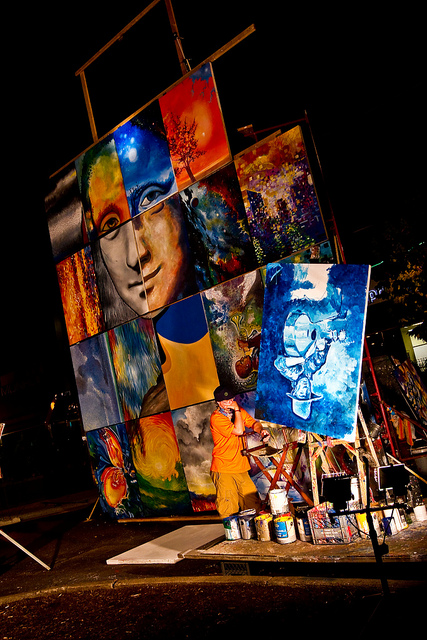
ARTPRIZE 2011-5780

ARTPRIZE 2011-5780, photo by RichardDemingPhotography

ArtPrize opened yesterday in Grand Rapids and runs through October 7th. Now in its 4th year, ArtPrize is the largest art competition in the world, awarding over a half million in prizes. $360,000 of this is awarded by public vote. If you’ve never experienced a city turned upside down by art, it might be a good idea to plan a trip to Grand Rapids.

This year in an effort to become a more sustainable effort, ArtPrize has added various levels of membership that include perks like priority seating and tickets & receptions to events during ArtPrize and year round.

Check it out bigger and see more in Richard’s massive ArtPrize 2011 slideshow.

Also see past ArtPrize photos on Michigan in Pictures and at absolutemichigan.com/artprize.  mLive’s ArtPrize section is a great resource as well.

Gabbro Falls and the Black River Scenic Byway

From Above - Gabbro Falls (Black River - Upper Michigan)

From Above – Gabbro Falls (Black River – Upper Michigan), photo by Aaron C. Jors

Gabbro Falls is one of several very nice waterfalls on the Black River. Others are Great Conglomerate Falls, Gorge Falls, Potawatomi Falls, Sandstone Falls and Rainbow Falls – click that link for more info from GoWaterfalling.com.

The Black River Scenic Byway:

…is in the western corner of Michigan’s Upper Peninsula, near the Wisconsin state line. The byway begins in Bessemer and travels north to the road’s end on the shores of Lake Superior. Black River is 15 miles long and follows North Moore Street, Saint Johns Road, and Black River Road (CR 513). All are two-lane paved roads suitable for all types of vehicles. The byway is open year-round.

The Black River scenic byway crosses the Ottawa National Forest alongside the meandering Black River through areas of old growth hemlock and hardwoods of the Black River Valley. The byway offers scenic views of the distant Porcupine Mountains. In autumn, the byway is bathed in colors of red, orange, and gold.

Aaron’s photo from early October of 2010 certainly bears that out. See it on black and view more in his awesome Waterfalls slideshow.

More waterfalls on Michigan in Pictures.

Fall is coming down the road

Autumn

Autumn, photo by AcrylicArtist

After 70s and 80s for weeks & weeks, there’s a snap in the air as the north wind is rustling the leaves and it’s still dark at 6:30 in the morning. Those longer nights are key to the Science of Fall Color, and you can read all about what makes leaves change color and see another cool fall photo at that link!

Starting to lay plans as to how to enjoy Michigan’s fall color? While a helicopter color tour is probably out of reach for most of us, the fall color tours on Pure Michigan offer some solid ideas for experiencing Michigan at its colorful best. One note: while they invite you to see the dynamic colors of a trillion trees, the actual number (according to Michigan Forests Forever) is about 11.3 billion. That’s still quite a lot – here’s hoping you get to see at least a few hundred thousand!

Check this out background bigtacular and in Rodney’s Autumn slideshow.

Many more fall photos & wallpaper from Michigan in Pictures.

Channel Currents & Longshore Currents at Picnic Rocks

Storm Clouds over Picnic Rocks in Marquette, MI Labor Day 2012

Storm Clouds over Picnic Rocks in Marquette, MI Labor Day 2012, photo by Superior Seasons

Picnic Rocks is a popular beach area in Marquette. I thought that I’d come up with a good story for the name, but instead, I learned about the formation and dangers of what are known as channel & longshore currents. The Marquette National Weather Service explains:

A channel current is caused when water is squeezed between the shore and an offshore structure or feature (such as an island). When water is squeezed it speeds up, thus causing the current. This is like putting a smaller nozzle on a garden hose. When the smaller nozzle is on, the water comes out faster.

This current can be enhanced by what is known as a longshore current, a current that is generated by waves breaking onshore. As waves move onshore, they break in the direction they are moving in order to dissipate their energy. This causes the longshore current. Overtime, the current spans the entire width of the surf zone (the place where you swim). In the case of a channel current, the longshore current can speed up the channeling effect between the shore and the rocks, causing dangerous conditions to develop for those who are walking along the sandbar. The longshore current is maximized during times of higher waves that come in at a 45 degree angle to the shore.

…One could escape a channel current by swimming back to towards the shore. Many people make the mistake of swimming against the current as they are trying to get back to the sandbar. Think of the current as an underwater treadmill. In order to get off the treadmill, one needs to step off to the side of it. The channel current will be moving parallel to shore, so in order to escape, swim perpendicular to the shore.

Read on for more including a diagram demonstrating the best way to escape if you’re caught in these currents. A swimmer recently drowned here and this summer has been a deadly one – please use your knowledge to help others stay safe!

So we don’t end on a down note, let me say that in good weather, Picnic Rocks is a fantastic, natural playground for folks of all ages!!

Check this out background big and in Superior Season’s Marquette slideshow.

More from Marquette on Michigan in Pictures.

The Mighty Mac

The Mighty Mac

The Mighty Mac, photo by mi_kirk

In  6+ years as the author of Michigan in Pictures, it’s safe to say that I’ve seen more photos of the Mackinac Bridge than most people. That said, this is certainly one of the best photos of the Mighty Mac I’ve ever seen.

Since I’m expected to offer a little more, how about this History Channel video about the Mighty Mac or (if you don’t mind the lack of audio) this sweet collection of vintage clips of the days before the bridge at the Straits of Mackinac and the building of the Mackinac Bridge.

Check it out bigger and see more in Kirk’s Michigan slideshow.

Lots more about the Mighty Mac and other Michigan bridges on Michigan in Pictures.

Film?

Film

Film, photo by karstenphoto

Film. How does it make you feel? When you see a photo shot with real film on a computer – whether as a print or in the developing tray – is there a difference?

Check this out background bigtacular and see this and several more in Steve’s ectachrome slideshow and please share your comments below.

More on cameras & film on Michigan in Pictures.

Some say Masquigon, some say Muskegon

Masquigon

Masquigon, photo by Rudy Malmquist

Wikipedia’s Muskegon entry explains that:

“Muskegon” is derived from the Ottawa Indian term “Masquigon” meaning “marshy river or swamp”. The “Masquigon” river was identified on French maps dating from the late seventeenth century, suggesting that French explorers had reached Michigan’s western coast by that time.

Father Jacques Marquette traveled northward through the area on his fateful trip to St. Ignace in 1675 and a party of French soldiers under La Salle’s lieutenant, Henry de Tonty, passed through the area in 1679.

The earliest known Euro-American resident of the county was Edward Fitzgerald, a fur trader and trapper who first came to the Muskegon area in 1748 and who died here, reportedly being buried in the vicinity of White Lake. Sometime between 1790 and 1800, a French-Canadian trader named Joseph La Framboise established a fur trading post at the mouth of Duck Lake. Between 1810 and 1820, several French Canadian fur traders, including Lamar Andie, Jean Baptiste Recollect, and Pierre Constant had established fur trading posts around Muskegon Lake. In 1830 Muskegon was an Ottawa village.

Euro-American settlement of Muskegon began in earnest in 1837, which coincided with the beginning of the exploitation of the area’s extensive timber resources. The commencement of the lumber industry in 1837 inaugurated what some regard as the most romantic era in the history of the region.

Read on at Wikipedia.

Check this photo out background bigtacular and see more in Rudy’s Neutral Density slideshow. While we’re at Wikipedia…

In photography and optics, a neutral density filter or ND filter is a filter that reduces and/or modifies intensity of all wavelengths or colors of light equally, giving no changes in hue of color rendition. It can be a colorless (clear) or grey filter. The purpose of a standard photographic neutral density filter is to allow the photographer greater flexibility to change the aperture, exposure time and/or motion blur of subject in different situations and atmospheric conditions.

History? Yes, Michigan in Pictures has lots and lots of Michigan history … and a fair bit on Muskegon too!

Eastern Chipmunk (Tamias striatus)

Untitled

Untitled, photo by kdclarkfarm1

The newly redesigned University of Michigan Animal Diversity Web says that Tamias striatus (eastern chipmunk):

Eastern chipmunks live in shallow burrows in the ground. They are partial to areas near rocky crevices, decayed tree trunks, and fence corners. They do not like dense forests where no sunlight reaches the ground. Burrows are made by digging and carrying away the dirt in their pouched mouths. Unlike prairie dogs and other sciurids, eastern chipmunks do not leave the dirt in mounds near the entrances of their burrows. This makes it harder for predators to find chipmunks in their homes. These burrows can be up to 30 ft. in length with several different exits and tunnels. Eastern chipmunks conceal the exits with leaves and rocks. They may inhabit these burrows for several years.

Eastern chipmunks are larger than most chipmunks. They are reddish brown in color with 5 black stripes on their backs. These stripes are separated by brown, white, or grey fur stripes. They also have white and dark markings around their eyes. The stomach is usually a yellowish brown or white color. Their tails are reddish brown and furry, but not bushy like common squirrels. Like many rodents, Tamias striatus has 4 toes on the front feet and 5 toes on the rear feet.

…Eastern chipmunks have excellent vision, hearing, and sense of smell. They communicate with each other by making a variety of sounds, including the ‘chip’ for which they are named.

Tamias striatus eats a wide variety of foods including nuts, acorns, seeds, mushrooms, fruits, berries, and corn. They also eat insects, bird eggs, and sometimes small vertebrates such as young mice.

Read more and see a bunch more photos of chipmunks as well!

Check this out background big (which is decidedly bigger than a chipmunk) and see more in Diane’s slideshow.

More Michigan animals right here.

The biggest apple in Michigan … and the smallest crop

Biggest apple in Michigan. Wolf River apple. 1996

Biggest apple in Michigan. Wolf River apple. 1996, photo by vostok71

Orange Pippin says that the Wolf River apple (first discovered along the river of the same name in Wisconsin) is:

A well-known American cooking apple, notable for its large size. Wolf River is mainly used for cooking, and it keeps its shape when cooked. It is fairly sweet and doesn’t need much sugar added.

Wolf River has a very high natural resistance to the disease apple scab, and good resistance to fireblight and mildew. It is also very cold hardy, making it a good choice for growing in the northern part of North America.

The Freep notes that the extreme damage to Michigan’s 2012 apple crop has created problems for those in the apple business:

Prices will vary, but consumers can expect fresh apple prices to be about 30% to 50% higher than last year, according to Bob Tritten, Michigan State University Extension Service fruit educator for southeast Michigan. Cider prices are up about 50%.

Last year’s Michigan apple crop was about 26 million bushels, said Dawn Drake, manager of the Michigan Processing Apple Growers Division, a branch of the Michigan Farm Bureau. But early warm weather forced the apple blossoms out early, and that was followed by several days of freezes, which killed most of the tender young blooms.

“This year they’ll be lucky to have 2 (million bushels),” Drake said.

Sergei didn’t think much of the taste when he tried it at the Tree-Mendus Fruit Farm in Eau Claire, but I read that the Wolf River doesn’t reach full flavor unless it gets hit by frost. Check it out bigger and see more in his Fall slideshow.