Tahquamenon Falls are pretty big

Tahquamenon Falls Panorama

Tahquamenon Falls Panorama, photo by Unified Photography

Wikipedia’s Tahquamenon Falls entry says that the upper Tahquamenon Falls in Tahquamenon Falls State Park are more than 200 feet across with a drop of approximately 48 feet. In the spring, the falls can push as much as 50,000 gallons of water per second. That makes it the third most voluminous vertical waterfall east of the Mississippi, after Niagara Falls and Cohoes Falls in New York.

As you can see, they are impressive even during times of lower flow. I thought this shot did a great job of conveying the size of these magnificent falls and really hope you get a chance to see them!

Check this out big as a waterfall and see more in Kenneth’s Pure Michigan slideshow.

Much more about Tahquamenon Falls on Michigan in Pictures!

The Other Witch of November: Witch Hazel

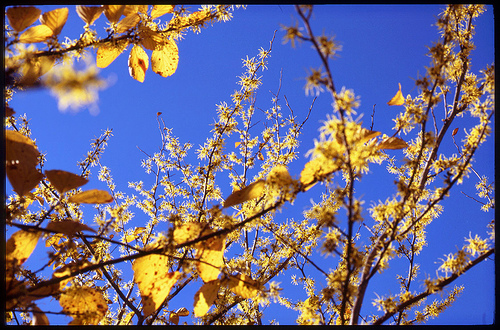
Witch Hazel

Witch Hazel, photo by Voxphoto

Naturalist Jonathan Schechter wrote an article last year entitled Witch of the Woods – and her name is Hazel about this small  tree that actually flowers in November:

Native Americans knew this tree before the invaders with guns and axes in tall sailing ships landed on the eastern shore and carved the land to suit their wants and needs. In colonial America even as the British exchanged shots with the rebellious colonists, the shrub’s flexible forked branches was being used as “witching stick” by the dousers: folks who held the forked branches in hand waiting for the tip to point to hidden waters. Bad news for Halloween fans: The word witch in witch hazel originates from the old English word for pliable branches “wych” and has nothing to do with a lady in black straddling an airborne broom.

Your grandmother and probably your mom (and maybe you) used this plant for a wide array of medical ailments. It is found in a liquid form in almost all drug stores today and sold as an astringent, and for treaments of irritations, pain and itching, skin conditions and another 20 or 30 uses!

More about Witch Hazel (Hamamelis) on Wikipedia.

Check this out background big, see  more in Ross’s garden slideshow and also see his past work on Michigan in Pictures.

Election Day: Sometimes the light shines on you

Rainstorm and Sunlight on Pictured Rocks

Rainstorm and Sunlight on Pictured Rocks, photo by ShelNf

I wondered a lot about what to post on Election Day, but when I saw this photo, I knew I didn’t have to look any more.

In the end, I suspect it doesn’t matter as much about what your vote is as the simple fact that you do vote. A lot of sacrifices have been made to give you this moment when you can make some statements about the future you want, and there’s way to much to be done to sit on the sidelines. Here’s an easy way to see your ballot courtesy of Absolute Michigan.

That light is shining today. Does it shine for you?

ShelNf writes that while walking out on Miner’s Beach in the Pictured Rocks National Lakeshore on a rainy day, he noticed a patch of sunlight that had broken through the clouds, illuminating part of the cliff face. Check this photo out on black and see more in his really awesome slideshow.

Lots more Pictured Rocks and more elections too on Michigan in Pictures.

Setting an Example at the Cadillac Tower

Setting An Example

Setting An Example, photo by DetroitDerek Photography

Wikipedia says that the Cadillac Tower was the first building outside New York City and Chicago to have 40 floors with a spire height of 438 ft making it Detroit’s 12th tallest building. It’s a Beaux Arts skyscraper that was designed by the architectural firm of Bonnah & Chaffee and built in 1927 as Barlum Tower.

The building is best known, however, for its hanging murals. From 1994 to 2000, one side of the building featured a 14-story Detroit Lions star Barry Sanders, which was replaced with one of Red Wings star Steve Yzerman. Currently the building features an ad for the Fidelity investments.

Also see the Cadillac Tower website and have a look at the proposed Cadillac Centre for this location.

Check this out bigger and see more in Derek’s Sunset and Sky Series slideshow.

More Michigan architecture on Michigan in Pictures.

Nawadaha Falls and the Sweet Singer of Hiawatha

Nawadaha Falls

Nawadaha Falls, photo by Jason W Lacey

Should you ask me, whence these stories, whence these legends and traditions,
With the odors of the forest, with the dew and damp of meadows,
With the curling smoke of wigwams, with the rushing of great rivers,
With their frequent repetitions, and their wild reverberations,
As of thunder in the mountains.

I should answer, I should tell you: “From the forests and the prairies,
From the great lakes of the Northland, from the land of the Ojibways,
From the land of the Dacotahs, from the mountains, moors, and fenlands,
Where the heron, the Shuh-shuh-gah,  feeds among the reeds and rushes.
I repeat them as I heard them.
From the lips of Nawadaha, the musician, the sweet singer.”

~Henry Wadsworth Longfellow, The Song of Hiawatha

You may already be aware that one of the main purposes of this blog is to allow me to indulge in my passion for Michigan and its history. Names of the first people who dwelt in Michigan are of particular interest to me, and I was very gratified to discover not only that nawadjiwan is an Ojibway word meaning in the midst of the rapids, but also that it was the name of the singer who taught Longfellow The Song of Hiawatha.

I almost had to leave it there, but then I found a reference in Michael Witgen’s book An Infinity of Nations: How the Native New World Shaped Early North America.

Longfellow acknowledges Schoolcraft’s influence on veiled fashion, when he tells the reader he learned Hiawatha’s story “from the lips of Nawadaha.”  Few readers would realize that this was the Indian agent’s Ojibwe name. Logfellow asserts that Nawadaha had merely repeated these stories, not unlike himself and not unlike an Indian sitting in his lodge on long winter nights telling stories to amuse the children.

You can read on for the author’s puzzlement that Michigan Indian agent Henry Rowe Schoolcraft – himself married to a native woman Jane Johnston Schoolcraft (Oshauguscodawaquat) – would tell tales that are in large part false. As the Wikipedia entry on the Song of Hiawatha notes however,  Longfellow was far more concerned with excitement over accuracy and made numerous editorial decisions in the construction of his epic poem.

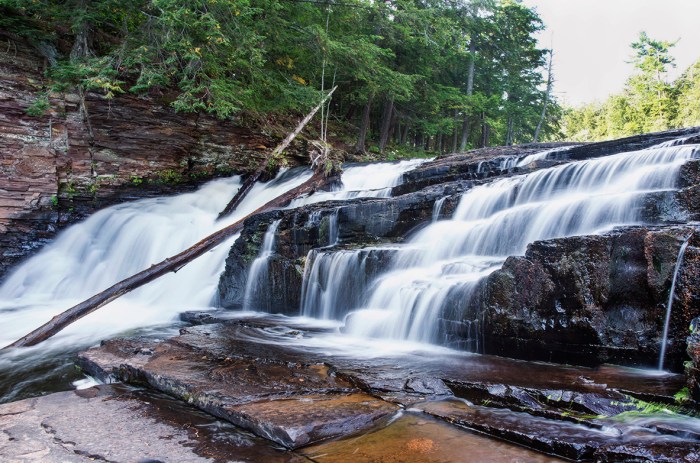
GoWaterfalling.com says that Nawadaha Falls is the upper most of the three falls along the Presque Isle Rivers final stretch.

This is a low, wide waterfall. Its width varies greatly depending on the water levels. Nawadaha Falls is similar to but a little higher than Manido Falls. The steepest part of the falls is on the eastern side, and when the river is low, most of the water flows there. There is a nice natural overlook out in front of this drop easily reached from the trail on the east side of the river.

South Boundary Road is not to far beyond Nawadaha Falls. You can cross river here and hike down the other side to make a loop around all the Presque Isle Falls. The eastern side is much wilder, but the whole hike is very enjoyable.

They add that Manabezho Falls is the larger and most interesting but that the whole hike is well worth it. To bring this full circle, the figure that Hiawatha is modeled on is the trickster god and emissary of the Great Spirit, Manabezho.

Check this out background bigtacular and see more in Jason’s great Michigan slideshow.

Many more Michigan waterfalls on Michigan in Pictures!

Fall is hanging on

Untitled

Untitled, photo by Brooke Pennington

Although an early leaf drop has been forecast, it seems from the photos in the Absolute Michigan pool that pockets of fall color are still to be found.

Check this out on black and see more in Brooke’s bokeh slideshow.

More bokeh on Michigan in Pictures including Ross’s excellent photo and explanation of what bokeh is and isn’t.

Frankenwaves

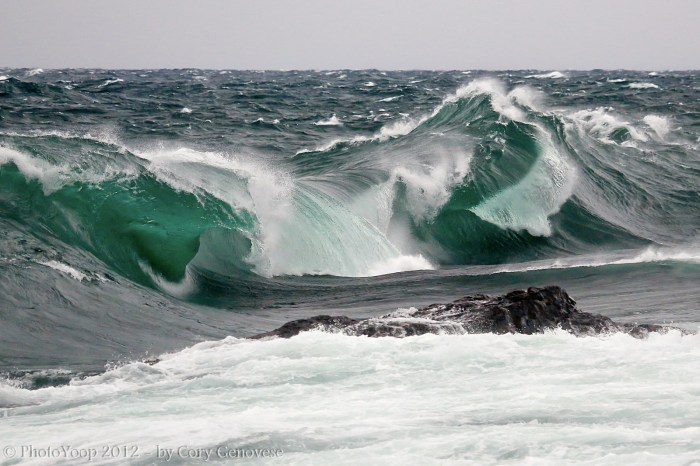
Frankenwaves

Sandy’s Frankenwaves, photo by PhotoYoop

Superstorm Sandy’s Michigan impact has been fairly minor, forcing a few power outages but mainly sending hundreds of Michigan power company employees east to help restore services. Lake Michigan did record the second highest wave height ever of 21.7 feet, and of course brought out surfers to test their skills against some big waves.

Check this out on black and see a few more shots of the Superior waves in Cory’s slideshow and also in this gallery on his PhotoYoop Facebook page.

Happy Halloween from Michigan in Pictures!

Halloween Spectacle, photo by Kim Nixon

The Halloween Spectacle is an annual event that took place last Saturday in Marquette. Here’s hoping you can get out and make a spooky spectacle of yourself tonight!

Check this out bigger on Facebook and see her slideshow from the Halloween Spectacle on Flickr. More work from Kim at Create with Kim.

…and more Halloween from Michigan in Pictures and Absolute Michigan!

Riding towards Halloween

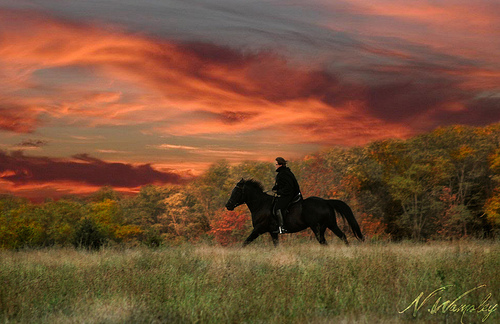
Halloween sunset... ©n.wamsley

Halloween sunset…, photo by Through My Eyes, Nicole Wamsley (astra.amara)

Nicole has the perfect photo for the day before Halloween. Check it out on black and see more including some really cool Headless Horseman (woman?) shots in her Halloween slideshow.

More Halloween photos on Michigan in Pictures.

The Strongest Storm Ever on the Great Lakes

"October Gale" Grand Haven lighthouse, Grand Haven Michigan

“October Gale” Grand Haven lighthouse, Grand Haven Michigan, photo by Michigan Nut

As the eastern seaboard braces for Hurricane Sandy, a storm of possibly unprecedented power, I thought I’d take a look back and see what the strongest October storm ever was. I didn’t have to look far, as it’s actually the Great Lakes storm of late October 2010:

On October 26, 2010, the USA recorded its lowest pressure ever in a continental, non-hurricane system, though its pressure was consistent with a category three hurricane. The powerful system was dubbed the “Chiclone” by the media as it hit the Chicago area particularly strongly, as well as Minnesota, Wisconsin and Michigan. It was also meteorologically referred to as a bombogenesis due to the rapid drop of barometric pressure experienced.

…The storm also produced some of the highest officially recorded waves by weather buoys stationed in Lakes Superior and Michigan. Specifically, on Wednesday, October 27, 2010, buoy no. 45136, operated by Environment Canada, in northern Lake Superior recorded a significant wave height of 26.6 feet (this is average height of 1/3 of the highest waves over an hour), and buoy no. 45002, operated by the National Data Buoy Center (NDBC), recorded a significant wave height of 21.7 feet in northern Lake Michigan. The NDBC and many models indicate that multiplying significant wave height by a factor of approximately 1.3 will equal the approximate average height of the highest 1/10 of waves recorded -here that would translate into such average wave heights of approximately 34.5 feet and 28.2 feet on Lakes Superior and Michigan respectively [please verify]. This would appear consistent with the NOAA forecast for northern Lake Michigan calling for 21-26 foot waves that day. The persistence and strength of the storm’s westerly winds also piled the waters of Lake Michigan along the Michigan shoreline leading to declines in lake levels on the Illinois and Wisconsin side of the lake. Based on NOAA lake level sensors, an updated analysis of Wednesday, October 27, 2010 water levels on Lake Michigan revealed a two-day decrease of 42 inches at Green Bay, WI and 19 inches at Calumet Harbor, IL—while NOAA sensors at Ludington, MI and Mackinaw City, MI measured lake level rises of 7 and 19 inches respectively.

A 78 mph gust was recorded the afternoon of October 27, 2010 at the Harrison-Dever Crib, three miles offshore of Chicago in Lake Michigan.

You can read a detailed account of the damage in the October North American Storm Complex on Wikipedia and also read Dr. Jeff Masters’ analysis of the storm at Weather Underground.

Check this out on black and see more in John’s Grand Haven Lighthouse slideshow.

More Michigan weather on Michigan in Pictures.