Draco, Snowmageddon and the naming of winter storms

Fierce

Fierce, photo by farroutdude

Meteorologist Paul Gross of WDIV has a nice forecast for Michigan & Metro Detroit (although the weather maps were a little confusing to me). In Winter Storm Draco ends record snowless streaks across Midwest, Dr. Jeff Masters of the Weather Underground adds that:

Winter Storm Draco is powering up over the Upper Midwest, and is poised to bring a resounding end to the record-length snowless streaks a number of U.S. cities have notched this year. Blizzard warnings are posted over portions of Colorado, Nebraska, Kansas, Iowa, Illinois, and Wisconsin, and snowfall amounts of up to a foot are expected in some of the affected regions. While the heavy snow will create dangerous travel conditions, the .5″ – 1.5″ of melted water equivalent from the the storm will provide welcome moisture for drought-parched areas of the Midwest.

…Average water levels on Lake Michigan and Lake Huron are near their lowest December levels ever recorded, preliminary data from NOAA’s Great Lakes Environmental Research Laboratory indicate. The U.S. has had its warmest and 12th driest year on record, according to NOAA’s National Climatic Data Center. It should be no surprise, then, that a number of major cities have set records for their longest period without snow. Most of these streaks have come to and end (or will do so in the next day or two) because of Winter Storm Draco.

Draco? You might be wondering when & why we started naming winter storms. The answer is actually due to social media:

A new naming system put in place by The Weather Channel has its roots in social media to make it easier for people to communicate and share information about winter storms. The network is the first to name them, similar to how tropical storms and hurricanes have been referenced for years.

“In addition to providing information about significant winter storms by referring to them by name, the name itself will make communication and information sharing in the constantly expanding world of social media much easier,” The Weather Channel meterologist Tom Niziol wrote on the site. “As an example, hash tagging a storm based on its name will provide a one-stop shop to exchange all of the latest information on the impending high-impact weather system.”

Mind your dragons folks and enjoy the last day of the 13th b’ak’tun cause the next time doesn’t roll around for 394.25 years!

See the dragon in faroutdude’s photo? View it on black and see more in his Marquette slideshow.

More Michigan blizzards on Michigan in Pictures.

Andy’s Trees … and Michigan Bigfoot

Andy'sTrees

Andy’s Trees, photo by swatzo

I’m guessing these trees aren’t for me, but I still love them. Another thing that I’ve loved since I was a kid was the search for Bigfoot. mLive reports that last April, the team of Bigfoot researchers from Discovery Channel’s Finding Bigfoot show came to Michigan:

After their first search yielded no sightings or additional evidence, BFRO held a town hall meeting in Houghton Lake to solicit additional leads from local residents. A show of hands revealed that a large group of those gathered had seen what they thought was a Bigfoot creature. One woman had made recordings of what she claimed could be a sasquatch which prompted Moneymaker to investigate further.

During the second night of searching, BFRO was joined by Mike Berg, a Michigan Bigfoot tracker. Berg partnered with Barackman to explore one tract of forest while Moneymaker camped out in a tree stand on the property of the woman who had made the sound recordings. While both locations yielded sounds that were thought to be from a Big Foot creature, no visual evidence was obtained.

Meanwhile, Holland and Fay were investigating woods where a local boy reported a sasquatch sighting. The two attempted to communicate with the creature by making different types of calls at varying pitches. After hearing several wood knocks after the calls, Bobo clapped back, which was followed by more of the wood knocks. The knocks were followed by movement on the road, but their chase also failed to provide a definitive picture of sasquatch.

Watch a clip at the Finding Bigfoot website and also on YouTube. The episode airs this Saturday at 7 PM and other times this week on Discovery. More about Bigfoot in Michigan at the Michigan Bigfoot Information Center.

Check this out on black and see more in Steve’s slideshow.

More trees on Michigan in Pictures.

Hill of Beans: The Michigan Bean Elevator in Saginaw

Michigan Bean Elevator - Saginaw, Mi

Michigan Bean Elevator – Saginaw, Mi, photo by jhoweaa

I know that many of you have been losing sleep because you don’t know the location of the world’s biggest bean elevator. You can rest easy now, because Waymarking.com explains that the largest bean elevator in the world is in Saginaw MI:

As a young man, (Albert L.) Riedel was one of the organizers of the Producers Elevator Company of Port Huron which later grew into the Michigan Bean Company. He was elected secretary of Michigan Bean when it moved its headquarters to Saginaw’s Bearinger Building and he was only 27 when he was named general manager of the company.

…In 1937, Riedel became president of the company as well as general manager and served in that capacity until the firm was sold to the Wickes Corporation in 1955. As president of Michigan Bean, Al Riedel pushed the idea of selling packaged, trademarked beans to the retail market instead of relying on bulk sales.

He was instrumental in making the Jack Rabbit brand of beans known all over the world. And it was while Riedel was president that the famous Bean Bunny neon sign was erected at the top of “the world’s largest bean elevator”.

The Bean Bunny, now proudly relit, has become one of Saginaw’s most beloved symbols. During World War II, too old for active service, Riedel volunteered as a dollar-a-year-man and served as a consultant attached to the Quartermaster Corp. He revamped purchasing and shipping programs and designed and developed waterproof bags for shipping food overseas.

You can learn a lot more about the Bean Bunny sign and see photos at mLive. The Michigan Bean Commission has tons of information about Michigan beans.

James also has some information about the bean bunny on his blog as well. You can also buy a print or a card there. View his photo on black and see more in his Interesting slideshow.

More from Saginaw on Michigan in Pictures.

Low water exposes Grand Haven shipwreck graveyard

Grand Haven Shipwrecks

Grand Haven Shipwrecks, photo by Kevin Ryan

mLive has a feature on how our historically low water levels have revealed a number of shipwrecks in Grand Haven:

Maritime archaeologist and director of the Tri-Cities Historical Museum Kenneth Pott said the area around Harbor Island was an apparent dumping zone for abandoned vessels and 1930s aerials held by the museum and the city of Grand Haven show that additional wrecks exist there. If the water line were to recede even more, then more vessels may be exposed.

“We’re quite sure that there are more in the area,” Pott said. “This is something akin to a graveyard for vessels. This is very unusual.”

The wooden sections of the 290-foot steamer Aurora, once the largest wooden steamer on the Great Lakes, and parts of at least four other shipwreck hulks were exposed recently by the low water levels and area residents alerted maritime historians to the find. The Aurora was identified by members of Holland-based Michigan Shipwreck Research Associates and local historians earlier this week.

Read on for more info including the publicly-accessible location. You can also read more about the Aurora right here and see a photo gallery.

Check this out background big and see a couple more views including a nice one of the rough outline of the wreck in Kevin’s slideshow.

More Michigan shipwrecks on Michigan in Pictures.

Dream on

Dream On

Dream On, photo by Unified Photography

I can’t make sense of what happened yesterday at Sandy Hook Elementary School and have nothing to say other than that my thoughts and prayers are with these families and all of us.

Get this photo background big and view more in Kenneth’s Sleeping Bear Dunes slideshow.

Happy Hobbit Day

Please come in...  3 Weeks Later

Please come in… 3 Weeks Later, photo by Craig – S

“There is nothing like looking, if you want to find something. You certainly usually find something, if you look, but it is not always quite the something you were after.”
― J.R.R. Tolkien, The Hobbit

Today The Hobbit: An Unexpected Journey opens. It really has nothing at all to do with Michigan, but it’s arguably the most powerful fairy tale of the modern era and also my personal favorite tale, both Tolkein’s books and Peter Jackson’s masterful films. So Happy Hobbit Day everyone, and may you find what you’re looking for and the good things you are not!

Craig took this photo at Margaret McIntire’s Boardwalk Cottage on Mackinac Island. Check it out as big as Smaug and see more including another view of this door in his Mackinaw – Mackinac Island slideshow. If it catches your fancy, you can buy a print from Craig too!

If you want to see some real Michigan hobbit homes, check out Earl Young’s boulder houses in Charlevoix.

McGulpin Point Lighthouse on the Straits of Mackinac

McGulpin Point Lighthouse Emmet County

McGulpin Point lighthouse circa 1900, courtesy Emmet County Davenport collection/Terry Pepper

Terry Pepper’s Seeing the Light says that McGulpin Point Lighthouse entry tells the story of this point at the tip of Michigan’s mitten from circa 1000 BC when the great Odawa war chief Sagemaw more or less wiped out the Mus-co-desh tribe for an insult to the Odawa to when John McAlpine and his Native American wife settled on McGulpin Point in the 1760s. Their son Patrick McGulpin was given the patent on this land and the first recorded deed in Emmet County in 1811.

With the opening of the Erie Canal in 1825, Americans started to flood to the Chicago area. During the 1850s, vessel traffic through the Straits of Mackinac was increasing rapidly, and while the Waugoshance Light marked the western entry into the Straits, and the Bois Blanc Island light marked the eastern entry, the absence of a navigational aid within the shoal-ridden Straits themselves made passage during darkness and periods of low visibility extremely dangerous. To answer that need, the Lighthouse Board petitioned Congress for the construction of a lighthouse and fog bell at McGulpin Point, approximately two miles west of Fort Michilimackinac. Congress responded favorably to the request on August 3, 1854 with the appropriation of $6,000 for the station’s construction.

However, as a result of difficulties in obtaining clear title to the land, no action was taken on the station’s construction for more than a decade. With the original appropriation unspent and expired, the Board again petitioned Congress for the construction of a station at McGulpin Point in 1864, this time receiving $20,000 for the project on July 26, 1866.

Work began at McGulpin Point early in 1869, and the station was built as a mirror image of the design used at Chambers Island and Eagle Bluff lights under construction in the Door County area that same year. This plan, which is sometimes referred to as the “Norman Gothic” style, was also later also used at Eagle Harbor in 1871, White River in 1875, and at Passage and Sand Islands in 1882. (click for photos of these lights)

The keepers dwelling and integrated tower were constructed of Cream City brick with the tower integrated diagonally into the northwest corner of the dwelling. The first and second stories of the tower were approximately ten feet square with buttressed corners, while the tower’s upper portion consisted of a ten-foot octagon. Similar to other stations built on this plan, the tower is double-walled with a circular inner wall approximately four inches thick and eight feet in diameter to house a set of cast iron spiral stairs. The tower was capped with a prefabricated decagonal cast-iron lantern and outfitted with a fixed white Third-and-a-half Order Fresnel lens.

You can learn a lot more if you read on at Seeing the Light including the role the light played in knowing when the lakes would be opened for navigation, the role of Keeper Davenport and his 9 children in the rescue of the Waldo A. Avery, how the light was decommissioned in 1906 after the construction of Old Mackinac Point Lighthouse and passed into private hands and its return to the public domain.

Today McGulpin Point Lighthouse is an Emmet County park and open to the public. There’s many resources including the McGulpin Point brochure and some photos from a 2012 CMU archaeological dig.

You can see more photos by clicking through. Also check out the McGulpin Point slideshow from the Absolute Michigan pool on Flickr for some modern day photos!

Many more Michigan lighthouses on Michigan in Pictures.

12-12-12

twelve

twelve, photo by n.elle

A few things I have found…

Nicole shot this at the Greektown Casino. Check it out on black and see more great work in her Flickriver.

Know Your Michigan Birds: Cooper’s Hawk

10 January ~ Breakfast (with an Attitude)

10 January ~ Breakfast (with an Attitude), photo by MichaelinA2

All About Birds says that Cooper’s Hawks (known as the Chicken Hawk in England) are among the bird world’s most skillful fliers, tearing through tree canopies in high speed pursuit of other birds. They have more information and hawk calls and offer some fun facts:

  • Dashing through vegetation to catch birds is a dangerous lifestyle. In a study of more than 300 Cooper’s Hawk skeletons, 23 percent showed old, healed-over fractures in the bones of the chest.
  • Once thought averse to towns and cities, Cooper’s Hawks are now fairly common urban and suburban birds.
  • Life is tricky for male Cooper’s Hawks. As in most hawks, males are significantly smaller than their mates. The danger is that female Cooper’s Hawks specialize in eating medium-sized birds. Males tend to be submissive to females and to listen out for reassuring call notes the females make when they’re willing to be approached. Males build the nest, then provide nearly all the food to females and young over the next 90 days before the young fledge.
  • The oldest known Cooper’s Hawk was 20 years, 4 months old. (and apparently good at either providing food or flying fast!)

See Michael’s photo on black and see more in his Top 99 Most Popular Photographs slideshow.

Many more Michigan birds on Michigan in Pictures!

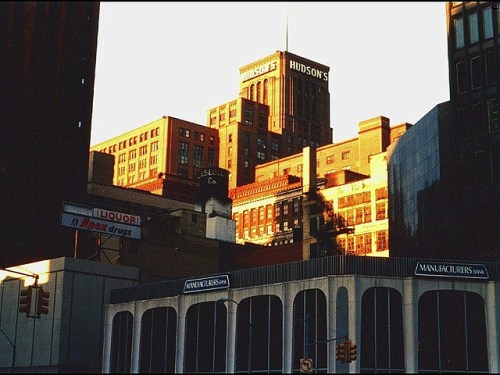
Hudson’s, a Detroit Icon

JL Hudsons Detroit

hudsons, photo by johnhoneyman

One of the signs that the holidays are approaching that I see on Michigan in Pictures is a surge of visits to the post about Holiday Shopping at J.L. Hudson in Detroit. Hudson’s was demolished in 1998, but the store remains a cherished memory for many.

Wikipedia’s entry for the J.L. Hudson Department Store and Addition says that the building was designed by Smith, Hinchman, & Grylls and named after the company’s founder, Joseph Lowthian Hudson. Construction began in 1911 with many additions throughout the years before being “completed” in 1946. Hudson’s Department Store at Historic Detroit has some great photos and a lot of facts:

  • The store was 2,124,316 square feet, making it second in size among department stores to only Macy’s in New York. Even then, Macy’s is only 26,000 square feet bigger.
  • The store was spread out over 32 floors: 25 floors, two half-floors, a mezzanine and four basements.
  • At 410 feet, Hudson’s was the tallest department store in the world.
  • The building had 51 passenger elevators, 17 freight elevators, eight employee elevators and 48 escalators. Its largest freight elevator could accommodate a semi trailer.
  • Hudson’s had to have three transformer centers in the store: They generated enough juice to power a city of about 20,000.
  • The store had 39 men’s restrooms, 50 for women and 10 private ones for executives. The largest was a women’s lounge on the fourth floor that had a whopping 85 stalls.
  • It had 705 fitting rooms, a world record.
  • The dining rooms and cafeterias served an average of 10,000 meals a day – not counting the 6,000 meals a day served in the employee cafeteria on the 14th floor. The 13th floor dining room was renowned for its Maurice salad and Canadian cheese soup.
  • The store originally had 18 entrances and 100 display windows, which were changed weekly.
  • The store featured more than 200 departments across an incredible 49 acres of floor space, and it featured about 600,000 items from 16,000 vendors from 40 countries. The building had 51 elevators serving its 17 floors of retail.

Much more at Historic Detroit and you will also want to check out Hudson’s in the Department Store Museum, a Hudson’s photo tour from Detroit Yes and a nice video of photos of Hudson’s.

Check this out on black and see more in John’s arkitektura slideshow.