January 26th is Michigan’s Birthday!

Leaping in a Winter Wonderland

Leaping in a Winter Wonderland, photo by karstenphoto

Today is Michigan’s 176th birthday. For the 175th birthday last year we compiled some fun facts that you can check out. Here’s hoping that you get a chance to get out and celebrate what Michigan has to offer this weekend!

If you’re staying warm inside, consider reading about Michigan’s statehood and associated documents at Seeking Michigan.

Check Steven’s photo out big as Michigan and see this and more winter fun in his winter slideshow.

Mackinac Island in Winter

Mackinac Island in the winter

Mackinac Island in the winter by SuzyQ0763, photo by SuzyQ0763

Mackinac Island is one of Michigan’s coolest places, drawing over 10,000 visitors a day for much of the summer. Winter on Mackinac is different though, and something that many of us never get to see.

The Arnold Line says that they keep boats running across until early January. After that, islanders use a six-seater plane operated by Great Lakes Air. Once the straits freeze (usually by February) folks can cross on snowmobiles, following the “bridge” marked by Christmas trees in the snow and ice between the Island and St. Ignace (click for a video).

If you’re interested in checking out the island in winter, the Mackinac Island Winter Festival takes place next weekend (February 1-3) at Great Turtle Park. The fun includes a bonfire cook out, sledding, snow golf, archery, snow volleyball, and broom hockey.

Check Suzy’s photo out background big or view all her photos from a winter’s day on Mackinac Island.

Today is National Pie Day!

National Pie Day ~ January 23, 2012

National Pie Day ~ January 23, 2012, photo by Trish P. – K1000 Gal

Today (Wednesday, January 23rd) is National Pie Day. A whole day just for pie? The Pure Michigan Blog explains:

Created by the American Pie Council, ‘Pie Day’ is dedicated to celebrating America’s love of pie. And in Pure Michigan, we know and love pie. In fact, Michigan produces:

  • More than 50 percent of the nation’s apple slices and is the largest supplier of apple slices used in commercially prepared apple pies.
  • Roughly 75 percent of the country’s tart cherry crop every year. Those are the ones that go into pies, juice and preserves.
  • 25 percent of the national highbush blueberry crop (110 – 180 million pounds)

While there are many flavors and variations of this classic American dessert, nothing makes for a better pie than using pure, fresh ingredients and fruits – Michigan’s surrounding Great Lakes and rolling hills create a perfect climate for fruit-growing and is a leading producer of many popular pie fruits that can be found in local bakeries as well as national store-bought brands.

To celebrate, Pure Michigan has teamed up with the Grand Traverse Pie Company to offer fans on Twitter the chance to win an entire pie every hour between 10 AM – 5 PM on the 23rd. Just tweet your favorite type of pie to both @PureMichigan and @GTPie. Tweets must include the hashtag #puremichiganpie and entrants must follow both Pure Michigan and Grand Traverse Pie Company on Twitter. Click through for more.

Trish made a peach/blueberry pie with Michigan fruit: Peaches from Steimel & Sons Farm in Suttons Bay, Leelanau County and blueberries from Hazen’s Farm in Howell, Livingston County.  Click to see it on black  and get lots more tasty goodness in Trish’s Michigan Harvest slideshow.

Ice Arch: Cold grips Michigan

Ice Arch

Ice Arch by adonyvan, photo by adonyvan

Got to love what a lake like Superior can carve out of ice.

Right now the coldest air of the last 4 years has settled in across Michigan. Metro Detroit will see wind chills below zero today, Bay City/Saginaw and the surrounding area faces single digit temps and wind chills 15-20 degrees below zero, and it’s just 1 degree right now in Traverse City with double digit wind chills. A scan of Michigan temps shows Ironwood leading the way at a frigid -18 degrees with wind chills up to -26 expected. Bundle up!!

Here’s a funny chart about how Michiganders deal with cold via Absolute Michigan!

View on black and if you want a treat, kick back and watch Jiqing Fan’s Houghton & UP MI slideshow.

More cold on Michigan in Pictures!

Martin Luther King, Jr. National Day of Service

MLK March 8

MLK March 8, photo by JSmith Photo

Today is Martin Luther King Jr. Day. I hope you have today off. I also hope that you get a little time to reflect on the continuing quest for equality for all, here in Michigan and all over the planet. Until we all have equal rights, it doesn’t seem to me like we can truly count ourselves successful.

If you do have the day off, MLK Day is also a National Day of Service. The State of Michigan explains:

Dr. Martin Luther King, Jr. once said, “Everybody can be great because everybody can serve.” To honor his words of inspiration and encouragement, the Michigan Community Service Commission asks you to mark January 21, 2013 on your calendar for the Martin Luther King, Jr. Day of Service. The MLK Day of Service was initiated by Congress in 1994 and has been developed beyond a federal holiday honoring Dr. King into a national day of community service. In honor of this special day, thousands of service projects will be planned across the country grounded in Dr. King’s teachings of nonviolence and social justice.

File that page away for next year as you can seek small grants from the state for events that engage volunteers in community projects and head over to MLKday.gov to find projects in your community.

See Jeffrey’s photo background big and see more in his MLK CommUNITY March and Peace Vigil slideshow.

More MLK on Michigan in Pictures – be sure to check out the Great March to Freedom!

Bishop Baraga, the Snowshoe Priest

Bishop Baraga Shrine, L'Anse

Bishop Baraga Shrine, L’Anse, photo by RPM-Photo

Bishop Frederic Baraga passed away 145 years ago on January 18, 1868. He was born on June 29, 1797* in the castle of Mala vas in the Northwestern part of Slovenia, and for over half of the 71 years of his life Baraga covered a vast territory of over 80,000 square miles in Michigan, Wisconsin, Minnesota and Canada. The history page at the campaign for sainthood of Bishop Baraga explains that:

Father Baraga arrived in the New World on December 31, 1830. For the next 37 years he travelled the length and breath of the Great Lakes area to minister to the Ottawa and Chippewa Indians. His first mission (Arbre Croche, 1833-1835) was established along the shore of Lake Michigan at present day Harbor Springs to Cross Village. Fr. Baraga labored two years at Grand River (1833-1835) presently known as Grand Rapids, before moving his mission to LaPointe (1835-1843) and L’ Anse (1843-1853) on Lake Superior. During the summer months, Father Baraga traveled on foot and by canoe. During the winter months, he traveled on snowshoes thus giving him the titles of “Apostle of the Lakelands” and “Snowshoe Priest.” He wrote long and frequent accounts of his missionary activities including a three-volume diary. He also wrote seven Slovenian prayerbooks and authored 20 Native American books which inlcudes his monumental Grammar and Dictionary of the Chippewa Language , still in use today. He was the first bishop to write a pastoral letter in both the English and Chippewa languages.

From 1840 to his death, he ministered to the immigrants who came to the Upper Peninsula of Michigan to work in the iron and copper mines of the region. About the same time, he began the practice of rising at 3 a.m. in the summer and 4 a.m. in the winter to spend three hours in prayer, which he continued until the end of his life. His responsibilities grew even greater when he was named bishop of the newly created Vicariate of the Upper Michigan. He was consecrated bishop in Cincinnati on November 1, 1853. The lack of priests and money weighed heavily on his heart. Due to his hard work and dedication, Bishop Baraga was able to report to the Holy See a year before his death that his diocese rested on a firm foundation, with enough priests and churches for the fast-growing area. Sault Ste. Marie was his See City until 1866, at which time he moved to Marquette-a more centrally located and accessible city by both ship and train. In the Fall of 1866 while attending the Council of Baltimore, Bishop Baraga suffered a severe stroke. Afraid that his fellow bishops would not allow his return to the severe climate and remote regions of Lake Superior, he begged the priest who accompanied him (Rev. Honoratus Bourion) to take him back to Marquette. Understanding his bishop wanted to die among his flock, Rev. Bourion practically carried Baraga to the train for the long trip back to Marquette.

There’s a lot more about Baraga there including an excellent tour of Baraga’s life in the Upper Peninsula that I imagine would make a great vacation.

You can have a look at Bishop Baraga right here and read more in the entry for the Venerable Frederic Irenaeus Baraga in Wikipedia where I found the link for an online version of Father Baraga’s 1853 Ojibwe Dictionary. Here’s the direct link to the dictionary. You can read more about the Baraga shrine at Roadside America.

View RPM’s photo on black and see more in his Mich-ellaneous slideshow.

*Coincidentally enough, that’s my birthday too!

Great Lakes Ice at near-record lows

Winter 2011 - Lake Ice

Winter 2011 – Lake Ice, photo by danbruell

The Great Lakes Echo reports that:

composite map of the Great Lakes produced by NOAA’s CoastWatch organization shows near-historic low ice coverage across the region.

The map, known as the Great Lakes Surface Environmental Analysis, is a composite of data taken from NOAA satellites orbiting the earth’s poles and radar scans of the lakes by the National Ice Center. The resulting image shows surface water temperature and ice coverage, important data for region scientists, fishermen and boaters. The map’s data is updated daily.

“Previously, the lowest ice coverage year was 2002,” CoastWatch manager George Leshkevich said. “2012 came very close to 2002, and this year is looking very similar to last year.”

Lack of ice cover leads to increased water evaporation, a serious concern in light of already-low lake levels.

You can read more about last year’s ice cover and impacts on Absolute Michigan.

Check Dan’s photo out background bigtacular and see more in his Lake Ice slideshow.

More winter wallpaper on Michigan in Pictures!

The Michigan Moose Lift

Like posts like this? Please consider supporting Michigan in Pictures through Patreon!

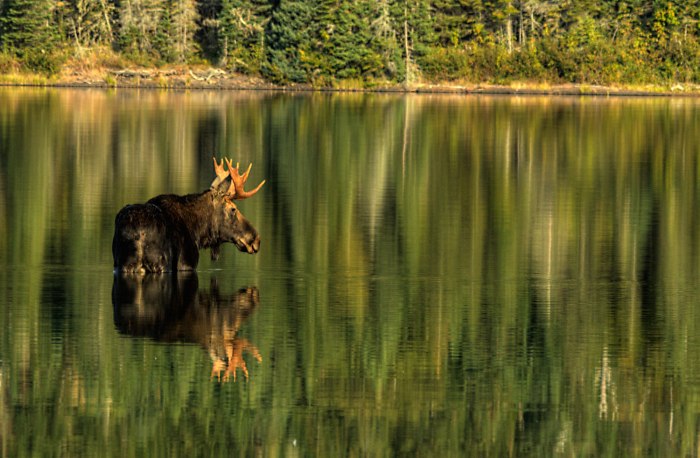
Michigan Moose Reflections

Moose Reflections, photo by yooper1949

NOTE: I’ve edited this post because the State of Michigan removed it from the internet. Thank you archive.org for saving it via The Wayback Machine so I could share it in its entirely!

Remembering Michigan’s Historic Moose Lift from the Michigan DNR says:

On Jan. 20, 1985, separate convoys carrying men and equipment set out from Michigan on a mission to reach the 3,000-square-mile Algonquin Provincial Park in Ontario, Canada.

Over the next two weeks, this team of wildlife biologists and veterinarians from the Michigan Department of Natural Resources, working with a team of Canadian specialists from the Ontario Ministry of Natural Resources, would locate, capture, transport and release a number of wild moose to form the nucleus of a new population in Michigan’s Upper Peninsula.

It was an unprecedented, historic operation. The wind chill at times approached 100 degrees below zero. Utilizing helicopters, tranquilizing dart guns and slings, some moose were air-lifted as far as 14 miles from the capture area to base camp.

At base camp, each animal was subjected to thorough medical testing and was fitted with a sophisticated radio collar, before being lifted into a shipping crate and placed onto a transport truck for the non-stop 600-mile overnight journey back to Michigan.

The remarkable effort was called “moose lift.” A total of 29 moose (10 bulls, 19 cows), ranging in size from 750 to 1,250 pounds, survived the arduous journey.

Crowds assembled each day at the release site north of Lake Michigamme in Marquette County. Despite temperatures well below zero, a welcoming committee of U.P. residents always showed up to greet the new “American” citizens.

As we mark the 20th anniversary of the first moose lift, the most common question that arises is, “How are the moose doing now?”.

“The department’s goal was to produce a self-sustaining population of free-ranging moose, and we have that,” said Dean Beyer, wildlife research biologist for the Michigan Department of Natural Resources.

Since the first moose lift in 1985, and a similar effort two years later when another 30 moose were released in the same area, the DNR has closely monitored the reintroduced moose population.

“At first, the size and growth of the herd was determined through a simple process–similar to balancing a checkbook,” Beyer said. “Because all moose were radio-collared, biologists could monitor each animal and tell when it died, and they could follow cows to record any births. The population could be tracked simply by adding the number of calves born and subtracting the number of animals that died.”

As the population grew, the new animals in the herd did not have radio collars.

“Over time, maintaining an adequate sample of radio-collared animals for the population would not be feasible,” Beyer said.

So in 1996 and 1997, the DNR conducted aerial surveys, which are the most common method of estimating moose numbers. Unfortunately, the population estimates from the aerial surveys were lower than estimates from the population model.

“At that point we knew we needed to conduct a more intensive study of the reintroduced population,” Beyer said. “And we also wanted to determine a more accurate picture of what’s reasonable growth for this population.”

With the help of the Michigan Involvement Committee of Safari Club International, which also provided the single largest financial contribution to the first moose lift, the DNR began a more intensive study of the reintroduced population in 1999, in cooperation with Michigan State University.

“Our research team is developing a technique to estimate the size of the population by estimating the probability of seeing moose from an airplane given the group size; behavior, whether the animal is standing or bedded; and the amount of canopy cover,” Beyer said.

When the moose were reintroduced into the western Upper Peninsula, biologists hoped the population would grow to 1,000 animals by the year 2000. Although that objective was not reached, results of the current study indicate the population is growing, on average, between five and ten percent each year. The research also has shown that poaching, moose/car accidents, brainworm and wolves are not major factors influencing the moose population at this time.

According to Beyer, the herd ranges over approximately 1,800 square miles in Marquette, Baraga and Iron counties. Moose also are found in several parts of the eastern U.P., most notably around the Tahquamenon River.

“Moose in this region have not been studied in detail,” he said.

Although records from the early explorers show that moose were common throughout Michigan, by the late 1800s moose numbers were very low. Moose soon disappeared from the Lower Peninsula and only a small number survived in the U.P., perhaps supplemented by animals coming in from Minnesota and Canada.

Thanks to the vision and hard work of many DNR biologists a generation ago, moose are once again establishing themselves as a premiere Michigan mammal.

Several U.P. communities, in fact, now vie over the self-proclaimed title, “Moose Capital of Michigan.” Mascots, motels, restaurants, candy and even ice cream are named after the mighty moose. Its image is common on billboards, television, artwork and printed materials. But most importantly, moose are alive and well, and rambling about in the wilds of Michigan’s Upper Peninsula once more.

Here’s a great video about the Moose Lift – highly recommended!

The last DNR moose survey pegs the UP’s moose population at about 500 with another 750 on Isle Royale.

Carl took this shot on Isle Royale in September. Check it out big as a moose and see much more (including some more moose shots) from one of Michigan’s coolest parks in his Isle Royale slideshow.

More moose on Michigan in Pictures!

NAIAS: 2013 Detroit Auto Show roars into town

LFA

LFA by JSFauxtaugraphy, photo by JSFauxtaugraphy

Snapshots from the 2013 North American International Auto Show aka NAIAS 2013 aka the Detroit Auto Show started yesterday for media & industry. The public show runs Saturday, January 19 through Saturday, January 26. Here are a few quick hits:

Check this out background bigtacular and see more in Joseph’s NAIAS 2012 slideshow.

More NAIAS on Michigan in Pictures.

Michigan Wild & Scenic Rivers: Manistee River

Manistee River, near Sharon, Michigan

Manistee River, near Sharon, Michigan, photo by gregorydseman

It is hereby declared to be the policy of the United States that certain selected rivers of the Nation which, with their immediate environments, possess outstandingly remarkable scenic, recreational, geologic, fish and wildlife, historic, cultural or other similar values, shall be preserved in free-flowing condition, and that they and their immediate environments shall be protected for the benefit and enjoyment of present and future generations.
~Wild & Scenic Rivers Act, October 2, 1968

Michigan has 16 nationally designated Wild & Scenic Rivers. The stretch of the Manistee River from the DNR boat ramp below Tippy Dam to the Michigan State Highway 55 Bridge is the designated stretch (click for map and river management plan). They explain:

The Manistee Wild and Scenic River is well known for beautiful scenery, excellent fishing and a variety of recreational activities. In the spring and fall, high numbers of anglers are attracted to the superb salmon and steelhead runs. During the summer, walleye and pike fishing become the primary recreational activity. The river supports a variety of other recreational uses including wildlife viewing, hiking, canoeing and hunting.

Private businesses and government agencies have developed a variety of facilities and services to meet the expanding recreation demands of the public. Commercial guided fishing is one of the most popular activities on the Manistee River. The amount of recreational use fluctuates from year to year, mostly based on the fishing runs and local economic factors. There are eight developed river access sites within the wild and scenic river corridor. The Forest Service maintains sites at High Bridge, Bear Creek, Rainbow Bend and Blacksmith Bayou. The state of Michigan operates a river access site at Tippy Dam. Private recreation sites include Big Manistee Riverview Campground and Coho Bend Campground. The U.S. Forest Service developed recreation sites along the Manistee River require a vehicle parking pass under the Recreation Enhancement Act.

Greg says he took this photo back in 1998 when the river had more water – check it out bigger and see more in his slideshow.

More Wild & Scenic Rivers on Michigan in Pictures!