Ice on the Chippewa River

_JMC5873aw

_JMC5873aw, photo by Jeff Caverly

Wikipedia’s Chippewa River (Michigan) says that the river runs 91.8 miles from its beginning in northeast Mecosta County in the village of Barryton to where it flows into Big Cranberry Lake in southwest Clare County. It’s a tributary of the Tittabawassee River and part of the Saginaw River drainage basin.

To learn more about the river and some of the natural preserves on the river, visit the Chippewa River Watershed. You can also check out the Chippewa River Water Trail.

Get Jeff’s photo background bigtacular and see more in his slideshow.

More Michigan rivers on Michigan in Pictures.

Heavy (Space) Weather: Coronal Mass Ejections and the Northern Lights

Northern Lights

Northern Lights, photo by gkretovic

Michigan in Pictures has a whole lot on the Northern Lights.

The aurora borealis are one of the world’s most rare and wonderful sights and Michigan – especially the Upper Peninsula – is blessed with more than a few nights every year when this elusive phenomenon makes an appearance.

The Library of Congress page What Are the Northern Lights? calls on NASA’s Dr. Sten Odenwald, author of The 23rd Cycle, Learning to Live with a Stormy Star, to provide insight to how northern lights are formed:

The origin of the aurora begins on the surface of the sun when solar activity ejects a cloud of gas. Scientists call this a coronal mass ejection (CME). If one of these reaches earth, taking about 2 to 3 days, it collides with the Earth’s magnetic field. This field is invisible, and if you could see its shape, it would make Earth look like a comet with a long magnetic ‘tail’ stretching a million miles behind Earth in the opposite direction of the sun.

When a coronal mass ejection collides with the magnetic field, it causes complex changes to happen to the magnetic tail region. These changes generate currents of charged particles, which then flow along lines of magnetic force into the Polar Regions. These particles are boosted in energy in Earth’s upper atmosphere, and when they collide with oxygen and nitrogen atoms, they produce dazzling auroral light.

We focus on the beauty, but as he explains:

“Aurora are beautiful, but the invisible flows of particles and magnetism that go on at the same time can damage our electrical power grid and satellites operating in space. This is why scientists are so keen to understand the physics of aurora and solar storms, so we can predict when our technologies may be affected.”

Dr. Odenwald’s book is out of print but he has made it available online. There’s some interesting stuff in there, and be sure to check out his Astronomy Cafe site too.

One benefit from the economic & security concerns of predicting space weather is that you can get some great northern light forecasts. My favorite is NOAA’s Space Weather Service. They reported a G1 storm on March 1st – it’s the lowest intensity on the Space Weather Scales but as you can see is still able to produce auroral activity!

Greg took this photo Saturday night just before midnight at Presque Isle in Marquette – check it out on black and in his slideshow. You can see more of Greg’s work on Michigan in Pictures, at michigannaturephotos.com and definitely follow him at Michigan Nature Photos on Facebook.

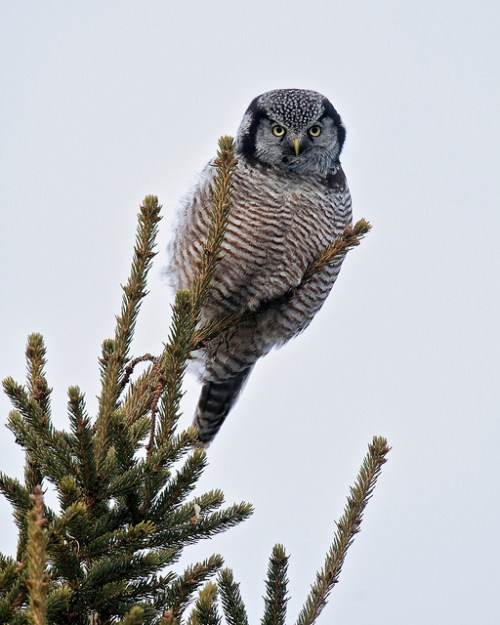
Northern Hawk Owl, and the NMC Hawk Owls

northern hawk owl, chippewa county, michigan

northern hawk owl, chippewa county, michigan, photo by twurdemann

Northwestern Michigan College here in Traverse City has just under 5000 students and is turning from a 2 year to a 4 year college. As part of this, they will be adding athletics again, and that means they need a mascot. So this week they selected a new one – the NMC Hawk Owls.

With a weight of half a pound to a pound, a length of just 14-16″ and a wingspan of just under 2 1/2 feet, the Northern Hawk Owl appears to be the perfect mascot:

Northern Hawk Owl – Surnia ulula at OwlPages.com:

Hunting & Food: Takes mainly small mammals as prey, mostly lemmings and voles. Will also take birds, frogs and occasionally fish. Prey weight is normally below 70g. Hunts by searching from a lookout, then quickly flying to swoop down on prey. Has been observed hovering also.

Breeding: Male advertises potential nest sites, and the female selects one. Nests in Cavities on top of broken trunks, natural tree hollows, abandoned holes of large woodpeckers. Will accept nest boxes, and occasionally use a stick nest of a larger bird. Laying normally occurs in April and the first half of May. Clutch sizes are usually between 5 and 13 eggs, each 36-44mm  x 29-34.4mm. Eggs are laid at 1-2 day intervals, and incubated by the female alone for 25-30 days. During this time, the male feeds the female.

Northern Hawk-Owl at Wikipedia:

The Northern Hawk-Owl has been said to resemble a hawk in appearance and in behavior. In North America, its appearance in flight is often considered similar to a Cooper’s Hawk (Accipiter cooperii). It has been suggested that this may be because the Hawk-Owl may partially fill an important diurnal niche similar to that of day hunters such as hawks.

…Northern Hawk Owls are unevenly distributed and highly variable throughout the boreal forest. They live mostly in open coniferous forests, or coniferous forests mixed with deciduous species such as larchbirchpoplar, and willow. They are found in muskegs, clearings, swamp valleys, meadows, or recently burnt areas, and generally avoid dense spruce-fir forests. Winter habitat is usually the same as breeding habitat. 

Northern Hawk Owl at All About Birds adds that their International conservation status is Least Concern and some cool facts:

  • The Northern Hawk Owl can detect prey by sight at a distance of up to 800 meters (half a mile).
  • Though it is thought to detect prey primarily by sight, the Northern Hawk Owl can find and seize prey under 30 cm (1 foot) of snow.

The Whitefish Point Bird Observatory adds that Northern Hawk Owl were observed yesterday in Trout Lake and Dryburg, Michigan.

Grabbing a mouse through a foot of snow? That’s a seriously scary predator … at least if you’re the prey. Click all those links to explore photos, calls and more about these tiny terrors.

Check this photo from Chippewa County out on black and see more including another shot of this owl in twurdemann’s Birds slideshow.

More owls (and also apparently words that end with owl) on Michigan in Pictures.


Living in the Light at Friends of Miners Memorial Heritage Park

Miners Memorial Heritage Park (2)

Miners Memorial Heritage Park (2), photo by siskokid

I’ve always found snow & cold to be a lot more tolerable when accompanied by a healthy dose of sun & blue skies. About this photo Jim writes:

During the recent snowshoe weekend with my buddies Jim, Fred and Roger, we snowshoed the trails of this beautiful park located in my hometown. A recent snowfall had left a good blanket of powder that hadn’t been groomed as of yet for cross-country skiing. Lucky for us!

The City of Ironwood, Michigan passed an ordinance in 2011 that designated 167 acres of city-owned land in the center of Ironwood as the Miners Memorial Heritage Park. This area once contained five iron ore mines, the last of which closed in the 1960’s. The Friends of Miners Memorial Heritage Park has created a 2.6 mile looping trail through a portion of this area for hiking in the summer and cross-country skiing and snowshoeing in the winter. The Park is “Dedicated to those who toiled underground to work these mines. Many died in the darkness so future generations could live in the light.”

More about the park including some old photos at fmmhp.com.

Check this photo out on black, see more from the park in Jim’s slideshow and also view more of his UP shots on Michigan in Pictures.

In My Kingdom Cold

In My Kingdom Cold II

In My Kingdom Cold II, photo by Shadows in Reflection

While Winter Storm Rocky hammered states west of us with high winds and over a foot of snow, it was relatively mild here in Michigan. Still, numerous schools canceled classes, prompting Lindsay Knake of the Saginaw News to ask readers if Michigan has gone soft. It’s an interesting discussion with good points on both sides. I thought that Neksom had a useful & thoughtful comment:

It’s a different world. I have no doubt administrators would have closed school a lot more in days gone by if it weren’t such a logistical nightmare. Today, technology makes the process relatively simple. Heck, most districts have automatic systems that call parents and employees when a snow day has been announced. And let’s face it – we see too many fatal accidents on days like today not to be a little concerned about safety. If it saves us from even one potential catastrophe, the mild inconvenience is most certainly worth it.

Check this out on black and see more in Michael’s slideshow.

More snow on Michigan in Pictures.

Weird Wednesday: South Arm Nessie

South Arm Nessie

South Arm Nessie, photo by Cvx_Wx

Absolute Michigan has been known to hold Weird Wednesdays on the last Wednesday of every month. Our Michigan Sea Monsters post featured two denizens of the deep courtesy Linda Godfrey’s Weird Michigan, the Sea Monster of the Straits and the Lake Leelanau Monster:

The story of an early 20th Century sea monster sighting was sent to The Shadowlands Web site by a reader whose great-grandfather was the witness. The boy was fishing for perch one day in 1910 in the shallows of Lake Leelanau in Leelanau County. The lake had been dammed in the late 1800’s to provide water power for the local mill and to enable logging. The dam also flooded much surrounding area, turning it into swamps and bogs punctuated by dead, standing trees.

On that particular day, the young great-grandfather, William Gauthier, rowed out to a new fishing spot near the town of Lake Leelanau. Looking for good perch habitat, he paddled up close to a tree that he estimated to stand about five feet tall above the water, with a six-inch trunk. He was in about seven feet of water, and after deciding this would be a good place to stop and cast a line, began tying the boat to the tree.

That’s when young William discovered the tree had eyes. They were staring him dead in the face at about four feet above water level. The boy and serpent exchanged a long gaze, then the creature went, “Bloop” into the water. Gauthier said later that the creature’s head passed one end of the boat while the tail was still at the other end, though it was undulating very quickly through the water. The writer noted that Gauthier always admitted to having been thoroughly frightened by his encounter, and that the event caused him to stay off that lake for many years.

The writer added that his great-grandfather came from a prominent area family and was very well-educated, and that he knew others who would admit privately but not publicly that they, too, had seen the creature. No sightings have been reported in recent times, but who knows how many people have believed they were passing by a rotting old cedar when in fact they had just grazed the Leelanau lake monster?

Could the South Arm of Lake Charlevoix hold similar creatures? Check this out big as a beastie and see more in Ed’s My Neighborhood slideshow.

More weird Michigan on Michigan in Pictures!

city

city

city, photo by buckshot.jones

Check Scott’s photo out background big and see more in his slideshow.

More Detroit on Michigan in Pictures

Black Bear in Michigan

Bear

Bear, photo by Majestic View Photography

Here’s a few of the many Michigan Black Bear Facts available from the DNR:

What is the status of black bear in Michigan?

Approximately 15,000 – 19,000 black bears (including cubs) roam the hardwood and conifer forests of northern Michigan. About 90 percent of the bear live in the Upper Peninsula, while the remaining ten percent are mainly found in the northern Lower Peninsula. However, it is becoming increasingly common to see bear in the southern half of the Lower Peninsula. During the past twenty-five years, the status of the Michigan black bear has been elevated from pest to prized game species. Today, Michigan’s only bear species is protected by law and managed by the Department of Natural Resources (DNR).

What are the physical characteristics of the black bear?

Most black bear in Michigan have dark black fur. Brown color variations are more common in western states. The size of a bear depends on its age, sex, diet, and season of the year. Adult female bear are generally smaller than adult males. In Michigan, female bear range from 100-250 pounds, while adult males weigh between 150-400 pounds. Adult black bear measure about three feet high when on all four feet and about five feet when standing upright. A bear is considered an “adult” when it is capable of reproducing, which generally occurs at three to four years of age in Michigan. In the wild, bear can live 20 to 30 years.

What is the home range of a black bear?

A bear’s home range is the area that provides sufficient food and cover for the animal to survive. Black bear are solitary animals, but family groups such as a sow and her cubs may be observed. Male black bear live in an area about 100 square miles in size, while females live in smaller areas of 10-20 square miles. Home range size is affected by food availability, the number of other bear in an area, and human development. As more people move to northern Michigan, the amount of undeveloped bear habitat declines.

What is the diet of the black bear?

In one word – everything. Black bear are considered opportunistic feeders, taking advantage of many seasonally available foods. Bear eat succulent, new green vegetation in the spring after they leave their dens. Colonial insects, such as ants and bees, may make up over half of their diet in late spring and early summer. Black bear experience rapid weight gain in years when wild berries, which are high in sugars and other carbohydrates, are available beginning in mid summer. Nuts and acorns, because they are high in fats and protein, are the best fall foods for bear when preparing for their winter’s sleep. If given the chance, black bear will supplement their natural diet with human garbage, pet foods, birdseed, or any foods placed to feed or attract other wildlife.

Read on for more, see the State of Michigan’s Black Bear section and also check Ursus americanus American black bear from the UM Animal Diversity Web for comprehensive information & photos.

View Dan’s photo out on black  and see more in his Animals slideshow.

More animals on Michigan in Pictures.

Is our summer out there?

090611_1186

090611_1186 by jsorbieus, photo by jsorbieus

Don’t get me wrong, I love winter, and we’re having a great one. Around this time I start to wonder when we’ll be able to walk out of winter and into warmer times.

Check Jim’s photo out background bigtacular, view it in his Sleeping Bear Dunes National Lakeshore slideshow and see more of Jim’s work on Michigan in Pictures.

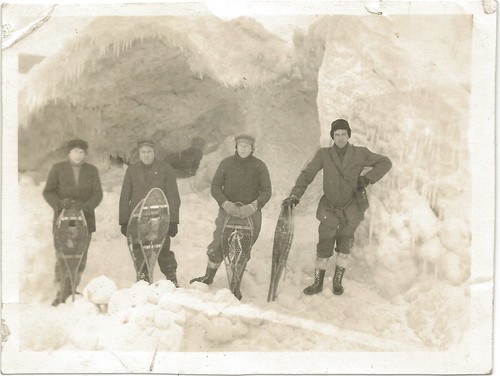
Men at Work, Snowshoe Edition

Real Photo Men at Work with Snow Shoes Winter Ice and Snow location Unknown 4-1 2 x 3-1 2 size

Real Photo Men at Work with Snow Shoes Winter Ice and Snow location Unknown, photo by UpNorth Memories – Donald (Don) Harrison

Don Harrison collects and sells postcards. His Flickr features some really great old postcards, mostly from Michigan. Check this photo out background bigtacular and see many more in Don’s Winter slideshow.

More postcards on Michigan in Pictures.