Before the fall at Miner’s Castle

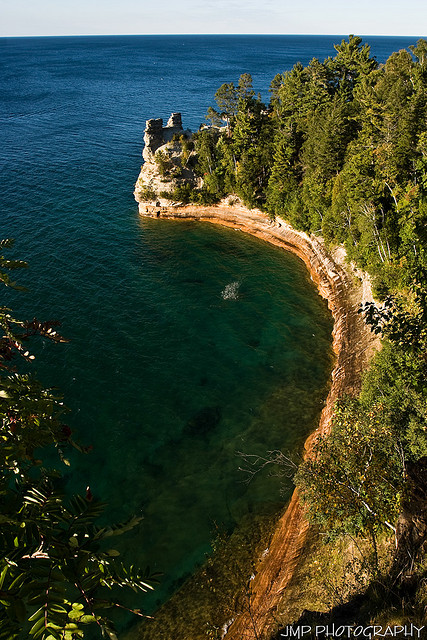
Miners Castle

Miners Castle, photo by James Marvin Phelps

The Pictured Rocks National Lakeshore feature on the collapse of one of the two turrets at Miner’s Castle explains that 7 years ago today:

On Thursday morning, April 13, 2006, the northeast turret of Miners Castle collapsed. One turret remains on Miners Castle, the best-known feature of Pictured Rocks National Lakeshore. The collapse was reported via cell phone by fisherman in the area, according to chief ranger Larry Hach.

Most of the rock fell north and into Lake Superior, and there were no injuries. The lower overlook platform near Miners Castle appears to be unaffected.

While the rockfall at Miners Castle on April 13 was startling, such events are not rare along the Pictured Rocks escarpment. At least five major falls have occurred over the past dozen years: 1) two different portions of Grand Portal Point, 2) the eastern side of Indian Head just east of Grand Portal Point, 3) Miners Falls just below the (now modified) viewing platform, and 4) beneath the lip of Munising Falls (along the former trail that went behind the cascade).

All the rockfalls involved the same rock unit, the Miners Castle Member of the Munising Formation. Rock units are named for places where they were first technically described. The Miners Castle Member consists of crumbly cross-bedded sandstone that is poorly cemented by secondary quartz, according to U.S. Geological Survey Research Ecologist Walter Loope.

Rockfalls along the cliffs typically occur in the spring and fall due to freezing and thawing action of Mother Nature.

Check this photo out bigger, see Jim’s “after” photo and get a lot more great photos in his Pictured Rocks National Lakeshore slideshow.

There’s more from Jim and more from Pictured Rocks on Michigan in Pictures!

Spring Bokeh

Untitled

Untitled, photo by Brooke Pennington

I refuse to give the ice storm that’s outside my door any power.

Brooke takes some great shots of flowers – check this out on black, see more in his slideshow or here on Michigan in Pictures.

More about bokeh.

Twin Turbines

TWIN TURBINES

TWIN TURBINES, photo by marsha*morningstar

Art is all around us. Check out Marsha’s photo from Blissfield on black and see more in her ARTSY slideshow.

More art on Michigan in Pictures.

Crocus kind of mood

DSC08382

DSC08382, photo by ansonredford

Crocuses have to be one of my favorite flowers. In addition to being beautiful, they are also one of the leading harbingers of spring in Michigan!

Check this out background bigtacular, get yourself in a springtime mood with Donald’s Flowers slideshow and see more of his photos on Michigan in Pictures.

More flowers on Michigan in Pictures, and if you want to be particular, here’s just the crocuses!

Spring storm in the “D”

Spring storm in the "D"

Spring storm in the “D”, photo by Malena †

Check this out on black and see more in Malena’s Detroit slideshow.

More Detroit on Michigan in Pictures.

Wind, Water & Warmth

DSC00936

Untitled, photo by Jben21

As the air heats up we will get these warm and wave-tossing winds in the Great Lakes. The Chicago Tribune explains why spring brings us stronger lake breezes, the coastal wind that blows from the lake to land:

It’s powered by differences in density between warm (less dense) air over land and cool (more dense) air over Lake Michigan. Because temperature greatly affects air density, a lake breeze is most likely to form (and it will blow most strongly) when large temperature differences exist between the “land air” and “lake air.” Those temperature differences are greatest in April and May when the lake air is chilly because Lake Michigan waters still retain much of winter’s cold and the land air is warming strongly in response to the strengthening spring sun.

Check this photo from last April near Muskegon out big as the Big Lake and see more in Jben’s Sunsets on Lake Michigan slideshow. It’s also the cover of the Michigan in Pictures Facebook!

More spring wallpaper on Michigan in Pictures and also lots more cool wind photos!

Maple Syrup: Not for the lazy!

Maple syrup 2

Maple syrup 2, photo by Deb Perry Studio

One of the best things about spring for my money is that it’s the one time of year that you can make maple syrup! Michigan ranks 5th in the US in maple syrup production, and the Michigan Maple Syrup Producers Association has a page about the history of maple syrup production that shows we’ve been a maple syrup player for a long time:

Native Americans have many wonderful stories about how they began making maple syrup. The first is the legend of Glooskap. Many, many, many years ago the Creator had made life much easier for man. In fact, in those days the maple tree was filed with syrup and all man had to do was cut a hole in the maple tree and the syrup dripped out. One day the young prince Glooskap (known by other names in other tribes) came upon a village of his people that was strangely silent. There were no dogs barking, no children playing, no women minding the cook fires, and no men getting ready to go hunting! Glooskap looked and looked and finally found everyone in the nearby maple grove. They were all lying at the bases of the trees and letting the sweet syrup drip into their mouths. Even the dogs were enjoying the syrup. “Get up, you people,” Glooskap called. “There is work to be done!” But no-one moved.

Now Glooskap had special powers, and he used these powers to make a large bark container. He flew to the lake, filled the container with water and flew back to the maple grove. When he poured the water over the trees it diluted the syrup so it was no longer sweet. ”Now, get up you people! Because you have been so lazy the trees no longer hold syrup, but only sap. Now you will have to work for your syrup by boiling the sap. What’s more, the sap will soon run dry. You will only be able to make syrup in the early spring of the year!”

…The Chippewas and Ottawas of Michigan tell a similar story of the god NenawBozhoo, who cast a spell on the sugar maple tree many moons ago, turning the near pure syrup into what is now called sap. He did this because he loved his people and feared they would become indolent and destroy themselves if nature’s gifts were given too freely. This legend is unique in that, in various forms, it can be found almost universally throughout the Eastern Woodland Indian tribes. This is unusual for cultures that did not have a written history.

Read on for more about how the process and techniques have evolved through the years. Michigan in Pictures has a ton of photos documenting the process of making maple syrup. that you’ll want to check out as well!

See Deb’s photo on black and see how it fits together in her maple syrup slideshow.

Spring in a drop of water

Untitled

Untitled, photo by ~Abby

I feel certain that spring is about to break over us in a warm & refreshing way … I just wish I hadn’t felt this way for 3 weeks.

Check it out on black and see more in Abby’s Water slideshow.

More spring on Michigan in Pictures!

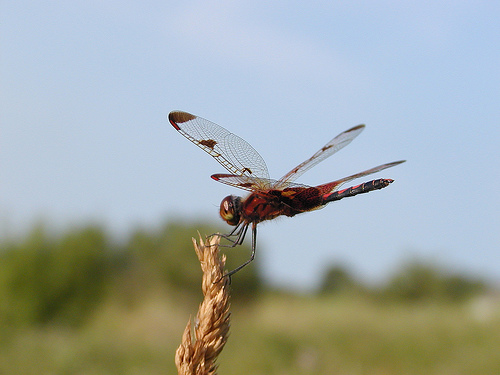
Don’t mess with a Dragonfly

DragOnFly

DragOnFly, photo by farlane

Yesterday Michigan in Pictures regular Mark O’Brien shared Nature’s Drone, Pretty and Deadly. The article says that although lions (25% hunting success rate) and great white sharks (50% success) look deadly, the dainty dragonfly may be the most effective hunter in the animal kingdom:

When setting off to feed on other flying insects, dragonflies manage to snatch their targets in midair more than 95 percent of the time, often wolfishly consuming the fresh meat on the spur without bothering to alight. “They’ll tear up the prey and mash it into a glob, munch, munch, munch,” said Michael L. May, an emeritus professor of entomology at Rutgers. “It almost looks like a wad of snuff in the mouth before they swallow it.”

Next step: grab more food. Dragonflies may be bantam, but their appetite is bottomless. Stacey Combes, who studies the biomechanics of dragonfly flight at Harvard, once watched a laboratory dragonfly eat 30 flies in a row. “It would have happily kept eating,” she said, “if there had been more food available.”

In a string of recent papers, scientists have pinpointed key features of the dragonfly’s brain, eyes and wings that allow it to hunt so unerringly. One research team has determined that the nervous system of a dragonfly displays an almost human capacity for selective attention, able to focus on a single prey as it flies amid a cloud of similarly fluttering insects, just as a guest at a party can attend to a friend’s words while ignoring the background chatter.

Read on for more including some very cool videos of dragonflies in action.

I don’t usually use my own photos on Michigan in Pictures, but I really like this one. Check it out background big and see more in my Leelanau slideshow.

More science on Michigan in Pictures!

Spring Return: Eastern Redbud

I'll Return With Spring

I’ll Return With Spring, photo by MightyBoyBrian

On AnnArbor.com Rick Meader writes:

When you think about popular, colorful ornamentals, Eastern Redbud (Cercis canadensis) often comes to mind. It’s a real crowd-pleaser, with a graceful, ornamental shape that puts out a “bouquet on a stem” look, with thousands of tiny pink/purple flowers lining its branches in early spring before its leaves emerge.

And, the best thing about it is, it’s native to southern Michigan, as well as most of the eastern half of the United States south of here. Furthermore, as a member of the Pea family (Fabaceae) it’s a cousin to the previous pod-producers we’ve learned about, Honeylocust (Gleditsia triacanthos) and Kentucky Coffeetree (Gymnocladus dioica).

As mentioned before, Eastern redbud is native to southern Michigan, occurring naturally up to a line across the lower peninsula from Kent County to Genesee County.

…If you want to use it in your landscape, it is fairly flexible in terms of where it will grow. It naturally occurs in rich soil along stream and river banks but is tolerant of a wider range of conditions. It likes sun or partial shade and can do well in most soils except waterlogged soils and dry, sandy soils.

Read on for more including Rick’s advice to make sure your tree comes from a northern nursery because trees from southern nurseries often are killed off by Michigan’s cold winters.

Brian’s photo is the first background we selected for the new Absolute Michigan, and  as you can see from past features of his work on Michigan in Pictures, he’s a really talented photographer who uploads big enough for backgrounds. See this shot from April of last year background bigilicious and see more in his Nature slideshow.

More spring wallpaper on Michigan in Pictures!