Big Sable Point from 2,000 feet

Big Sable Point from 2,000 feet

Big Sable Point from 2,000 feet, photo by Innerspacealien

The Detroit Free Press recently had a fun article by Ziati Meyer titled Michigan Lighthouse Trivia that related:

LIGHT AFTER DARKNESS: The deaths of 48 people in one year prompted the building of the Big Sable Point Lighthouse. The stretch of water between Big Sable Point and Ludington saw 12 shipwrecks in 1855, so Congress was asked to send money to help. The result — after a Civil War delay — was a $35,000 lighthouse to help ships navigate that area of Lake Michigan

Read on for more fun facts and definitely check out Terry Pepper’s Seeing the Light and our Michigan in Pictures archive for more info and photos of this iconic light north of Ludington.

Check this out background bigtacular and see some more aerial views of the area in Craig’s slideshow.

More great aerial photos on Michigan in Pictures.

2013 Perseid Meteor Shower

Perseids & the Milky Way

Perseids & the Milky Way, photo by gkretovic

EarthSky.org’s Meteor Shower Guide explains:

The Perseid meteor shower is perhaps the most beloved meteor shower of the year for the Northern Hemisphere. The shower builds gradually to a peak, often produces 50 to 100 meteors per hour in a dark sky at the peak, and, for us in the Northern Hemisphere, this shower comes when the weather is warm. The Perseids tend to strengthen in number as late night deepens into midnight, and typically produce the most meteors in the wee hours before dawn. They radiate from a point in the constellation Perseus the Hero, but, as with all meteor shower radiant points, you don’t need to know Perseus to watch the shower; instead, the meteors appear in all parts of the sky. They are typically fast and bright meteors. They frequently leave persistent trains.

Every year, you can look for the Perseids around August 10-13. They combine with the Delta Aquarid shower to produce the year’s most dazzling display of shooting stars. In 2013, the Perseid meteors will streak across the short summer nights – August 10-13 – from late night until dawn, with little to no interference from the waxing crescent moon. Plus the moon will be near the planet Saturn in the evening hours, giving a colorful prelude to late-night Perseid show. Best mornings to look: August 11, 12 and 13.

Check out Everything you need to know about the Perseid Meteor Shower on EarthSky and also don’t  miss Star Trails, the Perseid Meteor Shower and the Tears of St. Lawrence in the Michigan in Pictures archives!

Greg took this shot in the UP – I’m thinking that’s the Nahma Burner on Big Bay de Noc at the right. Check it out bigger and see more in his stunning Upper Peninsula of Michigan slideshow.

More meteors on Michigan in Pictures.

Aurora over Mackinac … and a chance tonight!

Aurora over Mackinac

Aurora over Mackinac, photo by Aurora over Mackinac by Neil Weaver Photography

I’ve had an eye on the Space Weather over the last few days, and while it doesn’t look like this weekend’s G1 level solar storm has produced anything, there’s a slight chance we’ll see something tonight. Their definition of the G1 level says that aurora may be visible at high latitudes, i.e., northern tier of the U.S. such as northern Michigan and Maine, so you want to check tonight!

Neil shot these Northern Lights over the Straits during the early hours of July 15, 2013. Check it out bigger, view his slideshow and see lots more from Neil on Michigan in Pictures too!

SUP Yo?! Stand-up Paddleboarding at the TC Waterman

SUP Yo?!

SUP Yo?!, photo by Rudy Malmquist

I’ve been doing a lot of stand-up paddleboarding this summer on Grand Traverse Bay courtesy my friend Michael who owns The River of Traverse City. I have been pleasantly surprised at how much fun it is and also what a great workout it is.

In a couple of weeks Traverse City will host the TC Waterman. It takes place on Saturday, August 17th and is the largest paddle board event in the Midwest and also the site of the 2013 Great Lakes Regional Championship. In addition to a variety of races and skills challenges for all ages and skill levels, the event features 50 booths by local and national SUP organizations and companies, free clinics, seminars, and demonstrations. The weekend also features two events from Porterhouse Productions: Paella in the Park on Friday (wine, music & paella) and the Great Wakes Festival Saturday (water-themed activities, organizations, music & fun).

Check this photo out background bigtacular and see more in Rudy’s slideshow.

More Traverse City on Michigan in Pictures.

Wanna Swim There???

Wanna Swim There???/

Wanna Swim There???, photo by John Burzynski Photography

John snapped this on the shore in Manistee – I guess ambitions run high there! See it bigger and see more in John’s Beaches, Lighthouses slideshow.

PS: Because I know someone out there is wondering: Yes, people have swum across Lake Michigan:

Vicki Keith from Kingston, Ontario, Canada swam across Lake Michigan during the summer of 1988 as part of an event that saw her become the first person to swim across all five Great Lakes. She completed this task in a 2 month period and raised $548,000 to help kids with disabilities.

To date, Vicki hold’s 16 world records in marathon swimming, and has raised over $1,000,000 to help develop programs for kids with physical disabilities.

A number of other people have swum across Lake Michigan, including a fellow Canadian Paula Stephanson, and American Jim Dreyer. Jim Dreyer is from Byron Center, MI. He crossed Lake Michigan in 1991, from Two Rivers to Ludington, and raised money for the Big Brothers and Big Sisters of America mentoring program. He got involved with the program when he was in his 20s.

Jim Dreyer followed triathlon rules as opposed to marathon swimming rules and therefore wore a wet suit for his crossing.

More beaches on Michigan in Pictures!

Your Peach is Ready … thank Stanley Johnston for that

U-Pick peach

U-Pick peach, photo by Alissa Holland

“Life is better than death, I believe, if only because it is less boring, and because it has fresh peaches in it.”
― Alice Walker

Peaches are rolling in at farm markets all across Michigan.  A favorite article that Michigan History Magazine shared on Absolute Michigan tells the story of A Peach of a Man:

Many people have contributed to Michigan’s fruit industry, but Stanley Johnston stands above the rest. Johnston not only developed a new peach that is the most widely grown peach in the world today. He also made Michigan the nation’s leading producer of blueberries.

Johnston was the superintendent of Michigan State University’s (MSU) experiment station in South Haven from 1920 to 1969. There, he developed a better peach. Johnston took peaches that had good features, like ones that ripened at different times or did not turn brown when canned or frozen. He took pollen from the male plant and joined it to the flower of the female plant. When the fruit grew, he collected seeds and started a new tree. When the tree produced fruit five years later, he could see if he made a better peach.

During his career, Johnston grew and studied more than 20,000 peach trees. Eight different types, called “havens” (for South Haven), were planted by farmers. Havens ripened earlier, so the peach-growing season was longer, which meant more peaches could be grown and sold. One of these peaches, named Redhaven for its nice red color, is the most popular peach in the world today.

Johnston received much praise for his work with peaches. Comparing him to an artist, one man called Johnston a “Picasso among peach breeders-a plant breeding artist.”

Read on at Absolute Michigan and definitely get down to your local farmer’s market for some peachy goodness!

Check Alissa’s photo out bigger and see more in her Michigan’s west lakeshore slideshow.

More food on Michigan in Pictures.

Manitou Stormcloud and the Earth Science Picture of the Day

Manitou Stormcloud

Manitou Stormcloud, photo by ShaneWyatt

One of my favorite photoblogs is the Earth Science Picture of the Day (EPOD), and sometimes you’ll see photos from Michigan in Pictures there and vice versa. The EPOD is produced by the NASA Earth Sciences Division, and every day their stalwart blogger Jim Foster works with photographers all over the planet to highlight amazing things. In June the EPOD posted a cool photo of a roll cloud over Calgary, explaining:

Roll clouds are a type of arcus cloud often associated with turbulent weather. As is the case here, they sometimes look like a horizontal tornado. Although these cylindrically shaped clouds look quite fierce and may be observed to roll about their horizontal axis, they don’t usually generate dangerous winds. Roll clouds are typically found behind outflow boundaries but unlike shelf clouds are detached from any close-by cumulonimbus cloud.

I know that I featured a photo from Shane last Thursday, but this one was just too cool to hold back! Check his photo out bigger and see more in Shane’s slideshow.

More wild Michigan weather on Michigan in Pictures!

NASA turns 55

Milky Way - Silos

Milky Way – Silos, photo by eddy.matt

“To reach for new heights and reveal the unknown so that what we do and learn will benefit all humankind.”
~NASA’s Vision

On July 29, 1958, President Dwight D Eisenhower signed the  National Aeronautics and Space Act that established the National Aeronautics and Space Administration aka NASA. While I don’t think that we’ve seen quite the advances we expected after making it to the moon in just over a decade, NASA has evolved into a science agency that is engaged in an incredible range of operations from theoretical research (warp drive is my current favorite) to monitoring our planet, solar system and the visible universe (measuring Northern Lights and roving Mars) to a permanent presence in space (I watched NASA TV live from the International Space Station this morning) and plans for a manned Mars mission.

Check Matthew’s photo out bigger and see more in his slideshow. This photo is a still from a gorgeous time-lapse on the Leelanau Peninsula that he did last year in July.

More space on Michigan in Pictures!

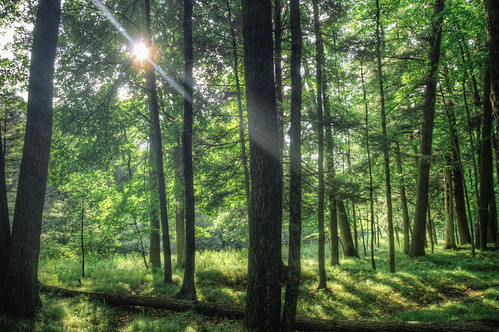
To Be In Green

To Be In Green

To Be In Green, photo by MightyBoyBrian

This photo is the current background for Absolute Michigan and cover photo for the Absolute Michigan Facebook. Brian shared it in our Michigan Cover Group on Flickr and I encourage you to do the same and also to get out and enjoy some of Michigan’s green glory this weekend!

Check this out background bigtacular and see more in Brian’s Nature slideshow.

More trees on Michigan in Pictures.

Great Lakes Waves offer beauty, power & danger

DSC01071P

Untitled, photo by Scott Glenn

“These are not lakes, these are the world’s eighth seas, and her bottom is littered with the wreckage of over six thousand ships.”
~The Three Sisters, Song of the Lakes

This gorgeous shot of the St. Joseph Pier Lighthouses demonstrates the incredible power of Great Lakes waves. I live in Traverse City, and this summer it feels like Lake Michigan has claimed the lives of more people than normal. Whether or not that’s true (it’s not), I thought this photo offered the perfect opportunity to share some tips and tools for staying safe on Lake Michigan, Lake Huron, Lake Superior and Lake Erie!

  • Thinking of any of the Great Lakes as anything like any lake you’re familiar with is a mistake. They are freshwater seas that can pack  incredible power. They are stronger than you and can end your life in an instant if you don’t respect them.
  • The Great Lakes Surf Rescue Project is a nonprofit dedicated to drowning prevention that keeps track of drowning statistics: 74 in 2010, 87 in 2011, 101 in 2012 and 39 so far in 2013. (you can also keep up with them on Facebook)
  • Life jackets can save your life.  U.S. Coast Guard statistics show that 90% of the people who drown in a boating or water accidents would survive with a life jacket.
  • Cold kills! Hypothermia is a danger all year round on the Great Lakes. Click that link for tips on how to stay alive if you do end up in the water.
  • Rip Currents (sometimes called “undertow” or “rip tide”) are a big danger on Michigan beaches accounting for the majority of drownings. Michigan is 4th in rip current related fatalities behind Florida, California, and North Carolina – we have “ocean force” rip currents. Learn how to beat them in this video.
  • The National Oceanic and Atmospheric Administration (NOAA) offers comprehensive Great Lakes marine forecasts.
  • The MyBeachCast smarthphone app can predict waves and warn you of hazardous conditions.
  • Do you have more tips? Share them in the comments!

Check it out bigger and see more in Scott’s Lighthouses slideshow and also check out a winter view of the pier that Scott shot.

Catch a Michigan wave on Michigan in Pictures!