Farmers’ Almanac calls for cold & snowy winter 2013-2014

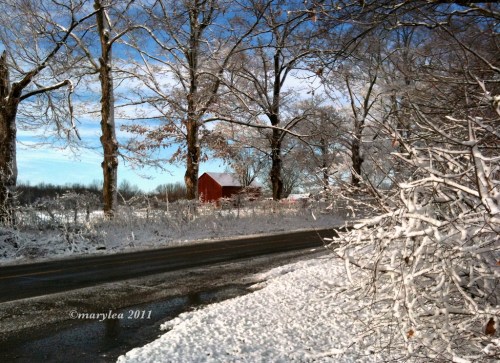
Snowfall: Scenic Drive

Snowfall: Scenic Drive, photo by marylea

In Farmers’ Almanac prediction: valid winter forecast or ‘darts at a dartboard’?, the Great Lakes Echo explores the accuracy of the venerable Farmers’ Almanac, writing:

…this year, like many before, bloggers, newspapers and local TV stations alike are abuzz with the Almanac’s prediction for winter 2014 – particularly a notably bitter, cold, precipitous winter for the Midwest and most of the Great Lakes region.

“This winter is shaping up to be a rough one,” the almanac reports.

So how much weight does this prediction hold?

“The value of the Farmers’ Almanac in terms of weather forecasting is no better than a comic book,” says Detroit-based meteorologist Paul Gross. “If we knew the forecast a year in advance, we’d be utilizing that knowledge by now.”

The Almanac, which famously keeps its weather predicting methods rather hush-hush, claims to be 80 percent accurate – although the lack of concrete evidence proving that claim draws some skepticism.

The Almanac also makes a questionable remark about the relationship between global warming and a winter with heavy snow.

“Brrrrr!” says the excerpt. “It looks like global warming will soon be taking a vacation to make room for Old Man Winter.”

Heavy snow in winter means quite the opposite in regards to global warming, says Gross. “What people don’t understand is that global warming means that more ocean water is evaporated into the atmosphere,” he said. “And that water vapor in the atmosphere is what becomes available to storms to create precipitation.”

Global warming isn’t “taking a vacation” to make way for the heavy precipitation, Gross said. Rather, a warming climate cause increased precipitation. “It’s shocking, but four of Detroit’s top 10 snowiest winters in history have occurred since 2002,” he said.

They add that the Almanac’s prediction does appear to be somewhat in line with predictions like the National Oceanic and Atmospheric Adminstration’s. Read on for more at the Echo.

Check Marylea’s photo out bigger and see more in her Winter 2011-2012 slideshow.

More weather on Michigan in Pictures.
A Lake, a Lady and a Legend

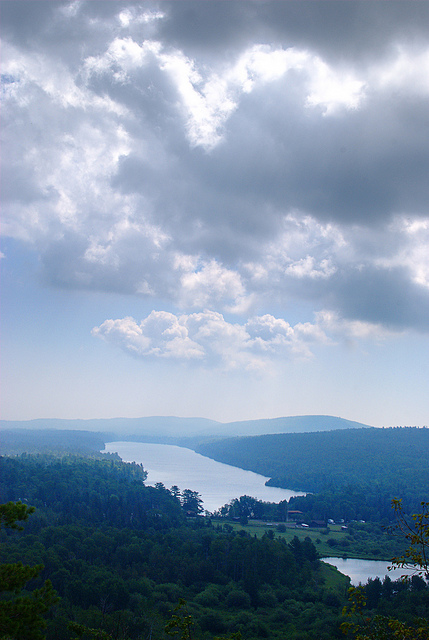
Sky and Fanny Hooe

Sky and Fanny Hooe photo by dcclark

Lake Fanny Hooe is located in Fort Wilkins State Park on the Keweenaw Peninsula near Copper Harbor. A great article from Marquette Monthly about the hard life of UP women back in the day tells about how the legend of the lake turns out to be a lot more dramatic than the reality:

Local tales related that the beautiful young woman had drowned in the lake, or got lost in the woods while picking blueberries and was never seen again. In truth, Lucy Frances Fitzhigh Hooe, Fannie, spent the summer of 1844 visiting her brother Thornton, who was stationed at Fort Wilkins. Her sister, Richardetta was the wife of Lt. Daniel Ruggles, also stationed there. At the end of the summer, she returned to the family home in Virginia. She then married Chester Bailey White in 1849, and had three children. While she led an interesting life, her visit to Fort Wilkins was not a major part of it. She died in 1882, probably in Fredericksburg, (Virginia).

Read on for lots more!

Dave took this photo from Brockway Mountain Drive, looking towards Copper Harbor and Fanny Hooe. See it bigger and see more in his Copper Country slideshow.

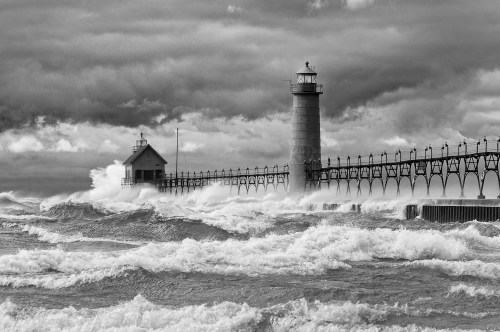
100 Years after the Great Storm of 1913

NovemberGaleGrandHaven-2

NovemberGaleGrandHaven-2, photo by Rich Wyllis

100 years ago today the most devastating storm in Great Lakes history began. It raged across the Great Lakes from November 7-10, 1913. As NOAA’s commemorative website explains:

In November of 1913 the Great Lakes were struck by a massive storm system combining whiteout blizzard conditions and hurricane force winds. The storm lasted for four days, during which the region endured 90 mile per hour winds and waves reaching 35 feet in height. With only basic technology available, shipping communication and weather prediction systems were not prepared for a storm of such devastating force. When the skies finally cleared, the Great Lakes had seen a dozen major shipwrecks, an estimated 250 lives lost, and more than $5 million in damages (the equivalent of more than $117 million today).

Nicknamed the “White Hurricane” and the ‘Freshwater Fury” the 1913 storm remains the most devastating natural disaster to ever strike the Great Lakes. One hundred years later, NOAA commemorates the Storm of 1913 not only for the pivotal role it plays in the history of the Great Lakes but also for its enduring influence. Modern systems of shipping communication, weather prediction, and storm preparedness have all been fundamentally shaped by the events of November 1913.

Head over to NOAA for more on the weather technology of 1913 and today and definitely check out more on the Freshwater Fury on Michigan in Pictures!

Check Rich’s photo out bigger and see more in his slideshow.

Bent Trees at Sleeping Bear

Bent tree forest ... II

Bent tree forest … II, photo by Ken Scott

One of my favorite photographers (Ken Scott) was featured Monday on one of my favorite blogs (NASA’s Earth Science Picture of the Day). Via the EPOD:

During a hike late this summer I noticed the oddly bent trees shown above in Sleeping Bear Dunes National Lakeshore, Michigan. It’s likely that snow loading or extreme icing from big storms during a previous winter caused this bowing. These trees were perhaps big enough to bend but not yet so inelastic as to break beneath heavy the snow/ice load. In subsequent years, with less damaging weather conditions, their crooked trunks may begin to straighten. Photo taken on September 21, 2013.

Check Ken’s photo out bigger and see more including another view in his Sleeping Bear Dunes National Lakeshore slideshow.

If you have photos of interesting natural phenomena, consider submitting them to the EPOD!

Stand up tall and vote

VOTE!

VOTE!, photo by ktpupp

This is a frightening statistic. More people vote in ‘American Idol’ than in any US election.
~Rush Limbaugh

You’ll become a statistic whatever you do today. Here’s hoping you become one of the statistics who took a little time to make decisions about your community.

Check K.T.’s photo out background big and see more in her slideshow.

Land of the Lost: Central Mine

land of the lost

land of the lost, photo by Marty Hogan

The Keweenaw Historical Society page on Central Mine and Village explains:

One of the most noteworthy historical sites in Keweenaw County is Central, or Central Mine, a village that once was the home for over 1,200 people, and the site of one Keweenaw’s most successful mines. The mine, opened in 1854, produced nearly 52 million pounds of copper by the time it closed in 1898.

Several miners’ homes and buildings still stand on the site. In 1996, the Keweenaw County Historical Society acquired 38 acres of the old Central site. Some of the residences are being restored, and a Visitors Center provides interpretive exhibits not only about the mine but also about the miners’ families, homes, schools and churches.

Click through for maps, photos and more information about Central and other sites.

Marty took this photo in Engine House No.2 at the Central Mining Company in Central, Michigan. He says that from 1875-1898, it housed the Steam Hoist for Shaft No.2. Check it out background bigtacular and see more in his Central, Michigan slideshow.

There’s a whole lot more from Marty and his travels to some of Michigan’s coolest places that once were on Michigan in Pictures!


Falling back at Sturgeon Falls

Lower Falls Sturgeon Gorge

Lower Falls Sturgeon Gorge, photo by Shadows in Reflection

Say hello to your last early evening light for a while today, and don’t forget to set your clocks back for Daylight Savings Time tonight!

Back in May I posted a pic of Sturgeon Falls raging with the spring snowmelt. I thought Michael’s photo provided a cool look at how much the snowmelt changes the flow of UP rivers from spring to fall.

Michael writes that this is an awesome place and a must visit if you like waterfalls. See it bigger and see more in his slideshow.

For a look at how to get there, check out the North Country Trail guide for the Sturgeon Gorge area and see many more Michigan waterfalls on Michigan in Pictures.

Happy Halloween!

DSC_6744_edited-1.jpg

Untitled, photo by Bearcats Photography

Mike writes that every year they have family and friends over for homemade stew and fresh bread. He says the only catch is they have to carve a pumpkin.

I’m thinking that’s a great plan – Happy Halloween everyone!!

View his photo background bigtacular and see more in his slideshow.

More Halloween fun on Michigan in Pictures!

American Kestrel, the Sparrow Hawk

American Kestrel with mouse

American Kestrel with mouse, photo by Kevin Povenz

The American Kestrel entry at Wikipedia says:

The American Kestrel (Falco sparverius), sometimes colloquially known as the Sparrow Hawk, is a small falcon, and the only kestrel found in the Americas. It is the most common falcon in North America, and is found in a wide variety of habitats. At 19–21 centimeters (7–8 in) long, it is also the smallest falcon in North America. It exhibits sexual dimorphism in size and plumage, although both genders have a rufous back with noticeable barring. Juveniles are similar in plumage to adults.

The American Kestrel hunts by hovering in the air with rapid wing beats or perching and scanning the ground for prey. Its diet typically consists of grasshoppers, lizards, mice, and other small birds. It nests in cavities in trees, cliffs, buildings, and other structures. The female lays three to seven eggs, which both sexes help to incubate. It is a common bird to be used in falconry, especially by beginners.

All About Birds adds that it’s perhaps the most colorful raptor in the world, Wing over to their American Kestrel (Falco sparverius) page for photos, kestrel calls & more info.

More birds on Michigan in Pictures.

Check it out on black and see more in Kevin’s amazing Birds of Prey slideshow.

Many more Michigan Birds on Michigan in Pictures!

Remembering Detroit Tigers Manager Jim Leyland

James Richard Leyland

James Richard Leyland, photo by Buzz Click Photography

In 11 Reasons Baseball Is Going To Seriously Miss Jim Leyland Buzzfeed, Emily Orley & Matt Kiebus offer some really great reflection on the career of one of the great managers of the last two decades, concluding simply:

He was the last of his kind.

Jimmy Leyland never cared about being politically correct. He cared about his players, the fans, and winning baseball games. He rarely had a filter with the media and never met an umpire he wouldn’t give a piece of his mind. He was old-school in the greatest sense of the word, and he was beloved for it. He helped make Pittsburgh a baseball town, led the Marlins to a World Series, and embodied the city of Detroit. He enjoyed a cigarette and stiff drink, but most importantly he loved baseball, and baseball is going to miss him.

Definitely read the whole piece for some good thoughts (and video) about a Tiger legend. More about Leyland:

  • Jim Leyland on Wikipedia says that Leyland began his baseball career with the Tigers when they signed him as a catcher on September 21, 1963. A career .222 hitter, he managed the Montgomery Rebels. His last victory on Sept 26 was his 700th for the Tigers and clinched his 3rd straight Central title. He and Tony La Russa are the only managers who have led two different MLB franchises to three consecutive division titles.
  • Leyland’s entry at Baseball Reference details his career record. Leyland spent just over a decade managing in the Tigers minor league system before being taped as an assistant coach by Tony La Russa for the White Sox. He was named Pirates manager in 1986, moved to the Marlins in ’97 (when they won the Word Series), and spent a year with the Rockies in 1999. In 2006 after serving as a scout for 7 years, he returned to the  dugout for the Tigers. He compiled a 1769-1728 record in 3499 games over 22 seasons, winning 3 pennants and one World Series.
  • Here is Leyland’s press conference on retirement along with an article detailing his career from the Detroit Tigers. They note his 700 regular-season managerial wins are the third most in Tigers history, trailing only Sparky Anderson (1,331) and Hughie Jennings (1,131). His .540 winning percentage as Tigers manager ranks only behind Steve O’Neill (.551 from 1943-48) among managers with at least 500 wins.
  • Detroit writer Michael Rosenberg has a nice piece in Sports Illustrated that gives a little more in-depth look at the man from someone who covered him well.

About his photo from late September 2007, Spike says:

Now THIS is a rare shot: Jim Leyland smiling! The Tigers Manager usually shows no emotion but took this opportunity at the last 2007 home game to leave the umpires in stitches. Who knows what Leyland cracked before his audience on the mound but they quickly hid their grins as the opposing manager approached and scolded them.

Check it out on black and see more in great shots of Detroit moments in Spike’s sports slideshow.