Let’s Do Lunch (Snowy Owl Style)

Snowy Owl 1

Snowy Owl 1, Sherri & Dan

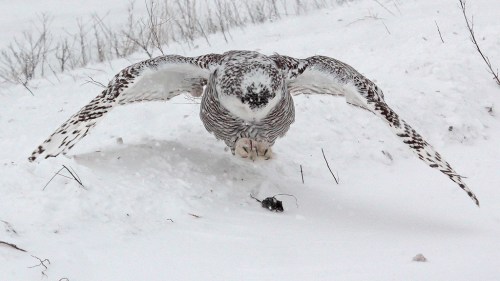
Dan Lockard captured a cool sequence last weekend of a snowy owl on the hunt. View his photo background big, watch the hunt (which doesn’t end well for Mr. Mouse) or check out his owls slideshow.

The Owl Pages entry for the Snowy Owl (Bubo scandiacus) says in part:

The Snowy Owl is a large diurnal white Owl with a rounded head, yellow eyes and black bill. The name “scandiacus” is a Latinised word referring to Scandinavia, as the Owl was first observed in the northern parts of Europe. Some other names for the Snowy Owl are Snow Owl, Arctic Owl, Great White Owl, Ghost Owl, Ermine Owl, Tundra Ghost, Ookpik, Scandinavian Nightbird, White Terror of the North, and Highland Tundra Owl.

…Most hunting is done in the “sit and wait” style. These Owls are highly diurnal, although they may hunt at night as well. Prey are captured on the ground, in the air, or snatched off the surface of water bodies. When taking snowshoe hares, a Snowy Owl will sink its talons into the back and backflap until the hare is exhausted. The Owl will then break its neck with its beak. Snowy Owls have been known to raid traplines for trapped animals and bait, and will learn to follow traplines regularly. They also snatch fish with their talons. Small prey up to small hares are swallowed whole, while larger prey are carried away and torn into large chunks. Small young are fed boneless and furless pieces. Large prey are carried of in the Owl’s talons, with prey like lemmings being carried in the beak.

…Snowy Owls produce large, rough-looking cylindrical pellets with numerous bones, feathers, and fur showing. They are usually expelled at traditional roosting sites and large numbers of pellets can be found in one spot. When large prey are eaten in small pieces with little roughage, pellets will not be produced.

Read on for much more about these winter visitors, who the DNR explain migrate to Michigan in wintertime and have been sighted as far south as Lansing. They add that because snowy owls see few if any humans in their Arctic home, they are not very timid and easier to observe than other owl species.

More Michigan owls on Michigan in Pictures!

Snowfall, with Color

Snowfall With Color

Snowfall With Color, photo by Mark Oliver Photos

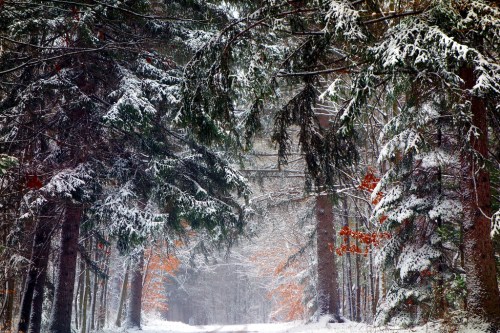
Mark took this in the Proud Lake Recreational Area near Milford last December. Check it out bigger and see more in his great Michigan slideshow.

More parks on Michigan in Pictures!

Early takeoff for the 2014 Michigan Ski Season

Mulligans Hollow

Mulligans Hollow, photo by Kevin Ryan

Michigan’s ski resorts have enjoyed the best launch to the ski season in recent memory. The reason for this is simple: steady cold temperatures and lots of lots of “white gold.” mLive’s Weekend Snowmobile and Ski Report leads with a graphic showing 4-40 inches of snow on the ground across Michigan:

In the Upper Peninsula, the Lake Superior shoreline has over 10 inches of snow cover. The Keweenaw Peninsula mostly has over 20 inches of snow. The deepest snow cover in the Great Lakes is just east of Lake Superior in Canada. Satellite reports have the snow cover over 40 inches already. That area has seen heavy lake effect due to very cold air and a persistent west wind.

…Gaylord has had 17 inches more snow than normal, and most other cities are near normal to slightly above normal on seasonal snowfall. Traverse City, Sault Saint Marie, and Petoskey have already shoveled over 20 inches of snow. This time last year northern Michigan was well below normal on snowfall.

Read on for more including a graphic of snowfall this year, last year and average totals – Gaylord is almost 1/3 of the way to last year’s total!

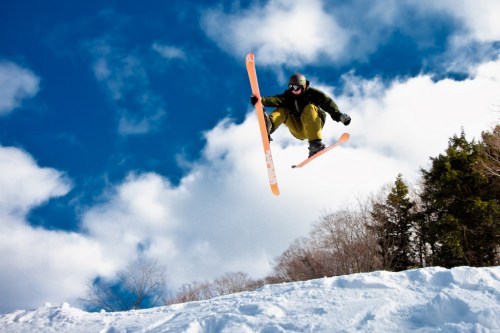
Check background big and see more in Kevin’s skiing slideshow.

PS: In case you’re wondering, Mulligan’s Hollow where this photo was taken is located in Grand Haven and is 100% open already. If you follow that link you can see their webcam.

More skiing photos on Michigan in Pictures.

Earth Wind … and Snow

Earth Wind and Snow

Earth Wind and Snow, photo by Beth

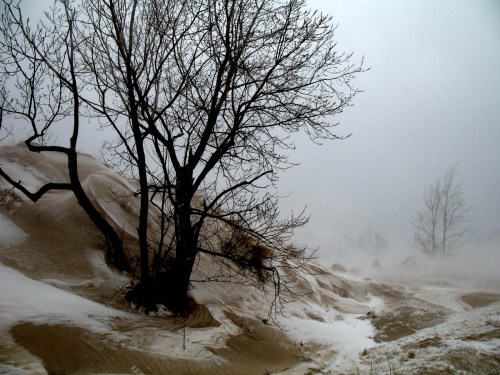
One of the lesser known bands of the 70s…

View Beth’s photo from the beach at Holland background bigtacular and see more in her Winter slideshow.

More winter wallpaper on Michigan in Pictures!

Keepsake: Pennsylvania Truss Bridge

keepsake

keepsake, photo by Marty Hogan

Marty shared this photo and also some information about the CR510 Pennsylvania Truss Bridge in Marquette County from historicbridges.org:

This is one of the largest, most beautiful, and most significant truss spans in Michigan. Not only does this truss bridge display the Pennsylvania truss configuration, it appears that it may have actually come from the state of Pennsylvania. In 1919, the Michigan State Highway Department purchased the bridge which originally crossed the Allegheny River. Relocating and reusing truss bridges was not unusual in this period of history. An example notice indicating bridges for sale from 1921 is shown to the right. At this time, CR-510 was a state trunk line route and purchasing and relocating this bridge would have been an inexpensive alternative to building a new bridge from scratch. It was erected on the CR-510 location in 1921. The Michigan State Highway Department’s Biennial Report stated that the bridge was one of two toll bridges crossing the Allegheny River within 500 feet of each other and was being removed due to the redundancy. Unfortunately, the report did not state exactly where on the river this bridge came from. Since most of the Allegheny River is in Pennsylvania, it is assumed the bridge came from Pennsylvania, although the Allegheny River does dip into New York State for a short time. Depending on where on the Allegheny River it was originally located, it may have been part of a multi-span bridge.

Pennsylvania truss bridges are an uncommon truss type, and the nature of their design means that they are reserved for longer truss spans. However, even among pin-connected highway Pennsylvania truss spans, this bridge’s span still stands out as fairly long. It is the longest pin-connected highway truss span in Michigan. The truss type is extremely rare in Michigan, and so the bridge has additional significance in the context of Michigan. The bridge also retains excellent historic integrity with minimal alterations despite its long service and being located in two different states over its service life. The bridge has decorative details on its portal bracing, another feature that is rare among Michigan truss bridges.

Read on for more.

View Marty’s photo background bigtacular and see more including a long view of the bridge in his 2013 Winter Photo Trip slideshow.

More bridges on Michigan in Pictures.

An Hour of Code could be good for Michigan!

Screen Head

Screen Head, photo by Chancellor Monnette

If there’s a front page of the internet, it’s probably Google. They manage to pack quite a lot into a spare layout. Today would have been computer science pioneer Grace Hopper’s 107th birthday, and in addition to a tribute doodle, Google is featuring a ridiculously star-packed video about An Hour of Code.

An Hour of Code is a project of Code.org, a non-profit dedicated to expanding participation in computer science education by making it available in more schools, and increasing participation by women and under-represented students of color. The state of Michigan has 13,484 open computing jobs (growing at 4.1x the state job growth average), 1,930 annual computer science graduates and just 78 schools teach computer science. You can get all the details on how you can help encourage schools to require more computer programming from code.org!

Check Chance’s photo our background big and see more in his Portrait slideshow.

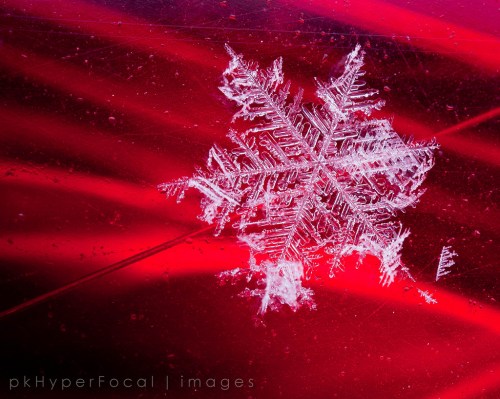
The Beauty of My Nemesis: Snowflake Edition

The Beauty of My Nemesis

The Beauty of My Nemesis, photo by pkHyperFocal

Waaaay back when I started out on the capital “I” Internet with an online publication called the Northern Michigan Journal. For over five years I edited NMJ, producing around 4 issues a year that featured some interesting work from a wide range of writers & artists.

Two of these were my friends Jerry Dennis and Glenn Wolff, a writer/artist duo who collaborated on several books.  Their first was called It’s Raining Frogs & Fishes: Four Seasons of Natural Phenomena and Oddities of the Sky, a fascinating romp through the oddities and beauties of the natural world through Jerry’s captivating prose and Glenn’s engaging drawings. You can click that link to learn more about the book from Jerry’s website. Trust me, it’s the perfect gift for the nature lover or scientist in your life!

Glenn & Jerry shared a chapter from the book with me that I published to the inaugural issue of NMJ. Here’s the beginning of Nature Baroque: Snowflakes & Crystals:

There is more to the birth of a snowflake than Aristotle’s assertion that “when a cloud freezes there is snow.” Snow is not merely frozen rain. Rain occasionally freezes, falling to the ground as sleet or freezing rain, but snow originates independent of atmospheric drops of water. Individual ice crystals for high in the atmosphere when water vapor freezes around dust or other particulates. Without particles to serve as condensation nuclei, water vapor can be cooled to -40 degrees Fahrenheit before freezing occurs. A supercooled cloud of this sort seeded with a few particles often escalates into a snowstorm. The individual crystals collect additional molecules of water vapor one at a time, building on one another symmetrically in a rapidly growing, widening circle. Temperature, wind, humidity, and even barometric pressure will determine the growth and ultimate form of the crystal. Large and elaborate crystals for at higher temperatures and humidity while, while the small, basic crystals such as those common in polar regions form when temperature and humidity are very low. As the crystals fall they bump against each other, breaking off pieces of ice that in turn serve as nuclei for new crystals. As they pass through warmer layers of air they adhere to one another, congregating into snowflakes that may contain a thousand or more crystals.

Snowflakes, then, are aggregates of snow crystals. When the temperature is near or slightly above freezing, snowflakes become wet, adhere to other flakes, and grow to two or three inches in diameter. On very rare occasions, they can grow larger yet. According to a report in a 1915 issue of Monthly Weather Review, a snowfall on January 28, 1887 dropped flakes “larger than milk pans,” measuring fifteen inches in diameter by eight inches thick across several square miles near Fort Keogh, Montana.

Only when the temperature remains consistently below freezing will complete, individual crystals fall to the ground. If the temperature of the cloud they form in and the air they descend through is warmer than 27 degrees Fahrenheit, the crystals tend to be flat and hexagonal. Between 27 and 23 degrees, they tend to be needle-shaped. Between 23 and 18 they are likely to be hollow and columnar, with prismatic sides. At temperatures below 18 they can be columnar, hexagonal, or fernlike. Virtually all have six sides. That hexagonal tendency is something of a mystery, although some scientists suggest it is produced by electrical charges in the crystals, while others say it is basic to the molecular structure of water molecules. The atoms in a molecule of H20 are arranged, in physicist Hans C. von Baeyer’s graphic description, “with two little hydrogens stuck onto a big oxygen like ears on a Mickey Mouse’s head.” Scientists like von Baeyer believe that the angle at which the hydrogen molecules protrude from the oxygen atom–about 120 degrees–causes snow crystals to grow to a six-pointed symmetry that repeats the molecular structure of water.

Read on for much more including whether or not two snow crystals are alike, heavy snowfalls and snow words & myths.

View this photo background bigtacular and see more in pk’s really, really cool Chromatic Progression slideshow.

More snow, sciencewinter wallpaper on Michigan in Pictures!

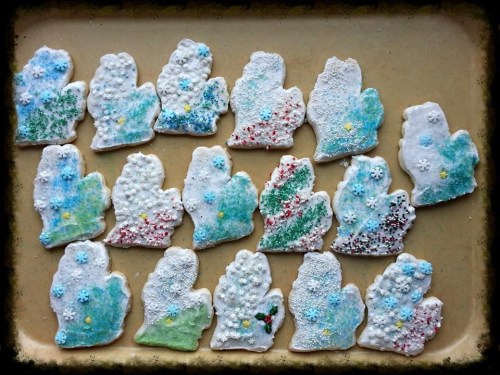
Michigan’s Winter Sprinkles

Michigan's Winter Sprinkles

Michigan’s Winter Sprinkles, photo by LadyDragonflyCC

The weekend outlook is for snow with a chance of sprinkles!

Check Christine’s photo out bigger and see more in her cookie slideshow.

PS: In case you’re wondering, she does have a UP cookie cutter too!

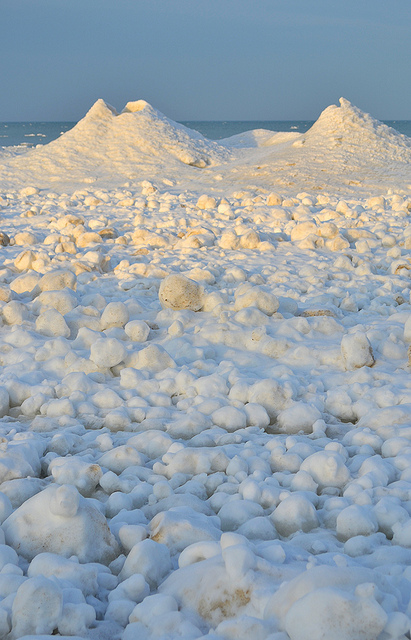
Ice Volcanoes in Michigan

Shore Ice

Shore Ice, photo by timmerschester

The Weather Notebook has this to say about Ice Volcanoes:

Ice volcanoes can form during winter on the Great Lakes. They are not lava-spewing mountains of ice, but water-spouting ice cones.

As winter ice begins to build along the shores of large lakes such as Lake Superior, it is jostled, broken, and shifted by the winds and wave motions on the waters. When winds blow onshore, they can build an ice shelf, a jumble of ice chunks that anchors on the shore but extends some distance back into the water. Amongst the numerous ice blocks comprising a shelf, many open tunnels lead back to the lake waters.

To build a good ice volcano cone, the surface air temperature must be several degrees below freezing and lake waves should be several feet high and breaking onshore. As the waves strike the edge of the ice shelf, pulses of wave energy flow beneath the ice. Upon reaching the open end of a tunnel, the wave forces water to erupt out through the ice. If the hole has been covered with snow, the eruption may spray snow outward like a volcanic gas cloud.

As the ejected water falls back onto the ice, it quickly freezes and begins the formation of an ice cone, a process very similar to the building of a lava cone surrounding a geologic volcanic vent. A study of ice volcanoes on Lake Superior’s southern shore by students from Michigan Tech measured ice cones ranging from three to 25 feet in height.

Like rock volcanoes, ice volcano vents can heal over and become dormant during periods of low wave action. They lie in wait for a strong wave surge to awaken them back to explosive activity.

Also see the Ice Volcanoes page from Michigan Tech and a video of an ice volcano from Great Lakes Echo.

Kathy took this photo on November 29th on Lake Huron in Caseville – pretty early for ice this big! Check it out background bigtacular and see more in her Winter slideshow.

More icy goodness on Michigan in Pictures.

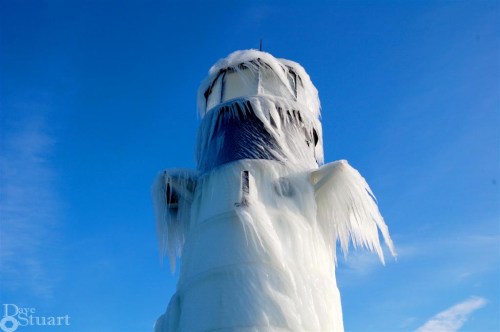
lighthouse snowman

lighthouse snowman

lighthouse snowman, photo by kiwirat

Frosty’s got nothing on the St. Joseph Lighthouse.

View Dave’s photo bigger or in his St. Joseph, MI slideshow.