Amongst Lovely Things

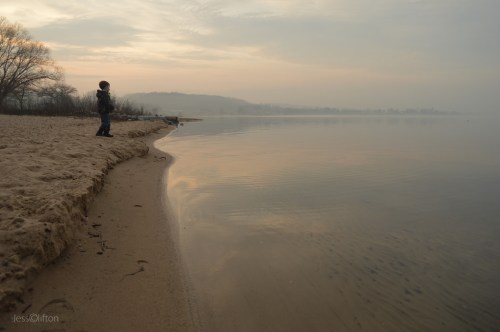
The most effective kind of education is that a child should play amongst lovely things. – Plato

The most effective kind of education is that a child should play amongst lovely things.
~Plato (photo by Jess Clifton)

Here’s hoping you have a chance this weekend to spend a little time amongst lovely things.

View Jess’s photo background big and see more in her Fabulous Fog slideshow.


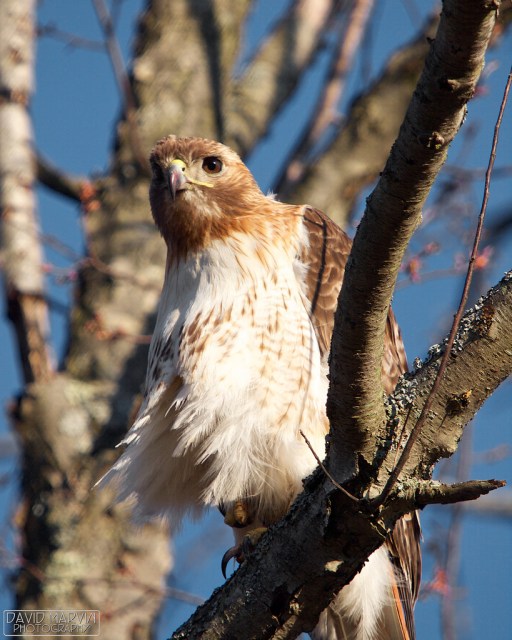
Red-Tailed Hawk (buteo jamaicensis)

Red Tailed Hawk

Red Tailed Hawk, photo by David Marvin

Sometimes the photos I link to go away, so here’s an old post with a new face!

All About Birds page on the Red-tailed Hawk (Buteo jamaicensis) says:

This is probably the most common hawk in North America. If you’ve got sharp eyes you’ll see several individuals on almost any long car ride, anywhere. Red-tailed Hawks soar above open fields, slowly turning circles on their broad, rounded wings. Other times you’ll see them atop telephone poles, eyes fixed on the ground to catch the movements of a vole or a rabbit, or simply waiting out cold weather before climbing a thermal updraft into the sky.

A couple fun facts:

The Red-tailed Hawk has a thrilling, raspy scream that sounds exactly like a raptor should sound. At least, that’s what Hollywood directors seem to think. Whenever a hawk or eagle appears onscreen, no matter what species, the shrill cry on the soundtrack is almost always a Red-tailed Hawk.

The Red-tailed Hawk is one of the largest birds you’ll see in North America, yet even the biggest females weigh in at only about 3 pounds. A similar-sized small dog might weigh 10 times that.

Courting Red-tailed Hawks put on a display in which they soar in wide circles at a great height. The male dives steeply, then shoots up again at an angle nearly as steep. After several of these swoops he approaches the female from above, extends his legs, and touches her briefly. Sometimes, the pair grab onto one other, clasp talons, and plummet in spirals toward the ground before pulling away.

Red-tailed Hawks have been seen hunting as a pair, guarding opposite sides of the same tree to catch tree squirrels.

The oldest known Red-tailed Hawk was 28 years 10 months old.

Click through for more info, photos and hawk sounds. Also see Buteo jamaicensis (red-tailed hawk) from the ADWRed-tailed Hawk on Wikipedia and Red-tailed hawk for Kids (also ADW).

View David’s photo background bigtacular and see more in his Birds slideshow.

More Michigan birds from Michigan in Pictures!

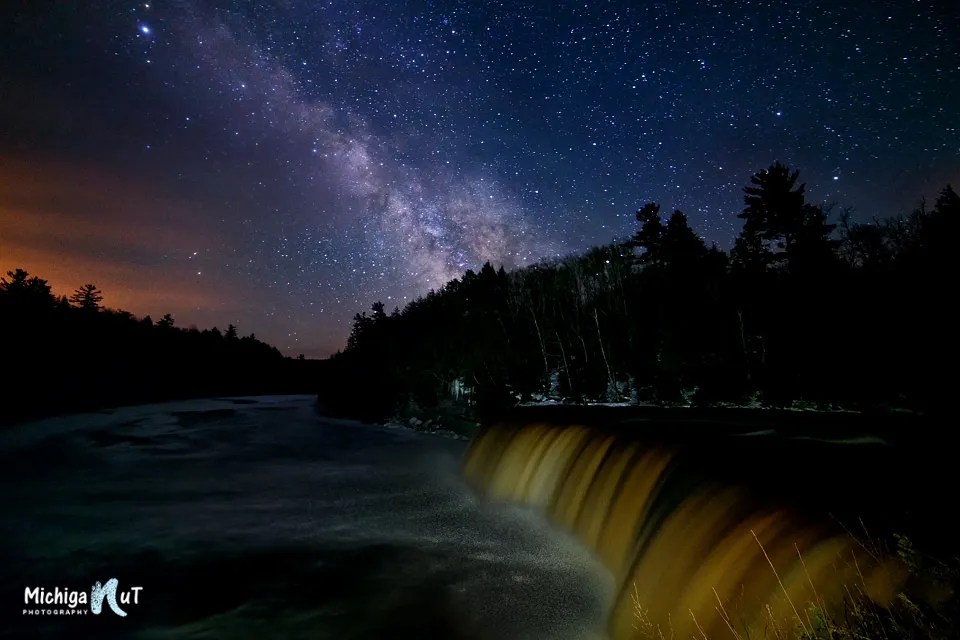
Milky Way at Tahquamenon Falls

Milky Way at Tahquamenon Falls, photo by John McCormick

I try not to blog photos from the same photographer close together, but sometimes the photos have different ideas. John aka Michigan Nut took this shot on April 26th at Michigan’s largest waterfall and writes:

Upper Michigan still has over a foot of snow on the ground and the Tahquamenon river is RAGING from the runoff. The mist was freezing on my camera. I think the light on the left side of the image is coming from the little town of Paradise, Michigan.

The official Tahquamenon Falls Facebook has a great video of the spring flow which can approach 50,000 gallons per second!

View his photo of the Tahquamenon Falls bigger and see more in his jaw-dropping Michigan waterfalls slideshow.

More Tahquamenon Falls and more waterfalls on Michigan in Pictures.

Support Michigan in Pictures with Patreon

Rock of Ages Lighthouse is Michigan’s tallest

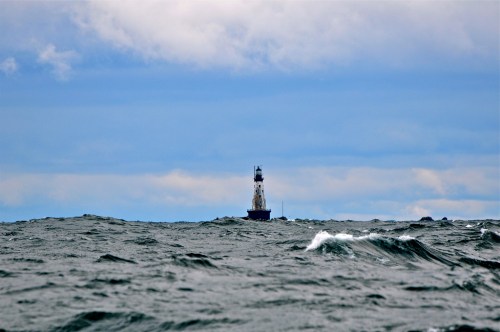
Rock of Ages Lighthouse

Rock of Ages Lighthouse, photo by Dave

I was looking for something on Michigan in Pictures and came across a series of “Michigan’s Tallest” posts that I did a couple of years ago. I thought it made sense to add to that list, so – according to Wikipedia’s list of the tallest lighthouse towers in the United States – measuring in at 130′ tall, Rock of Ages is Michigan’s tallest lighthouse.

It’s also the tallest lighthouse on the Great Lakes and on his Rock of Ages Light page at Seeing the Light, Terry Pepper writes (in part):

Consisting of a strip of exposed rock 50 feet wide and 210 feet long, with it highest point some sixteen feet above the water, Rock of Ages lies two and a half miles off the western end of Isle Royale. While the 205-foot wooden sidewheel steamer CUMBERLAND had been the rock’s only victim in over a half century of Superior navigation, changing navigation patterns in the final decade of the nineteenth century suddenly made Rock of Ages a critical impediment to safe navigation on the big lake.

As Duluth grew to preeminence as the lake’s major shipping port, a growing number of mariners were choosing to set a course along the northern shore during Superior’s violent storms in order to avoid the uncertain and changeable conditions of open water. With Rock of Ages lurking directly in the path of vessels choosing this course, a cry arose in the maritime community for the establishment of a Light on Rock of Ages.

…On completion, the tower stood eight stories in height, and offered relatively large and comfortable quarters for the complement of four keepers assigned to the station. A steam heating plant located in the upper cellar provided heat to cast iron radiators in all rooms, and the first deck was home to the fog signal plant and hoisting engines for the pillar crane located at the edge of the pier level. This crane was used both for raising supplies delivered by the lighthouse tenders at the wharf and for raising the keeper’s boat for storage on the safety of the pier deck. An office and common room made up the second deck, and a mess room and kitchen the third. The Keeper and First Assistant’s quarters were located on the fourth deck, with the Second and Third Assistants quarters immediately above on the Fifth deck. A service room and watch room comprised the sixth and seventh decks, leaving the huge lantern capping the structure above.

Much more at Seeing the Light including an aerial photo of this lonely location. Terry has a listing of verified tower heights for anyone who’s interested too.

About the photo, Dave writes: Photo taken from the back of Voyageur II heading into Windigo with 7 foot waves at 300mm. Yeah I almost got sea sick from taking these.

View his photo bigger and see more in his Lighthouses of Michigan slideshow.

More lighthouses on Michigan in Pictures.

Fancy Feathers, Fashion and the Dawn of Bird Conservation

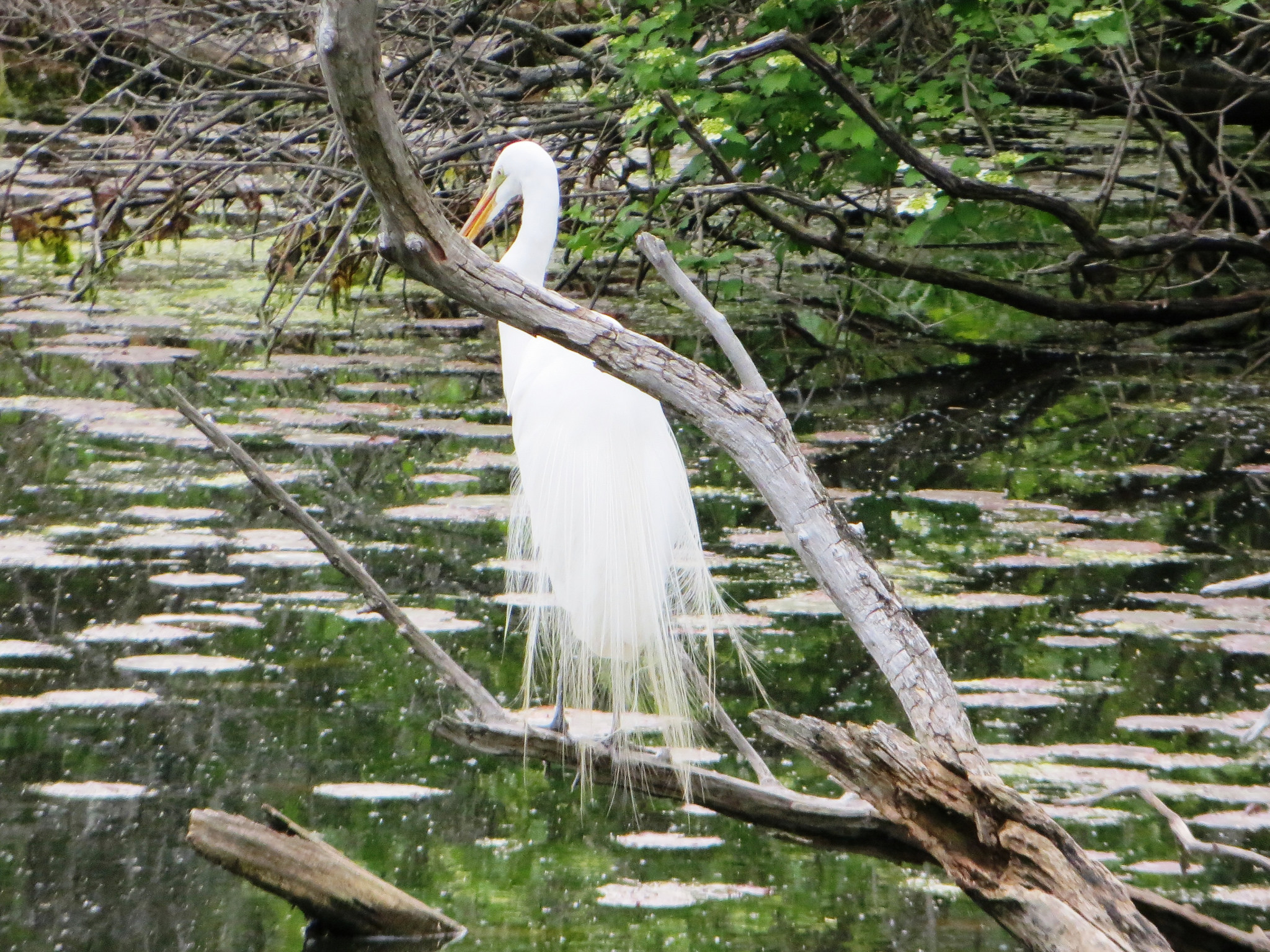
Spring Arrival Egret

Spring Arrival, photo by Cowboy*

How the Great White Egret Inspired Bird Conservation in the Smithsonian says:

One particular group of birds suffered near extermination at the hands of feather hunters, and their plight helped awaken a conservation ethic that still resonates in the modern environmental movement. With striking white plumes and crowded, conspicuous nesting colonies, Great Egrets and Snowy Egrets faced an unfortunate double jeopardy: their feathers fetched a high price, and their breeding habits made them an easy mark.

To make matters worse, both sexes bore the fancy plumage, so hunters didn’t just target the males; they decimated entire rookeries. At the peak of the trade, an ounce of egret plume fetched the modern equivalent of two thousand dollars, and successful hunters could net a cool hundred grand in a single season. But every ounce of breeding plumes represented six dead adults, and each slain pair left behind three to five starving nestlings. Millions of birds died, and by the turn of the century this once common species survived only in the deep Everglades and other remote wetlands.

This slaughter inspired Audubon members to campaign for environmental protections and bird preservation, at the state, national and international levels. The Lacey Act passed Congress in 1900, restricting interstate transport of wild fowl and game. In 1911 New York State outlawed the sale of all native birds and their feathers, and other states soon followed suit. Passage of the Weeks-McLean Act (1913) and the Migratory Bird Act (1918) took the protections nationwide and mirrored legislation in Canada, Britain, and Europe, effectively ending the fancy-feather era.

More about Great Egrets on the UM Animal Diversity Web.

You can view Cowboy’s photo from last May background big and see more in his Animals & Wildlife slideshow.

More birds and more Spring wallpaper on Michigan in Pictures!

Bring the rain

Green by kellyanne

Untitled, photo by kellyanne berg

“Some people walk in the rain, others just get wet.”
~Roger Miller

View Kellyanne’s photo bigger and see more in her Rain slideshow.

More rain on Michigan in Pictures.

Earth Day Daffodils

Happy Earth Day

Happy Earth Day, photo by Linda

I’d like to wish everyone who wants to have a happy Earth Day a very happy Earth Day.

I love this state and I love the planet it’s on and really hope that we can do a better job taking care of it because I want my kids and grandkids to enjoy it as much or more than me.

View Linda’s photo background bigalicious and see more from Linda’s backyard.

More Earth Day on Michigan in Pictures. If you’re interested in Earth Day’s Michigan roots, check out Ann Arbor’s First Earth Day from the Ann Arbor Chronicle and this video from the first Earth Day at UM courtesy the Bentley Historical Library.

Bring on the Spring!

Untitled

Untitled, photo by Brooke Pennington

Brooke has our yearly dose of spring bokeh. Drink deep and wash those winter blues away!

View his photo bigger and see more in his slideshow.

More about bokeh on Michigan in Pictures.

Menominee Ice Shoves

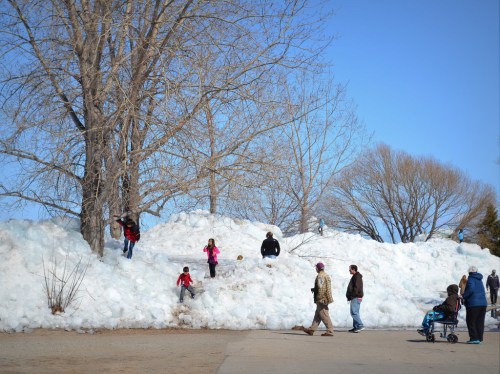
Everyone came out to see the ice shoves

Everyone came out to see the ice shoves, photo by Ann Fisher

While much of the state is enjoying springlike weather, folks in northern Michigan and the UP are still going toe to toe with a winter that will not quit. In solidarity, here’s one more wintry shot.

It comes from Ann Fisher in Menominee and shows the large “ice shoves” or “ice push” that came off Lake Michigan last Sunday. In Ice Shove: Giant Ice Slabs Invade Great Lakes Shorelines, Jon Erdman of the Weather Channel explains:

An ice shove is a rapid push of free-floating lake or sea ice onshore by wind. Strong winds from the same direction over, say, a 12 to 24 hour period, are enough to drive large chunks and plates of ice ashore.

The initial slabs or blocks of ice will slow down momentarily when reaching land, creating a traffic jam of ice piling behind and on top. The result is a massive ice pile often over 10 feet high, surging ashore in a matter of minutes, surrounding and damaging everything in their path, including trees, sod, fences, and homes.

Read on at Weather.com for more including the much bigger ice shoves in Oshkosh, Wisconsin and a look at the most widespread ice coverage on record for mid-April – over 39% of the Great Lakes! You can see some more photos from Fox6 in Menominee and if you head over to Absolute Michigan, you can look back to March of 2009 and some a CNN video of the crazy massive ice shoves on Saginaw Bay.

View Ann’s photo background big and see more in her Ice slideshow.

More ice on Michigan in Pictures.

Snowshoe on out of here, Winter!

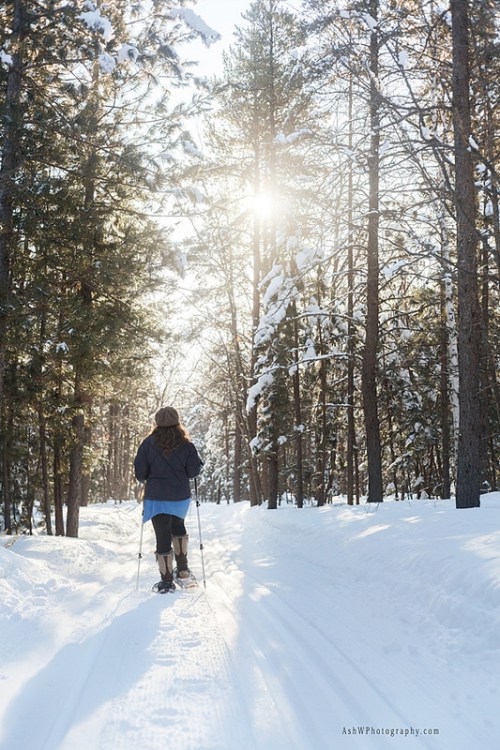
Snowshoeing the U.P.

Snowshoeing the U.P., photo by Ashley Williams

Ashley took this shot in February in the Upper Peninsula, and by “February” I mean “this Monday”. It’s a beautiful scene for sure, but I think I speak for most of us when I say, “You’re drunk, Winter. Go home.”

View her photo bigger and see more in her Nature slideshow.