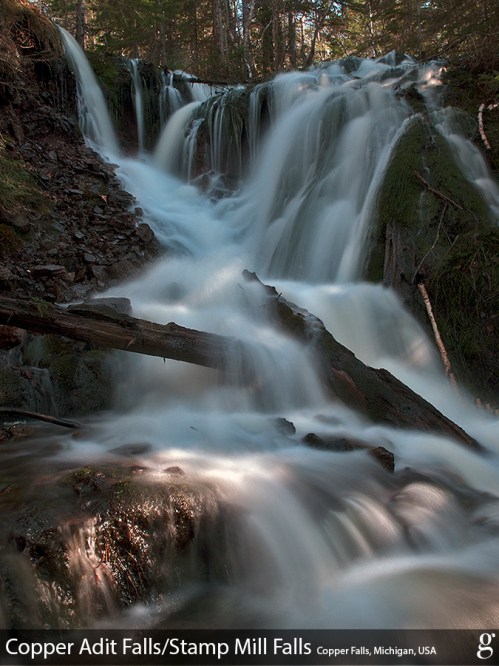
Copper Adit Falls, Stamp Mill Falls at Copper Falls Mine

n2c_113-4482

n2c_113-4482, photo by Gowtham

Gowtham writes:

Established in 1846, Copper Falls mine was a collection of several copper mine shafts and adits (definition below). Owl Creek — in what was once one of the richest fissure veins in the Keweenaw — seems to make a magical (and a seasonal) appearance out of a hillside draining the now closed Copper Falls mine to form this quite spectacular and scenic-looking Copper Adit Falls. With the nearby remnants of an old stamp mill, this waterfall is also known as Stamp Mill Falls.

Citing Wikipedia, an adit is an entrance to an underground mine which is horizontal or nearly horizontal, by which the mine can be entered, drained of water, ventilated, and minerals extracted at the lowest convenient level.

The Copper Country Explorer’s entry on Copper Falls begins:

Stamp Mills relied on two things in order to separate copper: water and gravity. Any stamp mill would be built near a source of water such as a river or lake. It also would be build along a hill, in order to make the greatest use of gravity. Because of this we started our search along the creek that had cut a path through the sands – Owl Creek.

Owl Creek was the lifeblood of the Copper Falls Mine. Steam stamps required water, and along the rugged ridges of the Copper Falls a natural source existed. Fed from atop the ridge by a lake of the same name, Owl Creek drops over 500 feet to the marshlands along Superior’s shore. This creek not only provided water to the mine and mill, but the potential energy stored in its banks could easily turn a water wheel for power (mechanical power, since electricity had yet to be invented). It was a perfect spot for a mill.

Read on for lots more and explore the Copper Falls Mill at with the Copper Country Explorer.

View Gowtham’s photo bigger and see more of his photos from the area on his website.

More waterfalls on Michigan in Pictures!
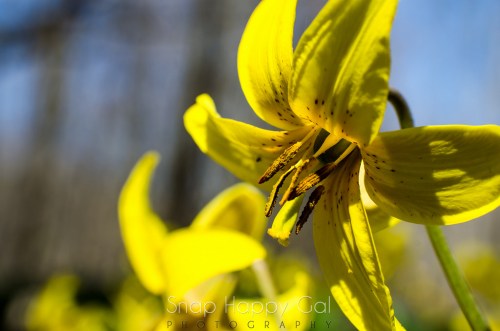
Find the Trout Lily where and when the trout hide…

Trout lily (3 of 3)

Trout lily (3 of 3), photo by Heather Higham

I love old books, and was happy to find Wild Flowers Worth Knowing by Neltje Blanchan, a 1917 book that is available online through Project Gutenberg. The entry for Yellow Adder’s Tongue; Trout Lily; Dog-tooth “Violet” (Erythronium americanum) is a good example of the descriptive & endearing turns of phrase you often find in books from another age:

Flower – Solitary, pale russet yellow, rarely tinged with purple, slightly fragrant, 1 to 2 in. long, nodding from the summit of a root-stalk 6 to 12 in, high, or about as tall as the leaves. Perianth bell-shaped, of 6 petal-like, distinct segments, spreading at tips, dark spotted within; 6 stamens; the club-shaped style with 3 short, stigmatic ridges. Leaves: 2, unequal, grayish green, mottled and streaked with brown or all green, oblong, 3 to 8 in. long, narrowing into clasping petioles.

Preferred Habitat – Moist open woods and thickets, brooksides.

Flowering Season – March-May.

Distribution – Nova Scotia to Florida, westward to the Mississippi.

Colonies of these dainty little lilies, that so often grow beside leaping brooks where and when the trout hide, justify at least one of their names; but they have nothing in common with the violet or a dog’s tooth. Their faint fragrance rather suggests a tulip; and as for the bulb, which in some of the lily-kin has toothlike scales, it is in this case a smooth, egg-shaped corm, producing little round offsets from its base. Much fault is also found with another name on the plea that the curiously mottled and delicately pencilled leaves bring to mind, not a snake’s tongue, but its skin, as they surely do. Whoever sees the sharp purplish point of a young plant darting above ground in earliest spring, however, at once sees the fitting application of adder’s tongue. But how few recognize their plant friends at all seasons of the year!

Every one must have noticed the abundance of low-growing spring flowers in deciduous woodlands, where, later in the year, after the leaves overhead cast a heavy shade, so few blossoms are to be found, because their light is seriously diminished. The thrifty adder’s tongue, by laying up nourishment in its storeroom underground through the winter, is ready to send its leaves and flower upward to take advantage of the sunlight the still naked trees do not intercept, just as soon as the ground thaws.

View Heather’s photo background bigtacular and see more in her Up Close slideshow.

Many more Michigan flowers and more Spring wallpaper on Michigan in Pictures!

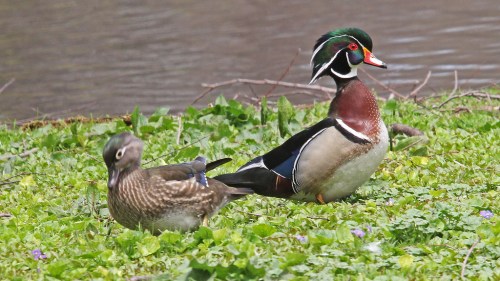
Chillin’ with the Wood Ducks

Wood Duck

Wood Duck, photo by Dan Lockard

The All About Birds listing for Aix sponsa (wood duck) says in part:

The Wood Duck is one of the most stunningly pretty of all waterfowl. Males are iridescent chestnut and green, with ornate patterns on nearly every feather; the elegant females have a distinctive profile and delicate white pattern around the eye. These birds live in wooded swamps, where they nest in holes in trees or in nest boxes put up around lake margins. They are one of the few duck species equipped with strong claws that can grip bark and perch on branches.

Wood Ducks thrive in bottomland forests, swamps, freshwater marshes, and beaver ponds. They are also common along streams of all sizes, from creeks to rivers, and the sheer extent of these make them an important habitat. Wood Ducks seem to fare best when open water alternates with 50–75% vegetative cover that the ducks can hide and forage in.

Some wood duck facts:

  • Natural cavities for nesting are scarce, and the Wood Duck readily uses nest boxes provided for it. If nest boxes are placed too close together, many females lay eggs in the nests of other females. (click for info about building a nest box)
  • The Wood Duck nests in trees near water, sometimes directly over water, but other times up to 2 km (1.2 mi) away. After hatching, the ducklings jump down from the nest tree and make their way to water. The mother calls them to her, but does not help them in any way. The ducklings may jump from heights of up to 89 m (290 ft) without injury.
  • Wood Ducks pair up in January, and most birds arriving at the breeding grounds in the spring are already paired. The Wood Duck is the only North American duck that regularly produces two broods in one year.

View Sherri & Dan’s photo background big and see more in their Animals slideshow.

Many (many) more Michigan birds on Michigan in Pictures.

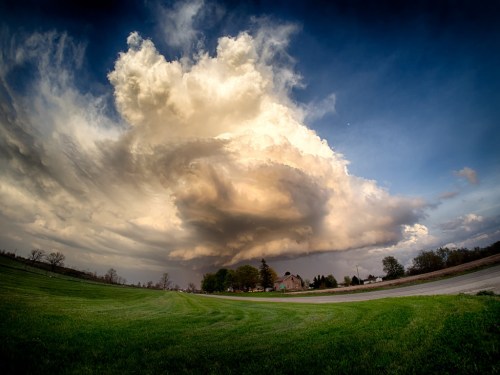
Beautiful Beast

Beautiful Beast

Beautiful Beast, photo by Jamie MacDonald

Yesterday saw strong storms in southeast Michigan including some tornado sightings (click that link for photos).

Jamie took this shot last week with a Rokinon 7.5mm Fisheye. Check his photo out bigger and see more in his Stormy Weather slideshow.

More wild & wonderful weather on Michigan in Pictures.

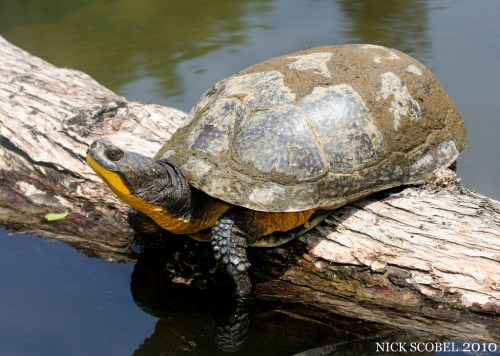
Know Your Michigan Turtles: Blanding’s Turtle

Blanding's Turtle

Blanding’s Turtle, photo by Nick Scobel

One of the most popular posts on Michigan in Pictures is Know Your Michigan Turtles where there’s now 6 of Michigan’s 10 turtle species profiled. For all those folks who come by to hang with our hard-shelled friends, here’s the latest installment in the series! 

The University of Michigan Animal Diversity Web entry for Emydoidea blandingii (Blanding’s Turtle) says that the Great Lakes region is currently a stronghold for this species:

Blanding’s turtles are found in and around shallow weedy ponds, marshes, swamps, and lake inlets and coves most of the year. They prefer slow-moving, shallow water and a muddy bottom with plenty of vegetation.

Blanding’s turtle are medium sized turtles with a carapace length ranging from 15.2 to 27.4 cm. These semi-aquatic turtles have moderately high, domed carapaces. They are elongate and smooth, lacking keels or sculpturing. The carapacial scutes display distinct growth annuli most prominently seen in juveniles. Coloration between individuals is highly variable. The carapace is black or gray with any variation of scattered light yellow or whitish flecks or dots. The light spots and flecks predominate in some individuals while others are almost solid black. The plastron is yellow in color with a dark blotch in the outer corner of each scute, and has a V-shaped notch near the tail.

Blanding’s turtles, like most other turtles, emerge to bask on sunny days. Basking sits include logs, grass clumps, sloping banks, or high perches near the water. Although these turtles are quite tolerant to cold, the summer heat may restrict their activities to early morning and evening or possibly a more nocturnal lifestyle. In the event of their habitat drying up some individuals will opt to migrate to new bodies of water while others simply burrow into the mud and aestivate until conditions improve. Blanding’s turtles generally hibernate from late October until early April, but quite often they can be seen moving slowly below the ice.

Blanding’s turtles are omnivores. Their favorite food items are crustaceans but they also feed on insects, leeches, snails, small fish, frogs, and occasionally some plants. Food is captured with a rapid thrust of this turtle’s long neck, similar to the feeding actions of the snapping turtle (Chelydra). Feeding mostly occurs underwater and food seized on land is generally carried to the water for swallowing. Prey is either swallowed whole or if it is too large it is held by the jaws and shredded into smaller pieces by the front claws.

The Michigan DNR notes that Blanding’s Turtle is protected as a species of special concern in Michigan and also has a map of occurences of Blanding’s Turtle.

View Nick’s photo bigger and see a lot more of his photos of Blanding’s turtles on Flickr including this shot of the turtle’s amazingly long neck. Nick also runs the Herping Michigan Blog, a great resource to see a lot of reptiles and amphibians in the wild!

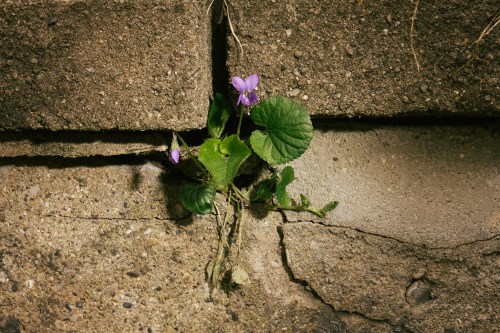
Roses are red, violets are tough

Roses are red, violets are tough

Roses are red, violets are tough, photo by Bill Dolak

View Bill’s photo background bigilicious and see more in his Flowers slideshow.

More Spring wallpaper on Michigan in Pictures.

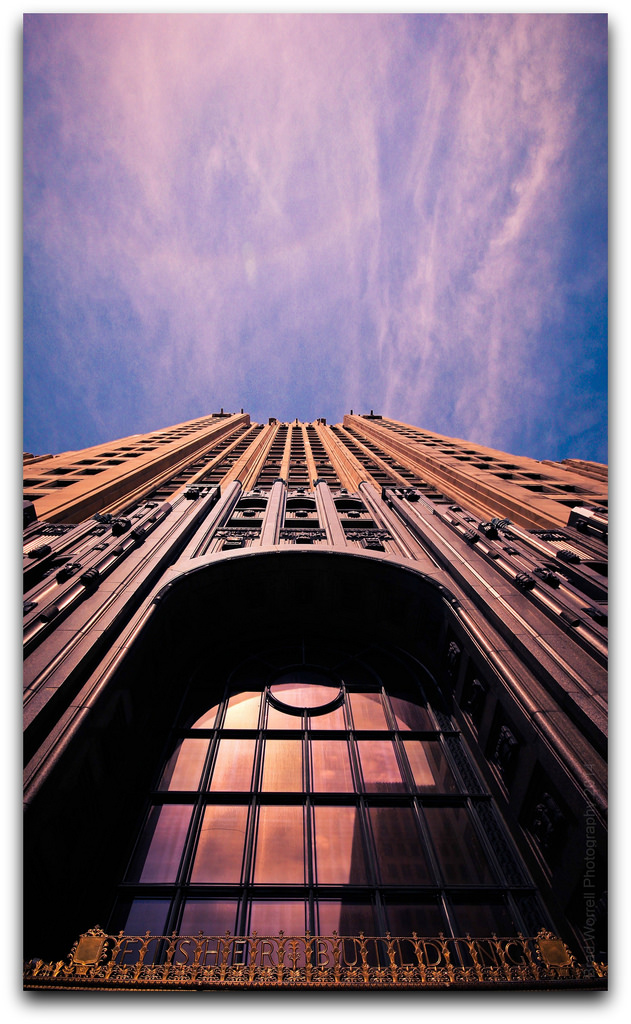
Fisher Brothers Legacy

Fisher Brothers Legacy...

Fisher Brothers Legacy…, photo by Brad Worrell

On his excellent Historic Detroit site, Dan Austin’s excellent & comprehensive article on the Albert Kahn designed Fisher Building says:

The late 1920s were a time of unprecedented growth in Detroit, especially when it came to skyscrapers. From the Penobscot Building to the Fox Theatre, 1928 saw landmark after landmark rise in the Motor City.

The 29-story Fisher is one of three National Historic Landmarks in Detroit, along with the Fox and the Guardian Building.

“The gold-capped tower has taken its proper place in Detroit’s ever-changing skyline,” the Detroit News wrote of the Fisher in October 1928, when the finishing touches were being put on the building. “This will be the most beautiful building of its kind ever created. … It is an outstanding example of the new American school of architecture, which has arisen to typify the spirit of modern progress. No expense, Mr. Kahn said, has been spared to make the Fisher building the very epitome of things beautiful.”

To achieve this feat, the Fisher was built — with only slight exceptions — entirely out of granite and marble, including on the exterior. More than 40 kinds of marble from all over the world were used. From the base of the building to 50 feet up — the first three floors — the exterior is finished in polished Minnesota pink marble and Oriental granite. Above that is Beaver Dam marvilla marble (named such because it was harvested from the Beaver Dam Quarry at Cockeysville, Md.) on the street fronts and Carthage marble on the courts. The marble was cut and positioned to give varying textures across the exterior. “The sun (plays) on differences of saw markings and grain on each block that identify the individual pieces from their neighbors,” the Michigan Manufacturer and Financial Record wrote in October 1928.

Read on for much (much) more about the Fisher Building including a sweet gallery of historic photos (including one looking up at this angle).  you can also visit the Fisher Building website.

View Brad’s photo bigger and see more in his Detroit slideshow.

More architecture on Michigan in Pictures.

Diego Rivera & Frida Kahlo exhibit coming to the DIA

Detroit Institute of Arts: "Detroit Industry" Murals, South Wall--Detroit MI

Detroit Institute of Arts: “Detroit Industry” Murals, South Wall–Detroit MI, photo by pinehurst19475

Michigan Radio Reports that the Detroit Institute of Arts is planning an exhibition that highlights Mexican artists Diego Rivera and Frida Kahlo and the year spent in Detroit. Between April 1932 and March 1933, Rivera created the Detroit Industry murals at the DIA and the museum will also show works created by Kahlo during that time.

The show is scheduled to run from March 15, 2015 to July 12, 2015, and you can click through to Michigan Radio for more including a film of Rivera working on the murals. Also check out photos of the Rivera Court murals at the DIA.

About this photo, pinehurst19475 writes: This section of the South Wall depicts line workers assembling tires, axles and wheels with a factory tour in progress. The Rivera murals were recently named a National Historic Landmark.

View the photo background bigtacular and see more in his Wayne State and the Cultural Center slideshow.

More art and more Detroit on Michigan in Pictures.

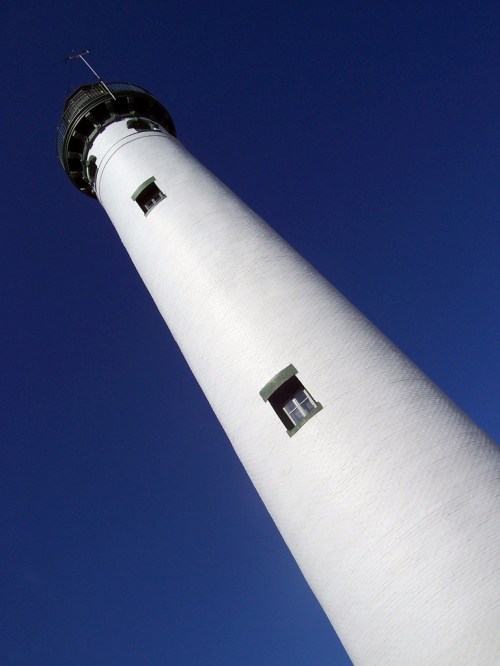
New Presque Isle Lighthouse

Presque Isle lighthouse (new)

Presque Isle lighthouse (new), photo by Jeff Rozema

Terry Pepper writes that the first Presque Isle Light was established in 1840 to serve as a guide to mariners seeking the harbor on Presque Isle, the spit of land protruding from the eastern shore of Lake Huron French trappers named “almost an island.” By 1866, the dwelling was judged to be a tear-down candidate and in March of 1967, Congress appropriated $28,000 for construction of the New Presque Isle Light according to the plan of District Engineer Orlando M Poe:

Poe’s classic design for the new tower was atypically elegant for such a utilitarian structure, and was so successful that it would be duplicated at a number of stations throughout the district, including Outer Island and Au Sable Point on Lake Superior, and at Little Sable, Big Sable and Grosse Point on Lake Michigan. Erected on a limestone foundation that extended almost ten feet below grade, the red brick tower stood 113 feet in height. 19 feet 3 inches in exterior diameter at the base, the structure tapered gracefully to a diameter of 12 feet beneath the gallery. Constructed with a double wall system, the outer walls stood 5 feet three inches in thickness at the base and the inner wall one 1 foot thick with a 2 foot three inch air space between. The inner walls did not reflect the taper of the exterior, but were erected as a pure cylinder, encasing a spiral cast iron stairway consisting of 138 steps and incorporating five landings and a watch room with four windows immediately below the gallery. Each of these windows featured a graceful arched top section, typical of Poe’s groundbreaking design.

Supported by a series of ornate cast iron corbels, the gallery provided a convenient location from which the keepers could observe vessels out on the lake during fair weather, and created a natural location from which to suspend a boatswain’s chair to conduct maintenance on the gallery supports and the masonry of the tower walls. Centered on the gallery, a prefabricated cast iron apparatus room was erected with a smaller encircling gallery. Centered within this secondary gallery, a cast iron lantern with vertical astragals was equipped with hand-holds to provide the keepers with an extra measure of safety while standing on the narrow upper gallery when cleaning or scraping ice from the plate glass lantern panes. A large cast iron pedestal to support for the lens was erected in the mechanical room below the lantern, and the massive Third Order Fresnel lens, which had been ordered from Henry LePaute Cie. of Paris assembled at its upper flare. Consisting of a brass support structure standing 8 feet in diameter, ten prismatic panels, each six feet in height and 2 feet 6 inches wide were carefully assembled within the frame to create the “crystal beehive” look typical of such lenses.

Read on for more about this lighthouse including some old pics.

View Jeff’s photo bigger and see more shots from here and far in his Lighthouses slideshow.

Many more Michigan lighthouses on Michigan in Pictures!


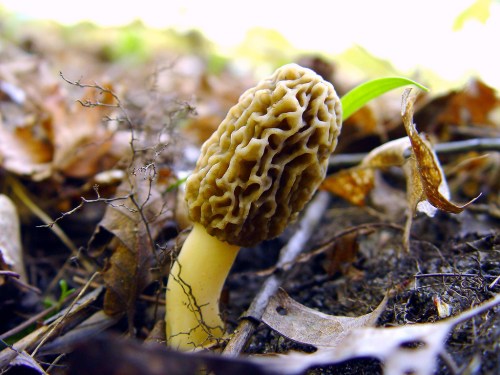
Michigan’s 2014 Morel Season has arrived!

The White Morels are just starting. Taken in the City Limits of Boyne City, Michigan, along with some others I might add.

The White Morels are just starting. Taken in the City Limits of Boyne City, Michigan, along with some others I might add., photo by Rick Wolanin

I’ve started to get reports of morels trickling in from here in Traverse City and other locations in the state. While we’re a ways from full-on morel madness, it’s a good time to start getting excited about the return of this once-a-year woodland delicacy.

Over 7 years, Michigan in Pictures has accumulated a lot of morel features – here are some favorites along with a couple from other sites:

Rick lives in Boyne City, one of Michigan’s morel epicenters. View his photo bigger and check out more of his great morel photos!