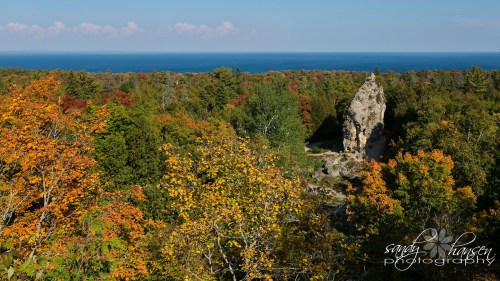
Fall at Sugar Loaf Rock on Mackinac Island

Sugar Loaf Rock Mackinac Island

The Rock, photo by Sandy Hansen Photography

Here’s a color check-in from last week on Mackinac Island. The Mackinac Island State Park Commission says the following about Sugar Loaf rock romation:

Sugar Loaf, a 75 foot tall limestone stack, is the largest rock formation on Mackinac Island. When glacial Lake Algonquin covered much of the Island 11,000 years ago, Sugar Loaf was connected to the nearby bluff face (today called Point Lookout). Wave action slowly washed away the softer limestone between the stack and the bluff, leaving Sugar Loaf as a stand-alone feature. High water levels during the Lake Algonquin period left only the top of Sugar Loaf exposed, as evidenced by the small cave cut into the north face of the formation by wave action. This cave was originally on the shoreline of the lake.

As with other geological features on the Island, numerous Native American legends have been passed down relating to the origin of Sugar Loaf. One story relates that a young man asked the spirits for eternal life. In response, they turned him to stone, creating Sugar Loaf.

View Sandy’s photo bigger and see more of her Mackinac Island photos.

Also check out Arch Rock and the Devil’s Kitchen on Michigan in Pictures.
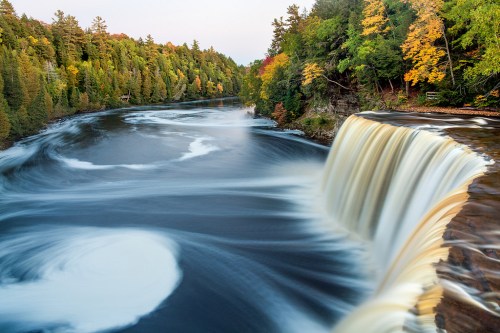
Fall Color at Upper Tahquamenon Falls

Upper Tahquamenon Falls

Upper Tahquamenon Falls, photo by Ashley Williams

If you’re wondering what fall color looks like in the northeastern Upper Peninsula, wonder no more! Ashley took this shot at Michigan’s largest waterfall, the Tahquamenon Falls last week. As you can see, it’s shaping up nicely.

If you’re wondering about statewide color, the Freep shared a NASA photo of Michigan’s fall color from space that’s pretty cool!

View her photo background bigtacular and see more in her Michigan’s Upper Peninsula slideshow.

There’s lots more fall wallpaper and more Tahquamenon Falls on Michigan in Pictures!

Playoff Time, 2014

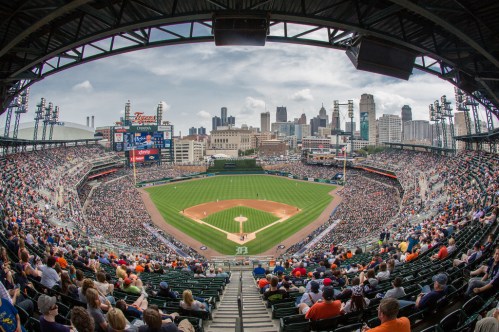
Tigers Win by rudymalmquist

Tigers Win, photo by Rudy Malmquist

The Detroit Tigers kick off their fourth straight postseason appearance today vs the Baltimore Orioles at 5:30 PM at Oriole Park at Camden Yards. While the Tigers were almost everyone’s pick for the playoffs in 2014, the Orioles were definitely not. View the series preview right here.

Here’s some interesting post-season storylines that may be of interest to only me!

View Rudy’s photo bigger and click for more of his baseball pics.

Lots more Detroit Tigers on Michigan in Pictures!

PS: Take a moment to appreciate what a great job Rudy did of capturing the Detroit skyline in this shot and LET’S GO TIGERS!!

October’s Full Moon: a super Hunter’s Blood Moon in eclipse

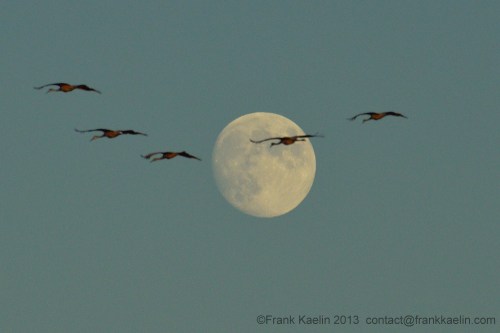
sandhill moon

sandhill moon, photo by Frank Kaelin

EarthSky reports that for the full moon on October 8th, there’s a whole lot going on!

In skylore, the Northern Hemisphere’s Hunter’s Moon on October 7-8 will be called a Blood Moon. Plus the October 7-8 total lunar eclipse – the second of four total lunar eclipses in the ongoing lunar tetrad – has been widely called a Blood Moon. Voila. Double Blood Moon.

Hunter’s Moon the name for the full moon after the Harvest Moon, which is the full moon nearest the September 23 autumnal equinox. This year, the Harvest Moon came on September 9. That’s why tonight’s moon bears the name Hunter’s Moon.

…In 2014 and 2015, a new usage of the term Blood Moon sprang up. Surely you heard about it at the total lunar eclipse in April 2014. It’s the name being used for the four eclipses of the ongoing lunar tetrad – four total lunar eclipses in a row, each separated from the other by six lunar months. (more on this on Michigan in Pictures)

The partial umbral eclipse begins at 5:15 AM EDT on October 8, with the total eclipse starting at 6:25 AM, peaking at 6:55 and ending at 7:24.  On top of all that is the question as to whether or not October 8th’s moon is a supermoon:

At least two commentators – Richard Nolle and Fred Espenak – disagree on whether the October 8, 2014 full moon should be called a supermoon. Is it? You’re likely to see all sorts of conflicting information in October, 2014. If you define a supermoon based on the year’s closest perigee and farthest apogee, then the October 8 moon is not a supermoon. If you define a supermoon based on the perigee and apogee for a given monthly orbit, then it is a supermoon. And not just any supermoon, but a super Hunter’s Blood Moon in eclipse!

I guess with Frank’s photo from October 2013, we could add “Sandhill Moon” to the list! He writes that he took this at the Phyllis Haehnle Memorial Sanctuary where counts were as high as eight thousand sandhill cranes a day during last fall’s migration! View his photo bigger and see more in his Landscape slideshow.

Lots more full moon magic on Michigan in Pictures!


Early fall color at Chapel Rock

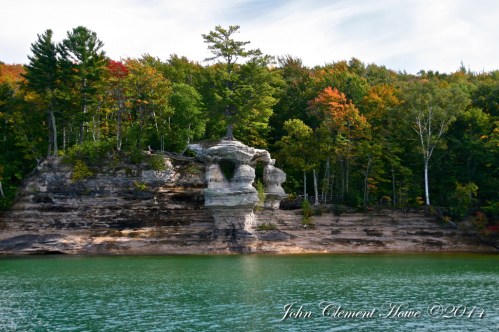
Chapel Rock Fall Colors

IMG_4776, photo by John Clement Howe

Around the end of September every year the request start to roll in regarding the state of fall color around Michigan, so it’s great to have photos like this one from last Wednesday to point them to! It shows one of my personal Seven Wonders of Michigan, Chapel Rock in the Pictured Rocks National Lakeshore.

View John’s photo bigger and see more in his Pictured Rocks National Lakeshore slideshow.

Lots more fall color on Michigan in Pictures!

PS: Check out John’s first appearance on Michigan in Pictures back in October of 2006!

Surf’s Up in Michigan!

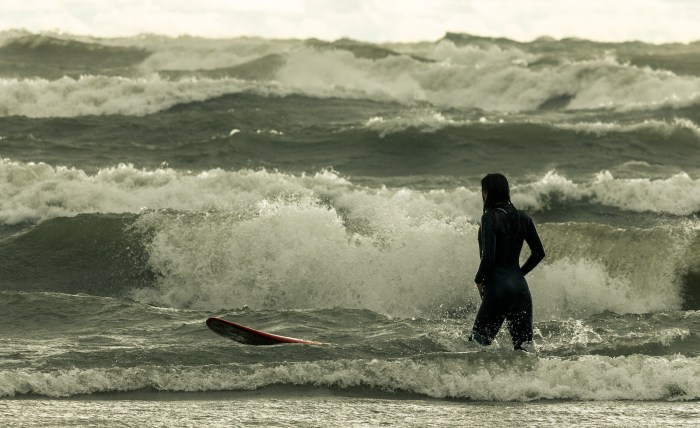
Surfs Up

Surf’s up, photo by Bill Dolak

Fall is surf season in Michigan, so I thought I’d share this photo and a link to a slideshow of nearly 500 photos from the Absolute Michigan photo group on Flickr.

View Bill’s photo from South Beach in South Haven background bigtacular and see more in his South Haven slideshow.

More surfing on Michigan in Pictures!

PS: I feel like I should tell you that if you aren’t a very good surfer, you should stay away from the Great Lakes in high winds and waves, particularly when the water is cold!

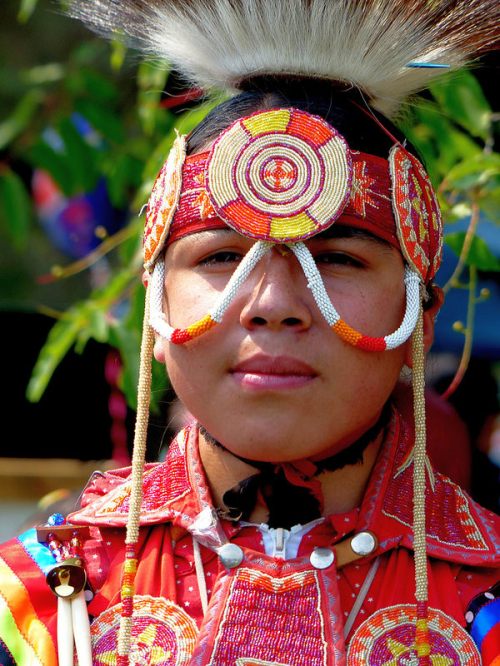
Happy Michigan Indian (Anishinaabek) Day

Odawa Indian Boy

Odawa Indian Boy, photo by Sharon

Michigan Indian Day was established as the 4th Friday in September by the State of Michigan in 1974.

The Little River Band of Ottawa Indians & Kenny Pheasant, Director of their Anishinaabemowin Program created a cool site to help people learn Anishinaabemowin, the language of the Anishinaabe nation. The history page begins:

In the beginning, Gizhemanidoo created the universe as we know it today. He created Grandfather Sun and Grandmother Moon, Mother Earth and Father Sky. And on the earth he created all things, living and nonliving. He created life in the earth, on the earth, in the sky and in the water. He created the plants, rivers, four-legged and winged creatures, and the swimmers. After this was done, he created one of the greatest mysteries of all – the four seasons – to bring harmony and balance to all.

After all creation was complete, he created man. After he created the first Anishinaabe, he came to him in a dream and instructed him that he was to name all things in the language that he gave him, Anishinaabemowin. So the first man went about on his journey and named all things he saw – all the animals, insects, birds and fish – however long this took. Afterward, he spoke to the Creator Gizhemanidoo in his dream and said, “I have finished what you have told me to do.” Then the Creator Gizhemanidoo spoke back to him and said, “Yes, you have indeed done so, and now it is time for me to give you your name. Your name shall be Nanabozho, and whenever your people meet and greet one another, they will say a part of your name. That is why whenever the Anishinaabe people greet one another, they say the word Bozhoo.

Our creation story tells us that we originally migrated to the Great Lakes region from the East Coast. There are many settlements of our original homes that still exist to this day, like Manitoulin Island, the Island of the Great Spirit.

We have always been a nation, and we knew one another as the Anishinaabek. It was not until the French and European settlers arrived on this part of the continent that we became known as the tribes now called Ojibwe, Odawa and Bodwe’aadamiinh.

Read on for more.

Sharon took this at the 2014 Odawa Homecoming Pow Wow in Harbor Springs. View it bigger and see more in her slideshow.

More portraits on Michigan in Pictures.


The Science of Fall Color, Revisited

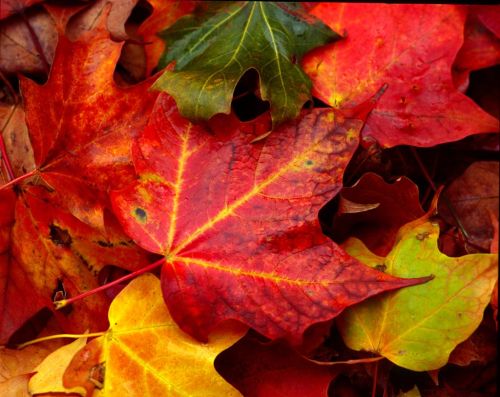
"Autumn Leaves" by Michael G.O'Callaghan

“Autumn Leaves”, photo by Michael G.O’Callaghan

Three years ago I posted this. It’s such good and useful information that I thought I’d share it again! #TBT?

The Science of Color in Autumn Leaves from the United States National Arboretum explains that process that starts the cascade of events that result in fall color is a growth process that starts in late summer or early autumn. When the nights get long enough, a layer of cells called the abscission layer forms that begins to block transport of materials from the leaf to the branch.

During the growing season, chlorophyll is replaced constantly in the leaves. Chlorophyll breaks down with exposure to light in the same way that colored paper fades in sunlight. The leaves must manufacture new chlorophyll to replace chlorophyll that is lost in this way. In autumn, when the connection between the leaf and the rest of the plant begins to be blocked off, the production of chlorophyll slows and then stops. In a relatively short time period, the chlorophyll disappears completely.

This is when autumn colors are revealed. Chlorophyll normally masks the yellow pigments known as xanthophylls and the orange pigments called carotenoids — both then become visible when the green chlorophyll is gone. These colors are present in the leaf throughout the growing season. Red and purple pigments come from anthocyanins. In the fall anthocyanins are manufactured from the sugars that are trapped in the leaf. In most plants anthocyanins are typically not present during the growing season.

As autumn progresses, the cells in the abscission layer become more dry and corky. The connections between cells become weakened, and the leaves break off with time. Many trees and shrubs lose their leaves when they are still very colorful. Some plants retain a great deal of their foliage through much of the winter, but the leaves do not retain their color for long. Like chlorophyll, the other pigments eventually break down in light or when they are frozen. The only pigments that remain are tannins, which are brown.

The explain that because the starting time of the whole process is dependent on night length, fall colors appear at more or less the same time every year and are not overly dependent on temperature, rainfall or other factors, other than the fact that weather can shorten or prolong the show by stripping leaves from trees.

Click through to the US Arboretum for more and also see Fall & Fuit from the Science of Color and Wikipedia’s entry on Autumn leaf color.

View Mike’s photo background big and see more in his Autumn slideshow.

Lots more fall color on Michigan in Pictures!

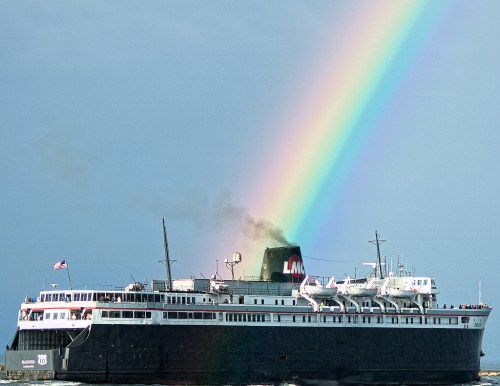
Rainbow over the Badger

Rainbow over the Badger

Rainbow over the Badger, photo by mark zacks

View Mark’s photo big as a boat and click for more of his Ludington shots including a few more of the Badger car ferry.

More ships & boats and more rainbows on Michigan in Pictures.

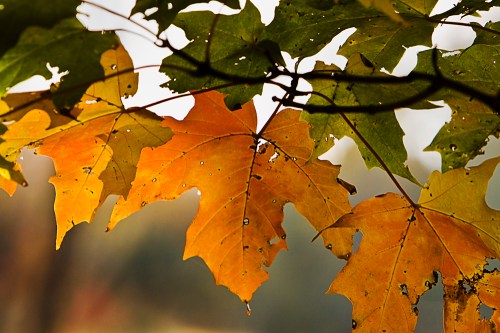
Fall Transition

Fall Transition

Fall Transition, photo by Terry Clark

The autumnal equinox happened last night at 10:29 PM, so today will our the first full day of fall. Here’s hoping this will be a warm & wonderful autumn for Michigan!

View Terry’s photo background big and see more of his fall photos.

Get your computer background updated for the season with more fall wallpaper on Michigan in Pictures. More fall photos too!