
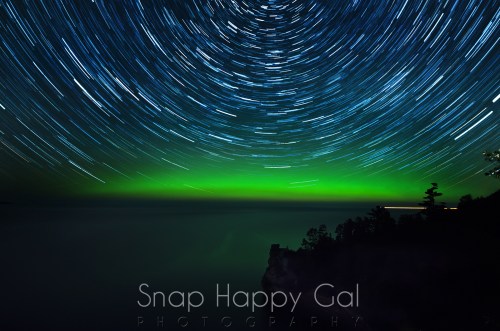
Miners Castle – Star Trails, photo by Heather Higham
Heather took this gorgeous shot a couple of weeks ago. Check it out bigger, see a day & night comparison and view her Aurora Borealis slideshow.
Miners Castle – Star Trails, photo by Heather Higham
Heather took this gorgeous shot a couple of weeks ago. Check it out bigger, see a day & night comparison and view her Aurora Borealis slideshow.
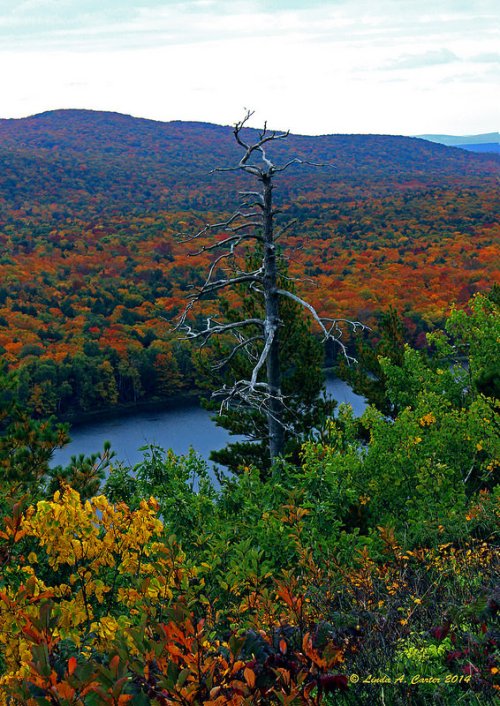
Lake of the Clouds from the Escarpment Trail, Porcupine Mountains, photo by Linda Carter
Linda writes that this photo is taken about 400 feet above Lake of the Clouds on the Escarpment Trail, which starts at Lake of the Clouds Overlook. She says that if you go the whole loop it’s 8 miles, but 2 or 3 miles along the trail you get the most beautiful views of the Lake.
Agreed!
View her photo bigger and see more in her Porkies slideshow.
There’s at the Porcupine Mountain State Park website including a map of the Escarpment Trail & Lake of the Clouds area and more Lake of the Clouds on Michigan in Pictures!
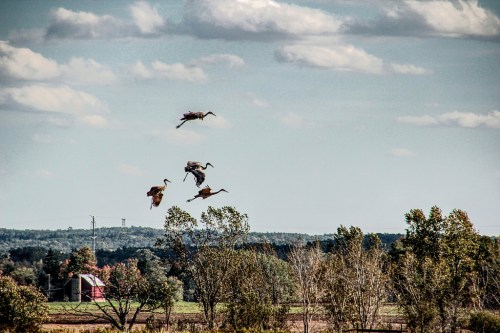
10-8 HDR 1e_Fotor, photo by Gregg Mulholland
Apparently the control tower likes to get those birds airborne.
Definitely check Gregg’s shot out big as the sky and roll through his Sandhill Cranes slideshow for more.
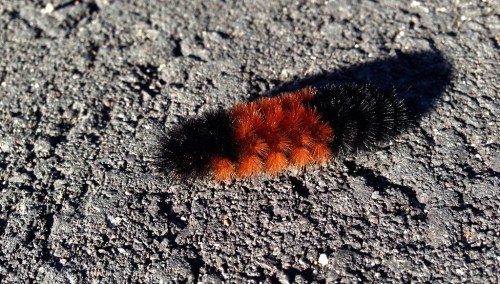
Hmmm…thick or thin? And what does it mean anyways?, photo by dan bruell
Predicting Winter Weather: Woolly Bear Caterpillars at the Farmer’s Almanac says that in 1948, Dr. C. H. Curran, curator of insects at the American Museum of Natural History in New York City sought to determine the average number of reddish-brown segments and use that to forecast the coming winter weather. For eight years, he continued to try and prove scientifically a weather rule of thumb that the wider that middle brown section is (and the more brown segments there are) the milder the coming winter will be, while a narrow brown band means a harsh winter.
Between 1948 and 1956, Dr. Curran’s average brown-segment counts ranged from 5.3 to 5.6 out of the 13-segment total, meaning that the brown band took up more than a third of the woolly bear’s body. As those relatively high numbers suggested, the corresponding winters were milder than average. But Curran was under no scientific illusion: He knew that his data samples were small. Although the experiments popularized and, to some people, legitimized folklore, they were simply an excuse for having fun. Curran, his wife, and their group of friends escaped the city to see the foliage each fall, calling themselves The Original Society of the Friends of the Woolly Bear.
…Mike Peters, an entomologist at the University of Massachusetts, doesn’t disagree, but he says there could, in fact, be a link between winter severity and the brown band of a woolly bear caterpillar. “There’s evidence,” he says, “that the number of brown hairs has to do with the age of the caterpillar—in other words, how late it got going in the spring. The [band] does say something about a heavy winter or an early spring. The only thing is . . . it’s telling you about the previous year.”
Read on for more!
View Dan’s photo background bigtacular and see more in his Fall 2014 slideshow.
More weather on Michigan in Pictures!
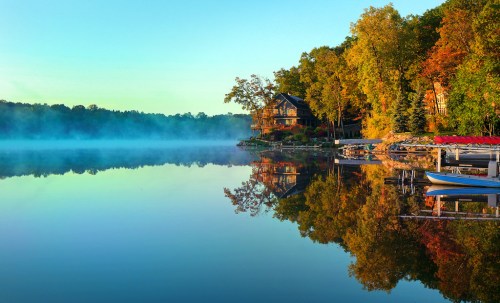
Fall Morning, photo by Steve
I bet your day starts out pretty well with a view like this.
View Steve’s photo bigger and see more in his LX7 slideshow.
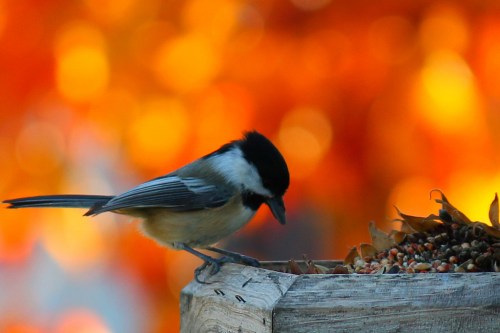
Fall Chickadee, photo by kdclarkfarm1
The UM Animal Diversity Web’s entry for Parus atricapillus (black-capped chickadee) says in part:
Black-capped chickadees prefer deciduous woodlands, open woods and parks, cottonwood groves, and willow thickets. They are most commonly seen near edges of wooded areas. They are a frequent visitor to backyard feeders. Black-capped chickadees nest in cavities, usually in dead trees or stumps, and are attracted to habitats with suitable nesting locations. During the winter, small flocks of black-capped chickadees can be found in dense conifer forests.
…Black-capped chickadees hop on trees (occasionally on the ground), rather than “walking.” These birds are very active during the day, and can often be seen foraging upside-down. Black-capped chickadees form monogamous pairs which usually stay together for several years. The black-capped chickadee social system has two extremes, one shown by territorial pairs during the breeding season, and the other consisting of non-breeding flocks. These are often mixed species flocks including nuthatches, woodpeckers, kinglets, brown creepers, warblers, and vireos. Black-capped chickadees perform short-distance migrations, but remain in the same general region throughout the year.
Read on for lots more including photos and chickadee calls.
View Diane’s photo background big and see lots more autumn goodness in her Fall slideshow.
More birds and more Fall wallpaper on Michigan in Pictures.
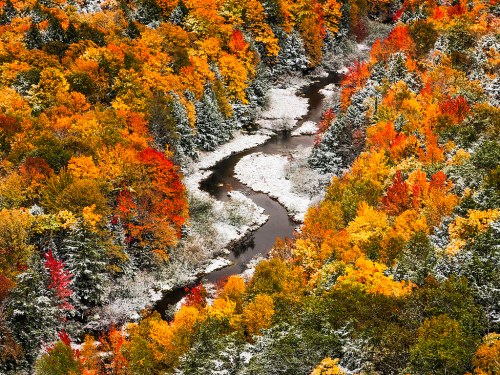
A Stream of Ice and Fire, photo by posthumus_cake (www.pinnaclephotography.net)
Fall color is everywhere this weekend in Michigan – get out and get some before the ice gets louder than the fire!!
About this photo of the Carp River in Porcupine Mountains State Park from five years and one day ago, Matthew writes:
Autumn in the Porcupine Mountains, from a few years ago…arguably one of the most bizarre weather experiences I’ve encountered. When I arrived, it was full-on blizzard conditions. The snow only lasted a few hours, but for that time, the forest was utterly surreal.
View the photo bigger, see more more in his Porcupine Mountains slideshow and also at his website, Pinnacle Photography.
More from the Porcupines on Michigan in Pictures including this photo that Matthew took from the Lake of the Clouds overlook in 2009!!
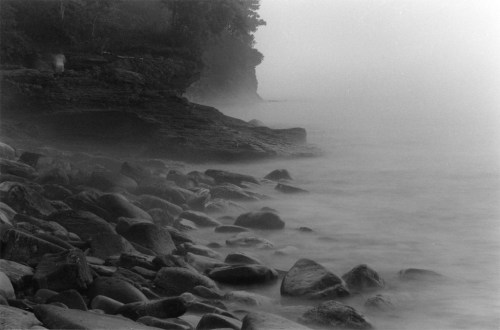
Presque Isle Fog, photo by Mark O’Brien
On Thursday October 16 from 6-8 pm, Mark’s show of black and white prints opens at the Argus Museum at 525 West William Street in Ann Arbor. The show runs through December 5th, and the museum is open 9-5 weekdays.
View Mark’s photo bigger and see more in his Recent monochrome work slideshow.
PS: There’s a nice feature on the Argus Museum on Michigan in Pictures that features one of Mark’s photos!
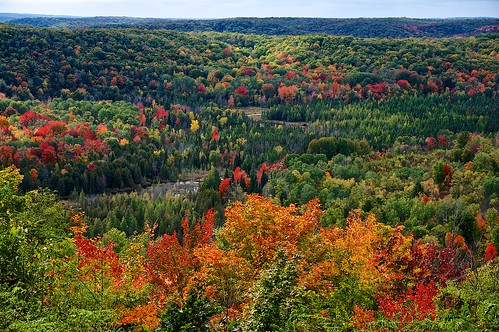
Deadman’s Hill Overlook, photo by Frank Wulfers
The Michigan DNR’s page on the Jordan River Valley in Northwest Lower Michigan says:
The Jordan River Valley is an 18,000-acre block of state-owned forest land in northeast Antrim County. Good wildlife watching and beautiful scenery are common along the Jordan River, Michigan’s first waterway to be officially designated as a Wild and Scenic River. Much of the area has been proposed as an old growth forest area. Access to the river valley is provided by local county roads and an 18-mile hiking trail, the Jordan Valley Pathway, that winds through this portion of the Mackinaw State Forest. The Pathway contains several loops of varying lengths. One loop begins at Deadman’s Hill, which offers a spectacular vista of the surrounding countryside and river floodplain. A second breathtaking and popular vista is Landslide Overlook. Part of this Pathway is the North Country National Scenic Trail, that when finished, will extend 4,000 miles from New York to North Dakota.
…Fall colors are noteworthy in early October due to the hardwood forests throughout the valley.
Indeed! Click to read more about wildlife in the Jordan Valley and get directions.
Frank took this shot on Saturday so you can see that color is coming along nicely. View it background bigtacular and see more in his Michigan – Northwest slideshow.
Lots more fall wallpaper on Michigan in Pictures!
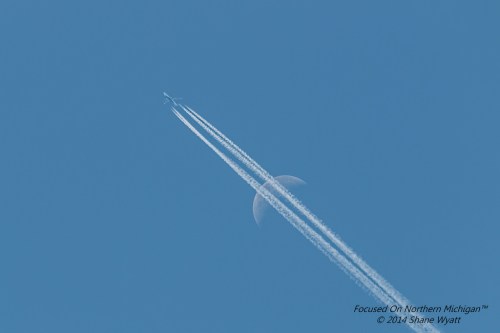
Something Special in the Air, photo by Shane Wyatt
A reminder that The Lunar Express boards early tomorrow morning for a total eclipse of the October full moon. The partial umbral eclipse begins at 5:15 AM EDT on October 8, with the total eclipse starting at 6:25 AM, peaking at 6:55 and ending at 7:24.
Get all the details on the Super Hunter’s Blood Moon in eclipse from Michigan in Pictures!
View Shane’s photo bigger and see more of Shane’s moon photos right here.
 Michigan in Pictures