

Saginaw Train Bridge, photo by n8xd.
Keith DeLong writes: This is a train bridge near St. Mary’s Hospital in Saginaw, Michigan.
I recommend you check this one out bigger.
Saginaw Train Bridge, photo by n8xd.
Keith DeLong writes: This is a train bridge near St. Mary’s Hospital in Saginaw, Michigan.
I recommend you check this one out bigger.

Shaft entrance at the abandoned Hiawatha Iron Ore Mine, U.P. Michigan, photo by dietrichlawrenz.
Dietrich writes that the cement is stained from iron ore dust that came out from the shaft.
This photo is part of a great set rusty/snowy photos of Upper Michigan and you absolutely must view it large.

Fearless, photo by Bobby Alcott
I was working one day in the Book Building where I shared an office a couple of summers ago, when my associate and I started to smell the familiar wafts of a building fire — which is not very good when you work in a highrise downtown. The Book, being as old as it is, doesn’t have either the proper capabilities to fight off a major fire, nor the alarm system swift enough to notify those on the 23rd floor (et al) that there’s a blaze in the building. So, worried, we stuck our heads out the big picture windows and saw the small building next to the partly-demolished Statler ablaze. VERY ablaze.
We ran down to the street level and actually got very close to the fire; on the same block, in fact, and got there before the fire crews did.
The fire got bigger and bigger until we realized that this was getting more than slightly out of hand. The fire crews were already on the scene, and as they hoisted the firefighters up in the water cranes, they also put the ladders leading to the roof in place. I could NOT believe the brave souls moving steadily but cautiously up to this burning roof with literally 50 foot flames coming from the surface.
This photo, as dear to me as it is for obvious reasons, also has different meanings for me. I think about the fire signifying our city and it’s troubles, and the fact that so few are actually trying – honestly trying – to put out the fire. There are so many causes for the blaze: carelessness, neglect — and possibly direct intent. You look at the fire and wonder if it will be extinguished before the structure is destroyed altogether; such an unfair, uphill battle.
Those that live outside the city, and remember it as it was, tend to reminisce about the ‘good old days’ when everything about Detroit was right. This, in many cases, is done in a very shallow manner — why do people believe the ‘good old days’ were good for everyone? The old buildings in Detroit, to many native Detroiters, symbolize an era when many citizens were not afforded equal rights and protections; a time when segregation was alive and well in many forms, and law enforcement did not always look kindly on a large swath of the city’s residents. Why, then, should many people that lived in the city at that time celebrate the ‘rebirth’ of a city that they were not privy to in the first place? When the berms at the RenCen were removed, very few Metro Detroiters understood how significant that was in the city’s communities, as symbolic as it might have seemed. These buildings – some built for visiting royalty both foreign and domestic – were not originally built for all people. This is not forgotten, and should not be forgotten.
I’m very thankful to live in this city built on so much beautiful diversity — diversity of people, races, cultures, attitudes, symbolisms and, yes, histories. Even though we all share one history, we all have our own parts of it… and sometimes, we forget how easily we put that, which is behind us, firmly in our path to the future – for the simple fact that we fail to address it properly when it occurs. Maybe we can all learn, finally, from the past.
Michigan Photographer Profile III
Prequel: Skyed
Day I: Michigan in Pictures talks with Bobby Alcott
Day II: Bobby Alcott responds to reader questions
Day III: Bobby’s Favorite

BenGreen asks “What photographers influence your work?”
I’ve always loved Annie Leibovitz, and was simply moved by her show at the DIA – it was an honor to be there. Garry Winogrand, W. Eugene Smith … I’m moved by the photographer that can capture the spirit of a person in a single frame. Architecturally, Margaret Bourke-White was an very early influence on my design, and later, my photography.
 Cave Canem wonders “What kinda party stores should one ‘knock over’ to get a decent digital setup like yours?”
The ones that have a liquor license, of course.
One of the drawbacks of being a pro photographer is that one constantly has to reinvest in new equipment. It’s not a vanity thing, and not everything needs to be replaced — my main camera, a Hasselblad 500 EL/M, was built in 1965 — but the market changes rapidly, and to fall behind is to give up. Digital backs, lighting, new DSLR bodies, software … all are critical and volatile tools that have to be state of the art.
Bill Alcott (a relative) says “Please say something about the location of this photo.”
Last November, Cave Canem and I planned this elaborate shoot to coincide with the only time a full moon would rise over the city of Detroit as seen from Windsor.  Well, the shoot was a bust, as we were way, way too close to make the moon dramatic enough. It was 4:30am when we gave up trying to make it work, and he suggested we go to the Ford Rouge factory to get some cool sunrise shots. We stood on a bridge over the Rouge River as the colors crept up on us. Cave has better shots of this place, but I was happy with the way this came out.
Kiddarhma (and CC) ask “How did you get EXPOSURE:Detroit going, and how is it going?”
My wife is from the wonderful city of Pittsburgh, and so we spend a few weekends there a year, visiting her Mom. I became friends with a great bunch of photographers there, and the beginning of our friendship coincided with the birth of the EXPOSURE program – a localized group of photographers that form a support system to grow as shooters and, once a month, to take over a space and celebrate the work of one of it’s members by devoting a gallery opening to them. After the Pittsburgh group found some real success, the founder of the group, Joey Kennedy, asked me if I would start a Detroit chapter to help local photographers grow and shine — how could I resist? I’ve had so many people help me along my path, and it thrills me to help others as well.
 EXPOSURE.Detroit is going through a bit of a remake right now, as participation wasn’t at a sustaining level. We’re now starting to see the transformation bring real change to the group, and the members are becoming more involved. I’m excited about the future of the group.
Joan wants to know “Are there are any people or places in Michigan you’d really like to photograph?”
Other than the city, which offers a never-ending canvas to a photographer, I enjoy the coastlines and sailing. Not much compares to shooting a regatta on board a dinghy! I do love the Traverse City area, Petoskey and Harbor Springs — beautiful areas to landscape. Mackinac Island has been thoroughly photographed, but there are always new ways to show an old subject. The Dunes are fantastic at sunset, too. This is a magical state to photograph; there are so few places in the country that offers everything we have here.
Michigan Photographer Profile III
Prequel: Skyed
Day I: Michigan in Pictures talks with Bobby Alcott
Day II: Bobby Alcott responds to reader questions
Day III: Bobby’s Favorite

Today, Wednesday & Thursday Michigan in Pictures will be talking with Detroit photographer Bobby Alcott for our third Michigan Photographer Profile.
Michigan in Pictures: Tell us a little something about yourself Bobby
Bobby Alcott: I’m a native Metro Detroiter – born here in 1969, and grew up on the East side. I now live in downtown Detroit with my lovely wife Elizabeth, daughter Abby… and another baby girl due in April.  I’m kind of a regular guy: graduated from MSU, love my Red Wings and Tigers, love all people of all walks of life, and hope to make a difference someday.
MP: How did you get involved with photography?
Bobby: I’ve always owned a camera, it seems – from a 110 to a Disc (remember those?) to SLRs. I dabbled a bit in college; East Lansing can be so intensely beautiful in the Springtime, and any guy attending State will tell you how pretty the girls are. I was a TV and Video Production Major, so it was a natural one-off. It wasn’t until the birth of my first daughter, Abby, in 2001 that I again took photography seriously. I realized then how badly I had missed it as a creative outlet, and started to admit to myself that I might be fairly good at it, too.
Then, for my 35th birthday, my father gave me a used digital camera he got from a friend of his — and I was hooked. I literally didn’t have it out of my reach for the first several months. I found Flickr, and the feedback at that point was a supremely important confidence builder.  The more I shot, the better I got. The better I got, the more I experimented. I invested in better equipment, and the snowball was rolling downhill at full speed.
MP: You’re a full-time photographer now – did you ever think you would get to that point and what led you here?
Bobby: I was the kind of guy that never really laid out a path; I guess because I never wanted to be railroaded into one thing because I hadn’t honestly figured out what it was I loved to do. Therefore, I’ve had my fair share of jobs – great, good, bad and awful. Through the years, I’ve been in retail, insurance, a programmer and a dishwasher. I’ve also been a sportscaster, an illustrator, the lead singer of a funk band (with a few CDs to my name), and I’ve sung over 200 TV and radio commercials. It’s not that I failed at any of these jobs – I just never fell in love with them (except for the singing, which I still do now).
A year ago now, I was the Creative Director for a small ad agency when it finally hit me. After 37 years, I finally figured out what I wanted to do with my life – or at least, I resigned myself to the theory that I needed to make this photography thing work.  I pow-wowed with my wife, and we figured out we had ‘x’ amount of time, financially, to make it work. I was ready to go back to school full-time for photography when I met my mentor, Jack Weber, at Acme Photo in Highland Park. He took me under his wing and hired me as a third assistant at the studio. I worked all last summer there, doing what thirds do: driving the van, hauling the equipment, getting lunch for the crew – basically starting from scratch. I learned so very much last summer, and as painful as it was on my ex-hockey-player knees, it was invaluable experience. I spent my time building my portfolio – spending all my time learning about the business and techniques and tricks and don’ts (many more than do’s).
Luckily, the good folks at Acme started to take notice of what I was doing, and after some discussions, they offered me representation. As of January 1, I’ve been fully represented by Acme Photo Works, and I couldn’t be working with a better bunch of people.
 I’m very – VERY – fortunate to be able to make a living doing what I do.
MP: You have been a pretty active member of Flickr’s community of Detroit photographers. What do you feel working with other photographers adds to your own work?
Bobby: Flickr, without question, was a major factor in my development as a photographer. How wonderful is it that, in this day and age, you can bounce ideas off a million other photographers? It’s the community aspect that makes Flickr so unique; moreso that any other photo site, I think.
MP: Speaking of Detroit, it’s obvious that you love the city. What are your three favorite things about it?
Bobby:
 MP: Your photography spans a wide range: music, sports, architecture, travel, portraits – what’s your favorite type of photography.
Bobby: I don’t know that I have a favorite type of photography yet. I initially started shooting the architecture of the city, which constantly reminds us all of what once was, but more importantly, what the effects of racism and race-based economic plans can do to a city and it’s people. Since then, I’ve enjoyed portraiture much more, and I’ve always loved tabletop work. My goal is to spend more time shooting in the studio, working with people and objects.
Michigan Photographer Profile III
Prequel: Skyed
Day I: Michigan in Pictures talks with Bobby Alcott
Day II: Bobby Alcott responds to reader questions
Day III: Bobby’s Favorite
More from Bobby Alcott
Bobby Alcott Photography – features a great slideshow. Really.
Photos from UrbanTiki on Flickr -Bobby’s Flickr page.

Much of Michigan (including these two horses) is socked in by a winter storm.
More photos by Jim Sorbie on Michigan in Pictures.
We will positively, for sure, I promise be starting our profile of Bobby Alcott tomorrow!

The Salmon Trout River on the Yellow Dog Plains, photo by savethewildup.
Somewhere there are lines, and I’m pretty sure that today I will cross a few. Over the life of this blog, I have stayed away from things that have sides, because sides too often divide us and this blog is really all about loving Michigan.
In my day job, I build web sites. A short while ago, I and some really talented people put together a new site for some people that have spent the last few years at a hard and lonely task: speaking up and standing up for Michigan’s rivers and lakes against the terrible risks posed by metallic sulfide mining and acid mine drainage. 
They have been focused on the Salmon Trout River on the Yellow Dog Plains, but that is just the first of many that will follow. To be very clear: There has never been a metallic sulfide mine that has failed to pollute its watershed. You can read more from Save the Wild UP … and scroll down for a special treat featuring tons more photos and music from Greg Brown’s upcoming CD, Yellow Dog.
More photos of the beauty of the Yellow Dog Plains and Salmon Trout River can be seen at Save the Wild UP’s web site.
If you are a photographer who loves Michigan’s water and wild, please consider making them available to be used in fighting metallic sulfide mining and other threats to Michigan’s legacy of unspoiled water and add them to the Save the Wild UP photo pool.

Holga: Lake Erie, photo by Matt Callow.
I wavered back and forth between this one and Matt’s other photo of ice on Lake Erie. The photo was taken at Sterling State Park between Monroe & Detroit Beach, and Matt has helpfully placed it on a map.
Wikipedia says that William C. Sterling State Park is:
…the only Michigan state park located on the shores of Lake Erie. The park encompasses 1,300 acres. The park sits just north of where the River Raisin empties into the lake. The park boasts many lagoons and marshes, providing good habitat for a variety of wildlife and bird life. The park is situated in Monroe County just south of Detroit Beach/ Sandy Creek and north of the city of Monroe. It is the fourth busiest state park in the state. The park is located less than a mile from Interstate 75, which provides easy access from the neighboring areas of Detroit and Toledo. The main attractions at the park include the beach, a boat launch, and shore fishing. Over two miles of asphalt surface are available for bike riding. Hiking trails are also available.
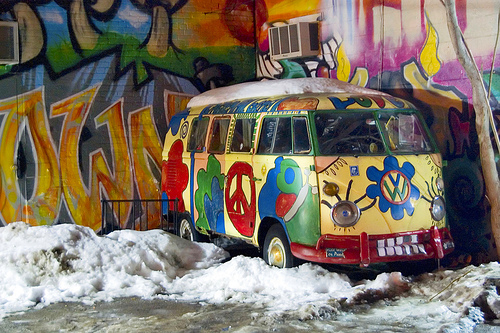
Lately it occurs to me: What a long, strange trip it’s been., photo by docksidepress.
Matt says that this was taken somewhere near Shakedown Street in
Grand Rapids, Michigan. I’m not familiar with that area of town, but I assume you take a left off Highway 61…

Drift at Sunrise, photo by CaptPiper.
That’s the assignment given to Mitchell Hirsch (a fifth grader at George G. White Middle School in Hillsdale, NJ). Your mission (should you choose to accept it) is to help Mitchell explain to his classmates and teachers why Michigan is the best state in the Country
Get all the details at Assignment: Why Michigan is the best state in the country on Absolute Michigan.
 Michigan in Pictures