Local food, affordable farms … and cows

mr. timmers cows

mr. timmers cows, photo by Latitude 45.

Martin’s photo reminded me of two very unrelated things. The first is an excellent program I heard on the radio last night on Interlochen Public Radio’s Points North featuring Ricardo Salvador of the WK Kellogg Foundation talking about “good food”. The Michigan-based WK Kellogg Foundation has an initiative that hopes to change things so that 10% of the nation’s food supply is healthy to eat, improves environmental quality, is fair to the producers and is affordable to purchase.

The 2nd half of the program introduced a new farm land trust program called A Spirit of Place that is getting going on the Leelanau Peninsula. The program would try to keep farm prices low and keep lands in farming.

Since it’s Saturday, I can probably pass the second link along as a Saturday morning cartoon. Cows with Guns is one of the funniest things I’ve seen on these internets. I hope you enjoy it (rated PG for brief, mild language and cartoon violence).

Connecting the dots on the Grand Rapids skyline

Grand Rapids skyline

Grand Rapids skyline, photo by sparky05.

Web technology like tagging and social networks are increasing our ability to relate our photos to real world data and to relate to each other through our photos.

A great example of this can be found in the ways in which photos of Grand Rapids are woven together. Using Flickr, you can assign locations to your photos. Here’s a photo map of downtown Grand Rapids featurign pictures taken by Sparky and others.

Maps aren’t the only way to connect with photographers (and photographs) of Grand Rapids. Check out the Grand Rapids, Michigan Group on Flickr. Two other good spots are the Grand Rapids Photo Blog and the Grand Rapids forum on UrbanPlanet.org.

Building buffs will also want to head over to the Skyscraper Page for buildings of Grand Rapids. It gives details of all the buildings (including those under construction), drawings of the individual buildings and a lineup of Grand Rapids buildings by height.

All of this may seem like overkill, but consider how incredibly useful this might be to a company that was scouting Grand Rapids (or your city) as a potential location.

From the top of Sleeping Bear Dunes

Muted by Jessie Turner

Muted, photo by Jessie Turner

This is the view of Little Glen Lake (foreground) and Big Glen Lake from atop the Sleeping Bear Dunes. It’s part of a great set of photos of the Sleeping Bear Dunes National Lakeshore.

I don’t have time to do a full history on the Sleeping Bear Dunes, but I can say that if you visit, you will not be disappointed. More information at the Sleeping Bear Dunes National Lakeshore web site and also the Unofficial Sleeping Bear Dunes Homepage. There is a shot from here in this YouTubed 1949 travelogue of Northern Michigan.

Six Degrees from the Ypsilanti Farm Bureau

ypsi5.jpg

ypsi5.jpg, photo by mfophotos.

From the “It’s a small world but I wouldn’t want to paint it” department…

maproomsystems says:

So we’re walking along, and I see some dude taking a picture, and then I see it’s a polaroid, and so I say to my wife, “You know, I’d bet anything that that’s one of those krappy kamera people. When I get home, I’m going to do a flickr keyword search for Ypsilanti and I’ll bet that photo he’s taking will be posted.”

And lo and behold, I was right.

Ypsilanti Farm Bureau elevator and silos

This photo is part of Mark’s set of cool Polaroids, which includes another angle of the Ypsilanti Farm Bureau Grain & Feed towers.

On the subject of interconnectedness, check out what Kevin Bacon has to say about the concept of six degrees at sixdegrees.org.

Waterfall Hunting in the Upper Peninsula

Ripley Falls

Ripley Falls, photo by We Are CS.

It’s probably fitting that I came to today’s post in a roundabout fashion. I was checking out UPLiving.com, a new addition to Absolute Michigan. On their photo page I saw this gorgeous photo of Ripley Falls. A quick check of The Google found a page on the Hiawatha National Forest site that itself seemed lost from their waterfalls page titled
115 Waterfalls of Michigan’s U.P.:

It’s been said there are two things man never tires of watching – fire and falling water. Hence the fascination of fireplaces and waterfalls. Fireplaces, fortunately, are found everywhere in the land. But waterfalls are found only in very special parts of the land. One of these is Michigan’s Upper Peninsula. There are more than 150 waterfalls across the length and breadth of this rugged peninsula – enough to satisfy any collector of cascades. Some are tall and stately like the Laughing Whitefish. Some are broad and massive like the mighty Tahquamenon. All are spectacles of white splendor … A few of the Upper Peninsula’s falls are located conveniently along well-traveled highways. More often the falls are the dramatic climax to a rewarding hike through the woods and in every case they are well worth the effort involved in getting there. Some waterfalls are located on private property permission should be secured from the owner to cross the property. When large land holders such as paper, utility, mining, and forest companies are involved, the public is usually welcome to use the forest lands, unless posted against entry.

Ripley Falls was listed as #42 with just the terse note Ripley Falls, on Ripley Creek behind school of Ripley. Springtime flow only.. The Keweenaw Local Resource Guide has better directions, but still not much to say.

Then I stumbled onto Wayne Premo’s Waterfalls from Hunt’s Guide to Michigan’s Upper Peninsula. Wayne tells the tale of how he lost the Michigamme Falls and then says:

As an adult I started to explore the Upper Peninsula further. The state’s Department of Natural Resources county maps became my guide. All the squiggles marking falls became increasingly intriguing. Would any of these be as impressive as Michigamme Falls, the one I had lost? I charted my plan of attack.

My goal was to search out every squiggle and photograph it, so that then I would have seen every waterfall of consequence in the Upper Peninsula. At the time, I was in no hurry and the task did not appear formidable.

Michigan WaterfallsSo go to Hunt’s Guide and read Wayne’s tale and check out some of the waterfalls he has photographed. Then think about bagging a few waterfalls this year. You can click the photo to the right to go on a Flickr tour of Michigan waterfalls.

And after all this, what does Wayne say about Ripley Falls? Only that it’s one of the few falls not on the DNR maps.

Fitting.

Timber Cruising and Hulbert Lake

Hulbert Lake

Hulbert Lake, photo by Joslynan.

Josie took this photo in August of 2006 and you can also check out this satellite view of Hulbert Lake and the UP.

Exploring the North’s page on Hulbert Lake says that the lake was also named Lake Glimmerglass by William Hulbert. The page tells an interesting story of William’s grandfather, Francis, who was a “timber cruiser” and raced a fellow cruiser to file for title to the lake in Marquette. He won the race.

When Pine Was King (excerpted from Larry B. Massie’s “Voyages into Michigan’s Past) tells a little more of timber cruising:

The logging cycle began with the timber cruiser. Armed with a map and compass he would tramp the wilderness for weeks seeking prime stands of white pine located near a stream, then race to the nearest U.S. land office to register the find.

Earth Day from high above Michigan

36,000 feet over Michigan

36,000 feet over Michigan, photo by bksecretphoto.

Landon Michaelson writes: One of my favorite shots out the airline window. I liked the clear day, the curvature of the earth, the black sky and the cloud layers beneath. Pocket digital several years ago (still easier to use than my DSLR in-flight) and of course I always request a window seat.

Landon is an East Wenatchee, WA based photographer whose work can be found by clicking the photo above or visiting Best Kept Secret Photography.

Last night I attended the Northern Michigan Environmental Action Council’s annual celebration of work on the behalf of the environment in our region. The even is timed as a lead-in to Earth Day and featured a ton of talking and pictures showcasing Michigan’s incredible natural bounty. Facts like “Michigan is the second most agriculturally diverse state in the country.”, the very funny and very compelling wombat video (highly recommended) and all the pictures showing land the Grand Traverse Regional Land Conservancy has preserved for enjoyment and habitat or is helping to remain in farming and forestry forever.

The GTRLC’s Glen Chown delivered the keynote. One of his themes was that not only has the preservation and promotion of our natural and cultural heritage has proven to be good business in northwest lower Michigan, it also likely holds part of the answer to Michigan’s need for a new economic engine. Glen also related the observations of Michigan astronaut Jerry Linenger of Michigan from much higher window seat. Linengar has logged more hours in space than almost anyone and had ample time to marvel at the beauty of Michigan’s spectacular coastline, green forests and rich farms.

I imagine that he also felt how deep and cold the black is that lies just miles away from the only planet we have.

Have a very happy Earth Day, Michigan. I hope you get a chance to hike a Michigan trail, walk a Michigan beach and otherwise enjoy this magical place.

Kayak on the Pine River Channel

Kayaking through the Channel

Kayaking through the Channel, photo by smiles7.

The lighthouse is the Charlevoix South Pier Light, and it marks the mouth of the Pine River channel that extends from Lake Charlevoix to Lake Michigan. Terry Pepper’s Seeing the Light explains:

The Pine River Channel is believed to be unique in the entire world inasmuch as it has a two-way current. After severe westerly windstorms, waters pushed high into Lake Charlevoix will swiftly flow back out to meet other inbound currents. Small whirlpools and eddies at the harbor mouth are not uncommon, and whitecaps can frequently be observed within the channel on the calmest days.

You can get a lot more information about the history of Charlevoix’s Pier Lights from Terry Pepper and see historical photos including a cool postcard of the Charlevoix North Pier Light in 1909. If you want to visit Charlevoix, the Charlevoix Area Convention and Visitors Bureau is a good place to start.

Danny Lane’s sculpture ‘Borealis’ at the Renaissance Center

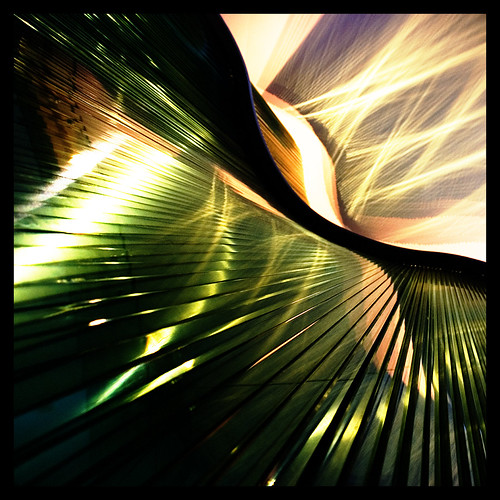
Reflective Distortion

Reflective Distortion, photo by rckrawczykjr.

Ralph writes: Detail of a glass wall within the entrance space of the Renaissance Center with a happy little cross process filter applied for good measure.

The wall is part of the Danny Lane sculpture Borealis. As the Kinetic Curtain in Glass Magazine explains, Borealis is one of the largest glass sculptures in the world:

Borealis comprises two enormous walls of undulating glass that measure 47 and 50 feet long, and weigh nearly 50,000 pounds each. A single wall contains about 1,100 43-pound panels of annealed float glass (auto safety glass of course) 4 inches wide, 11⁄2 inches thick and 221⁄2 feet long. The panels stand on end side-by-side and lean at different angles up to 71⁄2 degrees from center to create a wave effect. If laid end-to-end, the panels would extend 9.4 miles.

The article is pretty interesting and details the engineering challenges in building this amazing work of art. You can also see more from Danny Lane at his web site.

Time again for Holland’s Tulip Time Festival

214_1469

214_1469, photo by pablohart.

As someone who lives near a city (Traverse City) that is inextricably tied to an event (Cherry Festival), I imagine that the approach of Tulip Time can be a bittersweet thing.

According to the Tulip Time Festival web site

The idea of Tulip Time was introduced in 1927 at a Woman’s Literary Club meeting. Miss Lida Rogers, a biology teacher at Holland High School, suggested that Holland adopt the tulip as its flower because of its close ties to the Netherlands, and set aside a day for a festival. She titled her talk that day “Civic Beauty” and spoke at length about the area’s unique sand dunes, its fine trees, safe water supply, pure milk, and ample playgrounds. She advocated planting more trees, and because the Chamber of Commerce was seeking something appropriate, suggested planting tulips in every yard. She concluded with reading a poem, “Come Down to Holland in Tulip Time.”

In 1928, City Council, under Mayor Ernest C. Brooks, appropriated funds to purchase 100,000 tulip bulbs from the Netherlands. These bulbs were to be planted in city parks and other areas. Initial plans called for a “Tulip Day.” Bulbs were available to Holland residents at one cent a piece…

Tulip Time Festival will be held May 3-10, 2008 and features many musical acts, parades, trolley tours of Holland, an art & craft fair, fireworks and of course, klompen dancing.

For more Holland Tulip goodness…
Tulip Time, Holland Michigan from last year on Michigan in Pictures
The Tulip Time group and the Holland Michigan group, both on Flickr
Tulip Time Festival photo gallery from the Holland Sentinel