The Islands of Isle Royale

Little Dean Is.

Little Dean Is., photo by yooper1949

Wikipedia lists islands in Isle Royale National Park (but not this one):

  • Amygdaloid Island – has a ranger station
  • Barnum Island
  • Beaver Island – has a campground
  • Belle Isle – a small island just off the north shore of Isle Royale at the head of Belle Harbor. It is the site of a primitive campground and is visited every second day during the peak season by the island-circling ferry.
  • Caribou Island – has a campground
  • Grace Island – has a campground
  • Johns Island
  • Long Island
  • Menagerie Island – has a lighthouse
  • Mott Island – summer park headquarters
  • Passage Island – has a lighthouse and short trail
  • Raspberry Island – has a nature trail
  • Rock of Ages – has a lighthouse
  • Ryan Island – the largest island in the largest lake on the largest island in the largest freshwater lake in the world
  • Tookers Island – has a campground
  • Washington Island
  • Wright Island

Learn more from Isle Royale National Park (U.S. National Park Service) and check this out bigger (along with many more) in Carl’s spectacular Isle Royale Natonal Park slideshow.

Peaches to Pie

Peaches by Pentax K1000 GalPeach Pie by Pentax K1000 Gal

Peaches & Peach Pie, photos by Pentax K1000 Gal

These photos are both part of Patricia’s Leelanau set (slideshow).

Learn more about Michigan peaches and Stanley Johnson, Michigan’s Picasso of Peaches from Absolute Michigan!

Heidi Johnson and the angels in the architecture

Heidi Johnson, Third Floor, Men's Ward

Heidi Johnson, Third Floor, Men’s Ward, photo by mstephens7.

Michael told me yesterday that Heidi Johnson passed on. He has a post Remembering Heidi Johnson and took a tour of Building 50 with her (slideshow).

I didn’t know her well, but I’ve always had an enormous amount of respect for her work and her depth of passion for photography, and specifically her teaching of photography and Interlochen and her photography of the former Traverse City State Hospital. I don’t know what role (if any) her work played in the rebirth of the former mental institution as The Village at Grand Traverse Commons, but I do know that it did awaken the community to what an architectural and natural treasure it was.

On her web site, heidijohnson.com she wrote:

about the book Angels in the Architecture

I have been fascinated by the history of rural America for years and specifically with the history of the former Traverse City State Hospital in Traverse City Michigan (also called The Northern Michigan Asylum until 1911.) Based upon childhood memories of having an Aunt institutionalized there from the 1950’s – 1970’s to the belief that I was meant to tell this story lead me to embark upon a three year immersion into the early history of the facility as well as special permission to photograph inside the various structures (primarily Building 50) from 1997 -1998. This body of work evolved into a book which was published by Wayne State University Press in 2001 entitled Angels in the Architecture: A Photographic Elegy to an American Asylum

You can view an amazing gallery of Heidi Johnson’s photography through her site and learn more about the Traverse City State Hospital from Kirkbride Buildings.

Heidi’s obituary in the Record-Eagle directs memorials to the American Institute for Cancer Research and the Arthritis Foundation.

A great weekend for the Great Lakes Folk Festival!

Stephen LeBlanc by Patrick T Power

Stephen LeBlanc, photo by Patrick T Power

The annual Great Lakes Folk Festival takes place this weekend [August 8-10, 2008] in East Lansing. It showcases the traditional musical, art & cultural treasures of the upper Midwest along with a sampling of the best of traditional artists from around the country and the world.

The festival encourages cross-cultural understanding of our diverse society through the presentation of musicians, dancers, cooks, storytellers and craftspeople whose traditions are rooted in their communities.

The festival includes nearly 100 musicians or dancers in groups, who perform at least twice and sometimes as many as four times over the weekend. Also featured are traditional and other food vendors, craft vendors and many other individual artists/demonstrators. There are five performance stages (including one with a 2,400 sq. ft. dance floor), a children’s hands-on activity area, crafts demonstrations, and crafts marketplace. In addition there are special programs every year, which feature some aspect of traditional culture.

You can click for a listing of musical performers that run the gamut from bluegrass to zydeco to gospel to performers of all kinds of ethnic music that make up our shared musical experience. There’s a bunch of MP3s to listen to as well!

This photo is part of Patrick’s Great Lakes Folk Festival 2007 set (slideshow). You may also want to check out his 2005 and 2006 photos.

90th PGA Championship at Oakland Hills Country Club

1st hole Oakland Hills

1st hole Oakland Hills, photo by mandj98.

This photo is part of James’ 2008 90th PGA Championship set (slideshow).

The 90th Professional Golfers’ Association Championship takes place today through Sunday at Oakland Hills Country Club in Bloomfield Hills. They explain that although the South Course of Oakland Hills was formally opened on July 13, 1918, the legendary reputation of the course came some 40 years later:

Although many tournaments have been held throughout the years at Oakland Hills, the one which gave the course its greatest reputation as “The Monster” was the 1951 Open. The result was a tournament in which only two subpar rounds were shot during the entire 72 hole affair. Ben Hogan won with a total of 287 by shooting a final round 67 after which he was quoted as saying “I am glad I brought this course, this monster, to its knees.” He also said that it was “the greatest test of golf I have ever played and the toughest course.” The late Clayton Heafner who had a final round of 69, the only other sub-par of the tournament, finished second two strokes back. There was some comment after the last round of the tournament of the effect that the tee markers had been moved so far forward that last day as to take some of the fairway traps out of play. In any event, the natural result of this extremely difficult Open was that from that point on the USGA no longer permitted the host Clubs to control the layout for an Open tournament.

You can read more about the history of the club through Wikipedia’s Oakland Hills Country Club entry and view more photos through the Oakland Hills CC course tours and a search of Oakland Hills Country Club photos at Flickr (slideshow). The PGA has a great photo gallery with pics of the course and from the tournament.

Saginaw River Rear Range Light

Saginaw River Lighthouse

Saginaw River Lighthouse, photo by SNiedzwiecki.

Stacy says that she took this photo on a boat tour of the Saginaw River and that access is very limited. It’s one of a number of photos in her Michigan Lighthouses set. She has also placed it on a map.

Terry Pepper’s page on the Saginaw River Rear Range Light brings the usual 110% of awesome with historical photos and a complete history of the lighthouse that explains (in part):

Eleventh District Engineer Major Godfrey Weitzel’s design for the combined rear range tower and dwelling was unique. Consisting of a large elevated concrete base supporting a combined brick dwelling and tower, the swampy ground in the chosen site first required the driving of timber piles deep into the ground to provide a solid foundation on which timber forms for the concrete base could be erected and filled. Atop this concrete foundation, a square two-story Cream City brick keeper’s dwelling 26′ 6″ in plan was constructed. Integrated into the northwest corner of the dwelling, a tapered 53′ tall square tower with double walls housed a set of prefabricated cast iron spiral stairs. Winding from the cellar to the lantern, these stairs also serving as the only means of access to the first and second floors by way of landings on each floor, each outfitted with tightly fitting arch-topped iron doors designed to stem the spread of fire between floors. A timber deck supported by timber columns encircled the dwelling at the first floor level, providing easy and dry access to all sides of the structure. The living quarters consisted of a kitchen, parlor and oil storage room on the first floor, and three bedrooms above. The tower was capped with a square iron gallery, supported by five cast iron corbels on each of its four sides. An octagonal cast iron lantern was installed at its center, with a fixed white Fourth Order Fresnel lens placed at a focal plane of 61 feet.

You can also check out some photos of the light and information from the Saginaw River Marine Historical Society and read a bit about the possible haunting of the Saginaw River Lighthouse.

Late July Corn

Late July Corn

Late July Corn, photo by n.weaver.

Hastings … and all over Michigan.

Check out the Michigan Farmer’s Market map on Absolute Michigan and have a couple ears for dinner soon – it’s wonderful!

The Last Sunset of July, Wishing You Were Here

The Last Sunset of July, Wishing You Were Here, photo by limegreen_kayak

Limegreen kayak says that the pier in Muskegon was a great place to see the last sunset of July and that if you have the time, view it large and on black. Take the time!

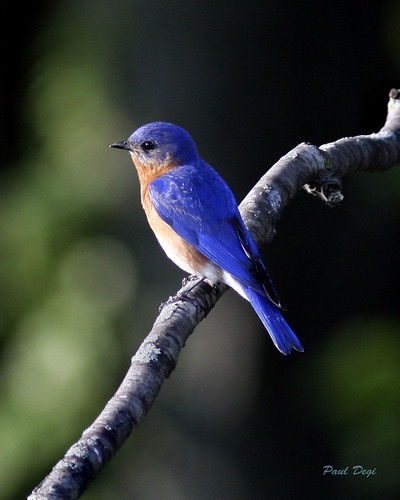
Michigan Bluebird

Michigan Bluebird

Michigan Bluebird, photo by incaseofme.

Paul suggests that you view this photo larger. It’s part of his Birds & Wildlife set (slideshow) and also appears in the Birds of Michigan group.

All About Birds: Eastern Bluebird from the Cornell Lab of Orinthology has some great information (including photos and sounds) of this lovely bird. They have a range map that shows bluebirds are seasonal residents of Michigan, preferring to head south in wintertime. You can also see the UM Animal Diversity Web’s Eastern Bluebird (Sialia sialis) and the Wikipedia Eastern Bluebird.

The Michigan Bluebird Society says that:

Back in the 1700’s when the eastern U.S. was getting populated, indications are that bluebirds were more common than they are now. As more and more farmland was created, bluebird numbers almost certainly expanded even more. Why? First, more farms meant there was more open habitat which bluebirds love. Second, the early settlers typically planted apple orchards. Apple trees are one tree which easily produces cavities which are perfect for bluebird nests. And third, in building these early farms, settlers would erect fences made of wooden posts from the trees they cleared. These many fenceposts would eventually develop rotted out cavities and woodpecker holes which again, would provide ideal bluebirds nesting sites.

Bluebird numbers are believed to have expanded up until the late 1800’s when two non-native bird species were introduced to the U.S. – the House Sparrow and the Starling. These two aggressive and invasive species quickly spread and out-competed bluebirds for natural nesting sites. In addition, as urban areas expanded in the 1900’s and pesticides started to be used in agriculture in increasing amounts, bluebird numbers declined more quickly.

They and bluebird groups across the country have worked to restore these birds and their numbers have been increasing since the 1970s.

Sunset Baseball – Comerica Park

Sunset Baseball – Comerica Park, Detroit, Michigan, photo by jkissnhug

Farewell, Pudge Rodriguez.